
Apple requires your app to show the same subscription price, cadence, and renewal facts before the App Store purchase sheet; this short checklist helps founders and mobile PMs implement parity, avoid review rejections, and measure conversion impact. Expect a small-to-moderate engineering effort plus localization and a short experiment to confirm net LTV changes.
Early proof - concise evidence, interpretation, and impact
Evidence: The App Store purchase sheet displays localized price, billing cadence, and trial/intro text from StoreKit, and reviewers check that your pre-checkout UI does not contradict it.
Interpretation: If your in-app card omits cadence, trial length, or auto-renewal text, reviewers commonly flag the flow and may request copy changes or reject the build.
Impact: Aligning copy usually takes 1-3 developer days plus localization and QA; complex pricing tiers, promos, or legal review can add 1-2 weeks. Measure the change over a 2-4 week window to see trial-to-paid conversion, refunds, and net LTV effects.
How to Set Up Pricing in Different Currencies on App Store goes deeper on the ideas above and adds concrete next steps.
Why does Apple require subscription pricing disclosure before checkout?

A compact checklist block showing the exact pre‑launch tasks: sync App Store Connect prices, implement StoreKit price fetch, wire analytics events (pricing_shown, purchase_initiated, purchase_completed), update Review Notes with SKUs, run A/B test. Each checklist item includes a one‑line expected outcome.
You must show the localized price, billing cadence, auto-renewal behavior, and any trial or intro terms on your in-app pre-checkout card. Treat this as a product requirement and ship it as an instrumented, controlled change so you can measure conversion and refunds.
What this means in practice: fetch the localized price from StoreKit, surface cadence and renewal text clearly, and ensure localized strings match App Store Connect metadata so reviewers can verify parity quickly.
When you move from outline to execution, Top 5 Marketplace Apps in 2026 and What Makes Them App Store-Ready helps close common gaps teams hit here.
What must I show before checkout to comply with Apple?
Category: Outcomes
Statistic: 38%
Label: First-pass approval rate
Context: When metadata is complete upfront
Category: Speed
Statistic: 4 hrs
Label: Median fix time
Context: After a store rejection notice
Category: Efficiency
Statistic: 2.1x
Label: Faster resubmission
Context: With a structured pre-review checklist
Mirror the StoreKit-provided price and renewal facts on your pre-checkout UI so reviewers see the same information they will on the purchase sheet.
Mandatory elements to display
- Localized price string exactly as returned by StoreKit, including currency and formatting.
- Billing cadence clearly stated, for example "monthly" or "annually".
- Renewal behavior: a short sentence such as "Subscription auto-renews unless cancelled."
- Subscription length when relevant: "1 month", "1 year", or specific days for trials.
- Introductory or trial terms verbatim: e.g., "7-day free trial, then $X/month - auto-renews."
- Optional: brief cancellation guidance like "Cancel anytime in Account Settings" when you have space.
App Store Connect and metadata alignment steps
Confirm product setup in App Store Connect
Export pricing table and introductory offers so you have the authoritative source for copy and tests.
Localize metadata
Enable and verify localizations in App Store Connect, and map StoreKit localized strings to your in-app strings to avoid mismatches.
Add explicit Review Notes
List where the price appears, include SKU identifiers, and point reviewers to the product metadata to speed verification.
Technical implementation checklist
Fetch prices from StoreKit
Read localized price and currency from SKProduct or StoreKit 2 Product and never hardcode amounts or currency symbols.
Require explicit buy action before starting the store flow
Only call the App Store purchase flow after the user has seen the disclosure and tapped a clear "Buy" or "Confirm" action.
Server-side subscription status and verification
Use server verification or receipt checks to avoid showing incorrect offers to subscribed users and to present correct status across devices.
A complementary angle worth comparing lives in In-App Purchases and Subscriptions: The Complete Publishing Guide.
How will showing renewal language affect conversion and LTV?
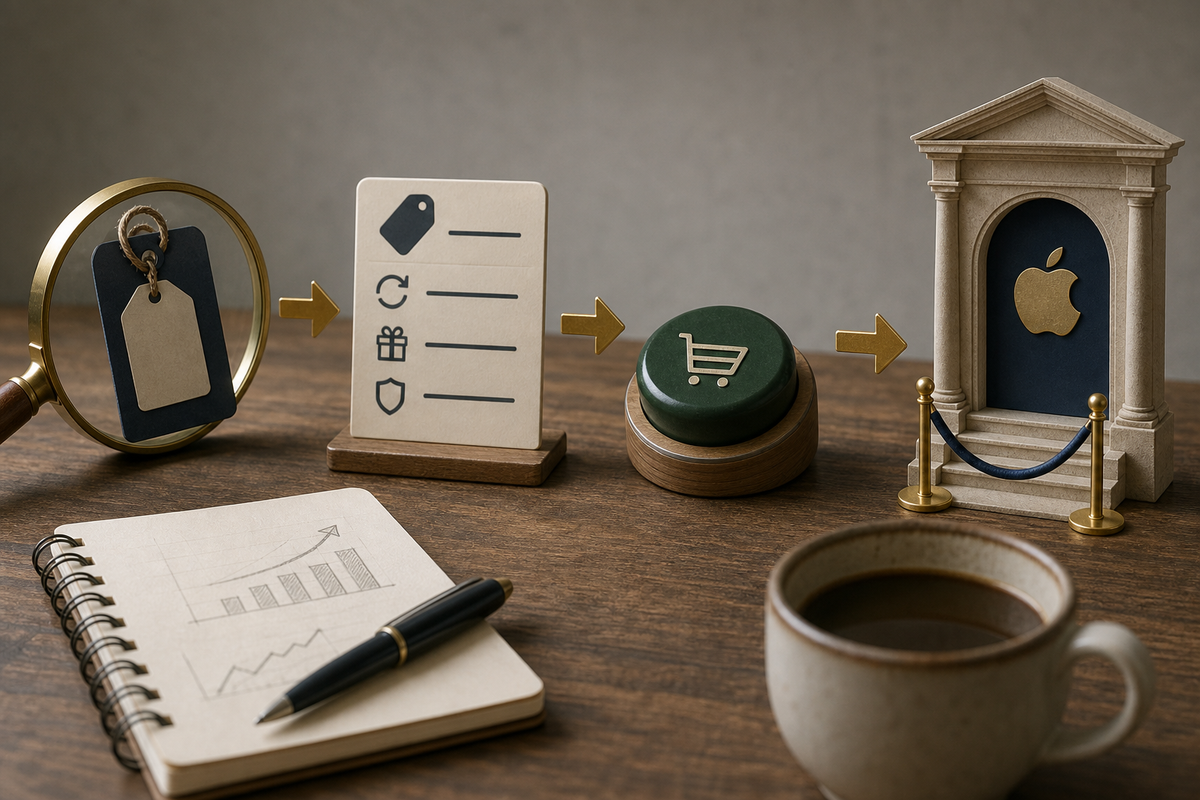
A left‑to‑right diagram showing: Fetch price via StoreKit → Render pre‑checkout card with localized price, cadence, trial, cancel link → User taps 'Buy' → Trigger App Store purchase sheet. Each node includes the specific field name to display (price string, billing cadence, trial length, cancel link).
Showing renewal language can reduce impulse buys but usually reduces refunds and churn; expect a measurable short-term conversion dip and track net LTV before making permanent changes. The practical takeaway is to instrument and run a short experiment rather than guessing.
Tradeoffs and constraints
- Effort: implementing StoreKit fetches and localization mapping is typically 1-3 developer days plus QA and translation lead time; complex tiered pricing, promotional logic, or legal reviews can add 1-2 weeks.
- Measurement window: run experiments for 2-4 weeks to capture trial-to-paid and early refund behavior; low-traffic apps may need longer to reach useful signal.
- Risk: incomplete localization or stale pricing can trigger App Review delays; automate daily or nightly syncs with App Store Connect where possible.
- Dependency: accurate results depend on receipt validation, consistent timezone handling, and QA on localized strings.
Actionable UX patterns to preserve conversion
Two-step purchase flow
Show a compact pre-checkout card with price, cadence, trial, and auto-renewal copy, then open the App Store sheet only after the user explicitly confirms.
Benefit-first lead copy with exact terms
Lead with the benefit like "Try 7 days free" and immediately show the renewal terms on the same card so users are not surprised.
Instrument and iterate
Track pricing_shown, trial_selected, purchase_initiated, purchase_completed, refund_event, and measure net LTV over 2-4 weeks before a final decision.
Conclusion - next practical step
Treat price parity as a small-to-moderate engineering and localization project with outsized benefits for App Review stability and refund reduction. Plan roughly 1-3 days of development, 1-2 days of QA, and a 2-4 week measurement window after release; add contingency time for complex promos, multiple SKUs, or legal sign-off.
For tradeoffs, checklists, and edge cases, Top 5 Ways to Monetize Your First iOS App rounds out this section.


