
App Store Optimization in 2026 is less about hiding more keywords in your title and more about improving the app store funnel. This guide shows how to improve discovery, clarity, trust, and installs without spending a full release cycle on cosmetic metadata edits.
App Store Keywords: The Only Guide You Actually Need goes deeper on the ideas above and adds concrete next steps.
Early proof: the ASO levers worth measuring first
ASO changes should be judged by what they affect in the funnel. Apple and Google do not publish exact ranking formulas, so treat these levers as practical inputs to test, not guaranteed ranking weights.
One useful reference point is Apple's 2026 research on App Store search relevance, which discusses textual relevance, behavioral signals, LLM-generated relevance judgments, and screenshot OCR in a research context. That does not reveal exact ranking weights, but it reinforces a practical point: store pages need to be relevant, understandable, and useful to users.
| ASO lever | Main role | What to watch | Common risk |
|---|---|---|---|
| App name or title | Discovery and clarity | Keyword rankings, impressions | Keyword stuffing that weakens trust |
| Subtitle or short description | Clarity and persuasion | Page views, conversion rate | Repeating the title without adding meaning |
| iOS keyword field | Discovery | Rankings for precise terms | Wasting space on duplicated terms |
| Google Play description | Discovery and persuasion | Rankings, conversion, install quality | Writing for bots instead of humans |
| First three screenshots | Conversion | Product page conversion rate | Showing UI instead of user outcomes |
| Ratings and reviews | Trust | Conversion, objections, retention signals | Ignoring bugs or pricing confusion |
The practical interpretation: metadata helps the right users find and understand the app. Screenshots, ratings, and reviews often decide whether that visibility becomes installs.
The business impact is simple. If impressions are weak, improve relevance and eligibility. If page views are healthy but installs are weak, prioritize conversion, trust, and product page testing before another title rewrite.
When you move from outline to execution, ASO Without Guessing: A Practical Keyword Workflow for Indie Founders helps close common gaps teams hit here.
How should you audit ASO before making changes?
Before editing your App Store or Google Play listing, capture the current state. This usually takes 30 to 60 minutes if your data is organized, and longer if rankings, review themes, or screenshots are scattered across tools.
Record:
- Search impressions, keyword rankings, page views, conversion rate, and installs
- Current title, subtitle or short description, keyword field, full description, and screenshots
- Rating, review volume, and repeated review themes
- One priority market and one realistic competitor set
- Release date, app version, pricing changes, campaigns, and product changes
One constraint matters: traffic volume. If organic traffic is low, one day of movement is usually noise. You may need one to three weeks before a pattern is clear enough to trust.
How do you improve app discovery with ASO keywords?
The goal is not to add every possible keyword. It is to put accurate language in the fields that help users and stores understand the app.
Use the strongest natural phrase in the title
Choose a phrase that matches real user intent and the actual product. "Habit Tracker for ADHD" may work if the app genuinely supports that audience. If not, it can attract the wrong users and reduce trust.
Use the iOS keyword field for precise terms
Add relevant indexing terms that do not need to appear in public copy. Avoid duplicating title words unless current App Store Connect guidance or your own testing supports it.
Use the subtitle or short description to add meaning
Clarify the audience, outcome, or differentiator. A meditation app might mention sleep, anxiety, focus, or breathing instead of repeating "meditation app."
Use the Google Play description for context
Explain who the app is for, what problem it solves, key features, and credibility signals. Write for humans first while using natural language around core use cases.
A focused update is easier to measure than a full overhaul. If you change metadata, screenshots, pricing, onboarding, and paid traffic at the same time, results may improve, but you may not know why.
How do screenshots improve app store conversion?
Screenshots are often the fastest way to answer the user's question: "Is this app for me, and is it worth installing?" A practical screenshot refresh can take one to three days, depending on design resources, localization, approvals, and review cycles.
Use the first three screenshots with a clear purpose:
| Screenshot | Job | Example |
|---|---|---|
| 1 | Show the main outcome | Better sleep, calmer evenings, fewer surprise bills |
| 2 | Show the core workflow | Start a session, review spending, track a habit |
| 3 | Reduce hesitation | Privacy cue, review quote, clear differentiator |
Here is the thing: polished creative can improve conversion, but it takes time and may need localization. A simpler update can still work if it makes the outcome clearer than the current listing.
If product page views are strong but installs are weak, screenshots, ratings, reviews, pricing clarity, and onboarding expectations may matter more than another keyword edit.
Avoid ASO mistakes that waste release windows
Common ASO mistakes are not harmless style issues. They can reduce trust, distort measurement, and delay learning.
Avoid these patterns:
- Keyword stuffing the title: It can make the app feel spammy and misaligned with user expectations.
- Judging results too quickly: Low traffic needs more time before results are meaningful.
- Ignoring weak reviews: More visibility will not fix repeated complaints about crashes, pricing, or missing features.
- Changing too many variables: Broad changes can help performance but make attribution harder.
- Copying competitors blindly: Competitor language is useful research, not a substitute for product fit.
Early apps may not have enough traffic for clean tests. In that case, use directional data, customer interviews, competitor analysis, and review mining until store data becomes stronger.
Ship ASO as a measured release
Treat ASO like a release workflow, not a one-off rewrite. The work is modest, but it needs discipline: plan the change, document it, wait long enough, and compare against the baseline.
| Stage | What to do |
|---|---|
| Before release | Verify field limits, policies, baseline metrics, target market, and success criteria |
| At release | Document metadata, screenshot, pricing, onboarding, and campaign changes |
| After release | Compare rankings, impressions, page views, conversion, installs, reviews, activation, and retention |
The practical takeaway: update the weakest funnel layer first. Then measure what changed, what did not, and what should feed the next release.
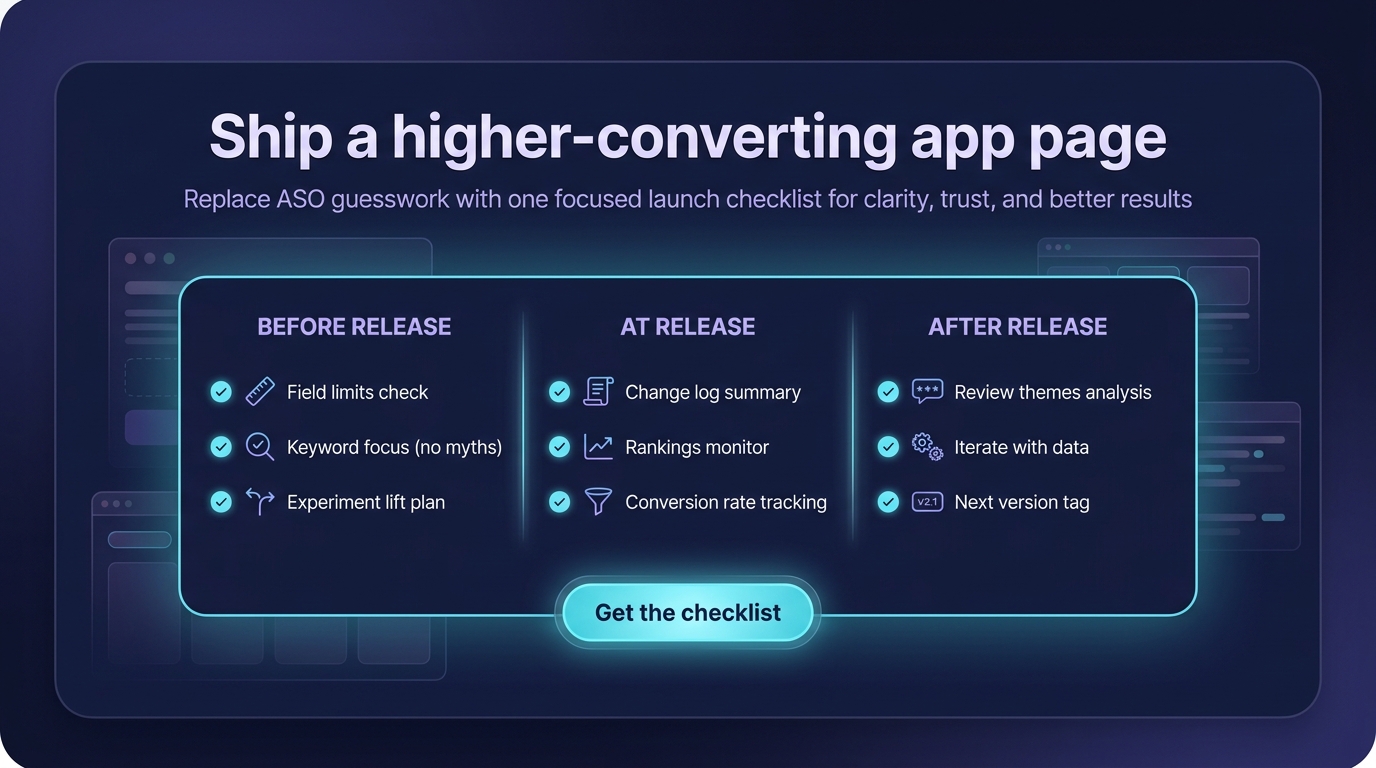
A single focused CTA turns the article’s guidance into action: replace low-value ASO myths with a practical conversion checklist before shipping.


