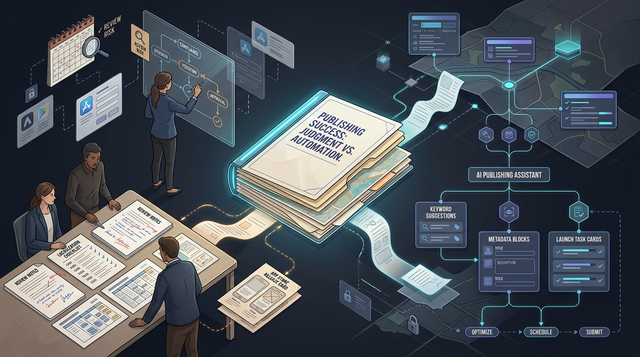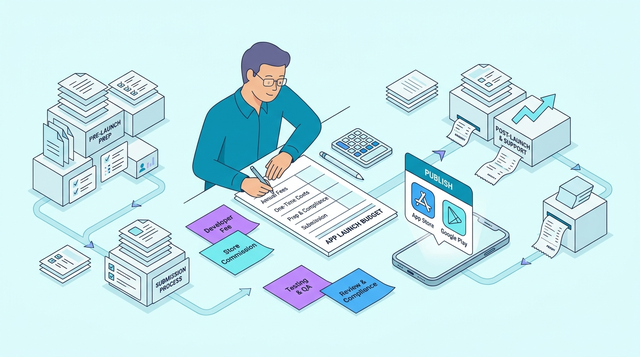
App publishing still feels like a decade-old chore for many founders. Manual, brittle processes in App Store Connect and Google Play Console cause rework, rejected submissions, and time lost chasing metadata and certificates. This guide gives a compact, agent-augmented workflow you can pilot in one release to reduce avoidable rejections and shorten cycle time; results will vary and require some upfront integration effort.
| Signal | What current AI tools do | What an autonomous agent will do next |
|---|---|---|
| Developer accounts | List missing roles and suggest invites | Prepare a role checklist, generate scoped CI/service invites, and warn about over-privileged tokens |
| Code signing | Detect cert/profile mismatch in a build | Map build identity to exact provisioning, surface remediation steps, and link to exact artifacts to replace |
| Metadata & compliance | Draft privacy and data-safety answers from prompts | Extract binary signals, pre-fill platform fields, and flag uncertain/legal items for human approval |
| Preflight & tests | Run heuristic checks and unit tests | Run a single pre-submit scan that groups issues and creates a prioritized patch list for approvers |
Explanation: these are directional examples based on early pilots and typical tool behavior, not vendor benchmarks. In many cases current tooling already removes obvious manual checks; an agent moves from surfacing issues to preparing approved actions. Expect setup and tuning work before you get predictable results.
Practical interpretation and impact: run a one-release pilot over 1-2 weeks, including setup and monitoring. Plan roughly 8-24 engineering hours to wire an agent into CI and approval gates for a small team; complexity rises if you have custom signing or flaky test accounts. Typical per-release savings are often 2-8 hours on metadata and preflight work, but results depend on app complexity, prior rejection rate, and CI maturity.
Froxi AI vs Manual Publishing: Risk, Complexity, and Speed Compared goes deeper on the ideas above and adds concrete next steps.
Who still loses time to manual publishing?
Category: Risk
Statistic: 29%
Label: Avoidable rejections
Context: Tied to metadata or policy gaps
Category: Timeline
Statistic: 72 hrs
Label: Typical review delay
Context: When issues need a second pass
Category: Baseline
Statistic: 7 stages
Label: Manual publishing touchpoints
Context: More handoffs mean more time lost before launch
Profiles that feel the pain today
Solo indie founders, early-stage startups with a single engineer, and non-technical product managers feel the pain most. Solo founders become single points of failure for keys and provisioning, and small teams often outsource builds while keeping metadata work in-house, which breeds repeated errors.
Agencies and publishers hit scale limits as each app needs manual checks. The implication: automating rule-based checks reduces routine rework, but it requires upfront integration and ongoing maintenance.
Concrete metrics founders should track
| Metric | Why it matters |
|---|---|
| First-submission rejection rate | Directly increases time-to-market and engineering churn |
| Time to resolve reviewer rejections | Measures reactive effort and context switching cost |
| Avoidable metadata revisions per release | Shows wasted copy and design cycles |
Track these monthly and compare pre-agent vs post-agent pilot to see ROI. One thing worth noting - accurate baselines usually take 2-3 releases to stabilize.
When you move from outline to execution, Why Your App Gets Rejected Even When the Code Is Perfect helps close common gaps teams hit here.
How can founders run an agent-augmented publishing workflow this week?
Category: Prevention
Statistic: 65%
Label: Issues caught pre-submit
Context: With an internal QA pass
Category: Rejection Risk
Statistic: High risk
Label: Permissions & paywalls flagged
Context: Action: remove non-essential permissions; ensure paywall disclosure is clear
Category: Privacy
Statistic: Mismatch alert
Label: Privacy labels vs app behavior
Context: Action: reconcile SDK data flows with disclosures; update labels before submit

A process diagram showing prerequisites flow: Build artifact → Agent scan → Approval gates configured (privacy owner, product owner) → Scoped console access. Icons represent App Store Connect, Google Play Console, CI artifact, and human approvers.
Prerequisites - set these before you start
- Signed build artifact (ipa or aab) and a build manifest listing SDKs and requested permissions.
- Demo credentials and a test account that reproduce core flows and paywalls.
- Approval rules: named owners for privacy, age ratings, and reviewer responses.
- Scoped console access: CI/service accounts with least-privilege roles.
One thing worth noting: agents need reliable inputs. Missing manifests, flaky demo accounts, or inconsistent build outputs reduce value quickly.
Five numbered steps to a pre-submit-ready release
Inspect the binary and extract signals
Use an artifact scanner to extract permissions, embedded SDKs, entitlements, and endpoints. Plan 30-90 minutes for a fresh scan and a short review after any build change.
Auto-draft compliance answers and privacy/data-safety fields
Map extracted signals to platform fields and produce drafts with evidence links. Expect the agent to flag uncertain items and keep a named owner to make legal judgments.
Generate platform-specific metadata drafts
Have the agent draft subtitles, descriptions, keywords, and a screenshots checklist while flagging mismatches. This usually reduces copy-edit cycles but requires a human review pass.
Run a pre-submit functional checklist
The agent should exercise demo credentials, verify login/paywall flows, and check deletion or export endpoints. Allow manual testing when server-side flags or complex UX flows block automation.
Produce a single approval payload and submit
Bundle metadata, compliance drafts, and a changelog into an approval packet for sign-off. If a platform lacks a reliable API, the agent can prepare the upload and notes but a human may still need to complete the console steps.
Tradeoffs and risks: automating legal or age-rating decisions is risky. Platform APIs, console UI changes, and rate limits are practical dependencies. Mitigate by keeping approval gates, using least-privilege service accounts, and accepting that tuning alerts takes several releases.
A complementary angle worth comparing lives in The Last Step AI App Builders Don't Solve: Publishing.
How should you validate results and measure ROI?
- Validate before submit: permission rationales match observed behavior, demo credentials work, and screenshots reflect the current UI.
- Metrics to watch: first-submission rejection rate, time-to-fix per rejection, and count of agent-flagged vs human-found issues.
- Typical pilot timeline: one release gives directional feedback; expect 2-4 releases to tune alerts, thresholds, and approval workflows. Longer if you need to fix signing or account-role issues.
For tradeoffs, checklists, and edge cases, App Publishing Agency vs AI Publishing Assistant rounds out this section.
Conclusion checklist
- Prepare a signed build and manifest.
- Configure least-privilege accounts and named approval owners.
- Plan integration effort - roughly 8-24 engineering hours for a small team to wire an agent into CI (directional).
- Run an initial pre-submit scan and review drafted compliance answers.
- Pilot one release, log metrics, and iterate approval rules.
How to Publish an AI-Powered App on App Store in 2026 reframes the same problem with a slightly different lens - useful before you finalize.