
When founders say, "the app is done," they usually mean engineering is done. That is not the same as being launch-ready. Many delays happen in the gap between build completion and store approval, where missing assets, weak disclosures, broken reviewer access, and late compliance fixes can slow publishing even after development is finished.
How Automated Publishing Tools Cut Time to Launch goes deeper on the ideas above and adds concrete next steps.
What operational signals show app launch risk before submission?
| Publishing blocker | Pre-launch signal to audit | Likely launch impact |
|---|---|---|
| Missing store assets | Screenshots, icons, feature graphics, or support URLs are incomplete or inconsistent | Submission stalls before review, or listing quality drops and needs rework |
| Incomplete privacy disclosures | Apple privacy labels or Google Play Data Safety answers do not match SDK behavior | Extra review questions, rejection risk, or delayed approval |
| Metadata rework | App description, categories, claims, keywords, or promotional text are not approved internally | Resubmission loops and slower go-live timing |
| Reviewer access issues | Test credentials fail, gated flows are undocumented, or region access is restricted | Reviewers cannot verify functionality, leading to rejection or follow-up |
| Last-minute compliance fixes | Sensitive permissions, account deletion flows, or policy-linked features are unresolved | Manual escalation, late product changes, and uncertain release dates |
This is directional proof, not a universal benchmark. The pattern is consistent across app publishing workflows: a stable app can still miss launch because the submission package is incomplete, unverifiable, or inconsistent.
In practice, this is usually an operations problem as much as a product problem. The reader impact is simple: publishing readiness should be treated as a launch risk map, with named owners and review time, not as a last-minute admin task.
When you move from outline to execution, Why Publishing Requires Structured Execution, Not Guesswork helps close common gaps teams hit here.
What usually causes app launch delays after development is finished?
This analysis focuses on the period after teams say the build is complete but before the app is approved and live. That window is often underestimated, even though outside guidance suggests submission quality, compliance clarity, and review readiness are major variables, not just engineering speed. See Sparkout Tech, Digia, and AppcheckAI.
There is no universal review timeline. Timing varies by app category, geography, account history, queue conditions, and platform review logic that publishers can only partly see.
The main delay clusters are usually:
Asset and metadata gaps
- Screenshots, icons, categories, support pages, descriptions, and promo text are often finalized late.
- These usually depend on product, marketing, or legal signoff.
Privacy and Data Safety mismatches
- Teams sometimes complete disclosures from assumptions instead of actual SDKs, permissions, or app behavior.
- Privacy policy language, Apple labels, and Google Play declarations can drift out of sync.
Reviewer access and compliance blockers
- Test accounts fail, gated features lack instructions, or required compliance flows are unfinished.
- Permission justifications and regulated claims can trigger late fixes.
What this means is practical: app publishing delays often come from information gaps and cross-team coordination, not just bad luck.
A complementary angle worth comparing lives in Why Most First App Submissions Fail - and How to Be the Exception.
How should founders plan a mobile app launch timeline around review?
A better launch plan starts from the reality that approval timing is partly outside your control. What you can control is package quality before upload, especially for App Store and Google Play tasks that often create avoidable rework.
Work backward from the public launch date
Treat store approval as a dependency, not a same-day assumption. Add enough buffer so PR, paid campaigns, and customer communications are not tied to ideal review timing.
Lock submission inputs 5 to 7 days before upload
Finalize screenshots, icons, support and privacy URLs, metadata copy, Apple privacy labels, and Google Play Data Safety answers before the submission window opens. For smaller teams, this can take a few rounds over several days, especially if legal or compliance review is needed.
Run a 24 to 48 hour pre-submit audit
Test reviewer notes, login credentials, gated feature instructions, region access, permission explanations, and policy-linked requirements. This audit is usually manageable, but skipping it can create days of avoidable back-and-forth.
A simple planning view looks like this:
| Timeline step | Typical effort | Main dependency |
|---|---|---|
| Asset and metadata lock | 1 to 3 working days | Product, marketing, legal |
| Disclosure review | Several hours to 2 days | SDK inventory, privacy owner |
| Reviewer access test | 1 to 4 hours | QA, staging stability, credentials |
| Final submission audit | 2 to 6 hours | Release owner availability |
This approach does not eliminate delayed approval. It reduces controllable risk and makes launch timing more credible internally.
For tradeoffs, checklists, and edge cases, 72-Hour App Launch Checklist: Verify Before You Submit rounds out this section.
How does a cleaner app store submission package reduce delays?
A cleaner package usually reduces back-and-forth on metadata, disclosures, and reviewer verification. In business terms, that can mean fewer resubmission loops, better launch schedule confidence, and less wasted effort across product, marketing, and operations.
The tradeoff is earlier coordination. Teams may need to freeze app store copy, compliance answers, or screenshots before they feel fully ready, and that can create internal tension if the product is still moving.
Better prep also does not override platform policy judgment. If your app touches sensitive categories, complex permissions, payments, health data, or region-specific rules, you may still face delays even with a clean package.
What is the practical takeaway for founders?
If launch timing matters commercially, treat submission readiness like part of release management, not post-build paperwork. Most teams do not need a heavy new process, but they do need clear owners, a short audit window, and enough schedule buffer for at least one round of questions or fixes.
Use a checklist before submission goes into review
A practical next step is to document assets, disclosures, metadata, reviewer access, and compliance checks in one place. Froxi can support that workflow, but any process that assigns owners and catches missing inputs early will improve submission readiness.
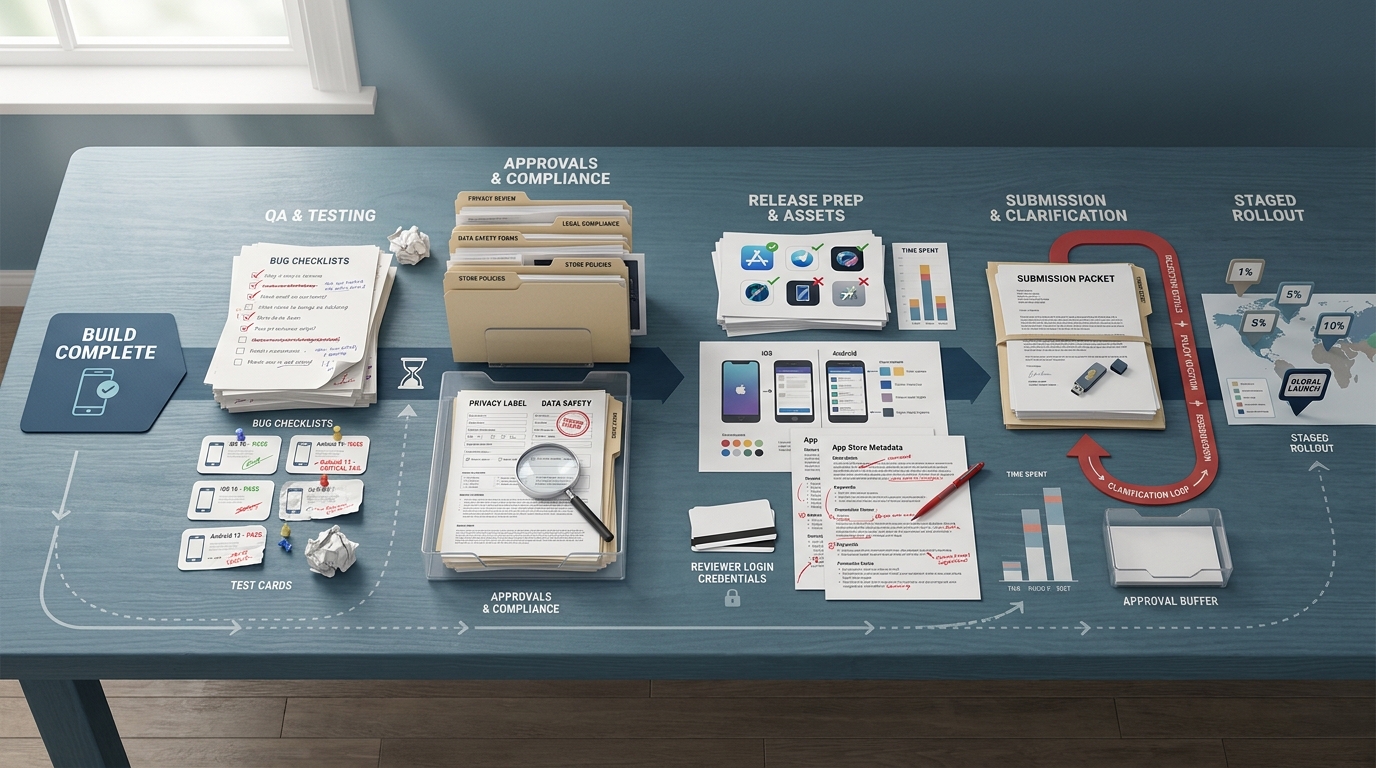
The timeline shows that delays usually accumulate after code completion, especially during QA, approvals, release prep, and coordinated rollout steps rather than during feature development itself.## FAQ
Why do app launch delays happen after development is finished?
Because store approval depends on more than code quality. Missing assets, disclosure gaps, metadata issues, reviewer login failures, and compliance questions can all delay publication after the build is complete.
What is the most common app store submission delay?
There is no single universal blocker, but incomplete submission prep is a frequent cause. Screenshots, privacy labels, Data Safety answers, and reviewer access details are common sources of delay.
Can a stable app still get delayed in review?
Yes. A technically sound app can still be delayed if reviewers cannot verify the experience or if disclosures and metadata do not match app behavior.
How much buffer should teams add to an app launch timeline?
There is no fixed rule. A practical baseline is to lock materials 5 to 7 days early and leave room for at least one clarification or resubmission loop, though higher-risk categories may need more.
What should be on an app launch checklist?
At minimum: screenshots, icons, support and privacy URLs, metadata copy, Apple privacy labels, Google Play Data Safety answers, reviewer credentials, gated feature instructions, and policy-related compliance checks.


