
If your build works, you are past the hardest engineering step. But app review delays often come from the submission package, not the app itself. This checklist helps you align App Store Connect and Google Play Console with the actual product before review starts.
| Review zone | What usually goes wrong | Practical impact |
|---|---|---|
| Metadata | Descriptions or claims do not match the build | Clarification requests or rejection |
| Privacy labels / Data Safety | Disclosures do not match SDK or app behavior | Compliance flags and resubmission work |
| Permissions | Sensitive access is requested without a clear reason | Extra scrutiny and slower review |
| Demo access | Reviewer cannot log in or reach core flows | Review paused or rejected |
| Account deletion | Deletion path is missing or hard to find | Compliance issues for account-based apps |
| Screenshots and previews | Assets show outdated UI or unavailable features | Misleading listing concerns |
| Reviewer notes | Notes omit test steps or restricted flow context | Back-and-forth that costs time |
Explanation: This is a directional, field-tested risk map based on common submission failures and platform guidance, not a formal benchmark.
Interpretation: In practice, most avoidable friction clusters around packaging, disclosure, and reviewer access rather than core app stability.
Reader impact: For a simple app, prep often takes a few focused hours. For apps with subscriptions, multiple SDKs, account systems, or sensitive data, teams often spend most of a day or 1 to 2 working days, especially when inputs are split across product, marketing, legal, and engineering.
Common App Store Rejection Reasons and How Froxi AI Helps goes deeper on the ideas above and adds concrete next steps.
What causes app store submission delays and rejection?
A preventable rejection rarely starts with a crash alone. More often, it starts with broken reviewer access, a missing privacy disclosure, unclear subscription context, or screenshots that show features not in the release build.
What this means is simple: even a stable app can lose days if the handoff is incomplete. If you do not have a release owner, this work usually falls to a founder, PM, marketer, or the last engineer touching the build, which is why it gets rushed.
When you move from outline to execution, How Subscription Apps Get Rejected - and How to Prevent It helps close common gaps teams hit here.
What should you check before you publish to App Store or Google Play?
Submission is not just a final click. It is a short operational workflow that connects product, legal, marketing, and support inputs into one review package.
Gather the required inputs
Before upload, collect:
- Final release candidate build or app bundle
- App Store Connect and Google Play Console access
- Privacy policy URL and support URL
- Current screenshots for required device sizes
- Age rating inputs
- Release notes
- Subscription details and paywall language if relevant
- Demo credentials and seeded test data if needed
- Notes for gated, moderated, location-based, or invite-only features
A common mistake is assuming QA signoff means submission readiness. It does not. Store review also depends on complete assets, working links, and clear reviewer access.
Check metadata and claims against the actual build
Audit visible listing fields
Review the title, description, category, URLs, and promotional text. Every claim should be visible and testable in the submitted build, not in a future release.
Remove risky wording
Avoid unsupported promises or language that can imply regulated claims in health, finance, safety, or legal categories. Overreaching copy can trigger closer review.
Match screenshots to the release candidate
If the UI changed recently, update the assets now. Reviewers compare the listing to the installed app, and users notice the mismatch too.
The practical takeaway is that metadata is part compliance, part marketing. If it gets ahead of the build, you create avoidable review risk.
Match privacy disclosures, permissions, and reviewer access
Apple and Google publish review and policy guidance on areas like app access, privacy disclosures, and account-related requirements. The exact interpretation can still vary by app category, region, and reviewer, so treat this as operational guidance rather than a guarantee.
Map disclosures to real app behavior
Cross-check App Store privacy labels and Google Play Data Safety answers against the current build, SDK list, analytics, login flows, and sharing practices. In practice, this usually means checking the release branch, not the roadmap.
Justify sensitive permissions
Camera, microphone, location, contacts, notifications, and tracking should have a clear product reason. The safer pattern is prompting near the feature that needs access, with plain-language context first.
Verify account and deletion flows
If users can create an account, confirm whether deletion is required for your app and whether the path is easy to find. This is a common gap when policy updates land before settings flows are fully finished.
Prepare reviewer access like a real handoff
Confirm the reviewer can log in, reach paid or gated areas, and understand restricted flows. In App Store Connect reviewer notes or the Play Console app access section, include working credentials, test steps, and a contact for same-day fixes if access breaks.
A complementary angle worth comparing lives in The Founder's Complete App Publishing Checklist.
What issues still cause app store rejection after a checklist pass?
A checklist catches most issues. The ones that remain are usually small mismatches that nobody reviewed end to end.
Watch for these patterns:
- The listing is ahead of the build: assets or descriptions show features not in the binary.
- Privacy documents disagree: your policy, privacy labels, and Data Safety form describe different behavior.
- Reviewer notes assume context: the team knows the hidden flow, but the reviewer does not.
- The tested version is not the submitted version: QA signed off on a newer build than the one uploaded.
One thing worth noting: even a complete checklist does not fully prevent delays. Policy interpretation changes, SDK disclosure ambiguity, and reviewer access issues can still create back-and-forth, especially around sensitive categories or fast-moving releases.
For tradeoffs, checklists, and edge cases, Submitting vs Publishing an App: What's Different rounds out this section.
Final pre-submit check
Use this compact pass right before submission:
- Confirm listing copy matches the exact uploaded build
- Confirm screenshots reflect current UI and real features
- Verify support and privacy policy URLs work publicly
- Re-test demo login on the submitted build
- Test gated flows and purchases if relevant
- Confirm account deletion is reachable and works as described
- Reconcile privacy labels and Data Safety answers with actual SDK behavior
- Review permission timing, wording, and necessity
- Add reviewer notes for restricted or subscription-dependent flows
- Assign one owner to monitor review emails and same-day follow-ups
The tradeoff is time versus risk. This final pass may take 30 to 90 minutes for a straightforward release, and longer when assets, policy answers, and reviewer access are owned by different people.
We Analyzed App Launch Delays: Why Mobile Apps Don’t Go Live on Time reframes the same problem with a slightly different lens - useful before you finalize.
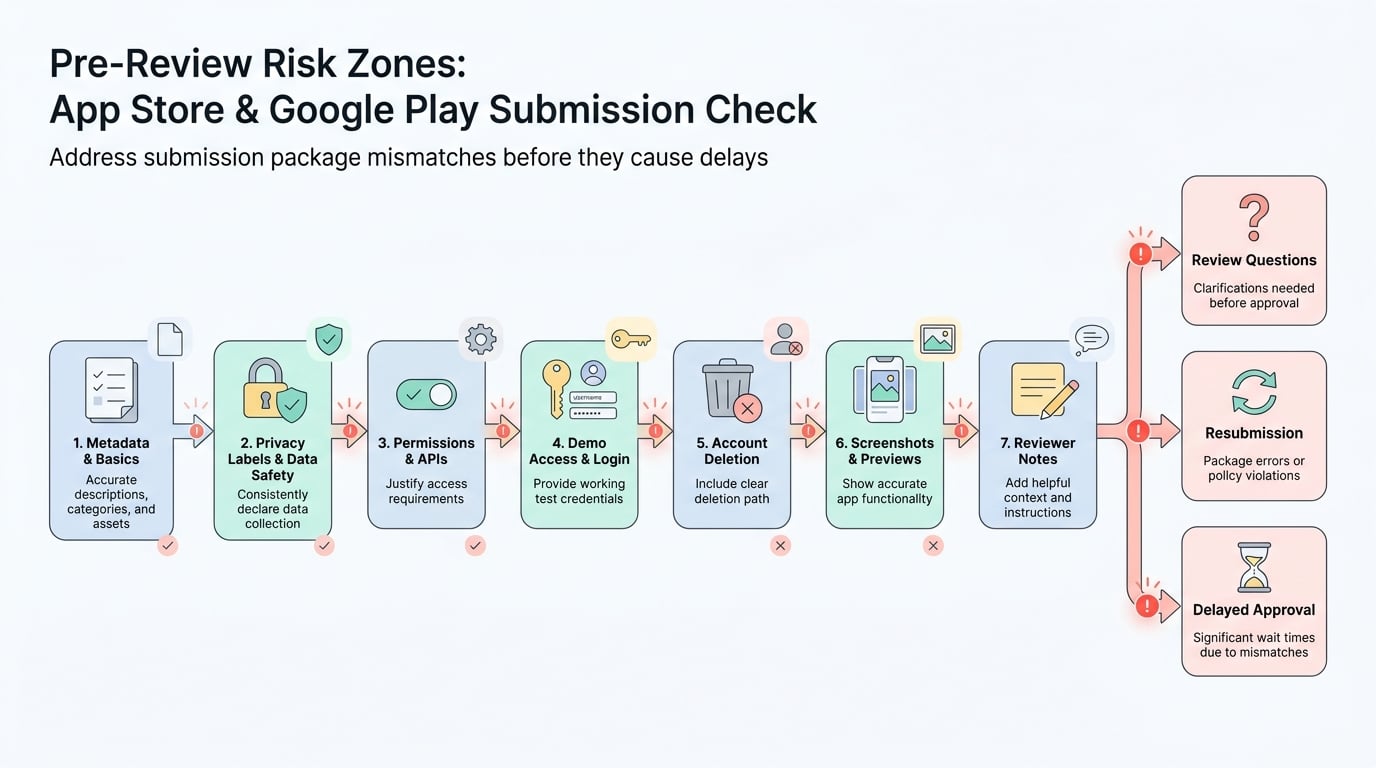
A clean sequence map showing the seven pre-review risk zones for mobile app submission: metadata, privacy labels and Data Safety, permissions, demo access, account deletion, screenshots, and reviewer notes. The flow should visually connect each zone to likely outcomes such as review questions, resubmission, or delayed approval.


