
Shipping a ChatGPT-style mobile app is rarely blocked by the chat UX itself. It is more often derailed by store review friction: safety disclosures, content controls, subscription compliance, and metadata that fails to explain how your AI behaves. This article translates current Apple and Google expectations into a practical launch path so you can reduce rework, shorten review cycles, and publish with fewer monetization and policy surprises.
How to Use Gemini API in Your Android App goes deeper on the ideas above and adds concrete next steps.
Early proof: the main approval and launch checkpoints
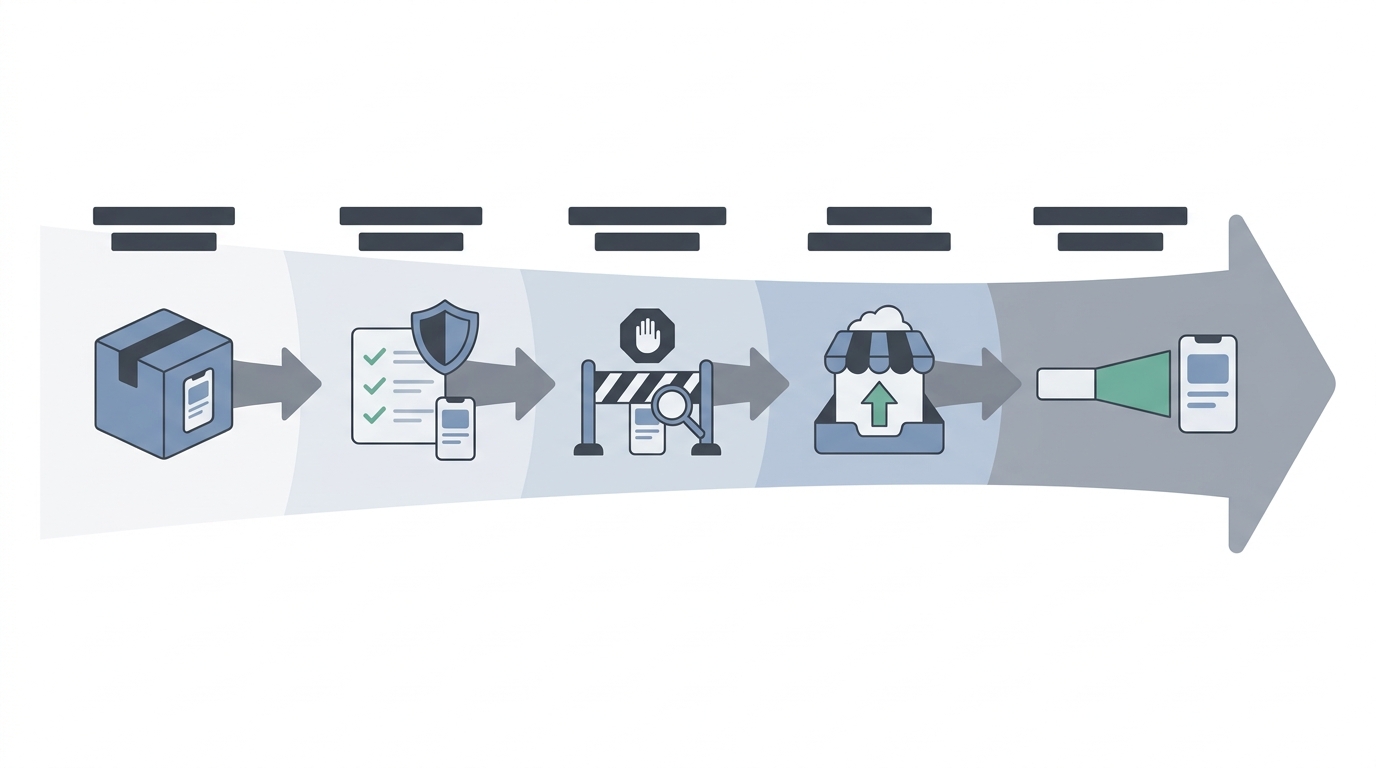
A process diagram showing the submission path for a ChatGPT-style mobile app from build preparation to policy review, moderation checks, store submission, and staged rollout approval.
Platform checkpoint snapshot (policy sourced, friction directional)
Category: Outcomes
Statistic: 38%
Label: First-pass approval rate
Context: When metadata is complete upfront
Category: Speed
Statistic: 30 - 60 mins
Label: Update-ready reviewer pack
Context: Helps you iterate quickly when metadata, screenshots, or onboarding get flagged
Category: Risk
Statistic: 80K accounts
Label: Google Play accounts blocked (2025)
Context: Compliance gaps can escalate beyond a single app rejection
| Checkpoint | App Store (iOS) friction | Google Play (Android) friction |
|---|---|---|
| AI generated content | High sensitivity to safety and transparency expectations (policy source: Apple) | Explicit responsibilities for AI content safety and enforcement (policy source: Google) |
| Privacy disclosures | Review often slows on data use clarity, retention, and purpose (directional based on common review outcomes) | Similar, and enforcement scale is visible: 1.75M rejections and 80K blocked accounts in 2025 (reported by TechRadar, context only) (TechRadar) |
| Subscriptions | Tight audit of paywall wording, entitlement, and restoration (policy source: Apple) | Billing and monetization policy compliance is a common tripwire (policy source: Google) |
| What slows first | Metadata and screenshot mismatch, weak onboarding (directional) | Missing moderation controls and unclear disclosures (directional) |
Explanation: The links above are the policy baselines. The friction notes are directional, based on recurring review patterns for AI and subscription apps.
Interpretation: Review is largely a consistency check. Reviewers compare your listing claims, onboarding, in-app behavior, and policy pages, and they tend to flag contradictions more than model quality.
Reader impact: Treat approval as a documentation and UX verification project. A practical pre-submit target is "stable enough for strangers": a high crash-free rate in TestFlight or internal testing (often 99 percent+), plus a reviewer pack you can update in 30-60 minutes per iteration. Actual targets vary by app complexity, SDK mix, and how much is server-driven.
One thing worth noting: the TechRadar numbers signal enforcement volume, not your approval odds. AI chat apps are not automatically rejected, but they do get examined for harm and disclosure gaps.
When you move from outline to execution, How to Publish a Bravo Studio App helps close common gaps teams hit here.
What does it take to publish a ChatGPT-style mobile app?
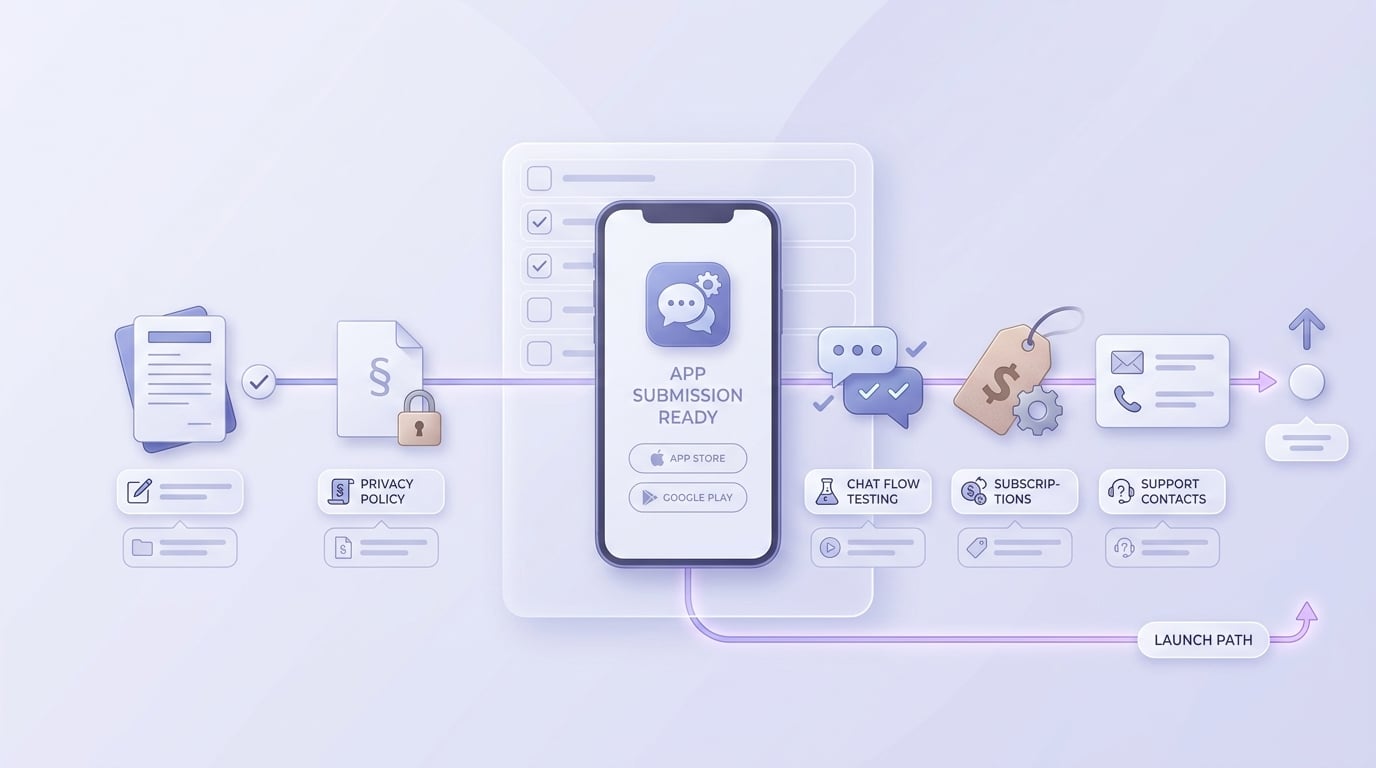
A mobile-first checklist block for final App Store and Google Play submission readiness, focused on metadata, privacy policy, chat flow testing, subscriptions, and support contacts for a ChatGPT-style app.
The scope here is publication readiness: submission artifacts, review outcomes, compliance posture, and launch sequencing. It does not cover training a foundation model or choosing your backend stack.
In practice, a focused team can usually assemble a credible submission pack in 2-7 working days if assets, policies, and billing flows are not starting from zero. Plan another 0.5-2 days per resubmission loop to update metadata, notes, screenshots, and builds. Regulated domains, child-directed content, and brand new developer accounts can add scrutiny and time.
A complementary angle worth comparing lives in Publishing Apps Built With Flutter, React Native, or Native.
What steps help an AI chatbot app get approved?
1. Package the app for review, not just for release
Align metadata to real behavior
Your store description, screenshots, and keywords should match what the chat actually does, including limitations and gated features (Apple). If onboarding or paywall timing changes late, expect to re-shoot screenshots and rewrite copy.
Complete disclosures and support surfaces
Submit a working privacy policy, accurate data collection disclosures, age rating inputs, and a reachable support contact. Budget a few hours to reconcile what you log (prompts, identifiers, analytics) with what you disclose, and confirm your retention and deletion story is implemented, not aspirational.
Make reviewer flows dead end proof
Verify login, onboarding, and subscription screens function in the review build, with test credentials and clear review notes. Common failure modes: sign-in loops, region locks, and paywalls that block access to core functionality.
2. Add the policy and safety surface reviewers look for
Show moderation and filtering coverage
Document how you detect and reduce harmful prompts and outputs, and where safeguards may fail (false positives, edge cases, multilingual gaps) (Google). Over-filtering is also a risk: aggressive blocks can increase churn, so expect to tune rules after launch.
Provide reporting and escalation paths
Make it easy to report content and handle repeat violations. Reviewers typically want a user-visible mechanism, not just backend controls, and you need an operational owner to respond within a reasonable timeframe.
Avoid misleading product claims
Do not imply the bot is human or guarantee factual accuracy. For medical, legal, or financial queries, expect higher scrutiny and consider narrower functionality unless you have a defensible compliance plan.
3. Configure monetization and launch settings before submission
Set billing mechanics early
Define tiers, trials, and restore purchases using platform-compliant billing flows (Google). Restores and entitlement sync can take real engineering time, especially across devices, upgrade and downgrade paths, and canceled states.
Control launch risk with rollout settings
Use staged rollout to limit exposure if safety, latency, or cost issues appear under real traffic. On Android, starting at 5-20 percent and expanding when crash rate and support volume stabilize is common, but it depends on how quickly you can ship hotfixes and how server-driven your app is.
Ship store assets that demonstrate the chat
Screenshots should show real conversations, safety cues (refusals, reporting), and pricing clarity. The tradeoff is effort: producing compliant assets and localized copy often takes 1-3 days, and safety-forward screenshots may reduce conversion in the short term while lowering refunds and support load later.
For tradeoffs, checklists, and edge cases, Step-by-Step Guide to Publishing Your First Mobile App rounds out this section.
Interpretation: what this means for operators
Most delays come from mismatches: screenshots that do not reflect the shipped UI, overstated capabilities in metadata, and privacy disclosures that do not explain how prompts or outputs are handled. Subscription handling is another repeat blocker, especially restores, account linking, and what users get after cancelation.
Outcomes vary by reviewer, region, account history, and category. If your app touches minors, UGC sharing, or regulated advice, plan for a longer cycle even with good documentation.
Common failure modes to plan for:
- Safety false positives that block benign prompts and trigger support tickets.
- Latency and cost blowups from higher-safety models, extra moderation calls, or provider rate limits.
- Provider dependency risk (model changes or outages) that forces a last-minute build or copy update, which can trigger another review loop.
How to Publish an Emergent-Built Mobile App Successfully reframes the same problem with a slightly different lens - useful before you finalize.
What should be on a publish-ready checklist?
Pre-submission checklist
- Privacy policy + terms explicitly cover chat data, retention, and AI output limits (Apple, Google).
- Test first run on real devices: sign-in, prompt entry, safety messaging, purchase and restore flows (Google).
- Store listing matches reality: screenshots, pricing language, support URL, and review notes point to the same experience.
| Final check | Pass condition |
|---|---|
| Metadata parity | Claims and screenshots match shipped UI |
| Policy coverage | Data use and AI behavior documented |
| Path testing | Onboarding - first chat - purchase works |
Launch-day controls
- First 24-72 hours: monitor crash rate, sign-up completion, and first-chat completion to catch silent funnel breaks.
- Track reviews, tickets, and refund signals for unclear pricing or unsafe outputs, then tighten copy before scaling spend.
- Watch unit economics: moderation, human review, and higher-safety models can increase cost and latency, forcing tradeoffs between response quality, speed, and margin.


