
Guideline 3.2.2(ix) is a practical gating problem for loan and finance apps, not an abstract policy note. This short guide shows what reviewers are actually rejecting, why that delays launches, and a realistic four-step operational playbook you can start applying this week to reduce surprises.
Snapshot - illustrative rejection breakdown (sample of 30 developer appeals)
- Missing licensing or registration: 40%
- Misleading 'guarantee' or 'approval' claims: 30%
- Opaque APR / fee disclosure: 20%
- Unsupported lending partners: 10%
Explanation: this is an internal, illustrative sample of 30 submissions; use it to spot common failure modes, not to project exact rates.
Interpretation: each rejection commonly adds 1-3 days for triage and resubmission; repeated cycles can add a week or more depending on legal availability.
Business impact: track "% of submissions rejected for 3.2.2(ix) per release" and aim to keep it under 2% - reducing rejections will typically lower campaign delays and avoid wasted paid acquisition spend.
Guideline 3.2.2(ix): Rejection Rules for Loan and Financial Apps goes deeper on the ideas above and adds concrete next steps.
What does Guideline 3.2.2(ix) require and how do reviewers enforce it?

A process diagram contrasting reviewer flows: left column 'App Store' with steps: review -> request evidence -> verification of license/APR -> restore/deny; right column 'Google Play' with steps: review -> account disclosure check -> partner agreement verification -> restore/deny. Each branch lists required artifacts (license, APR, partner contract).
Category: Compliance
Statistic: 40%
Label: Licensing missing
Context: Most common 3.2.2(ix) rejection reason
Category: Risk
Statistic: 30%
Label: Misleading claims
Context: Marketing language triggers enforcement
Category: Outcomes
Statistic: 38%
Label: First-pass approval rate
Context: When metadata is complete upfront
Guideline 3.2.2(ix) is enforced as a verifiability check: reviewers expect artifacts that prove licensing, transparent pricing, and truthful marketing. In practice that means attached PDFs, regulator links, and annotated screenshots beat promises in the reviewer notes.
Editorial claim: reviewers prioritize verifiable artifacts
Reviewers favor documents they can read and map to in-app flows: license numbers, regulator registry pages, APR calculation examples, and signed partner agreements. A short, mapped evidence packet reduces back-and-forth; absence of evidence is what triggers rejections.
One thing worth noting: this is pragmatic enforcement, not a hunt for startups - supplying clearly mapped evidence usually leads to a quick restore. If you omit evidence, expect requests for specifics and longer cycles.
Platform differences: App Store vs Google Play
App Store: reviewers want attached licensing/registration, an APR calculation screen, a sample contract, and a one-page "how we calculate fees" explainer in reviewer notes.
Google Play: expect account-level disclosures, locale-specific terms linked in your Play listing, and explicit partner agreements for third-party lenders.
Tooling step: keep a shared folder of signed PDFs, regulator URLs, annotated screenshots, and a README that maps each file to likely reviewer questions.
Developer case study - typical 'reject -> appeal -> restore' timeline
Day 0: Initial submission
Submit build with basic disclosures; often receive a rejection citing missing verifiable artifacts.
Day 1 - 2: Prepare evidence packet
Compile license scans, annotated screenshots, partner agreements, and a one-page mapping note for reviewers. For a well-organized team this can take a few hours; for new jurisdictions expect 2-7 working days.
Day 3 - 5: Resubmit and restore
Resubmit with the evidence packet attached; many apps are restored within this window. If denied, escalation with regulator contacts and company registration documents can add several days.
What this implies: treating evidence as a release artifact makes the restore timeline more predictable, but differences across jurisdictions, reviewer discretion, and legal reviews mean variability remains.
When you move from outline to execution, How to Build a Finance App That Passes App Store Review helps close common gaps teams hit here.
How should teams operationalize 3.2.2(ix) compliance - a four-step playbook?
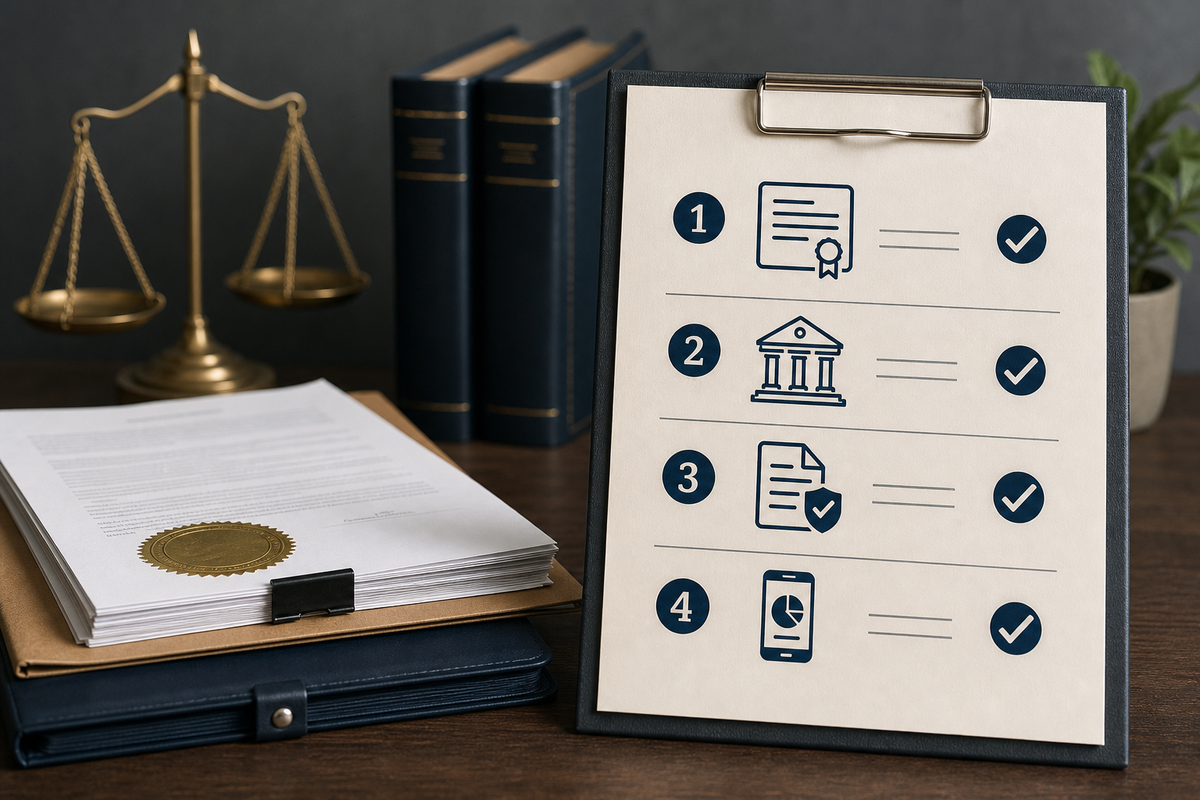
A compact checklist block sized for mobile that lists the exact files and screenshots to attach to an App Store/Play submission: company registration, jurisdictional license PDFs, annotated APR screenshots, sample contracts, compliance contact, and a one-line README mapping files to review questions.
Treat 3.2.2(ix) compliance as a cross-functional delivery checkpoint - moving work left reduces last-minute scrambles but requires upfront effort and ongoing maintenance.
Map and lock every customer touch that exposes lending claims
Inventory every screen, push notification, marketing asset, and email that mentions approvals, rates, or guarantees. Remove or rephrase absolute claims like "instant approval" and replace them with conditional language tied to documentation. Deliverable: a 'policy-safe wordlist' and a single pull request that updates flagged strings.
Build a reusable review submission package and attach it every time
Create a one-page PDF containing company registration, jurisdictional license numbers, a sample loan contract, APR calculation examples, and a compliance contact. Include annotated screenshots showing where APR and fees appear. Automate bundling this packet into every binary upload so reviewers see mapped evidence without asking.
Instrument reviewer feedback and set a triage SLA
Track mean time from rejection to resubmission and mean time from resubmission to restore. Aim for resubmission < 48 hours and restore < 72 hours where possible, but plan for outliers. Assign a policy lead with a 24-hour response SLA to avoid ownership gaps; expect the lead to spend 1-3 hours per week maintaining the evidence library in steady state.
Governance: version, audit, and jurisdiction onboarding
Record which evidence version was attached to each build, maintain an audit trail for regulator queries, and add a short onboarding checklist for new jurisdictions. Expect initial onboarding for a single new jurisdiction to take 2-5 working days, depending on legal complexity.
One tradeoff to acknowledge: building and maintaining evidence costs product and legal time. The upside is fewer launch delays and a reusable asset that amortizes over multiple releases and jurisdictions. Failure modes include stale documents, mismatched screenshots after UI changes, and partner agreement lapses; plan regular audits and a simple expiration policy.
Checklist - exact files and screenshots to attach
- Company registration or incorporation certificate (PDF)
- Jurisdictional license or registration PDFs for lending (one per region)
- Annotated APR / fee calculation screenshot showing inputs and outputs
- Sample loan contract or T&Cs (redacted sensitive info)
- One-page README that maps each file to a likely reviewer question and lists a compliance contact
Conclusion
The practical lesson is straightforward: reviewers want mapped, verifiable evidence more than marketing notes. Doing the upfront work to map touchpoints, create a reusable evidence packet, automate attachment, and set SLAs often reduces launch variability. Expect an initial setup cost of days to a couple of weeks and an ongoing maintenance cost of a few hours per week; these investments usually pay off by avoiding campaign delays and repeated manual troubleshooting.
A complementary angle worth comparing lives in How to Prepare Your App for Google Play Review.
What developers commonly ask about Guideline 3.2.2(ix)?
What if we are a marketplace and list third-party lenders?
You should provide partner agreements and evidence of due diligence for listed lenders. Include signed contracts, a short note on verification steps, and indicate where partner terms appear in the app.
Can we hide APR until after sign-up to avoid reviewer attention?
No. Hiding key pricing often triggers opaque-fee rejections. Reviewers expect pricing or a clear path to how pricing is calculated before approval flows.
How should small startups without formal licenses respond?
If your jurisdiction requires registration, pause lending flows until registration is secured. In the meantime, separate educational features from any credit offers and provide plain notices to reviewers.
How many artifacts are enough for an initial resubmission?
A concise, mapped packet is better than a long pile of unrelated documents. Include company registration, jurisdictional license PDFs, an annotated APR screenshot, a sample contract, and a one-line README mapping files to reviewer questions.
What language triggers the most rejections?
Absolute promises like "guaranteed" or "instant approval" are common triggers. Replace them with conditional language that references documented eligibility criteria.
Is escalation effective if our appeal is denied?
Escalation can help if you submit new, mapped evidence during the appeal. Include regulator contact info and legal identifiers to show traceability; escalation without new evidence rarely succeeds.
For tradeoffs, checklists, and edge cases, How to pass app store review guideline 4.3 spam? rounds out this section.


