
The way iOS apps make money in 2026 is less about picking the "best" monetization model and more about matching a model to how your app is used, how strong your retention is, and how much install volume you can reliably drive. Ads-only is harder than it used to be, but subscriptions are not a universal fix either. This guide ranks five models that still work, then gives you a decision framework to pick a primary model you can realistically execute.
| Rank (by fit) | Monetization model | Best-fit app types | Decision signal (what tends to matter most) | Revenue stability (directional) | Conversion sensitivity (directional) | Implementation complexity (directional) |
|---|---|---|---|---|---|---|
| 1 | Subscriptions | Productivity, fitness, education, premium content, B2C utilities with ongoing value | Retention and repeat use (weekly or more) | High if retention is strong | Medium to high (paywall tuning matters) | Medium |
| 2 | In-app purchases (IAP) | Games, creator tools, prosumer utilities, content packs, credit-based apps | "Upgrade moments" and clear value steps | Medium to high | Medium (offer design matters) | Medium to high |
| 3 | Ads | Casual games, news, lightweight content, broad utilities | Session volume and tolerance for ad load | Low to medium | Low at first, then high (ad load vs churn) | Low to medium |
| 4 | Paid download (upfront) | Niche pro tools, simple utilities, privacy-first apps, one-and-done value | Strong store positioning and clear differentiation | Medium (but capped) | Very high (pricing page must sell) | Low |
| 5 | Affiliate/partner revenue | Shopping, travel, deals, finance lead gen, content discovery | Purchase intent and outbound click quality | Medium (depends on partners) | Medium to high | Medium |
Explanation: This table reflects patterns I see when teams ship and iterate monetization, not third-party benchmarks. The "directional" columns call out where the bottleneck usually shows up once the first version is live.
Interpretation: Read "stability" as predictability after you find product-market fit, not a guarantee. Read "complexity" as total effort (engineering plus pricing, paywalls, analytics, support), and assume 2-6 weeks of iteration before things feel reliable.
Reader impact: Use this to avoid choosing a model your current product cannot support. If you do not have retention yet, a subscription can hide product issues until churn shows up; if you do not have volume, ads can stall even when the app is good.
Top 5 Ways to Monetize Your First iOS App goes deeper on the ideas above and adds concrete next steps.
Which iOS monetization model fits your app best?
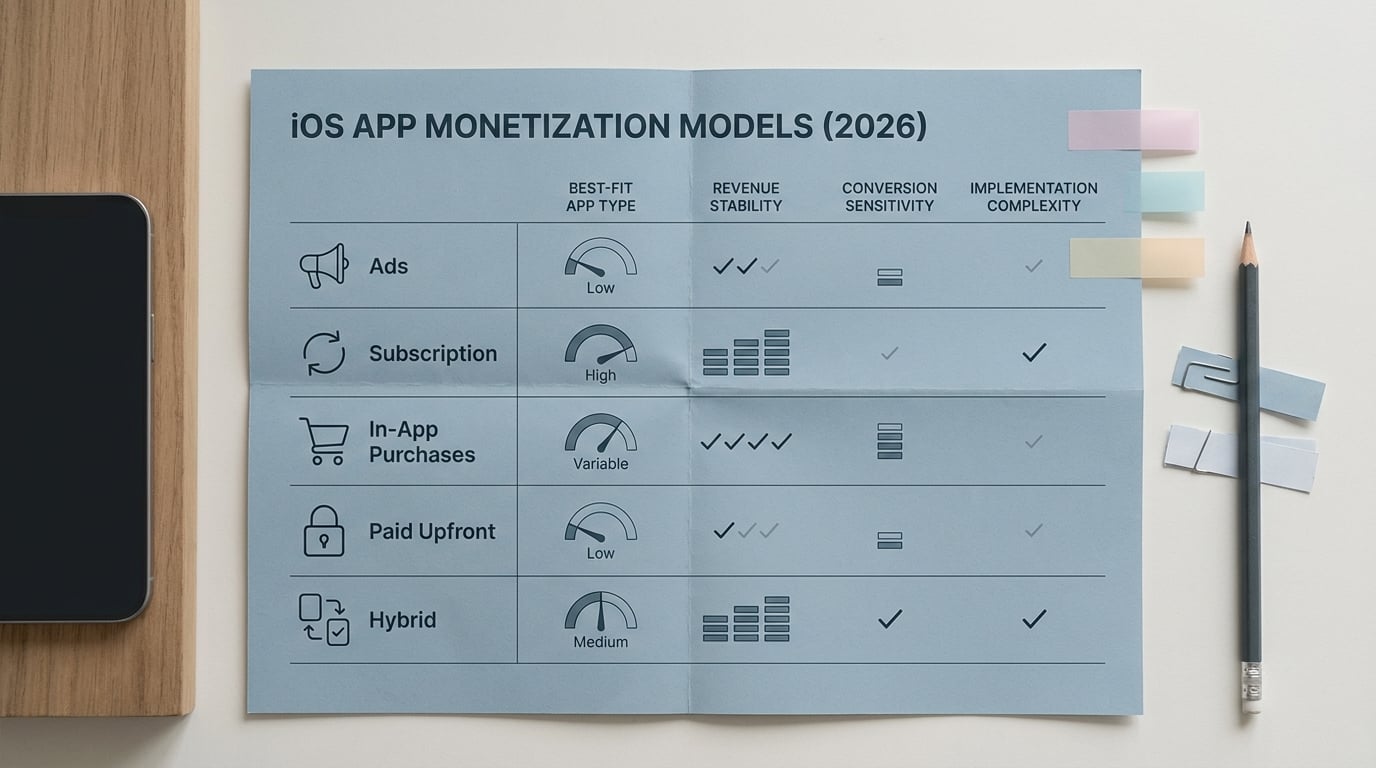
A compact comparison table showing the five iOS monetization models side by side, with columns for best-fit app type, revenue stability, conversion sensitivity, and implementation complexity in 2026.
This list is ranked by practical fit across common iOS categories, not by a universal score. Hybrids can work, but you still want one primary model so you can instrument, iterate, and learn without muddying the data.
1) Subscriptions for high-retention, recurring-use apps
A monthly or annual plan billed through the App Store for ongoing value: continuous features, fresh content, coaching, or persistent utility (Apple Developer). Expect 1-2 weeks to ship a basic paywall plus subscription flow, then 2-6 weeks of iteration on onboarding, trials, pricing, and win-backs. A common failure mode is free-trial signups that look great at first, then churn hard at renewal because the value was not obvious in week one.
2) In-app purchases (IAP) for games, creator tools, and upgrade moments
Users buy digital goods or unlocks inside the app: consumables (credits), non-consumables (feature unlocks), or content bundles (Apple Developer). The first version is often 1-3 weeks, but the real work is offer architecture and clarity across screens, receipts, and restore flows. A common failure mode is a messy SKU ladder that confuses users, increases refund requests, and adds support load.
3) Ads for scale-first apps with broad, frequent usage
Monetizing attention through banner, interstitial, native, and rewarded ads, often for price-sensitive audiences. Integration can be days to a week, but the constraint is ongoing tuning: placements, frequency caps, mediation, and churn management. A common failure mode is eCPM volatility (or mediation issues) pushing teams to increase ad load until retention drops.
4) Paid download (upfront) for clear, one-and-done value
Paid apps can still work for niche pro tools, simple utilities, and privacy-first positioning where users want a clean transaction. The constraint is conversion: your App Store page has to do most of the selling, and reviews become a bigger dependency than with free-to-download funnels. A common failure mode is pricing or positioning being slightly off, which can tank conversion and leaves you fewer iteration cycles to recover.
5) Affiliate/partner revenue for high-intent discovery
Affiliate can work when your app reliably drives high-intent outbound clicks (shopping, travel, deals, lead gen). Plan 1-2 weeks for partner setup, tracking, link handling, and basic fraud and attribution sanity checks, plus time for partner approvals and occasional policy updates. A common failure mode is tracking breakage or partner term changes that cut revenue overnight, so you need a fallback plan.
When you move from outline to execution, How to Monetize Your First Mobile App (Step-by-Step) helps close common gaps teams hit here.
How do you choose the right iOS monetization model?
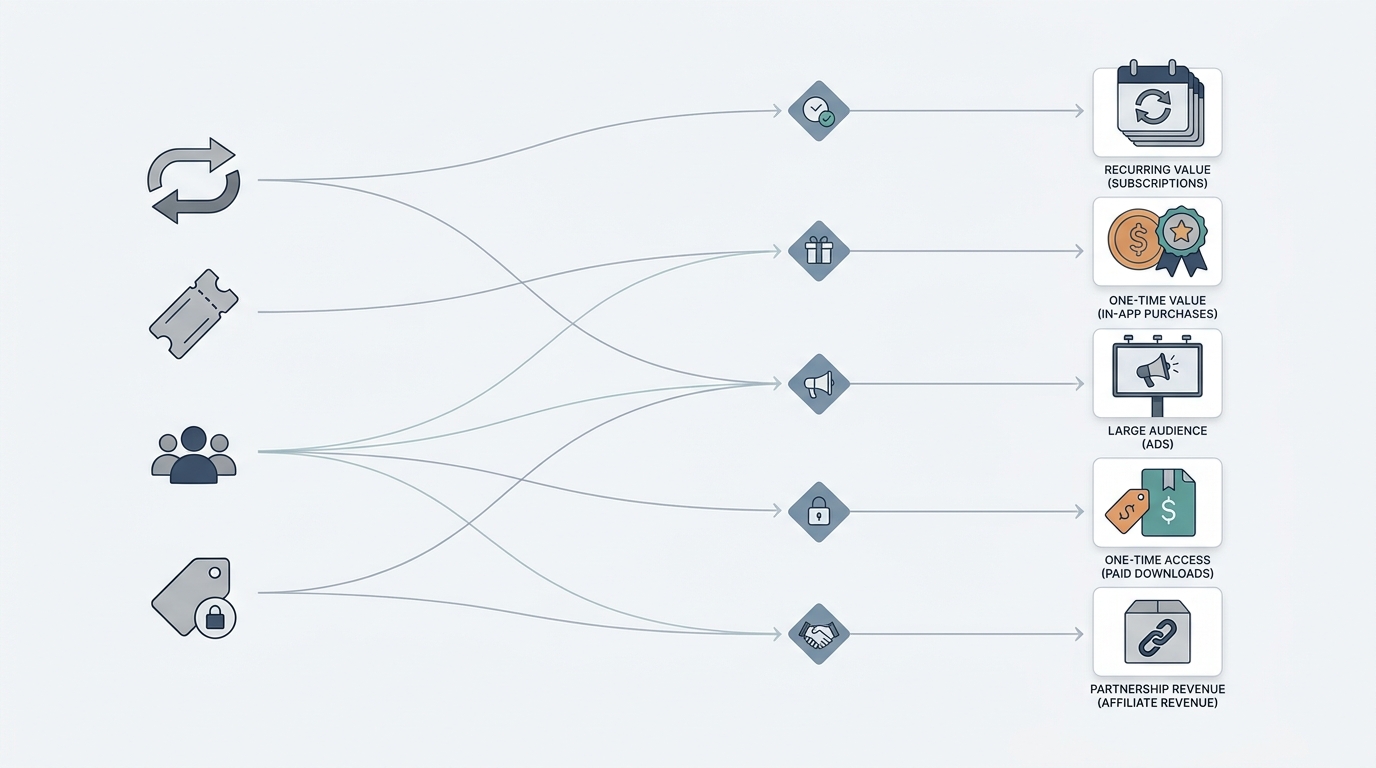
A simple decision flowchart that routes an iOS app toward subscriptions, in-app purchases, ads, paid downloads, or affiliate revenue based on usage frequency, audience size, and whether value is recurring or one-time.
The practical goal is to pick one primary model you can execute well, plus one fallback you only test after baseline metrics stabilize. If you try to ship everything at once, you will not know what moved the numbers, and you will pay for it in analytics ambiguity and support overhead.
Decision workflow (30-60 minutes)
Map your value cadence
Is the value recurring (weekly+) or milestone-based (export, unlock, level up)? If you cannot answer this, talk to 5-10 users first (usually 1-2 days including scheduling and synthesis).
Identify your biggest constraint: retention or volume
If you have repeat use but low installs, subscriptions or structured IAP usually give you more learning per user. If you have installs but shallow engagement, ads or affiliate may be more realistic, but plan guardrails so monetization does not destroy retention.
Choose one primary model and define one decision point
Pick the lowest-complexity version you can measure (one paywall, one bundle, or one ad setup), then set a revisit date. Decision point: if your guardrail metric (like D30 retention) drops after rollout, roll back, reduce friction/ad load, and retest.
Expected outcome
In 2-4 weeks, you should know whether the model is directionally viable, what the main bottleneck is (activation, pricing, volume, churn), and what to iterate next.
Common pitfalls and tradeoffs (quick scan)
| If you choose... | The upside | The tradeoff to plan for |
|---|---|---|
| Subscription | More predictable revenue if retention is strong | Requires ongoing value plus iteration on paywall, onboarding, and lifecycle |
| IAP | Monetizes upgrade moments and supports multiple price points | Offer design gets messy fast; complexity increases refunds and support |
| Ads | Low friction for users who will not pay | Needs scale and careful ad load to avoid retention collapse and eCPM swings |
| Paid download | Simple to implement and easy to understand | Conversion depends heavily on App Store page, reviews, and positioning |
| Affiliate/partner | Can work with purchase intent | Revenue depends on partner terms, tracking quality, and policy constraints |
Monetization and pricing audit checklist
Validate one primary model and one fallback against retention, session frequency, and App Store conversion. Expect 60-90 minutes the first time, plus 1-2 weeks of instrumentation cleanup if events or attribution are inconsistent.
Start the audit
A complementary angle worth comparing lives in Freemium vs Subscription: Which Makes More Money for Mobile Apps.
What do teams forget when monetizing iOS apps?
Category: Reach
Statistic: 100%+ reach
Label: Works for non-payers too
Context: Ads monetize the full free user base (unlike IAP/subscriptions)
Category: Risk
Statistic: 5 - 20% churn lift
Label: Retention risk if intrusive
Context: Poor ad UX can push users out; rewarded formats usually reduce this risk
Category: Ad Load
Statistic: 2 - 6 ads/session
Label: Ad-load to hit revenue
Context: Meaningful income typically requires frequent sessions and repeat impressions
- Instrumentation is part of monetization. Budget at least a half day to define events, and 1-3 more days to debug edge cases (restores, upgrades, cancellations, refunds).
- Apple rails are reliable, but not magic. Subscriptions and IAP are well supported, but pricing and messaging still live or die in your onboarding and paywall copy (Apple Developer).
- Support load is a real cost. Expect more tickets after any pricing change, trial launch, or new SKU, and plan who answers them.
Monetization decision sprint (30 minutes)
Identify your usage cadence, decide whether value is recurring or milestone-based, then pick the lowest-complexity model that matches. If your answer depends on unknown retention, run a small test and revisit in 2-4 weeks.
Run the sprint
For tradeoffs, checklists, and edge cases, Ways to Grow Your App Without Paid Ads rounds out this section.


