
Choosing between freemium and subscription is not a style preference, it is a revenue engine decision. Pick the wrong one and you can end up with great downloads but weak payback, or strong payer value but a funnel that never fills. This write-up compares the two models on conversion, LTV, churn, and revenue quality so you can choose what is more likely to grow revenue for your specific app and constraints.
Top 5 Ways to Monetize Your First iOS App goes deeper on the ideas above and adds concrete next steps.
What is the key tradeoff between freemium and subscription?
Category: Conversion
Statistic: ≈12% vs ≈2% (D35)
Label: Paid conversion (subscription vs freemium)
Context: Hard paywalls drive higher early paid conversion; freemium relies on volume
Category: Value
Statistic: ≈2× (1-year LTV per paye
Label: LTV (subscription vs freemium)
Context: Subscription payers tend to deliver higher value over the first year
Category: Outcome
Statistic: ≈11× revenue per install
Label: Revenue efficiency (subscription vs freemium)
Context: Higher conversion + higher LTV can outweigh freemium’s wider top-of-funnel
Across industry reporting, the repeated pattern is a tradeoff: freemium tends to widen acquisition and early engagement, while subscription tends to raise revenue per payer and improve forecasting if retention holds. Benchmarks vary by category and paywall design, but the direction is consistent in larger datasets and 2026 benchmark roundups, including Airbridge and others (Airbridge, AppVerticals, MWM).
| Metric lens (directional) | Freemium (free tier + upgrade) | Subscription or hard paywall (trial or pay-to-use) |
|---|---|---|
| Top-of-funnel reach | Higher, because users can start free | Lower, because payment decision comes earlier |
| Paid conversion rate | Typically lower across total installs | Typically higher among users who hit the paywall (Airbridge) |
| Revenue per payer (1 year LTV per payer) | Often lower, depends on upsell depth | Often higher if churn is controlled (Airbridge) |
| Revenue per install | Can be strong at scale, but sensitive to low upgrade rates | Can be higher, but sensitive to funnel drop-off (Airbridge) |
| Churn pressure | Less visible early, shows up as inactive free users | Very visible, churn directly hits recurring revenue |
| Forecastability | Lower, revenue is more event-driven | Higher, revenue is renewal-driven |
What this evidence is: directional benchmarks showing common patterns across many apps. What it does not prove: that your category, paywall timing, price point, or trial structure will behave the same way. The decision it enables: pick the next metric to validate in your own cohorts (retention and time-to-value first, then net revenue per install).
Practical takeaway: use this to decide what to measure next, not just what to "pick."
- If D7 and D30 retention are stable and users repeat a workflow weekly, lean subscription and focus on paywall timing and renewal drivers. This can fail if paywall drop-off meaningfully reduces activation.
- If time-to-value is slow (users need multiple sessions to trust outcomes), lean freemium and optimize upgrade triggers around the first real constraint. This fails if most users never reach that constraint.
- If paid UA is required and CAC is rising, prioritize the model that improves net revenue per install fastest. Expect a few weeks to trust the signal, depending on traffic, store review lag, and refund timing.
- If you cannot reliably measure renewals and refunds (privacy limits, missing server events), avoid confident subscription forecasts until instrumentation is fixed.
When you move from outline to execution, How Subscription Apps Get Rejected - and How to Prevent It helps close common gaps teams hit here.
What should you compare before choosing a monetization model?
The goal is practical: decide whether freemium or subscription is more likely to grow revenue without damaging acquisition or retention. The comparison stays anchored to conversion rates, LTV, churn, and what those numbers imply for forecasting, paid acquisition, and runway.
Scope and limits:
- This is directional, not a claim that one model always wins.
- Results vary by category, geography, price point, and user intent.
- Trials and soft paywalls can lift trial-start without improving paid retention, so define "conversion" carefully (Culta).
- Store policies, review delays, refunds, and taxes can change net revenue enough to flip an apparent winner, especially during pricing changes.
One operating rule: evaluate paid conversion and churn together. A higher conversion rate can still lose if churn collapses LTV, and a lower conversion rate can still win if retention and ARPU are strong.
A complementary angle worth comparing lives in In-App Purchases and Subscriptions: The Complete Publishing Guide.
How do freemium and subscription make money?
These are not just pricing choices, they are operating loops with different ongoing work. Freemium relies on usage creating the upgrade moment, which can increase support and infrastructure load as the free base grows. Subscription relies on repeated value delivery and retention operations (onboarding, lifecycle messaging, win-backs), which can be marketing and product intensive.
Freemium's revenue engine: scale first, convert later
- Lower friction onboarding: usually improves install-to-activation, but can pull in lower-intent users that dilute conversion.
- Gating and triggers: feature limits, usage caps, exports, templates, or premium tools become upgrade moments.
- Tiering: multiple paid tiers can capture willingness to pay, but they add messaging and support complexity.
- Metric to watch: cohort-based free-to-paid conversion by trigger (first session vs post-aha vs usage limit).
Effort note: freemium often needs ongoing tuning of limits, messaging, and pricing pages. Budget time for copy, localization, support edge cases, and occasional backlash if a limit feels like a bait-and-switch.
Subscription's revenue engine: retention and renewal
- Conversion mechanics: trials, introductory pricing, and annual anchors move active users into recurring billing.
- Core metrics: renewal rate, churn (logo and revenue), payback period, and LTV by plan (monthly vs annual).
- Commercial tradeoff: revenue can be easier to forecast, but you inherit a continuous obligation to defend value (improvements, content, or measurable outcomes).
One thing worth noting: subscription is less forgiving of weak first-run value. If paywall drop-off is high, fixes often require product work (time-to-value, onboarding, differentiation), not only paywall copy.
A practical workflow example (what to do Monday morning)
This is a minimum setup for a decision based on your own cohorts, not generic benchmarks. Typical ranges: 2-7 days to get clean event tracking if your analytics stack is already in place, and 2-6 weeks for an experiment cycle that captures early churn and refunds (longer with low traffic, heavy seasonality, or mostly annual plans).
Instrument the monetization funnel
Track
install -> onboarding_complete -> paywall_view -> trial_start -> purchase -> renewal -> refund/cancel. On iOS, App Store Server Notifications (v2) improves renewal and cancellation capture; on Android, use Google Play RTDN. Tools like RevenueCat can reduce implementation effort, but only if product IDs, paywall variants, and attribution are set up correctly.Add a value-achieved event and retention
Track
D1,D7,D30retention plus one outcome event (for exampleexport_done,workout_completed,scan_saved). Tie revenue to cohorts where possible, but assume gaps due to iOS privacy limits, ad network delays, and cross-device behavior.Run one controlled paywall test
Change one major lever at a time: paywall timing (first session vs post-aha), freemium cap placement, trial length, or annual anchor. Plan for store review lead time (often a few days, sometimes longer) and the risk that pricing changes increase support volume.
Decide using thresholds you can defend
Use net revenue per install and payback period, not conversion alone. If subscription lifts revenue per install but reduces activation or raises refunds, you might be trading short-term revenue for weaker long-term growth.
Pitfalls to watch: duplicated paywall events, trial-start inflation without paid retention, refund spikes after aggressive trials, and lifecycle messaging load that is not set-and-forget.
Which model is likely to win in your category
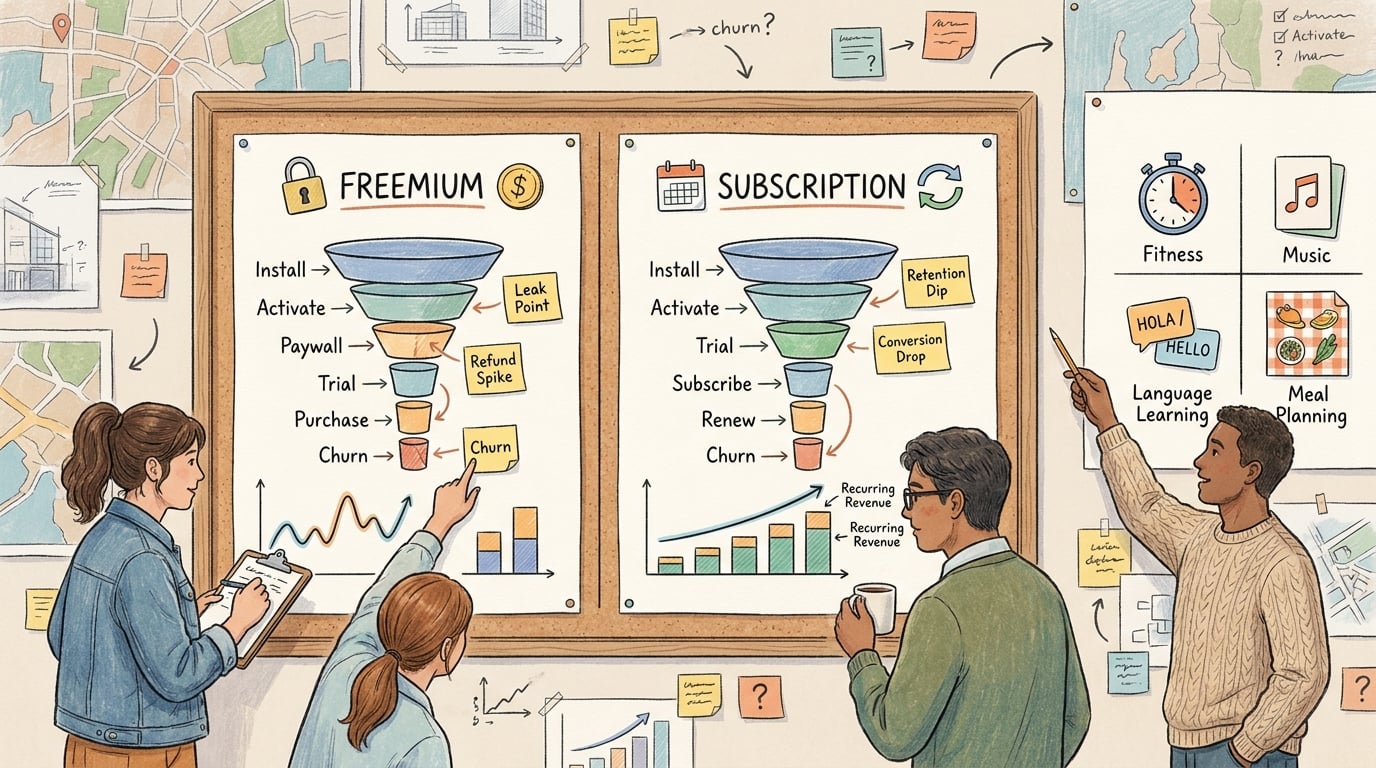
An editorial scene depicting a mobile app team reviewing category-specific monetization outcomes with charts that compare recurring revenue, churn, and user value over time. The image should visually suggest strategic decision-making between freemium and subscription for different app categories.

A process diagram showing the subscription revenue loop for a mobile app: install, activation, trial or paywall exposure, paid conversion, renewal, cancellation prevention, and re-engagement. The diagram should highlight churn leak points and where product teams can intervene.
No single model "makes more money" in isolation. The better choice matches user intent, time-to-value, and your team’s ability to run the loop consistently under real constraints (engineering bandwidth, store iteration speed, customer support, and content or product update cadence).
A quick decision table:
| If this is true... | Freemium is usually the safer bet | Subscription is usually the safer bet |
|---|---|---|
| Time-to-value | Users need multiple sessions to trust results | Users get clear value in first session or two |
| Market expectation | Category expects a free tier | Users expect to pay for ongoing access |
| Growth loop | Reach and sharing matter | Revenue density matters for paid UA |
| Ongoing ops burden | You can handle free-user support and infra | You can run retention ops and iteration cadence |
| Primary risk | Free users never upgrade | Paywall drop-off or early churn kills LTV |
Evidence caveat: reported uplifts are category-dependent and influenced by paywall timing and trial structure (Airbridge, Culta). Treat them as direction, then validate with your cohorts.


