
Making your first $1,000 from an iOS app is less about finding the perfect business model and more about removing avoidable delays between a new user and a payment. Many founders miss this milestone because they overbuild subscription infrastructure, overthink pricing, or wait for marketing to start after launch. This guide shows a practical path to reaching $1,000 in App Store revenue, with clear decision points and a realistic 30-day plan.
Top 5 Ways to Monetize Your First iOS App goes deeper on the ideas above and adds concrete next steps.
What is the fastest way to make your first $1,000 from an iOS app?
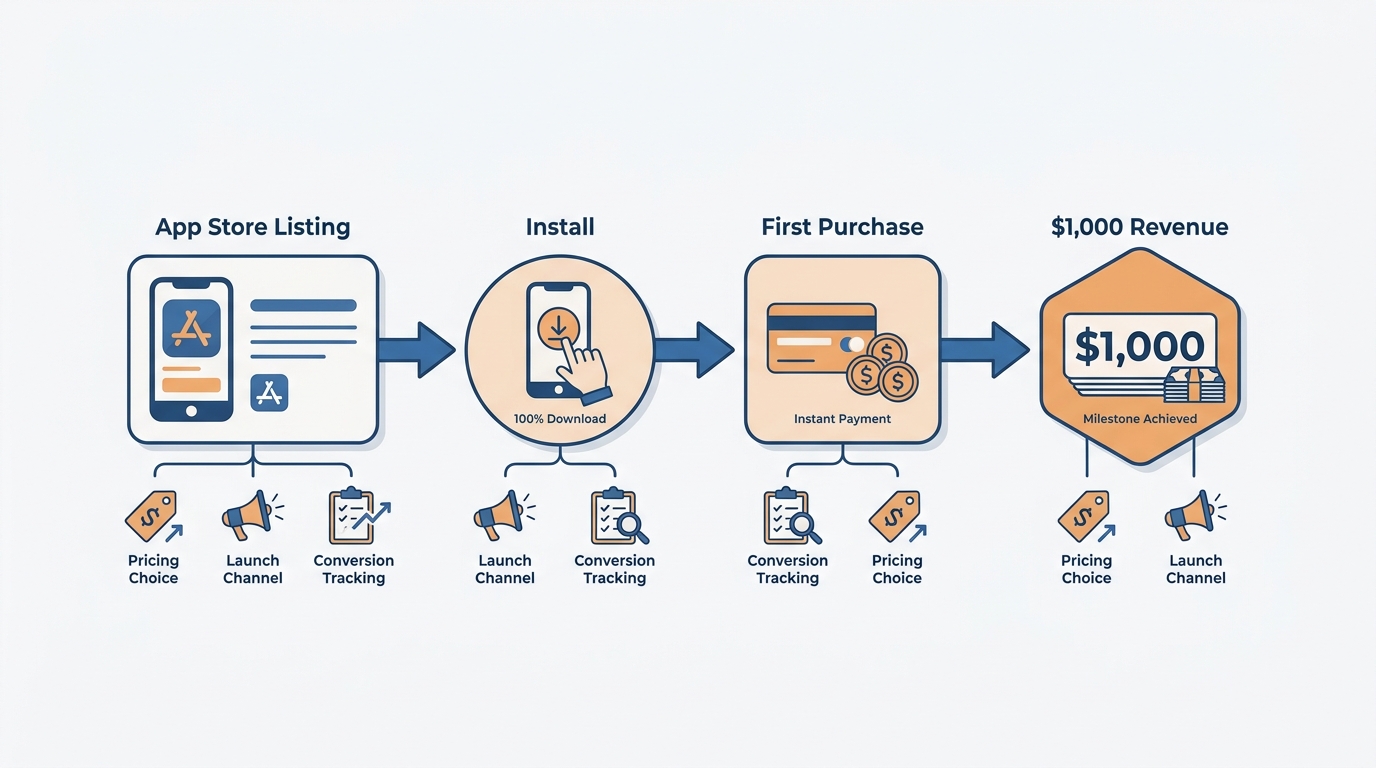
A simple flow diagram from App Store listing to install to first purchase to $1,000, showing the founder actions at each step: pricing choice, launch channel, and conversion tracking.
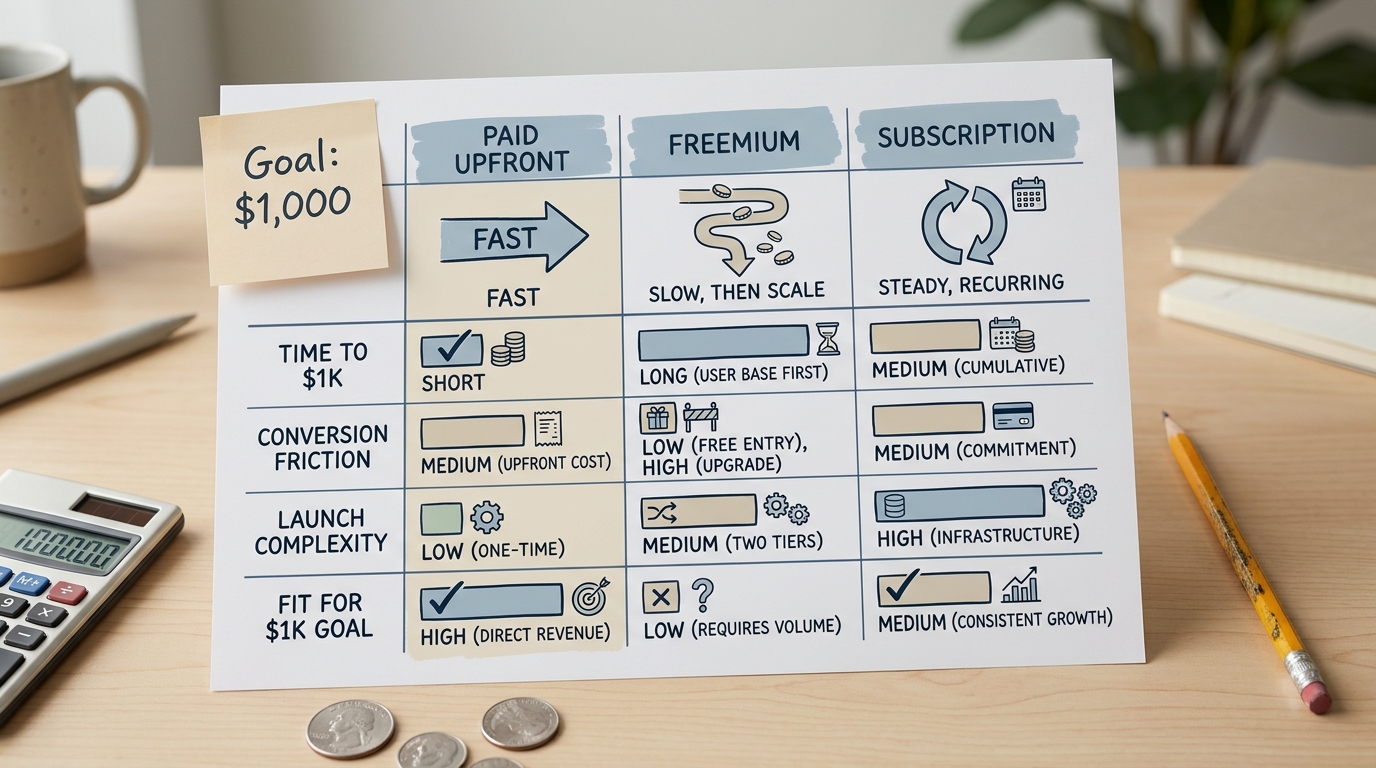
A compact comparison table showing paid upfront, freemium, and subscription models for a first iOS app, with columns for time to first dollar, conversion friction, launch complexity, and fit for reaching the first $1,000.
Subscriptions can dominate long-term revenue on iOS, but they often lose the race to the first dollar. For many indie apps, the quickest route to $1,000 is the model with the shortest path from "I get it" to "I paid".
This matches common launch advice that emphasizes reducing friction and validating pricing early (see TechConcepts and Rork).
| Model | Time to first dollar | Conversion friction | Launch complexity | Fit for first $1,000 |
|---|---|---|---|---|
| Paid upfront | Fast (pay happens before value delivery) | Medium (must justify price instantly) | Low | Strong when the value is obvious from the listing |
| Freemium with one IAP unlock | Fast (pay after a small demo) | Low to medium (depends on gating) | Medium | Strong when value is best felt after 30 to 120 seconds |
| Subscription | Often slower (needs trust and habit) | High (commitment + retention requirement) | High | Best when recurring use is already self-evident |
Explanation: This table summarizes common launch patterns, not a guarantee for your niche.
Interpretation: If value is obvious on the product page, paid upfront can work. If value is felt after a quick try, a single unlock often wins.
Reader impact: You can ship one model, start collecting real purchase data, and decide what to refine next without weeks of guesswork.
When you move from outline to execution, How to Get Your First 1,000 Users for Your iOS App helps close common gaps teams hit here.
Why is the fastest path not always the most scalable one?
Why speed matters more than model purity
Your first $1,000 is not a trophy. It is evidence that a stranger will pay for your solution inside Apple's constraints, on a small screen, with App Store friction.
What this means in practice is that early decisions should optimize for cash collected and learning speed, not perfect lifetime value math. You can improve packaging later, but you cannot iterate on revenue without real purchase behavior.
The first decision is monetization, not marketing polish
- Monetization sets the pace. It decides how many steps exist between install and payment.
- Models behave differently early. They create different conversion paths, review expectations, and refund dynamics.
- Your App Store listing is part of the paywall. If the model is unclear, you lose users before they install.
- This guide prioritizes the first $1,000 milestone. Tradeoff: faster validation now, more refinement work later.
A complementary angle worth comparing lives in How to Monetize Your First Mobile App (Step-by-Step).
How do you reach your first $1,000 from an iOS app?
Choose the model that minimizes decision friction
Start paid upfront if the app solves one obvious problem
If your screenshots can show the "after" state instantly, paid upfront is the simplest route. Implementation can be fast (often 2 to 6 hours), but plan another evening for App Store assets, pricing setup, and the review buffer.
Choose freemium with one clear unlock if value is experiential
If users need one core workflow to believe, give them a small win for free, then charge to keep using the core feature or remove a hard limit. For most teams, budget 1 to 3 focused days for paywall UI, entitlements, restores, and device testing (more if you are new to StoreKit or have many screens to gate).
Use subscriptions only when recurring usage is already believable
Subscriptions work when a user can picture using the app weekly and missing it if they stop. Expect more operational load: retention work, cancellation and grace periods, upgrade and downgrade logic, and more review risk if messaging feels misleading or the trial terms are unclear.
Price for the first conversion, not the perfect LTV
- Pick a price band that does not require a debate. Early, you want "sure, I will try it" pricing, not a procurement decision.
- Back into rough net math for $1,000. Apple takes a cut (often 15 to 30%), and taxes can apply. A safe planning assumption is about 70% net, but treat it as rough planning, not accounting.
- $4.99 needs about 287 purchases to net ~$1,000 (287 x $4.99 x 0.70 ≈ $1,002)
- $9.99 needs about 144 purchases (144 x $9.99 x 0.70 ≈ $1,006)
- Avoid multiple tiers at launch. Tiers create choice overload plus more support and QA work.
- Discount carefully. Promos can help distribution, but constant discounting is usually a positioning or value-clarity issue.
Launch where paying users already exist
Start with the warmest distribution you have
Email list, personal network, niche Slack and Discord groups, and communities that allow self-promotion tend to convert faster than cold ads. Budget a few evenings to draft posts, respond to questions, and do respectful follow-ups.
Make the payment decision consistent in three places
App Store screenshots, first-run experience, and the paywall should all say the same thing: who it is for, what it does, and what paid unlocks. Misalignment here is a common reason for installs with no revenue.
Track the funnel that actually produces revenue
You do not need enterprise analytics, but you do need a basic setup that survives real usage and App Review.
- App Store Connect (source of truth): impressions, product page views, downloads, proceeds.
- StoreKit testing (Xcode): validate purchase, restore, and error states before you ship.
- One SDK (optional): RevenueCat can simplify StoreKit wiring and entitlements (tradeoff: extra dependency and some vendor lock-in).
- Minimal events:
first_open,value_moment,paywall_view,purchase_success,purchase_failed,restore_success.
Plan 2 to 6 hours to wire this, verify events in a test build, and sanity check on at least 2 devices. If you skip it, you will spend more time guessing later.
Two common failure modes (and what to do)
- Low-intent traffic: People click, install, then bounce before the value moment.
- Fix: shorten onboarding, add a default sample, and move the "win" into the first 30 to 60 seconds.
- You get reviews but still no purchases: Users understand the app, but do not see enough value to pay.
- Fix: rewrite screenshots and paywall to name a specific outcome, tighten the free tier so it demonstrates value but hits a clear limit, and test one simpler price point.
One thing worth noting: sometimes nothing is "broken". Some categories have weak willingness to pay, and a small launch can be too low-sample to conclude much. Give yourself at least a week of consistent traffic before making a big model change.
For tradeoffs, checklists, and edge cases, 5 Proven Monetization Models for iOS Apps in 2026 rounds out this section.
Final position: optimize for proof of payment, then refine the business model
The action plan for the next 30 days
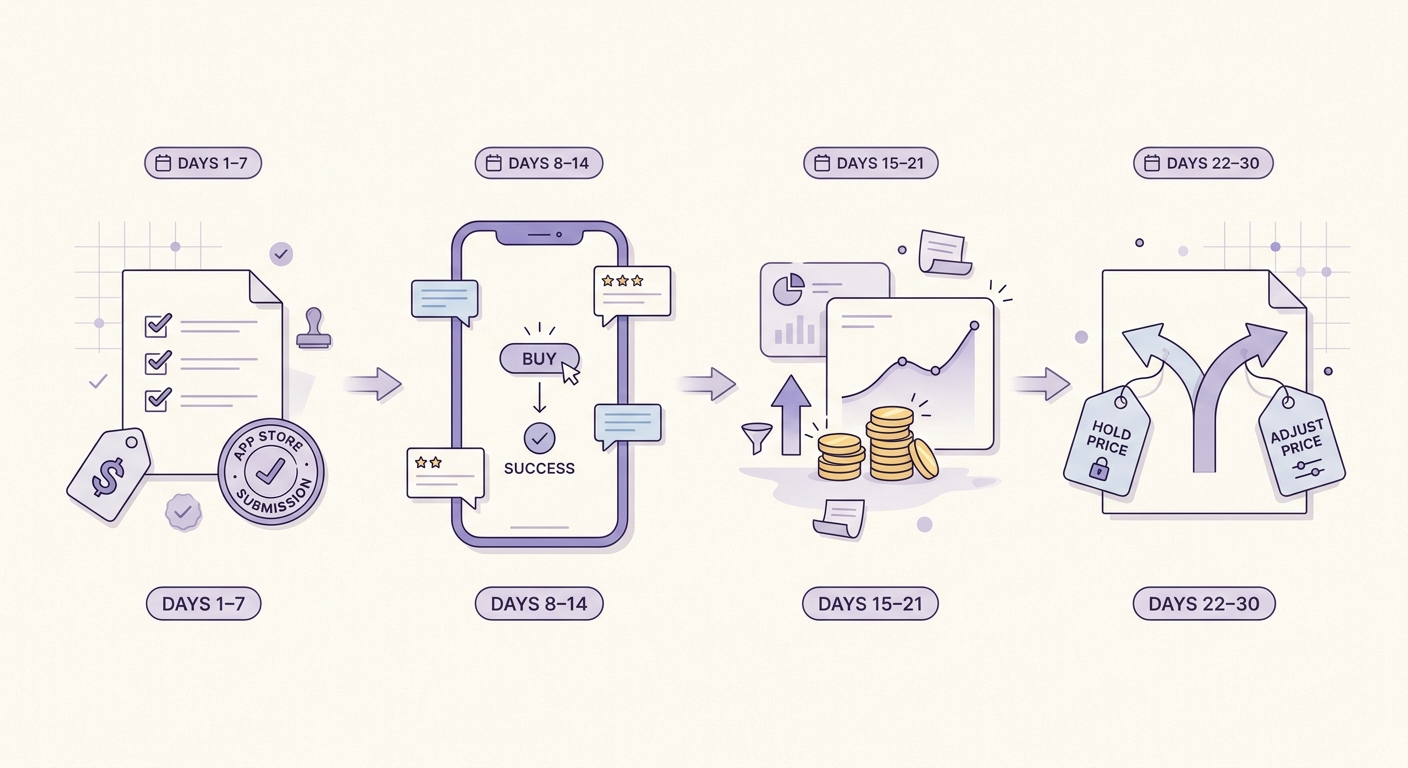
A 30-day founder timeline that maps the first iOS monetization sprint: choose a model, publish the App Store version, collect early feedback, review conversion, and decide whether to hold or adjust price.
- This week (4 to 8 hours): choose one monetization model and one price point, then rewrite your subtitle and first 3 screenshots to match.
- Next 7 to 14 days (1 to 3 evenings + review buffer): ship a version with an explicit purchase path, restore purchases, and onboarding that hits the value moment fast. App Review can take hours to a few days, and longer if you trigger guideline questions or need metadata fixes.
- Weeks 3 to 4 (ongoing): do a focused launch to warm channels and 2 to 3 niche communities, then iterate listing and paywall based on conversion and refunds.
The milestone to measure before anything else
- Total net proceeds toward $1,000. Not downloads, not impressions.
- Install to purchase conversion. If 100 installs produce zero purchases, the usual culprits are packaging, trust, pricing, or asking too early.
- Unprompted buyers. Count purchases that happen without you personally explaining the app. It is an imperfect proxy for scalable demand.
Ways to Grow Your App Without Paid Ads reframes the same problem with a slightly different lens - useful before you finalize.


