
Pricing an app in 2026 is less about picking a clever number and more about choosing a monetization path your users will actually complete and stick with. If you are deciding what to charge right now, the goal is not to defend a price philosophically. The goal is to align store funnel behavior with retention, conversion, and lifetime value so you can grow without constantly fighting churn, refunds, and review backlash.
| Early proof signal | What we know (2026 benchmarks) | How to interpret it | Reader impact |
|---|---|---|---|
| Distribution is overwhelmingly free-to-download | 91% of apps are free to download (Q1 2026) (App Pricing Lab) | Paid upfront is now a niche starting point, not the default expectation for many consumer categories | If you start paid upfront, assume lower install volume and plan for slower learning cycles |
| Subscriptions are still expanding fast | Subscription revenue grew 105% YoY (Q1 2026) (AppsFlyer) | Demand exists, but winners typically pair subscriptions with strong activation and value cadence | Subscription can work, but weak onboarding shows up faster as cancellations and complaints |
These are directional market signals, not guarantees for any single category. What this means is users are trained to try before they buy, and many teams are monetizing over time. The practical impact is you should reduce friction to reaching value first, then monetize in a way your retention, support load, and unit costs can actually support.
How Much Money Do Indie Apps Actually Make in 2026? goes deeper on the ideas above and adds concrete next steps.
How much should you charge for your app in 2026?
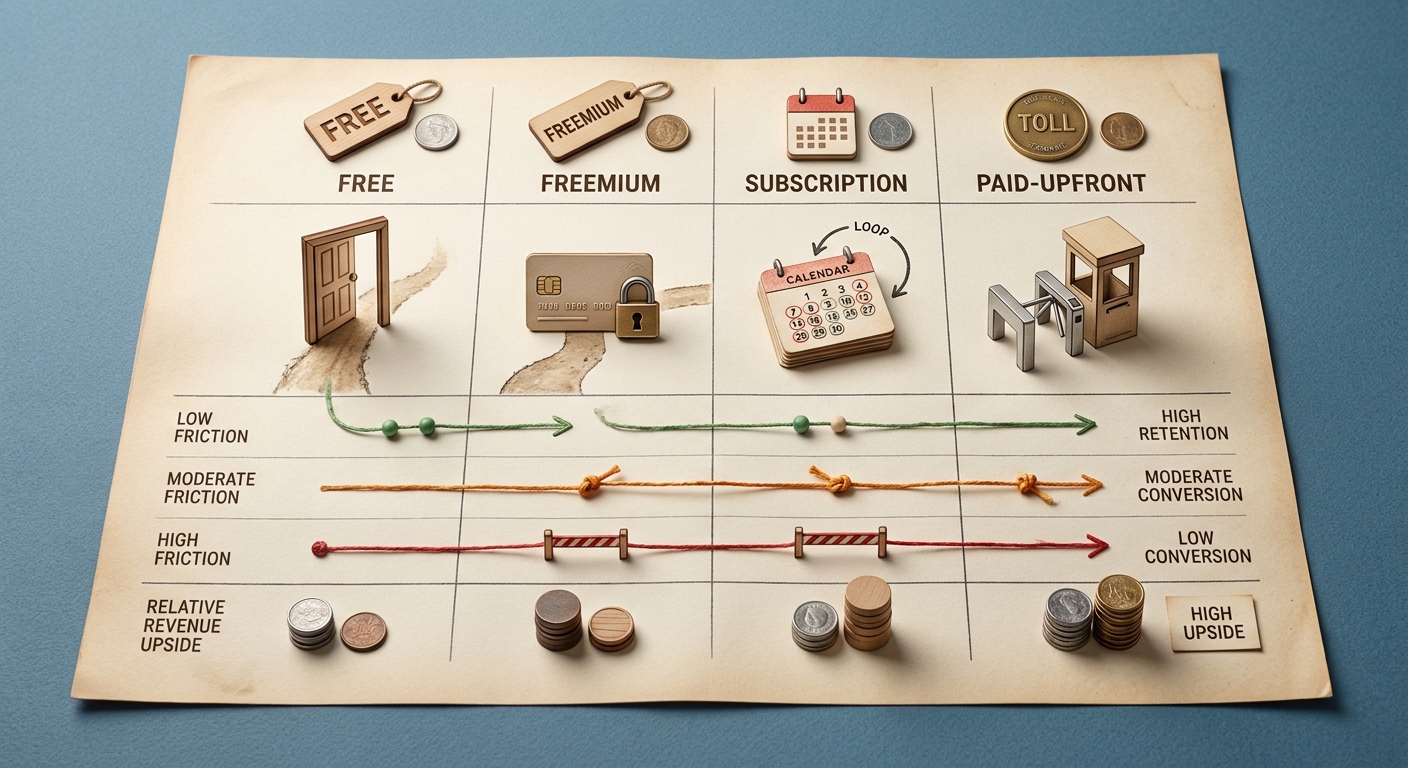
A compact pricing comparison table contrasting free, freemium, subscription, and paid-upfront app models for 2026, with columns for acquisition friction, expected conversion behavior, retention dependence, and revenue upside.
Upfront pricing is not automatically wrong, but it usually adds friction at the moment store visitors are most impatient. In practice, the decision is less about "fairness" and more about whether your funnel can generate enough installs, activation, and repeat usage to make the economics work.
One thing worth noting: both the App Store and Google Play often appear to favor products that generate consistent installs, engagement, and positive signals, but the effect varies by category, seasonality, and featuring algorithms. If an upfront price suppresses installs, you may lose speed in the feedback loop you need to improve onboarding and positioning, especially early on.
When you move from outline to execution, How to Set Up Pricing in Different Currencies on App Store helps close common gaps teams hit here.
A practical view of the four main pricing models
Use this as a decision aid, not a rule. Your category, acquisition mix (paid vs organic), and variable costs (especially AI or API usage) change the math.
| Model | Acquisition friction | Expected conversion behavior | Retention dependence | Revenue upside | Common failure mode |
|---|---|---|---|---|---|
| Free (ads or later upsells) | Lowest | High installs, low payer rate | Medium | Medium | Cost blowups if usage is expensive (AI, API, support) |
| Freemium (free core, paid features) | Low | Slower upgrade, higher trust | High | High | No clear upgrade trigger, users stay free forever |
| Subscription (monthly or annual) | Medium to high | Lower conversion, higher ARPU | Very high | Very high | Backlash if value cadence is weak, or paywall timing feels early |
| Paid upfront (one time purchase) | High | Lowest installs, highest intent | Low to medium | Low to medium | Slower learning due to fewer installs and fewer onboarding iterations |
Interpretation: lower entry friction usually widens the top of funnel, which gives you more shots at activation and upgrade. Higher recurring prices can raise LTV, but only if the app earns repeat attention and makes ongoing value obvious.
Business impact: pricing must fit your CAC, churn profile, store fees, and unit costs. If your model depends on high retention but your onboarding leaks, subscription will feel like a tax. If your model depends on volume but your costs scale with usage, free can quietly become unprofitable.
A complementary angle worth comparing lives in 5 Proven Monetization Models for iOS Apps in 2026.
What is the best app pricing model in 2026?
Free entry tends to work when discovery is the bottleneck and users need to try the app in context (consumer utilities, social products, many AI helper apps). Subscriptions tend to work when value is repeatable and noticeable over weeks (fitness, productivity, learning, content, workflow), but they carry operational requirements that show up quickly.
Constraints and failure modes to plan for:
- Value cadence has a real cost. If you promise ongoing value, you may need continuous content, feature shipping, model improvements, or support coverage, which can add weekly operational load.
- Seasonality and "burst use" categories break subscription logic. If users only need the app a few times a year (tax, travel bursts, one-off scanning), expect higher churn and consider one-time unlocks or usage-based options.
- Compliance and disclosure risk is non-trivial. Trials, renewals, and cancellations need clear disclosure and clean UX. If messaging feels pushy, you can see elevated refunds and review damage.
- Benchmarks vary heavily by category and channel. A $9.99/month plan can be normal in one niche and a conversion killer in another.
- Small samples make tests inconclusive. If your weekly installs are low or lumpy, treat results as directional and expect longer windows.
Pricing reference points (use as hypotheses, not targets): Airbridge reports a median monthly subscription rate around $6.68, with $9.99 as the most common price point, and annual plans often landing in the $29.99 to $59.99 range (Airbridge).
For tradeoffs, checklists, and edge cases, Everything You Need to Know About Apple and Google Developer Accounts rounds out this section.
How do you choose your app price without guessing?
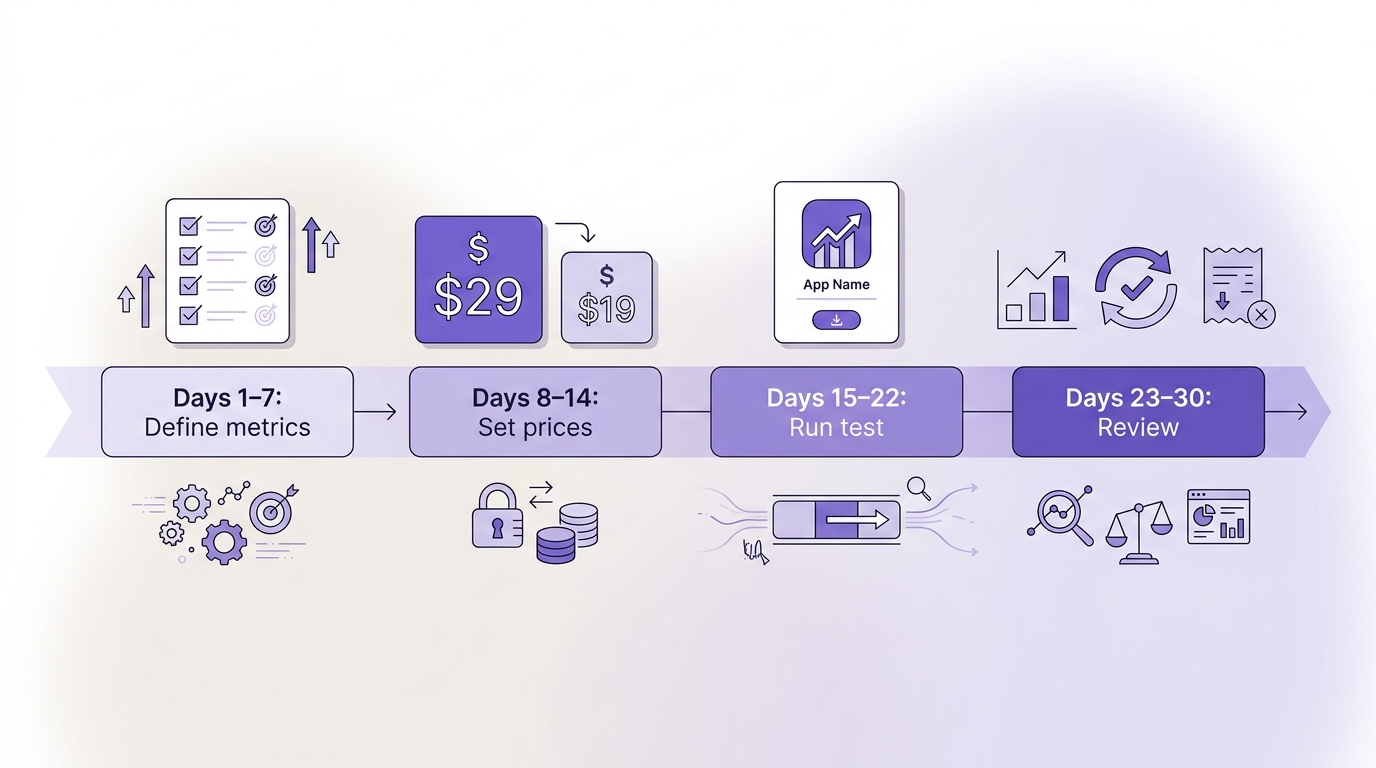
A simple 30-day pricing test timeline for an app launch: define target metrics, choose one price and one backup price, test in a single market or channel, and review conversion, retention, and refund signals before scaling.
Start with the model, then pick a number you can test
Match the model to usage cadence
If users get full value in one sitting, paid upfront or a one-time unlock can work. If value compounds over weeks, freemium or subscription often fits better because it monetizes after habit forms.
Map pricing to the first value moment
Write down when a user first says, "This worked." If that moment happens after importing data, finishing setup, or using the app 3 times, charging upfront is effectively charging for faith.
Align store listing and paywall promises
If your screenshots and copy imply "free" but the paywall hits on first tap, expect lower conversion and higher complaint risk. Use App Store Product Page Optimization and Google Play store listing experiments to test messaging before you rewrite onboarding.
Back into the price from unit economics (including operational reality)
Estimate true variable cost per active user
Include infra, third-party APIs, support time, and store fees. For AI-heavy apps, also include abuse and bot usage. Without rate limits, caching, or caps, "free" can turn into an unplanned cost center.
Set a payback window you can survive
Pick a payback window that matches your cash reality and channel mix, then work backward to ARPU and conversion. The constraint is usually runway and volatility in CAC, not the perfect price.
Run simple tests with enough volume to mean something
Most pricing tests take weeks, not days, because you need cohorts to mature (retention, refunds, cancellations). If you do not have volume, narrow the scope (one region, one channel) and treat results as exploratory.
A compact pricing instrumentation workflow (metric to decision)
If you already use RevenueCat (mobile subscriptions) or Stripe (web paywalls), you can often add these events in 1-2 working sessions plus QA. If you are starting from scratch across iOS and Android, plan 2-5 days to implement, test, and align definitions across platforms, plus extra time if your app has multiple paywalls or legacy entitlement logic.
| Metric (cohort-based) | Target or alert threshold (example) | Decision |
|---|---|---|
| Store page -> install rate | Drops after price or messaging change | Revert listing; rerun store listing experiment |
| Trial start -> paid conversion | Below your minimum viable threshold | Adjust paywall timing, trial length, or entry tier |
| D30 retention (free and paid) | Flat or falling despite more installs | Do not raise price yet; fix activation and value cadence |
| Refund rate / negative reviews | Spike after annual push or paywall change | Pull back annual emphasis; clarify terms; improve cancellation UX |
Top 5 Ways to Monetize Your First iOS App reframes the same problem with a slightly different lens - useful before you finalize.
What founders should do next: a simple, repeatable pricing review
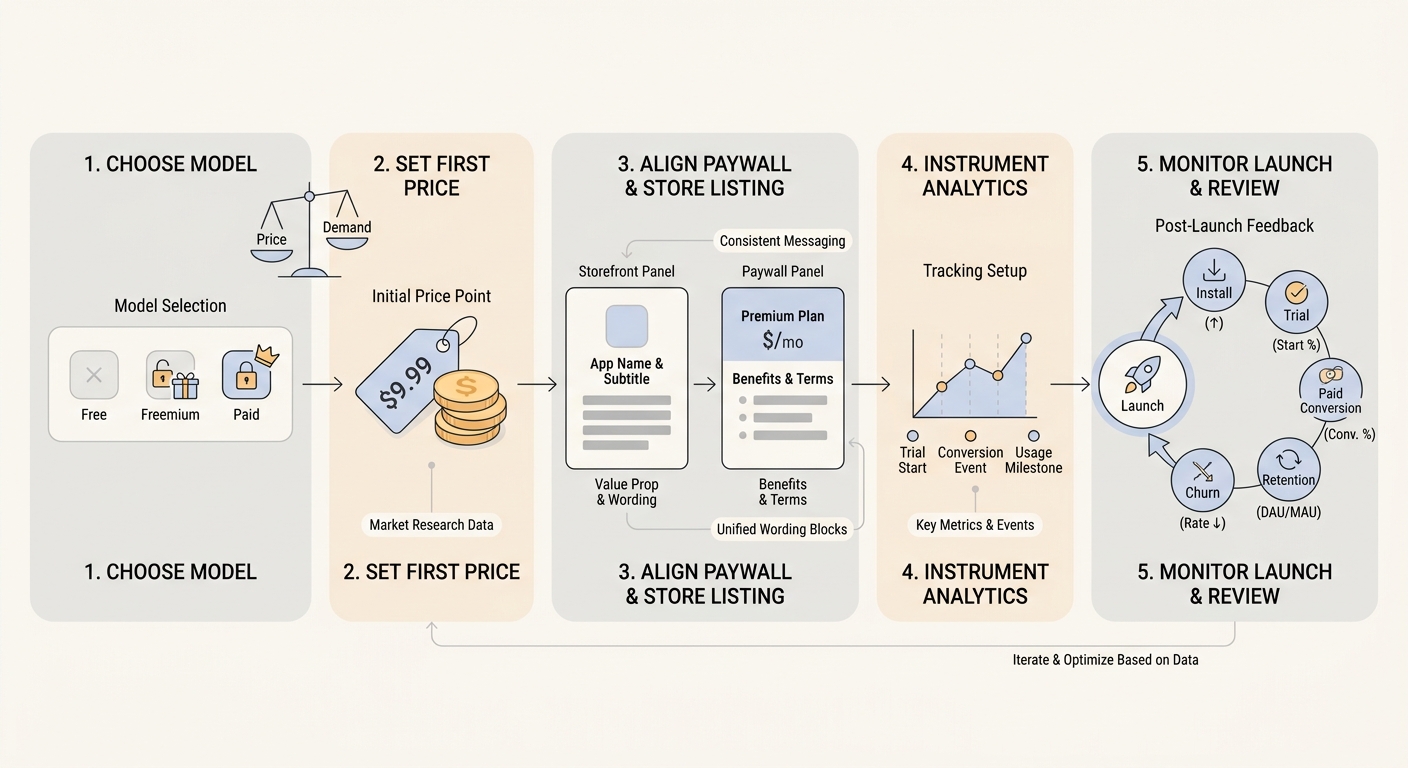
A process diagram showing the pre-launch pricing workflow for App Store and Google Play: choose model, set first price, align paywall and store listing, instrument analytics, then monitor conversion and churn after release.
A staged rollout reduces public downside while you learn. In practice, that means one market or channel, one primary price, one backup price, and a small metric set you review weekly for 4-8 weeks.
Decision point: if you cannot reliably attribute changes (seasonality, channel mix shifts, featuring, influencer spikes), treat the test as exploratory and avoid big pricing moves off a single noisy week. Also plan for the internal dependency: pricing changes often require updated support macros, updated store copy, and a clean entitlement migration path for existing users.


