
Everyone hears about the one app that hit $50k MRR, but most indie founders are trying to answer a more practical question: what does an indie app realistically earn in 2026, and what would it take to get there? This write-up uses founder-reported revenue roundups and monetization benchmarks to map common earning bands and the inputs that typically move an app from hobby money to something more durable.
| Monthly revenue band (gross) | What it typically looks like | Likely net take-home (directional) |
|---|---|---|
| <$50/month | Common outcome in founder roundups; many apps never escape this band | Often close to $0 after fees, tools, and the value of your time |
| $50-$1k/month | Small paid user base, light one-time purchases, low-scale ads | After platform fees and refunds, meaningfully lower |
| $1k-$10k/month | "Serious side project" band; consistent sales with moderate retention | Usually requires ongoing marketing and support work |
| $10k-$50k/month | Full-time viability for many solo founders, especially subscription-first | Net depends on refunds, taxes, churn, CAC, and support load |
| $50k+/month | Breakouts and portfolio effects; rare but real | Net can be strong, but ops complexity rises fast |
Explanation: This table is a planning frame synthesized from founder self-reports and operator discussions, not a quantified market distribution.
Interpretation: Founder-roundup style reporting summarized by Apps Finboard suggests a steep curve: the median indie app is under $50/month, roughly 17% report >$1k/month, and about 5% report >$10k/month. Treat these as directional because self-reports and definitions (gross vs net) vary.
Reader impact: Use these bands to set expectations and pick measurable inputs you can influence (retention, conversion, pricing, channels) rather than chasing a single "average" number.
5 Proven Monetization Models for iOS Apps in 2026 goes deeper on the ideas above and adds concrete next steps.
How much money do indie apps actually make in 2026?
Category: Net revenue
Statistic: ~70 - 85% net
Label: Likely take-home after fees
Context: App store + payment + tools commonly reduce gross
Category: Share of apps
Statistic: 17% / 5%
Label: Reach $1K / $10K per month
Context: Only a small share ever clears these milestones
Category: Gross revenue
Statistic: < $50/month
Label: Median indie app gross
Context: Most indie apps land below this baseline
Most indies cluster in low revenue bands, while a smaller group reaches part-time or full-time levels. The difference is usually not one tactic; it is compounding from retention, a clear paid outcome, and a distribution channel you can sustain for months.
Use the bands as decision checkpoints, not predictions. Outcomes are skewed, and your result will depend on category, distribution, retention, and how much ongoing operating time you can realistically support.
When you move from outline to execution, Top 5 Ways to Monetize Your First iOS App helps close common gaps teams hit here.
Which app categories and monetization models earn the most?
Category does not guarantee success, but it influences willingness to pay, retention patterns, and how much scale you need.
- Productivity, business, niche B2B tools: monetize earlier when the value maps to work outcomes, but reliability and support expectations are higher.
- Utilities: can monetize with subscriptions or one-time purchases, but differentiation is hard and copycats are common.
- Consumer lifestyle and habit apps: subscriptions can work, but churn is a recurring risk without a strong habit loop.
- Games: potential is high, but it is hit-driven and operationally heavy (content cadence, UA testing, live ops).
- Ad-first free apps: require large, retained audiences; CPMs vary by geo and season, and policy changes can hit revenue quickly.
Your monetization model changes what "enough users" means and what kind of work you sign up for.
| Model | Works best when | Main constraint to plan for |
|---|---|---|
| Subscription | Users get ongoing value and return frequently | Retention, clear paywall value, billing edge cases |
| One-time purchase | The app solves a focused problem and feels "complete" | Demand refresh: steady new users, upgrades, or bundles |
| Ads | Sessions are frequent and audience scale is large | CPM volatility, geo mix, placement and policy constraints |
| Hybrid | You have both casual and power users | More analytics, more UX surface area, more support |
Sources like App Verticals and AppOpportunity discuss why subscriptions and hybrids can look stronger at smaller audiences in many cases, but it is not universal. If usage is occasional or seasonal, a subscription can underperform due to churn and refund risk.
A complementary angle worth comparing lives in How to Get Your First 1,000 Users for Your iOS App.
What drives indie app revenue beyond downloads?
Category: Breakthrough
Statistic: 17%
Label: Ever reach $1,000/month
Context: Crossing four figures is the exception, not the rule
Category: Top end
Statistic: 5%
Label: Ever hit $10,000/month
Context: Usually requires strong monetization + scale (often subscriptions/hybrid)
Category: Baseline
Statistic: <$50/month
Label: Median indie app revenue
Context: Most apps stay in “hobby” income territory
Installs are a weak proxy for revenue. Retained active users are the monetization engine, and improving retention usually takes multiple iterations across onboarding, core loop, and pricing clarity.
Start with monthly active users (MAU), not downloads
MAU tells you how many people are still around to pay, watch ads, or renew. In practice, you often need 2-6 weeks of instrumenting events and fixing onboarding leaks before MAU becomes stable enough to compare.
Convert a small percentage, then improve it
For subscriptions, trial-to-paid only matters if renewals hold. Expect at least a few cycles of paywall messaging, pricing, and cancellation flow fixes before conversion reflects the real product value.
Use cohorts to see whether revenue compounds
Month-over-month growth should come from renewals plus new customers, not just launch spikes. Guidance like Balance Pro is useful because many indies under-measure churn and overestimate profitability.
Here is a compact metric stack most solo founders can sustain with a weekly review habit (typically 30-60 minutes, plus extra time when you ship major onboarding or paywall changes).
| Metric | Why it matters | Where most indies can track it |
|---|---|---|
| MAU / WAU | Baseline audience that can monetize | App analytics plus lightweight event tracking |
| Trial-to-paid or purchase conversion | Monetization efficiency | Paywall analytics, store conversion |
| Churn / renewal rate | Whether revenue compounds | Subscription dashboards, cohort exports |
| ARPU | Monetization per active user | Revenue tooling plus a simple sheet |
| LTV (directional) | How much you can spend to acquire users | Cohorts plus a conservative model |
Tooling note: App Store Connect, Google Play Console, and a subscription layer like RevenueCat can cover most needs. Attribution is often optional early, but becomes important if you scale paid acquisition or run multiple channels where you need to know what is actually working.
For tradeoffs, checklists, and edge cases, How to Monetize Your First Mobile App (Step-by-Step) rounds out this section.
What is the operational reality (hidden workload and failure modes)?
A revenue target becomes an operating commitment once users arrive. For a "simple" app, many founders should plan on 3-8 hours/week for support, fixes, and small improvements; it can be 10+ hours/week if you run frequent experiments, ship weekly, or support multiple platforms.
Dependencies you do not control include platform policy changes, review delays, attribution gaps, ad CPM swings, and competitor copycats in search-heavy categories. Plan buffer time and budget so one bad week does not stall the product.
Common failure modes are boring but expensive: retention cliffs after day 1 or day 7, a paywall that converts but triggers fast churn, pricing that fits one geo but fails globally, and ad economics that look fine in one month then compress seasonally.
Best App Store Optimization Tools Ranked reframes the same problem with a slightly different lens - useful before you finalize.
What should indie founders do with these numbers?
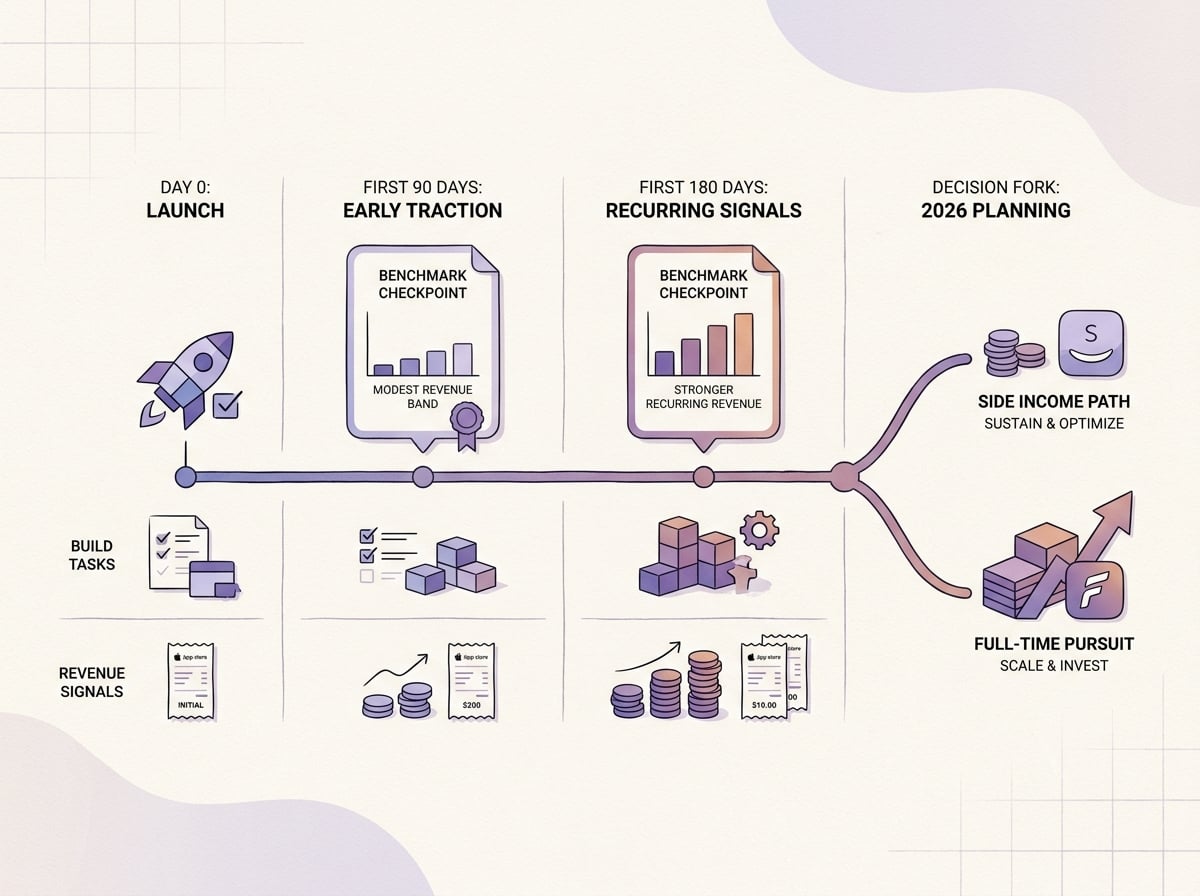
A simple planning timeline showing how an indie founder can use 2026 revenue benchmarks across launch, first 90 days, first 180 days, and the decision point for side income versus full-time pursuit.
Benchmarks only help if they change decisions. Pick a target band, then work backward into inputs you can influence and the time you can actually sustain.
- Choose a target that matches your model: subscriptions aim for compounding MRR; one-time purchases need steady new demand; ads need scale and session frequency.
- Run a 90-day validation window: expect 2-4 iterations on onboarding and paywall messaging before you trust conversion and early retention.
- Run a 180-day compounding check: you are looking for renewals and repeat usage, not just new installs.
- Define success in hours, not just dollars: decide what you can support weekly without burning out or neglecting your day job.
A simple go/no-go filter before you overbuild:
- Clear paid outcome: does it save time, make money, reduce risk, or unlock a capability users already pay for?
- Repeat usage loop: will users come back weekly, or is it one-and-done?
- Willingness to pay: is there a clear buyer persona and comparable paid alternative?
- Acquisition reality: can you reach qualified users via ASO, content, partnerships, communities, or paid ads?
- Pricing power: can you charge enough to hit your target band without unrealistic volume?
If you cannot answer the first three confidently, treat the idea as a learning project until you can.


