
Solo app founders are no longer a curiosity. A one-person shop can be competitive when you design for speed of learning, tight scope, and fewer handoffs, not when you try to match a team feature-for-feature. If you are trying to ship a real app business without a team, the goal is not to do everything yourself. The goal is to run a repeatable loop where one person can ship, learn, and improve without burning out.
Early proof (required): one-person app operations now cover more of the launch stack
| Launch function | Traditional team approach | Solo founder approach (today) | Concrete examples (directional) | Business impact (directional) |
|---|---|---|---|---|
| Validation | PM and research, long cycles | Landing page + lightweight prototypes + small closed test cohort | Framer/Webflow + Stripe waitlist, 10-30 user interviews over 1-2 weeks | Faster signal, less sunk cost |
| Build | Dedicated mobile engineers | AI-assisted coding + mature libraries + templates | Cursor/Claude for scaffolding, RevenueCat, Supabase/Firebase | Shorter path to a credible v1 |
| QA + support | QA lead + support reps | Crash reporting + beta feedback + macros/triage | Crashlytics/Sentry, TestFlight notes, HelpScout macros + a tight FAQ | Issues found earlier, fewer repeat tickets |
| Store prep + iteration | ASO specialist + release captain | Listing templates + staged rollouts + iterative testing | App Store Product Page Optimization, phased release controls | Clearer messaging, safer launches |
Explanation: this is an operating model comparison, not a promise of outcomes. The practical shift is that more of the "launch stack" can be covered with existing tools and lightweight process, which reduces coordination overhead.
Interpretation: fewer handoffs means you can run shorter feedback loops (days, not weeks) if your scope stays small and your instrumentation is minimal.
Reader impact: you get more chances to correct onboarding, pricing, and stability before ratings and reviews harden. The tradeoff is real: you often give up feature breadth and polish early so you can stay consistent.
How a Solo Founder Prepared Their App for Launch Without Hiring an Agency goes deeper on the ideas above and adds concrete next steps.
Why are solo app founders suddenly credible competitors?
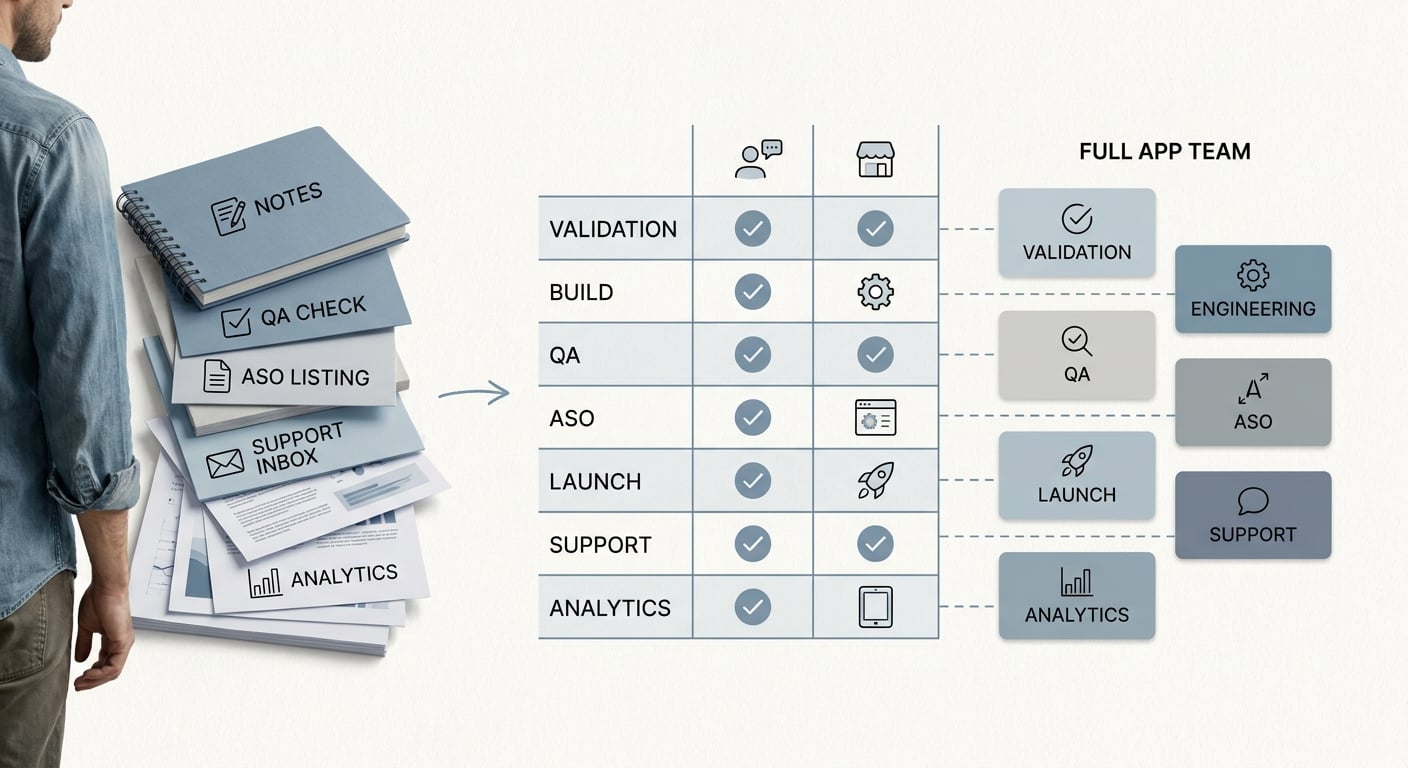
A compact comparison table showing how a solo app founder can cover validation, build, QA, App Store Optimization, Google Play launch tasks, support, and analytics with AI tools and store dashboards instead of a traditional app team.
The bigger shift is leverage, not superhero effort
Solo works when the app is designed for repeatable iteration: one change, one release, one learning. In mobile, a lot of outcomes are driven by positioning, onboarding clarity, and fast quality fixes, not just headcount.
This tends to be most viable in narrow categories like utilities, niche workflow tools, and focused consumer experiences where the value can be understood quickly. If your app needs heavy content, moderation, or enterprise-grade security from day one, solo gets hard fast.
What changed in mobile distribution to make this viable
A few ecosystem behaviors make the "small loop" strategy more practical than it used to be:
- Closed testing (TestFlight, Play testing tracks) makes it easier to validate onboarding and paywalls before broad release.
- Store listings and experiments are more accessible (for example, App Store Product Page Optimization), so you can iterate without a full growth team.
- Mature third-party services reduce custom backend and billing work, which is where solo projects often stall.
One thing worth noting: this does not mean stores will automatically reward you. Distribution still depends on ranking, conversion, and retention signals, and those can take weeks to stabilize after changes. Treat the first month as an experiment, not a verdict.
Realism check: what still takes time (and can go wrong)
Even with leverage, the workload is real. After launch, a typical solo baseline might look like:
- Support: 20-60 minutes/day (more when something breaks)
- ASO and listing upkeep: 1-2 hours/week
- Release overhead: 1-3 hours per update (testing, screenshots, notes, rollout)
Operational constraint example: App Review can add 24-72 hours per update, and rejections can add more. Plan releases so you are not pushing a risky build right before weekends or travel, and keep a rollback plan (or at least a quick hotfix path).
When you move from outline to execution, Best 5 App Analytics Tools for Mobile Founders helps close common gaps teams hit here.
How can a solo founder win on App Store and Google Play?
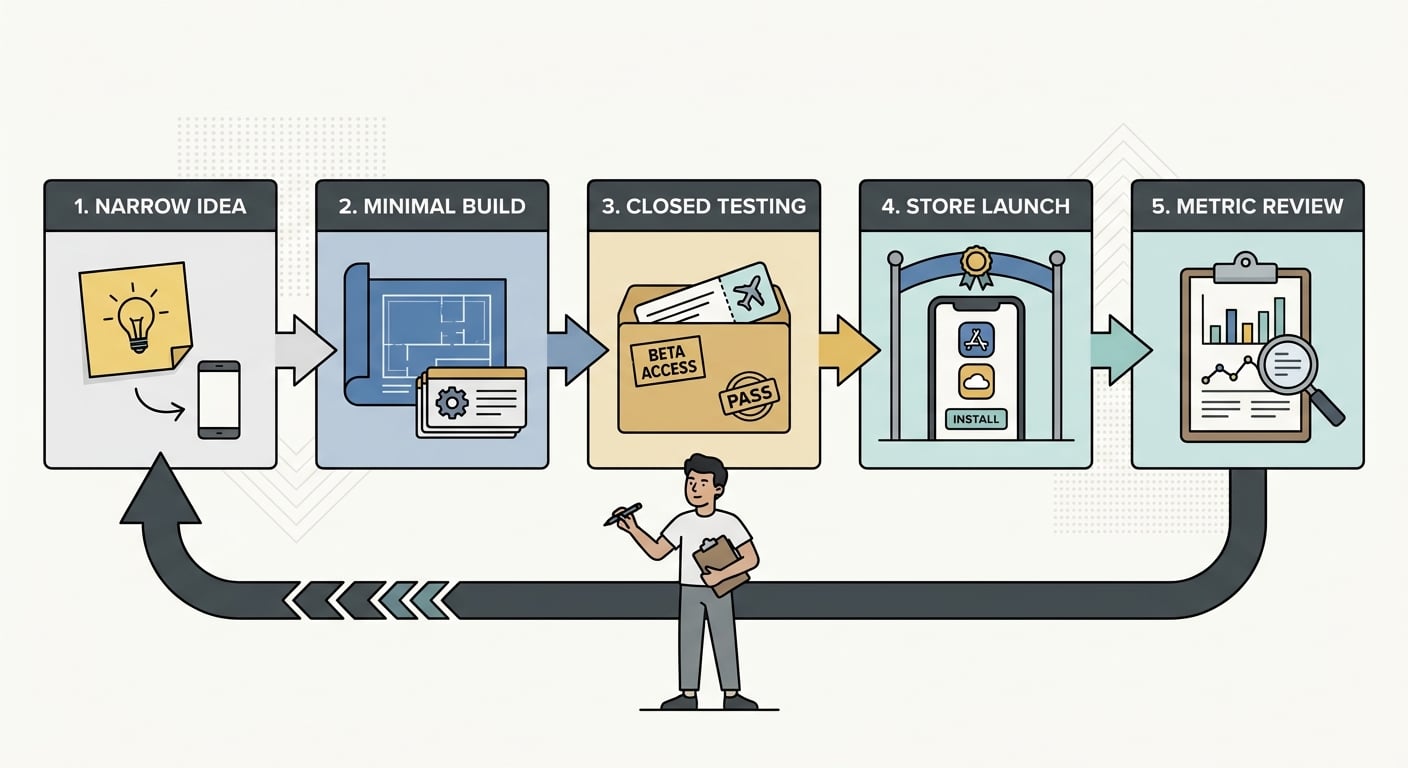
A process diagram of a solo app founder moving from one narrow app idea to minimal build, TestFlight or Google Play closed testing, store launch, metric review, and the next iteration cycle.
Start with one sharp wedge, not a broad platform
Pick a single job with a clear user (invoice follow-ups for freelancers, a shot list tool for creators, a timer for shift workers). A narrow wedge makes keywords, screenshots, and onboarding simpler because you are not explaining five features at once.
Tradeoff: a wedge can cap early market size. That is usually acceptable early because speed of learning and retention are better predictors of whether expansion is worth it.
Use a simple Week 1-4 launch workflow (and keep it boring)
| Week | Goal | Actions (time reality) | Metric to watch |
|---|---|---|---|
| 1 | Define the wedge and measure first session | 5-10 user conversations, draft listing story, implement 5-10 events (4-10 hours total) | Activation rate, time-to-value |
| 2 | Ship a credible v1 to closed testers | 2-4 focused builds + fixes (6-15 hours), recruit testers (1-3 hours) | Crash rate, onboarding drop-off |
| 3 | Launch small and stabilize | Staged rollout, answer every ticket (30-90 min/day), ship 1 bugfix update | Review sentiment, crash-free sessions |
| 4 | Improve one bottleneck | Run one listing or onboarding test (2-4 hours), simplify one flow | Day-1 retention, conversion |
In practice, the constraint is not ideas. It is your weekly bandwidth plus external dependencies like review times, metadata propagation delays, and how quickly testers respond.
What to watch weekly (so you do not drown in dashboards)
| Signal | Simple threshold | If it is bad, do this next |
|---|---|---|
| Crash-free sessions | Below ~99.5% (or trending down) | Stop feature work, ship stability fixes, add repro steps to QA notes |
| Day-1 retention | Flat or declining for 2-3 weeks | Simplify onboarding, shorten time-to-value, remove one confusing step |
| Conversion to trial/subscription | Down after a release | Check paywall, restore purchases, pricing display, and eligibility states |
| Recent reviews | New 1-2 star cluster | Read every review, map to one issue, ship one targeted fix and reply |
These are directional thresholds, not universal benchmarks. The practical takeaway is to pick a few signals you can review in under 30 minutes and act on the same week.
Ship in a tight build-test-launch-review loop
Build the smallest version that proves the job
Prioritize onboarding, the core action, and one moment of value. A realistic target is 2-6 weeks for a credible v1 if you know the domain and are not building a heavy backend.
Run a closed test before you chase scale
Plan a few days to recruit testers and at least 1-2 iterations to address obvious friction. You want blunt feedback like "I got stuck here" more than feature requests.
Launch with a small, survivable metric set
Track activation, day-1 retention, crash rate, install-to-signup conversion, and review sentiment. If you cannot review these weekly in under 30 minutes, your setup is probably too complex for solo.
Review within days, not weeks
Early on, one rejected update or one broken paywall can cost you a week. Keep changes small, ship fixes fast, and avoid bundling high-risk features together.
A complementary angle worth comparing lives in How Solo Founders Can Navigate App Publishing Without Losing Weeks.
Where do solo founders still lose, and how do they stay competitive?
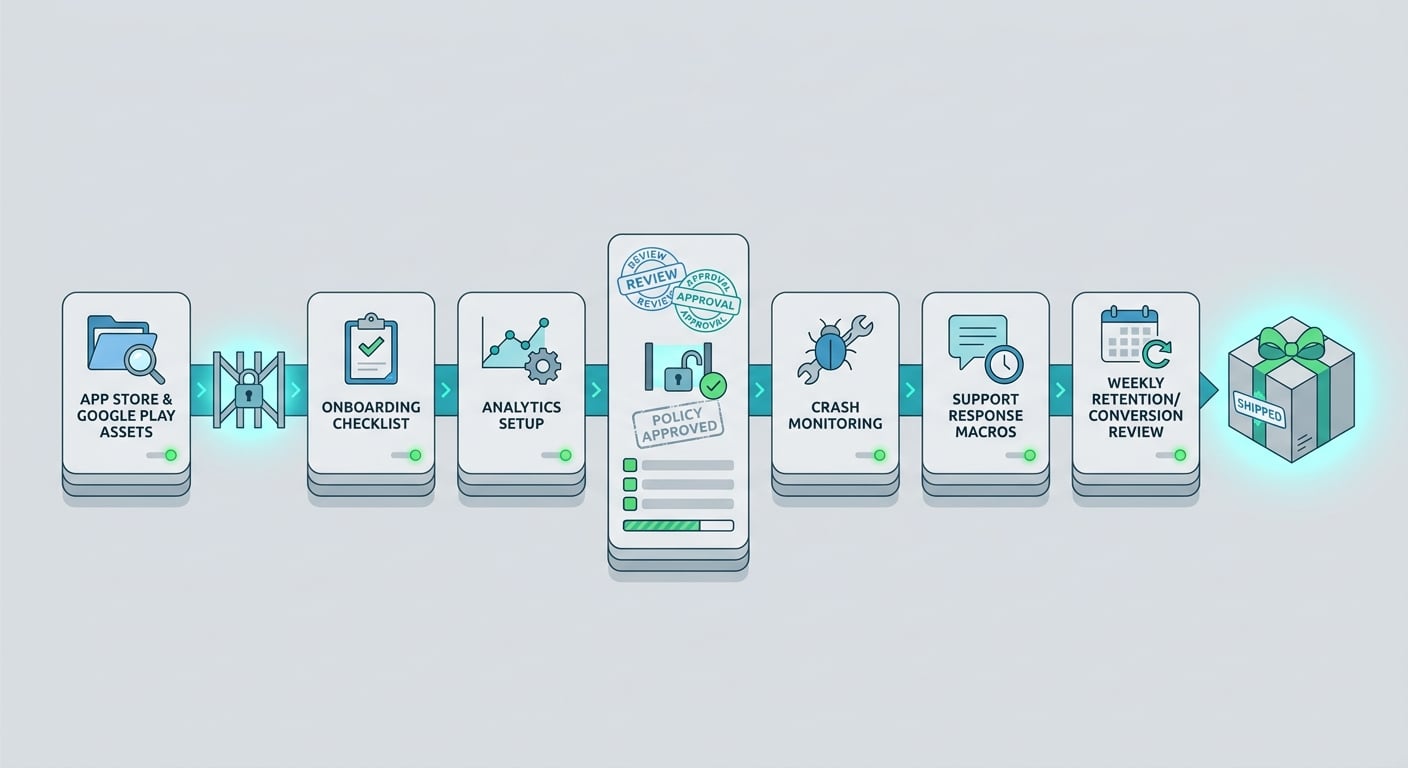
A solo founder stays competitive by treating publishing like a controlled pipeline: keep each release moving through policy, review, and approval gates so speed never comes at the cost of compliance.
The hidden weakness is attention, not ambition
The hardest part is context switching: product, support, ASO, analytics, and marketing all compete for the same brain. When response times slip for a couple weeks, you often see it show up as worse reviews, weaker conversion, and higher churn.
A practical rule that helps: protect retention and support before adding features or chasing new channels. In real terms, that might mean shipping a boring stability update instead of the new feature you are excited about, because the stability update reduces support load for the next month.
Use selective outsourcing where mistakes are expensive
Selective help can be worth it, but it is not free. It can add coordination time, and a bad handoff can create rework.
- Pay for design polish when icon, screenshots, or onboarding are limiting conversion.
- Get legal and compliance review when you touch payments, subscriptions, health claims, kids categories, or sensitive data.
- Use one-off creative help (video previews, ad creatives) if paid acquisition is part of your plan.
Dependency caveat: contractors move at their own pace and need tight briefs. Use fixed-scope deliverables, reference examples, and a clear definition of done so you are not managing an open-ended project.
For tradeoffs, checklists, and edge cases, The Founder's Complete App Publishing Checklist rounds out this section.


