
Launching on the wrong app store first does not just slow you down. It can skew early signal with the wrong users, the wrong pricing feedback, and the wrong review dynamics. This is for founders and small teams who need usable traction in the first 30 to 90 days and want a sensible launch order without guessing.
Early proof: the platform tradeoff in one comparison
Below is directional guidance, not a universal ranking. Category, geography, account history, acquisition channel, and price point can override these patterns, so treat this as a starting hypothesis.
| Launch factor | App Store (iOS) tends to bias toward | Google Play (Android) tends to bias toward | Why it matters in week 1-4 |
|---|---|---|---|
| Release cadence | More review friction and stricter enforcement | Often faster updates, but new accounts and some categories vary | How fast you can fix issues and run tests |
| Spending behavior | Higher monetization per user in many markets | More price sensitivity and broader volume | Whether revenue signal is clear or noisy |
| Discovery | Strong effect from positioning and category surfaces | Strong effect from keywords, scale signals, device breadth | How predictable organic growth feels |
| Best fit (often) | Subscription, premium consumer, high-ARPU niches | Mass-market utility, global reach, rapid iteration | Whether early learning is concentrated or diluted |
- Explanation: these are common platform tendencies that show up in many launches, not rules.
- Interpretation: pick the bias that supports your first experiment.
- Impact: you are more likely to get usable signal earlier, with fewer false positives from installs that do not retain or pay.
App Store Connect vs Google Play Console: Key Differences goes deeper on the ideas above and adds concrete next steps.
Which platform should you launch first?
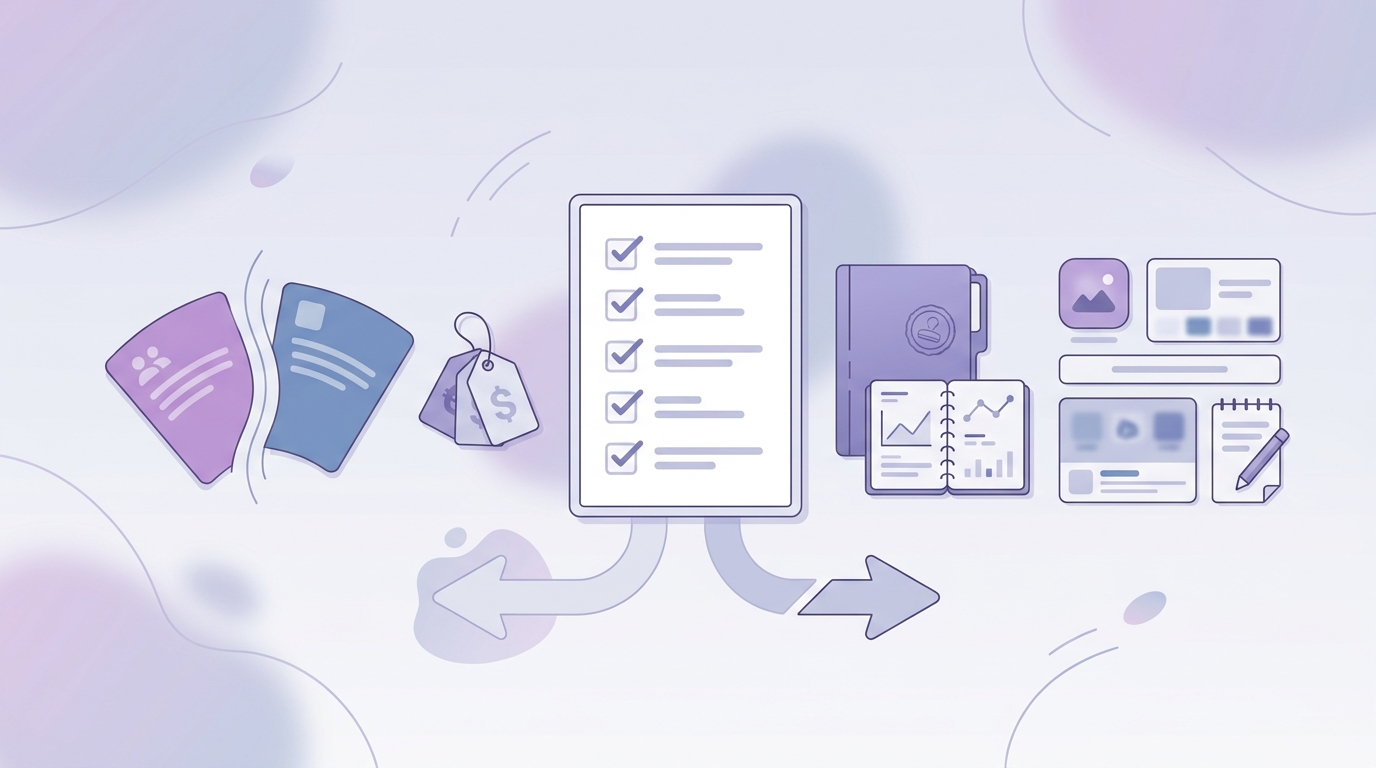
A mobile-friendly checklist of pre-launch items for choosing the first app store, including audience split, pricing model, policy review, analytics setup, and ASO assets.
App Store vs Google Play is not a philosophical argument. It is an operating decision that changes who shows up first, what they complain about, and how quickly you can learn.
Distribution is crowded and early ratings are fragile. One bad crash or a confusing paywall can drag your score when you only have a small number of reviews. The practical takeaway is to pick the store that matches your team capacity and the metric you most need to learn.
Why the first launch decision changes early traction
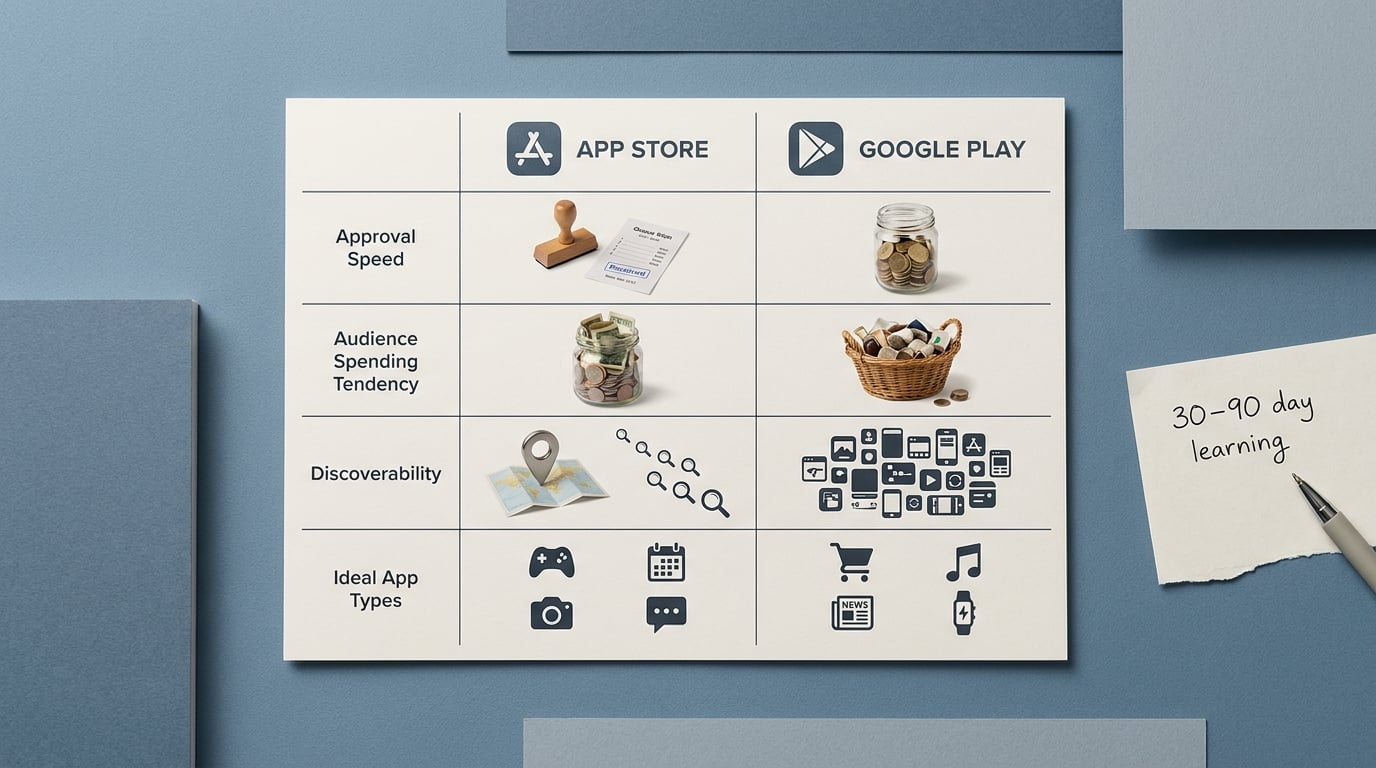
A compact comparison table showing App Store vs Google Play across approval speed, audience spending tendency, discoverability, and ideal app types, designed to support the article's early thesis.
Your first store choice affects three things immediately:
- Revenue velocity: how quickly you see real buyers (not just installs)
- Support load: how many tickets and device issues you handle
- Iteration speed: how quickly you can ship and validate fixes
In practice, the first 30 to 90 days are for tuning onboarding, pricing, and retention. If you launch where your real buyers are underrepresented, you can end up optimizing for noisy signal like installs or a handful of reviews.
A realistic baseline: what the first launch actually costs
Plan for real work, not a weekend push:
- Store assets: 4 to 10 hours for screenshots, copy, and listing setup (more if you localize or produce a video).
- Instrumentation: 1 to 3 days to validate funnels, paywall events, and crashes, plus a cohort view you trust.
- Review and rollout: same-day to several days; longer if you hit policy questions, account trust checks, or payments issues.
- Support and QA: expect a week 1 to 2 spike in tickets, plus time to reproduce and ship fixes.
- Learning cycles: meaningful learning often takes 2 to 4 release cycles and at least a couple weeks of stable traffic.
One tradeoff worth calling out: Android can create more QA overhead because of the device matrix (more OS versions, manufacturers, and edge cases). iOS can be less fragmented, but review and policy friction can slow experimentation when you are still finding product-market fit.
Common failure modes to watch for
- Overreacting to tiny cohorts (changes based on a handful of buyers)
- Policy churn that blocks updates or forces rework
- Device fragmentation driving bugs and support drag (often higher with broader device coverage)
- Ratings volatility when review counts are small
- Testing too many variables at once, making results hard to interpret
The rule of thumb I would use
- Choose App Store first if you need willingness to pay early (subscription, premium IAP) or your launch geos are iPhone-heavy.
- Choose Google Play first if you need faster iteration, broader device coverage, or you are launching into Android-dominant and price-sensitive markets.
- Do a dual launch only if you can support two storefronts well: ASO, screenshots, release notes, support, analytics, and bug triage.
Dependency callout: Play-first only helps if you can reliably ship fixes at least weekly and have the discipline to run controlled changes. iOS-first is most useful when you can measure paywall performance well enough to act on it, which usually means clean analytics and enough volume to avoid reading noise as truth.
When you move from outline to execution, Everything You Need to Know About Apple and Google Developer Accounts helps close common gaps teams hit here.
What are the main differences between App Store and Google Play?
If you are looking for a single winner, you will be disappointed. Each store nudges you toward a different launch strategy and different kinds of early users. Store-level trends also vary heavily by category, geo, and acquisition channel, so use them as context, not a promise.
Revenue potential rewards different app models
- Subscription and premium IAP: iOS often produces clearer early conversion in many premium consumer categories, which can make pricing and paywall tests easier to read.
- Scale-driven freemium or utility: Play can be a better test bed when your funnel depends on volume and diverse usage to see retention patterns.
- Ad-supported apps: early success depends more on retention and engagement than store-level spend; volume can be more informative than early revenue per user.
Tradeoff: iOS-first can concentrate monetization signal, but you may learn less about device edge cases. Play-first can surface stability issues sooner, but early revenue signal may be noisier depending on your market mix.
Approval and release cadence affects how quickly you can learn
App Store review scrutiny can slow early experimentation, especially if you are still tightening compliance, onboarding flows, or payments. Some teams see 24 to 48 hour cycles, but timing varies by category and account history.
Google Play is often faster to publish updates, which helps when onboarding has a bug or your messaging is wrong. Risk: faster shipping can also create churn if you push frequent changes without staged rollouts and a rollback plan.
One concrete workflow and metric (so you can actually measure)
A lightweight setup many small teams use:
- Crashes: Firebase Crashlytics (alerts + top crash-free users)
- Funnel events: GA4 events for
signup_start,trial_start,purchase,cancel - Metric to watch: D7 retention = percent of new users who are active again on day 7 (a simple read on whether onboarding and core value landed)
This is not the only stack, but it is enough to avoid guessing in week 1 while keeping implementation time reasonable.
A complementary angle worth comparing lives in Top 5 Ways to Monetize Your First iOS App.
How do you decide between App Store and Google Play first?
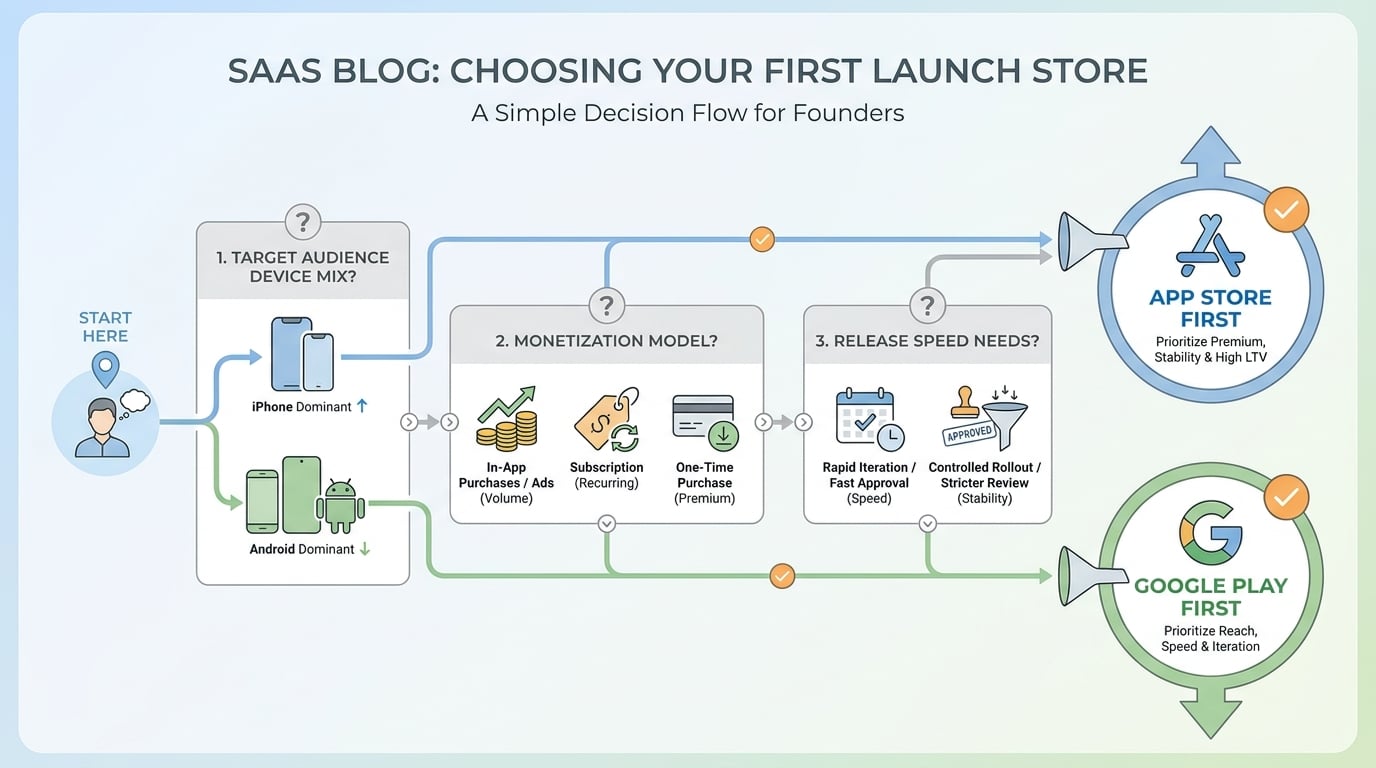
A simple decision flow that routes founders through target audience device mix, monetization model, and release-speed needs to decide whether App Store or Google Play should launch first.
Most launch mistakes happen because teams pick a platform before defining what "success" means in the first month. Your first launch is a learning system. Design it like one.
Use a three-part decision filter before you submit anything
Map your first buyers, not your total users
Write down launch countries, expected device split, and who is most likely to pay in month 1. If early revenue depends on higher-spend segments, that often points toward iPhone-heavy geos.
Choose the learning loop you need in the first 30 days
If you must iterate quickly on onboarding, pricing copy, or critical bug fixes, bias toward the store that supports your likely update cadence. If you need a polished first impression for premium positioning, bias toward the store norms that reward that standard.
Match the storefront to the business model you are validating
Subscription and paid apps need early conversion clarity. Ad-supported and scale-led apps need retention volume. Pick the store that concentrates the metric you cannot afford to misread.
A simple launch checklist to finish the decision
- Confirm your top 3 launch countries and expected device split.
- Pick the one metric you must learn in 30 days (trial-to-paid, D7 retention, referral rate, CAC payback).
- Match the store to the metric: conversion clarity (often iOS) vs volume and iteration speed (often Android).
- Prepare store assets: screenshots, keyword plan, and a pricing narrative that matches your audience.
- Do a policy pass early for your category, especially privacy, payments, kids, health, or finance.
- Ship analytics you trust on day one: funnel events, paywall events, and crash reporting.
For tradeoffs, checklists, and edge cases, Publishing at Every Stage: How App Store Strategy Changes as You Grow rounds out this section.


