
Most founders pick PWA vs App Store like it is a tech stack choice, then pay for it later in distribution friction, slower iteration, or weaker retention. The bigger shift is that publishing is a go-to-market decision first: a large share of mobile usage still happens inside installed apps, but getting an install is gated by store search, review timing, and permission prompts that can crush an early funnel. By the end, you will have a decision checklist plus a realistic 30-day experiment plan to choose based on your acquisition channel, update cadence, and the behaviors you need users to repeat (with the usual caveat that results vary by category and execution).
| Early proof (practical heuristic): what launch friction often looks like | PWA | App Store app |
|---|---|---|
| Approval dependency | None | Review gate (timing varies; plan for days, sometimes longer) |
| Install path | Link - use instantly - optional add to home screen | Store listing - install - open |
| Update speed | Instant deploy (but you still need QA and rollback) | New build - review - phased rollout |
| Trust signals | Brand + web UX | Ratings, reviews, store presence |
- What it shows: the difference is not just UX polish. It is how many steps and delays sit between you and learning from users.
- How to interpret it: if you need weekly onboarding or pricing tweaks, review gates slow the loop. If your category needs trust and install intent, store presence can help.
- Reader impact: you can choose what fits your next 30 days: faster learning (often PWA) or higher-trust distribution (often App Store). Timelines still vary with app complexity, reviewer load, and platform policies.
What Founders Should Know Before Their First Submission goes deeper on the ideas above and adds concrete next steps.
Should founders treat PWA and App Store launch as the same decision?
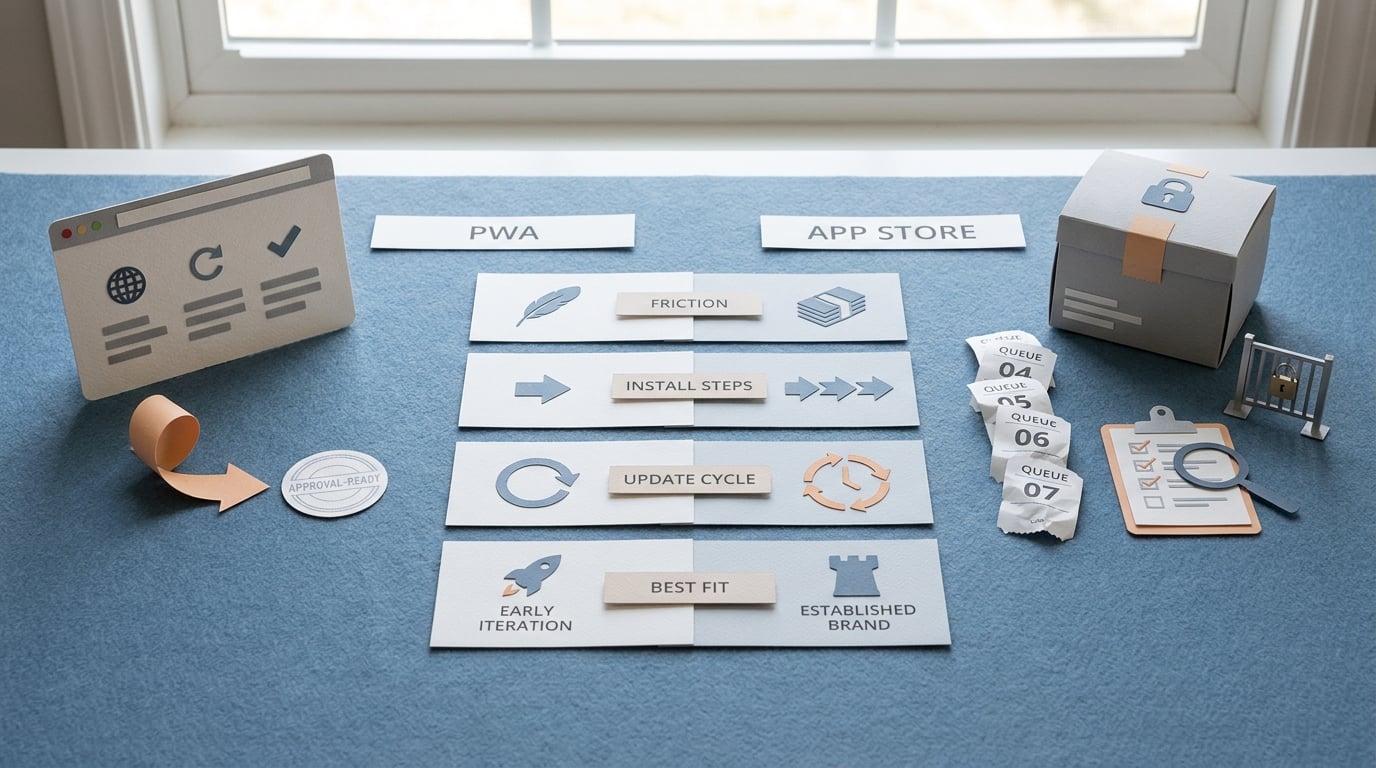
A compact comparison table contrasting PWA and App Store app on launch friction, install path, update speed, and typical founder advantage. The point is to show why the publishing choice affects time-to-market and iteration speed.
Treating PWA vs App Store as a platform debate is a category error. The real decision is which distribution model your next growth loop needs: speed and web flexibility, or store-driven discovery plus native mechanics that can support repeat use.
If you need to ship into demand now, test pricing, iterate onboarding, or get users to first value without detours, a PWA often wins. You can link directly from ads or content and update the same day. The tradeoff is you must earn trust without ratings, and iOS PWA constraints (background work, some notification and install behaviors) can weaken certain retention loops.
If your growth loop depends on App Store search or your audience explicitly expects "an iOS app," the store route can be worth the ceremony. The tradeoff is operational: more release overhead, more QA, and dependency on Apple review timing and occasional rejections.
When you move from outline to execution, Publishing at Every Stage: How App Store Strategy Changes as You Grow helps close common gaps teams hit here.
What to expect operationally (time, risks, dependencies)
Neither path is "free." The bottlenecks just move, and your calendar gets affected in different ways.
- App Store work is more than code. Each release usually includes signing, build validation, App Store Connect checks, and often some metadata upkeep. If features change, screenshots and copy can become a recurring chore, and that can take longer than you expect.
- PWA speed increases blast radius. Instant deploy is great, but it also means you can ship breakage instantly. You still need basic QA and a rollback plan, or you will learn the wrong lesson from messy data.
- Push is a dependency, not a guarantee. Native push helps only if users opt in and the messages are good. PWA push is more constrained on iOS and can be inconsistent across devices, so do not build your core loop assuming push will "save retention."
- Policy and payments can become the critical path. Review issues often cluster around payments, permission prompts, misleading claims, and content moderation. Even careful teams should budget time for fixes and resubmission.
Two common failure modes worth planning for:
- iOS PWA edge cases break a key flow. Examples: login handoffs, file uploads, camera access, and background refresh behaving differently than in Safari or in an installed app.
- Native ships, but retention still does not move. Store trust signals help conversion, but they do not guarantee users will come back if the habit loop is not real.
A complementary angle worth comparing lives in Top 5 Ways to Monetize Your First iOS App.
When does a PWA beat an App Store app?
Here is a practical comparison that avoids ideology.
| Decision factor | PWA tends to win when... | App Store tends to win when... | Cost or constraint to accept |
|---|---|---|---|
| Acquisition | You have link-led traffic (SEO, content, partnerships, ads to landing) | Users are already shopping in the store or need "an app" to trust you | PWA: weaker built-in social proof; App Store: extra funnel step |
| Learning speed | You need frequent onboarding, pricing, or copy iteration | You can batch changes and tolerate review cycles | App Store slows experiments; PWA requires QA to avoid regressions |
| Retention mechanics | Your loop works with lightweight return visits | Your loop depends on push, deep links, background behavior | Native can help, but only with opt-in and good messaging |
| Credibility | Your brand, UX, and security posture can carry trust | Ratings, reviews, and store presence help conversion | Store presence does not replace product quality |
Launch decision helper
Share your acquisition channel, update cadence, and the one behavior you need weekly, and I will suggest a realistic first launch.
Pick your launch path
For tradeoffs, checklists, and edge cases, Should You Publish Your App Yourself or Hire Someone? rounds out this section.
A realistic 30-day experiment plan (to avoid guessing)
If you are unsure, run a month-long plan that forces a decision based on lift vs overhead. This takes real effort: expect 1-3 days up front for analytics, QA setup, and assets, plus a few hours each week to ship, review data, and fix regressions.
Week 1: define the "must prove" metric
Pick one: activation rate (first value), D7 retention, or paid conversion. Instrument it in GA4 (or equivalent) and verify events fire on real devices (not just in your dev browser). Example events:
activation_event: completed_first_task,paywall_view,purchase.Week 2: ship the lowest-friction version and measure
For a PWA, deploy behind a feature flag and measure time-to-first-value and drop-offs. For native, use TestFlight to validate onboarding and permission prompts before you commit to a public release and store listing work.
Week 3: test re-engagement honestly
If you rely on push, measure opt-in rate and notification-driven returns. Treat low opt-in as a signal about user value and timing, not just copywriting, and be ready with non-push loops (email, SMS, in-product reminders) where appropriate.
Week 4: decide based on lift vs overhead
Compare metric lift against operating cost: release time, QA burden, review delays, and rejected experiments. If lift is small or uncertain, keep iterating where learning is fastest and delay the heavier path until you can name the benefit you are buying.
Publishing Apps Built With Flutter, React Native, or Native reframes the same problem with a slightly different lens - useful before you finalize.
What should founders check before publishing either version?
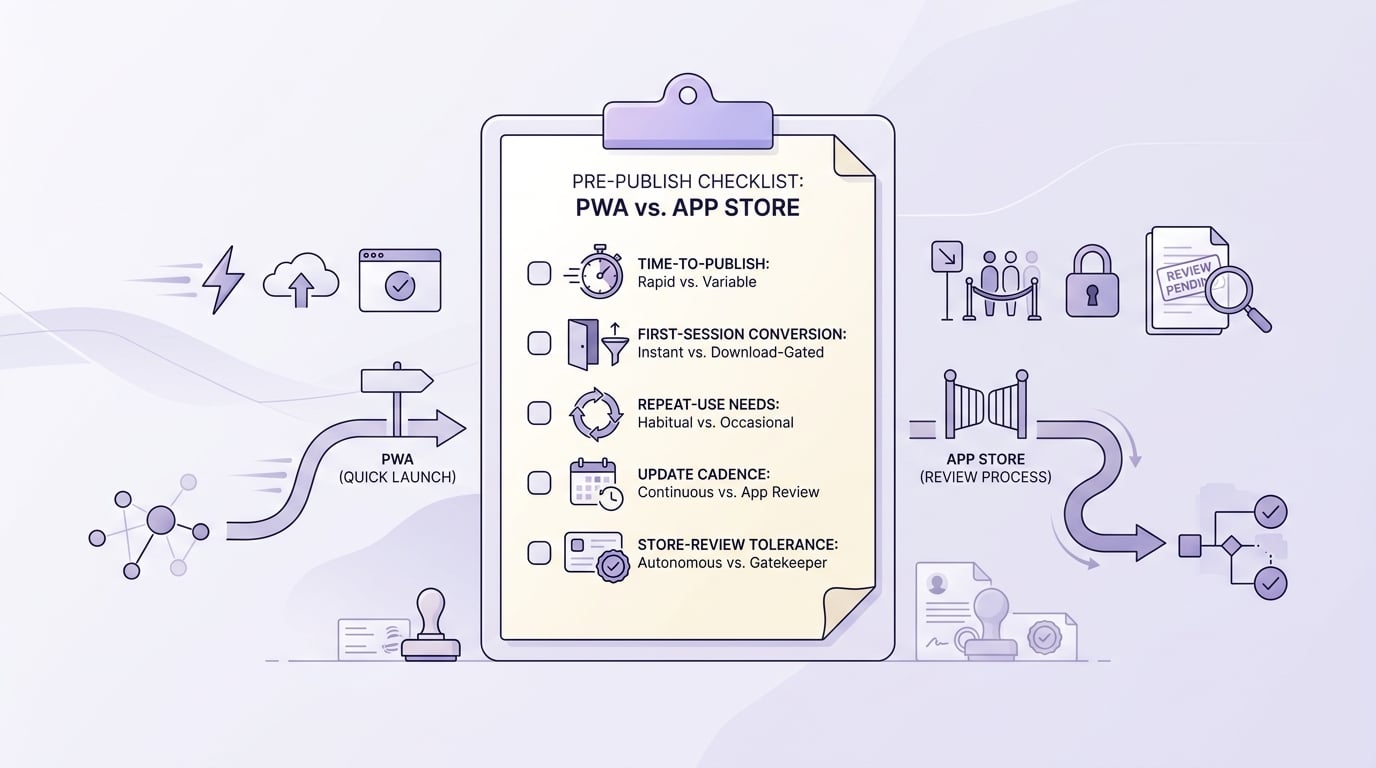
A pre-publish checklist with decision items such as time-to-publish, first-session conversion, repeat-use needs, update cadence, and store-review tolerance. It should help founders choose the right publishing path before committing engineering resources.
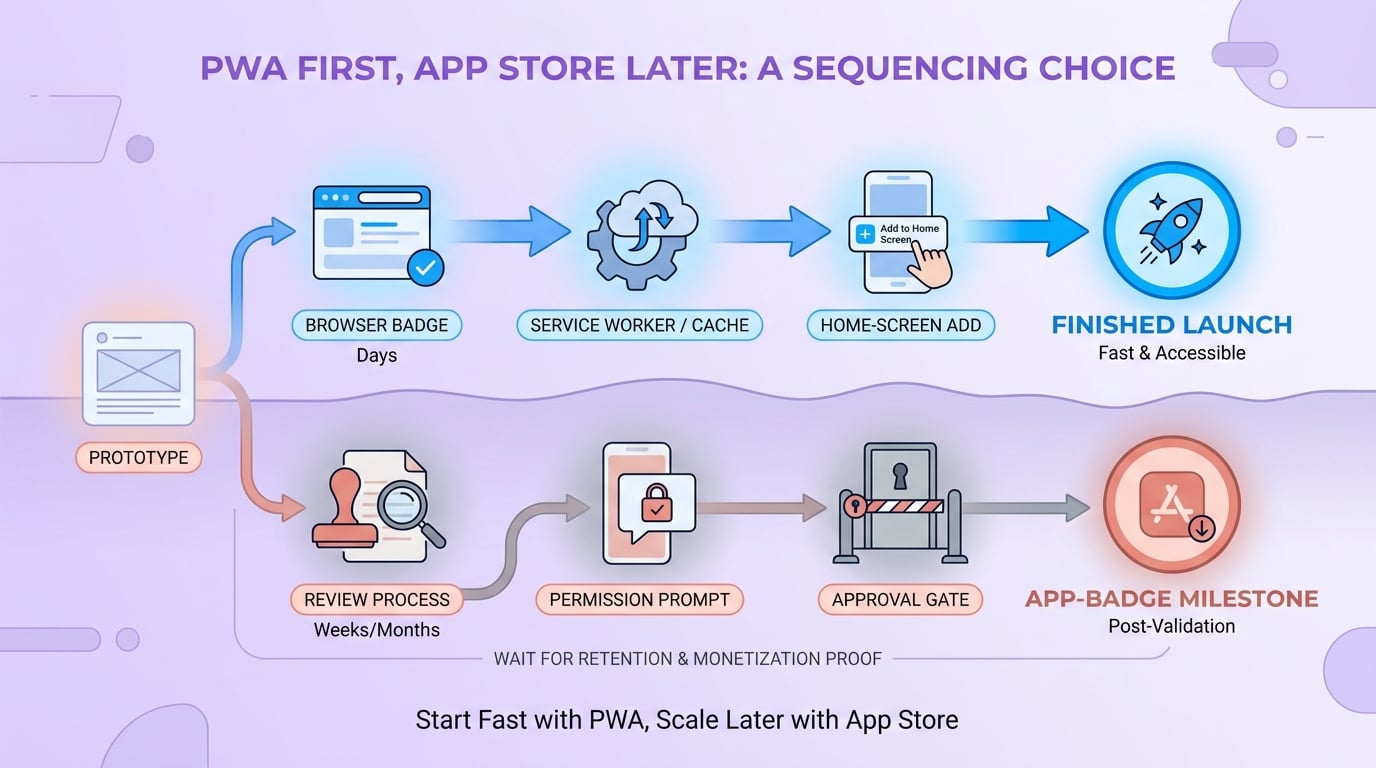
A simple timeline showing how a founder can move from prototype to PWA launch in days, then evaluate App Store publishing later once retention and monetization are proven. It should visualize the sequencing decision, not a generic roadmap.
Use this as a quick pre-publish gut check. It is not perfect, but it prevents the common "we shipped native because it felt real" mistake.
| Question | If "yes" - lean PWA | If "yes" - lean App Store |
|---|---|---|
| Do you need to change onboarding or pricing weekly? | Faster iteration matters | Review cycles are acceptable |
| Is your acquisition link-led (content, SEO, ads to landing)? | Click-to-value wins | Store page is required for conversion |
| Is repeat use driven by OS-level mechanics (push, widgets, deep integrations)? | Validate constraints first | Native advantages are likely material |
| Is trust or "having an app" blocking conversion? | Not yet | Likely yes |
30-day plan and decision matrix
If you share your product loop, constraints, and target platform, I will help you pick a realistic first launch and what to measure.
Get the 30-day plan


