
Most teams still treat app publishing like a one-off launch project. The result is predictable: every release cycle drags, costs more than expected, and increases avoidable review risk. AI publishing assistants can help standardize parts of ASO, localization, and store submission, but they do not remove the need for judgment or ownership.
Early proof block: where the decision shows up in the workflow
This is not a performance claim. It is a workflow reality check showing where time and risk typically sit in a modern release cycle, so you can see what is repeatable (often a good AI fit) versus policy sensitive (often better with experienced human review).
| Workflow step | AI publishing assistant (typical) | Publishing agency (typical) |
|---|---|---|
| Store listing copy + keywords | Fast drafts and variants, but needs human review for nuance, claims, and brand voice | Slower, more review loops, usually stronger positioning feedback |
| Screenshot variants | Rapid resizing and variant generation, but design QA and brand checks still take time | Heavier coordination, often higher polish and brand consistency |
| Release coordination | Checklists and reminders can reduce missed steps; setup and permissioning takes upfront effort | PM led, depends on the agency process and availability |
| Rejection follow up | Can suggest patterns and next edits; cannot negotiate or escalate | Human escalation paths and policy judgment |
Concrete operational example (illustrative, not a measured result)
Below is the kind of release checklist row an assistant might generate to reduce missed steps, plus the human gates that still tend to be required.
| Checklist item | Tool output (example) | Human gate (typical) | What can stall |
|---|---|---|---|
| Update subscription screenshot text | "Remove pricing claim, add trial disclosure, export 6.7 and 5.5 sizes" | Legal/brand check on claims | Legal queue (1-5 business days), designer availability |
| Submit build to review | "Confirm export compliance, upload build, attach notes" | Release owner verifies console fields | Missing permissions, MFA access, build not approved |
| Respond to rejection | "Draft reply + suggested edits by guideline" | Senior reviewer edits narrative | Rejection can add 3-7 days depending on back and forth |
Suggested metrics to track (over 2-3 releases): submission cycle time, rejection rate, and ASO experiments per month.
Interpretation: AI tends to help most when your bottlenecks are production and consistency. Agencies tend to help most when your bottlenecks are judgment, policy ambiguity, or cross functional alignment.
Reader impact: If your delays are mostly waiting on drafts, resizing, or copy updates, an AI assistant is worth piloting. If your delays are mostly rejections, rating issues, or stakeholder approvals, plan for more human oversight (agency or in house), because speed alone will not unblock you.
The Future of App Publishing: Where AI Agents Are Taking It goes deeper on the ideas above and adds concrete next steps.
Which is better: an app publishing agency or an AI publishing assistant?
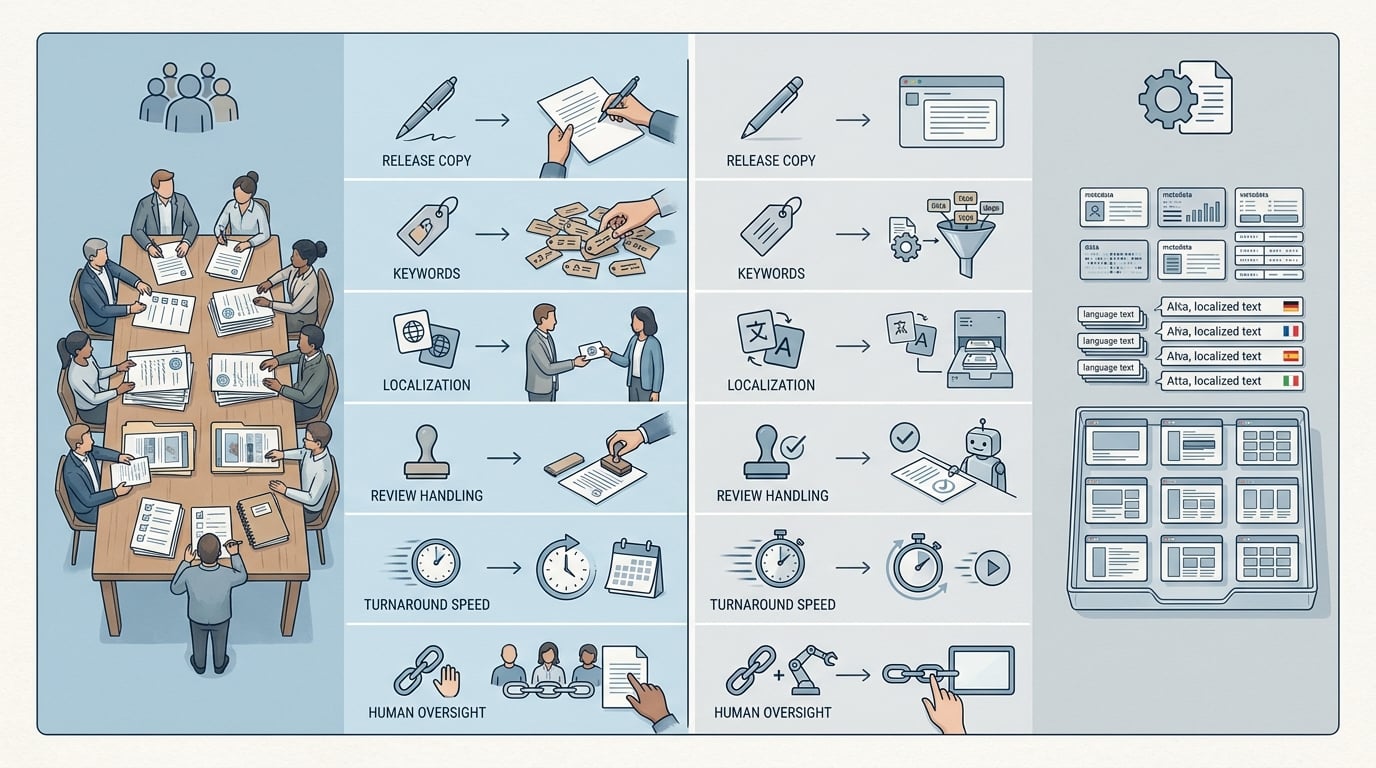
A compact comparison table showing app publishing agency versus AI publishing assistant across release copy, keyword work, localization, review handling, turnaround speed, and dependency on human oversight.
An AI publishing assistant can help when store work is repeatable: metadata refreshes, release notes, screenshot variants, and structured localization. Tools like TrueStore and AppSurge position themselves around faster execution and fewer manual handoffs.
The tradeoff is that speed can amplify mistakes if your inputs are weak or your review process is unclear. Agencies still tend to outperform when the launch hinges on policy nuance, category positioning, or breaking a cycle of rejections where escalation paths matter.
What most teams are actually buying:
- Higher ASO testing throughput without adding headcount (after you invest time in templates and review steps)
- Fewer blocked submissions caused by missing fields, inconsistent assets, or last minute copy changes
- Agencies: senior review, accountability, and help navigating edge cases
- AI assistants: operational leverage for frequent releases and multi locale coverage
- The right choice depends on cadence, team bandwidth, console permissions, and policy risk tolerance
One thing worth noting: both models still require internal ownership. Someone has to be accountable for what ships, even if a tool or agency does most of the work.
When you move from outline to execution, Froxi AI vs Manual Publishing: Risk, Complexity, and Speed Compared helps close common gaps teams hit here.
What changes when app publishing is automated with AI?
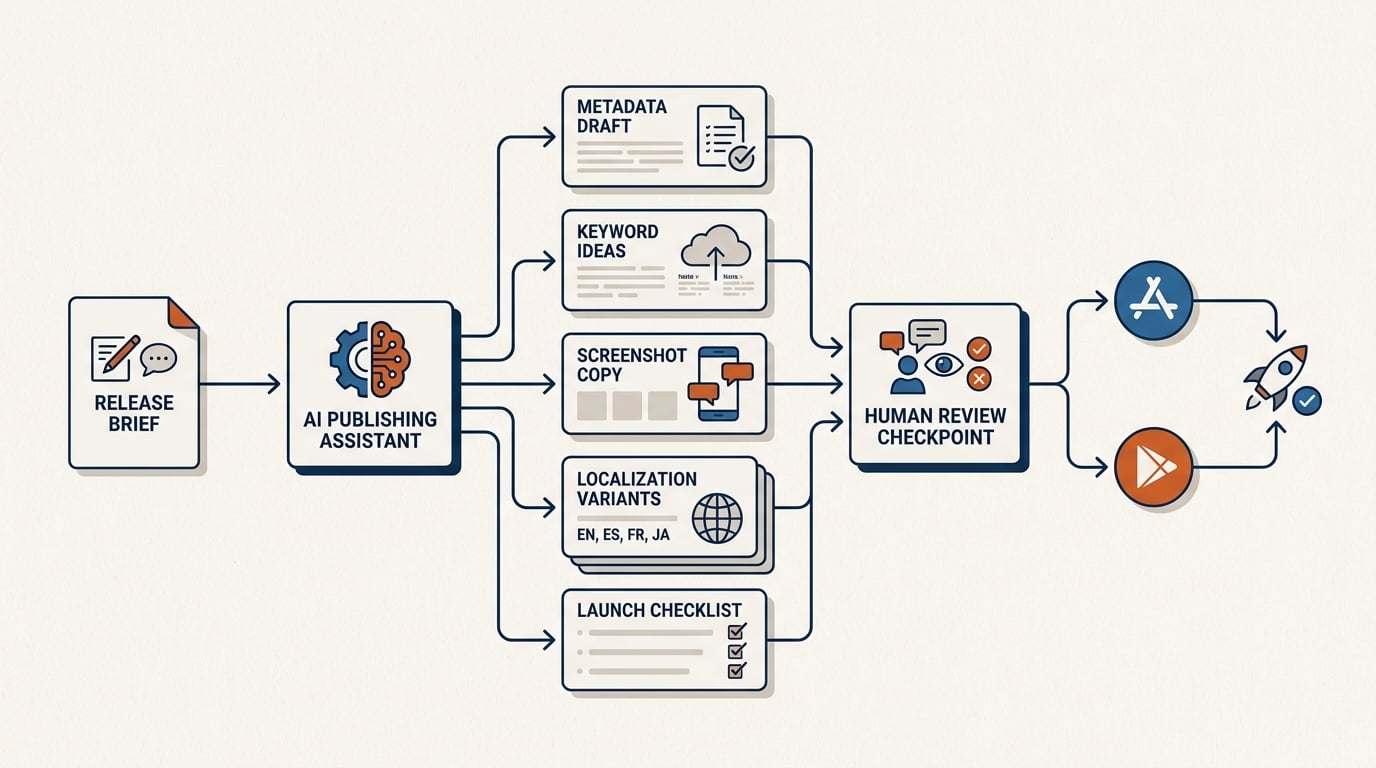
A process diagram showing how an AI publishing assistant turns a release brief into App Store and Google Play outputs: draft metadata, keyword suggestions, screenshot copy, localization variants, and launch checklist reminders.
The tasks AI handles best
Metadata and variant generation
AI is strongest where structure repeats: title variants, subtitle drafts, and short description rewrites. Tools like TrueStore, ASOForge AI, and AppLaunch Wizard can turn a brief into multiple listing options quickly, but you still need a reviewer for claims, tone, and product accuracy.
ASO iteration and localization throughput
Keyword clustering, draft localization, and refresh suggestions are predictable enough to assist with. The realistic win is lower marginal effort per locale or variant, as long as you budget review time by a native speaker or market owner when nuance and cultural fit matter.
Release execution hygiene
Release notes updates, asset checklists, and submission steps are boring but expensive when missed. Platforms like AppSurge and ReleaseRoute support repeatable pipelines, but you still need someone who owns final submission and handles console access.
Effort, dependencies, and failure modes to plan for
AI assistants are not set and forget. Expect a setup phase that is real work: often 3-10 hours across the first 1-2 releases to define templates, prompts, naming conventions, and approval rules. If your org requires security review, console permission changes, or legal/brand signoff, add queue time; for many teams that is days, not hours.
Common risks to mitigate:
- Incorrect or unsubstantiated claims in metadata or screenshots (policy and legal risk)
- Localization that is grammatically correct but commercially wrong (idioms, category norms, pricing expectations)
- Console permission constraints and separation of duties (who can draft vs who can publish)
- Template drift over time (someone must maintain standards after product changes)
- Faster output increasing reviewer workload (approvals become the new bottleneck)
A small workflow that is usually feasible:
Set an experimentation target you can actually staff
Aim for 1-3 listing tests per month (for example: subtitle + first two screenshots). Make sure you have reviewer time to approve variants, otherwise you will generate backlog, not learning.
Draft and package in the tool
Use an assistant to generate 3-5 options per asset plus a change log for reviewers. Expect 30-90 minutes to clean up inputs the first time (feature naming, benefit hierarchy, claim boundaries).
Human QA and policy preflight
Route through brand and legal where needed. Budget 30-60 minutes for a marketing owner to validate claims and tone, and plan extra time if you touch pricing, subscriptions, age rating, or regulated language.
Publish with a named owner
One accountable person submits to App Store Connect and Google Play Console and handles review replies. If you get rejected, plan for a real delay; 3-7 days is common when you need asset changes plus a new review cycle.
Audit your last 3 launches and mark where you waited on metadata, localization, screenshots, or review replies
Use that to decide what is safe to automate vs what needs senior review
Audit your workflow
A complementary angle worth comparing lives in Why Publishing Certainty Is More Valuable Than Faster Builds.
When does an app publishing agency still beat AI?
High risk launches where humans matter
If you are in a regulated category, selling a sensitive subscription, or relaunching after rejections, an agency can be the cheaper option because it may reduce review risk and revenue downtime. A seasoned operator can interpret policy gray areas, flag claims that might trigger rejection, and run a tighter preflight across receipts, trials, and disclosure language.
AI assistants can speed up packaging and iteration, but they can miss edge cases when inputs are ambiguous or policies change. Category and reviewer behavior also varies over time, so treat any workflow as something you will need to adjust, not a one time fix.
The hidden value agencies provide (and the tradeoffs)
- Positioning and messaging reviews tied to category norms and competitive patterns
- Preflight checks that catch policy and rating issues before you submit
- Localization prioritization by payoff, not equal effort everywhere
- Coordination across product, legal, design, and growth when timelines are tight
- Pattern recognition from many launches, including what fails quietly
Tradeoffs: agencies can introduce dependency risk if releases slow down when their PM is unavailable, or if you need rapid iteration outside the agreed cadence. A hybrid model is common in practice: AI for routine execution, with agency support for audits, exception handling, and high stakes launches.
For tradeoffs, checklists, and edge cases, Froxi AI vs Agencies: Which Gives Founders More Control? rounds out this section.
What should founders do next?
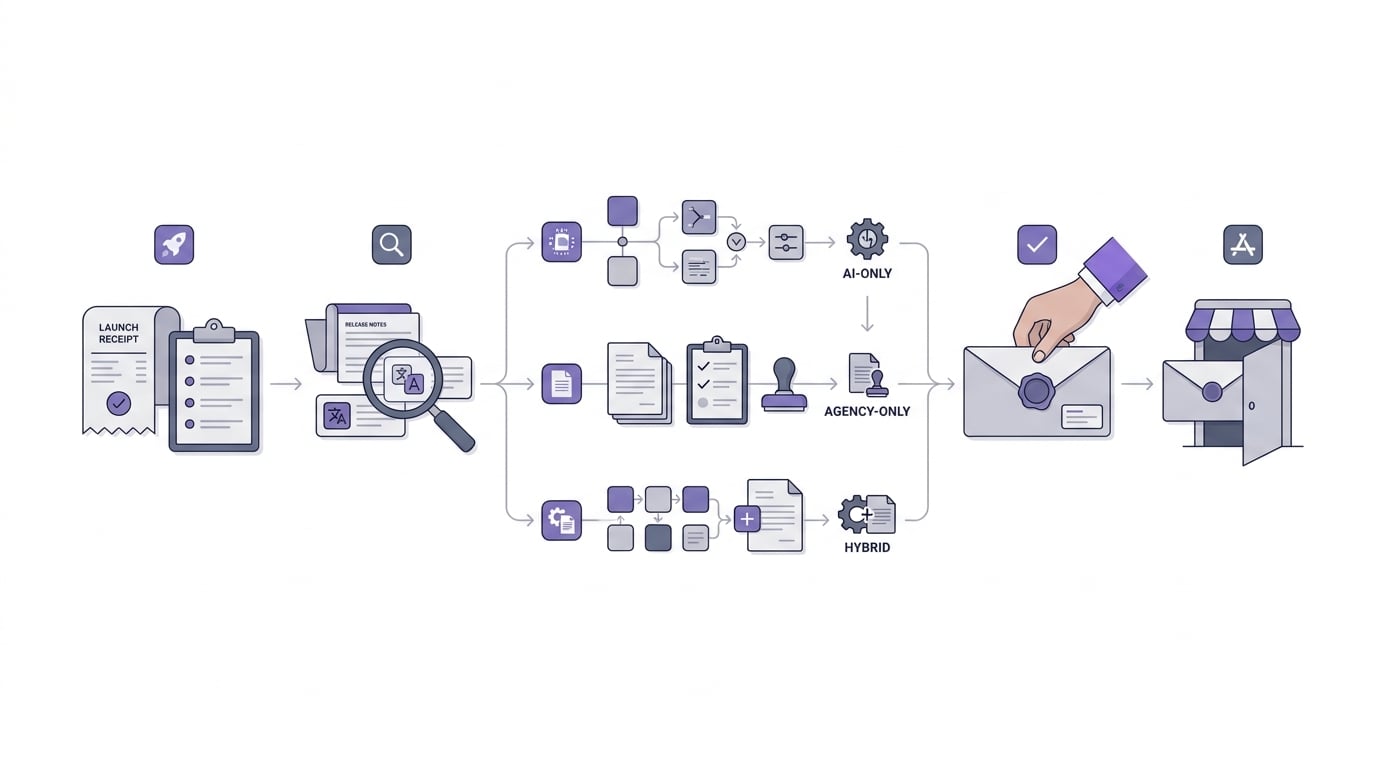
A short decision timeline showing a founder's path from auditing the last app launch, to identifying bottlenecks, to choosing AI-only, agency-only, or hybrid publishing support, with a final human review checkpoint before submission.
A simple decision rule:
- AI first if you ship frequently and your store work is mostly repeatable (metadata updates, screenshot refreshes, localization passes). Expect faster drafts and fewer manual steps, not zero review time.
- Agency first if a rejection, misrating, or messaging mistake can materially hit revenue (regulated categories, kids, health adjacent features, tricky IAP flows, or a flagship rebrand).
- Hybrid if you want automation for execution, but a human gate for policy nuance and final signoff.
Execution checklist before you switch:
- Assign a single owner for metadata, screenshots, release timing, and rejection appeals
- Standardize prompts, templates, and asset rules (plan 1-2 hours per month to maintain as the product changes)
- Add a human approval step for claims, rating sensitive assets, and policy sensitive changes
- Track 3 metrics for 2-3 releases: cycle time, rejection rate, experiments per month
Want a practical recommendation based on your last release?
Share your cadence, category, and last rejection reason (if any) and get a realistic next step plan
Do the bottleneck audit
Should You Publish Your App Yourself or Hire Someone? reframes the same problem with a slightly different lens - useful before you finalize.


