
Building an iOS app is hard, but shipping it is not the finish line. The real work starts when you need real people to install it, try it, and come back. This guide lays out a practical, low-budget workflow to reach your first 1,000 users using founder-led distribution, focused messaging, and a few validation checkpoints.
Early proof (directional, not a promise)
| Evidence (common patterns) | Interpretation | Reader impact |
|---|---|---|
| One strong, repeatable channel often seeds the first couple hundred installs | You are looking for one controllable source of installs, not a perfect launch day | You can focus your week on one channel test instead of spreading yourself thin |
| 1,000 users often comes from stacking a few "good enough" channels over time | Compounding starts after you find a segment that activates and returns | Your next channel choice gets easier because you have a message that already works |
| Most early traction is manual before it becomes scalable | Outreach and community work are slow, but they produce clear learning | Expect a few hours a day for 1-2 weeks to get signal, not an overnight spike |
How to read this: these are patterns I see across early-stage apps, not a forecast for your app. Results vary a lot by category, existing audience, pricing friction, and how quickly a user gets value in the first session. Dependencies like App Store review timing, analytics setup, and onboarding quality can easily add a week or force a reset.
Top 5 Ways to Monetize Your First iOS App goes deeper on the ideas above and adds concrete next steps.
Why are the first 1,000 iOS users so hard to win?
Category: Baseline
Statistic: 100 users
Label: Founder-led outreach first
Context: DMs, 1:1 asks, and warm intros validate positioning fast
Category: Momentum
Statistic: 300 users
Label: One repeatable channel
Context: A single loop (community post, newsletter swap, niche SEO) becomes the engine
Category: Scale
Statistic: 1000 users
Label: Only after stacking channels
Context: Layer 3 - 5 small channels; no single source typically carries you there alone
App Store approval is a compliance milestone, not a growth milestone. Even a polished app can sit in the store with near-zero installs because browse traffic is smaller than most founders expect, and trust usually takes repetition.
In practice, the first 1,000 users typically come from channels you can directly influence: outreach, communities, small partnerships, and referrals. The goal is not "more downloads" but faster learning about activation, retention, and messaging before you spend money.
Reaching 1,000 users matters because it creates enough volume to see patterns, even if the data is still noisy.
- It is an activation milestone more than a download milestone.
- It can increase the odds of steady reviews, but only if the product is stable and expectations match reality.
- It produces higher-quality feedback than friends and family because users have real context.
- It helps you find at least one repeatable channel, which is what makes scaling possible.
When you move from outline to execution, Step-by-Step Guide to Publishing Your First Mobile App helps close common gaps teams hit here.
Which channels work best for early iOS app users?
| Channel | Best for | Speed to first installs | Effort required | Common pitfall |
|---|---|---|---|---|
| App Store search (ASO) | Capturing existing intent | Medium to slow | Medium | Targeting broad keywords and hoping for discovery |
| Community posts | Spikes of targeted installs | Fast | Medium | Generic "launched!" posts without a clear problem statement |
| Founder outbound (DMs, email) | High-quality early users and feedback | Fast | High | Messaging people who are not a fit |
| Launch platforms | Visibility and social proof | Medium | Medium | Treating it as a one-day event with no follow-up |
| Referral loop | Compounding installs | Slow at first | Medium | Asking users to share before they get value |
App Store discovery alone is usually too slow early. Most teams still need at least one manual channel to create motion, then ASO and referrals can compound later if activation is real.
Which channel to start with depends on where your users already spend attention, and what you can execute consistently.
- Niche problem app: niche communities plus direct outreach.
- Consumer utility: App Store positioning plus a few use-case-driven community posts.
- B2B-ish workflow tool: a small set of professionals, then referrals once the workflow sticks.
Fast channels are usually manual, which means time and emotional energy. Plan for 5-10 hours of outreach and follow-up in week one, or you will abandon the channel before you learn anything.
Find your first repeatable acquisition channel
If you can describe your primary user and your top channel in one sentence, you are already ahead. Write it down, run a small test this week, and measure activation.
Start a simple channel and metrics worksheet
A complementary angle worth comparing lives in Top 10 Productivity Apps Launched This Week on App Store.
How do you reach your first 1,000 users step by step?
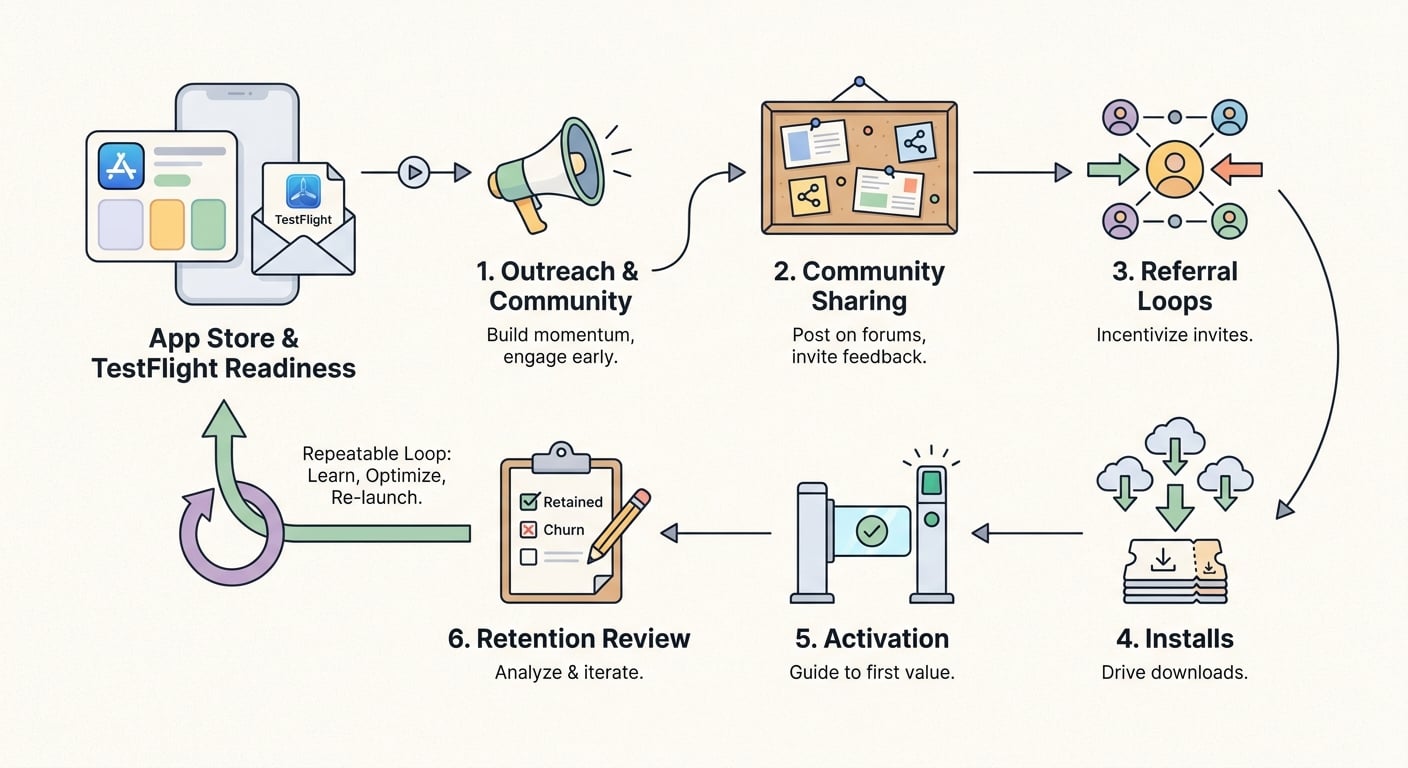
A simple process diagram showing the path from App Store/TestFlight readiness to direct outreach, community posts, and referral loops, then to installs, activation, and retention review. The diagram should highlight that early iOS growth is a loop, not a one-time launch.
Prepare the app before you ask for installs
Budget 2-6 hours if your assets are decent, or a full day if you are rebuilding screenshots and copy. This is not glamorous work, but it prevents wasted outreach.
- Make your App Store promise clear: title, subtitle, and first two screenshots should communicate value fast.
- Decide TestFlight vs App Store: TestFlight if core flows change weekly; App Store if stable enough for reviews.
- Define one activation event (first meaningful outcome): first task completed, first scan saved, first workout logged, first export.
Risk to watch: if you cannot name your activation event, you will optimize for installs and pull in low-intent users who churn.
Seed users through channels you can control
Expect 5-10 hours across a week for the first pass, plus time to reply and follow up. The follow-up is where many installs and insights come from.
- Founder outreach: 30-50 targeted messages beats 300 generic ones. Ask for feedback and make the next step simple.
- Community posts: lead with the problem and a specific workflow, then ask for 10-20 testers. Stay active in the comments for a few days.
- Add one shareable moment after value: a result, summary, template, or export. Do not ask on first launch.
Failure modes are common: channel mismatch, weak onboarding, pricing that surprises people, or review delays that break timing. Keep a backup plan (TestFlight list, waitlist email) and build in slack.
Validate before you scale effort
This usually takes a few days of data, not 24 hours. Early numbers are noisy, so look for directional signal, then iterate.
- Track install to activation, not just installs. Use App Store Connect acquisition data for context (App Store Connect Analytics - Acquisition).
- Check whether anyone returns on day 1 and day 7. It does not need to be great yet, but it needs to exist for at least one segment.
- Use this simple decision map:
| If you see... | Do this next (1 week scope) |
|---|---|
| Low activation across all sources | Fix onboarding, shorten time-to-value, tighten promise/screenshots |
| Good activation but low volume | Push harder on the best channel and improve follow-ups |
| One source brings better users | Rewrite your page and outreach to match that segment |
| Installs but no returns | Re-check the core value, paywall timing, and first-session experience |
Scaling before activation and early retention show up mainly scales confusion.
For tradeoffs, checklists, and edge cases, What Founders Should Know Before Their First Submission rounds out this section.
Minimal tracking setup (so you can make decisions)
Keep this small enough that it does not turn into an analytics project. Budget 1-3 hours if you already have analytics, or a half-day if you are starting from zero (including QA).
| What you track | Event name (example) | Where it fires | Tooling | Directional use |
|---|---|---|---|---|
| Activation | activated | After first meaningful outcome | Firebase, Amplitude, or Mixpanel | If consistently low, fix onboarding before more outreach |
| Early retention | returned_d1 | Second app open within 24h | Same tool | If nobody returns, value is not landing fast enough |
| Acquisition context | Source, impressions, product page views | Store listing and attribution | App Store Connect | If views are high but installs are low, fix screenshots and promise |
Dependency note: App Store Connect will not explain what users do inside the app. You usually need one in-app analytics tool to connect acquisition to activation and retention, and you will still have blind spots without proper attribution.
Publishing at Every Stage: How App Store Strategy Changes as You Grow reframes the same problem with a slightly different lens - useful before you finalize.
Common mistakes that stall growth
- Chasing broad exposure too early: impressions and likes are not activated users. Broad promotion often pulls in curiosity installs that churn and muddy learning.
- Overpromising on the App Store page: if the listing implies one thing and the first session feels different, activation drops and reviews trend negative.
- Running too many channels at once: you lose attribution and burn out. Run channels sequentially in 5-7 day blocks when possible.
- Ignoring operational friction: rejected builds, broken TestFlight links, missing analytics, and review delays can cost a full week.
If you want a second opinion on tactics, these cover similar patterns (start niche, stay practical, iterate): Trust and Traffic, IndieStore.
Final checklist and next moves
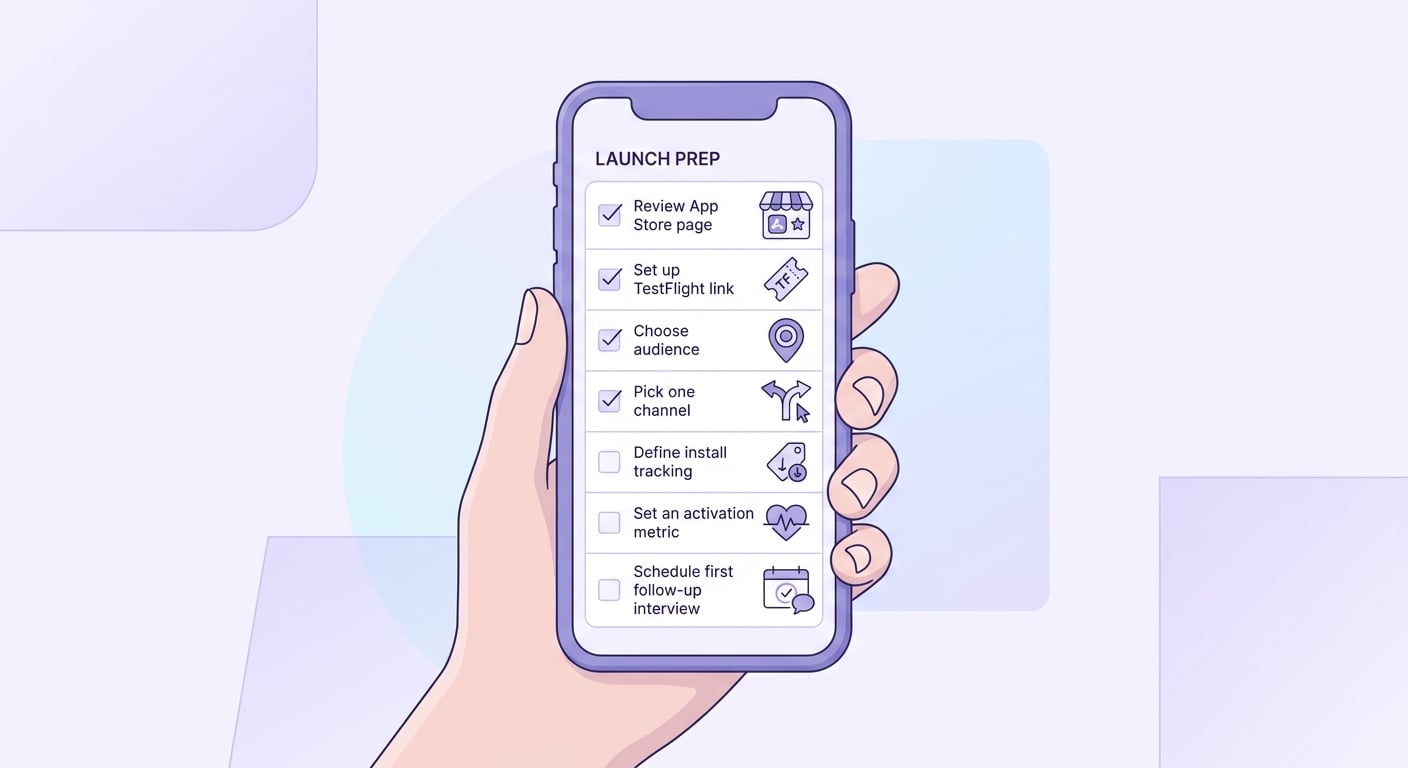
A mobile-friendly checklist block with the specific launch items for an iOS app: App Store page review, TestFlight link setup, audience choice, channel selection, install tracking, activation metric definition, and first follow-up interview scheduling.
- Confirm your App Store page: title, subtitle, keywords, first two screenshots, and a clear one-sentence value proposition.
- If using TestFlight, confirm the invite flow is frictionless and the feedback channel is clear.
- Choose one primary audience segment and write the "for people who..." sentence.
- Pick one primary channel and one backup channel (do not run five at once).
- Set up simple tracking: installs, activation count, day 1 return, day 7 return.
- Schedule 3-5 follow-up interviews with early users (20-30 minutes each).
After your first 100 users, do not assume you are ready to scale. If you are still seeing weak activation, poor retention, or consistent confusion in interviews, you may need another iteration cycle on onboarding, pricing, or the core workflow before chasing volume.
Build your repeatable iOS growth loop
Document the channel, message, and activation event that worked best, then turn it into a weekly system you can run without burning out.
Create your growth loop plan


