
If you check the App Store every week for a better notes app, task tool, focus timer, or planning workspace, the hard part is not finding options. It is filtering out unfinished launches, copycat products, and polished listings that do not hold up after first use. This guide uses a simple shortlist framework, grounded in discovery signals from sources such as LaunchTry, to help you decide which recent productivity app types are worth a quick test and which are easier to skip.
Top Productivity Apps That Hit #1 on App Store This Month goes deeper on the ideas above and adds concrete next steps.
How did we choose this week's new productivity apps?
The goal here is deliberately limited. This is not a verified "top 10" of the App Store or a claim about the best new apps of the week. It is a launch-week screening framework based on recent discovery signals, listing clarity, and whether an app appears understandable enough to justify a first test.
That tradeoff matters. Faster screening can save time up front, but confidence is lower when launch-week data is thin and long-term retention evidence does not exist yet.
When you move from outline to execution, How to Publish Your Vibe-Coded App (Without Getting Rejected) helps close common gaps teams hit here.
Early proof: the screening matrix behind the shortlist framework
| Productivity app type | Common launch-week use case | Best for | Likely setup effort | Initial verdict |
|---|---|---|---|---|
| Quick capture app | Fast note or task inbox | Busy solo users who want less friction | 3 to 5 minutes | Good first test |
| Focus timer | Deep work sessions | Students and freelancers blocking distractions | 2 to 5 minutes | Good first test |
| Weekly planner | Time blocking and planning | Operators planning work blocks | 10 to 20 minutes | Test if planning is the bottleneck |
| Document scanner | Receipts, forms, and admin | People handling frequent paperwork | 5 to 15 minutes | Useful if admin work is recurring |
| Meeting notes tool | Notes after calls or meetings | Managers and client-facing freelancers | 5 to 10 minutes | Test during one real meeting |
| Habit tracker | Simple daily check-ins | Users who want lightweight routines | 3 to 5 minutes | Best for narrow habits |
| Email triage app | Inbox cleanup | Professionals with high email volume | 10 to 25 minutes plus account linking | Test only if inbox pain is high |
| Team async update tool | Lightweight collaboration | Small teams needing quick status updates | 20 to 60 minutes across the team | Only test if adoption is realistic |
| Calendar control app | Scheduling and time blocks | Users who struggle with calendar sprawl | 10 to 20 minutes | Strong if scheduling is the pain point |
| AI workflow helper | Repeated prompt or task support | Users with repeatable AI-heavy tasks | 5 to 15 minutes | Wait unless the fit is obvious |
This table is an evaluation tool, not a source-backed ranking of weekly winners. LaunchTry helped surface recent launch patterns and categories, but the examples here are intentionally framed as app types because launch-week evidence is still directional.
What this means for readers is simple: start with your workflow problem, not novelty. If an app asks for imports, invites, or sensitive permissions before showing value, the real testing cost is usually higher than the listing suggests.
The practical filter we used
- Launch recency: Recently surfaced productivity launches, including directional discovery sources such as LaunchTry.
- Clear use case: The app needed an obvious job, such as capture, scheduling, scanning, habits, focus, or collaboration.
- Readable value proposition: If the listing could not explain itself in seconds, it did not qualify.
- Enough first-use evidence: Screenshots and descriptions needed to show how a real user would begin.
- Decision lens: We looked at apparent use case, likely setup effort, and who the app may suit.
- Important limit: This helps with shortlist decisions, not long-term quality, retention, or category leadership.
What made an app feel trial-worthy versus skippable
The stronger listings had a narrow promise, believable screenshots, and a clear first action. You could usually tell within 30 seconds what problem the app was trying to solve.
The weaker ones leaned on vague AI language or broad claims without a concrete workflow. In practice, test an app only when the core job is obvious and the first-use path looks realistic.
A complementary angle worth comparing lives in Top 10 Mobile App Development Tools You Need in 2026.
How do you choose the right productivity app without testing all 10?
You do not need a full comparison sprint. In many cases, 10 to 20 focused minutes is enough to decide whether one or two apps deserve a longer trial.
Name the bottleneck
Pick the job you need solved this week: quick capture, calendar control, focus sessions, file organization, or lightweight collaboration. The best app is usually the one that removes current friction, not the one with the longest feature list.
Shortlist by usage frequency
Choose apps you can imagine opening daily or several times a week. If it does not connect to a real habit, retention is unlikely even if the interface looks polished.
Check setup tolerance
If you want immediate value, prioritize solo tools with light onboarding. Be more cautious with apps that require imports, account linking, privacy permissions, or team buy-in before they become useful.
Run a 10-minute first-use test
Do one real task instead of touring menus. Capture a note, block tomorrow's calendar, scan a receipt, or complete one focus session. Many apps can show basic value quickly, but some categories need more than one session.
Apply a keep-or-delete checkpoint
Keep the app only if the value is obvious after the first task and it beats your current default in at least one meaningful way. If not, delete it before it becomes digital clutter.
Some app types need more patience to judge fairly. Collaboration tools, planners, and inbox products often have higher setup costs and weaker day-one payoff, so they are only worth testing if the problem is painful enough to justify the effort.
For tradeoffs, checklists, and edge cases, Top 5 Ways to Monetize Your First iOS App rounds out this section.
What is this productivity app shortlist actually good for?
Use it to reduce random installs, not to outsource your final decision. It helps you decide what deserves a first pass based on listing clarity, likely effort, and whether the workflow seems credible.
One thing worth noting is that launch-week impressions can be wrong in both directions. An app that looks rough at launch may improve quickly, while a polished listing can still disappoint after a week of real use.
Migration has a hidden price too. Moving tasks, reconnecting calendars, importing notes, or asking a team to switch can take 20 minutes or several hours, with no guarantee the app will stick.
A practical takeaway for builders and buyers
For users, the safest approach is to test narrowly and stop early when the first-use path is unclear. For builders, the pattern is similar: clearer screenshots, tighter messaging, and lower-friction onboarding usually improve the odds of a fair trial, even if they do not guarantee retention.
That is the real value of this framework. It helps readers spend less time on weak first tests and helps teams see what makes a new listing easier to trust.
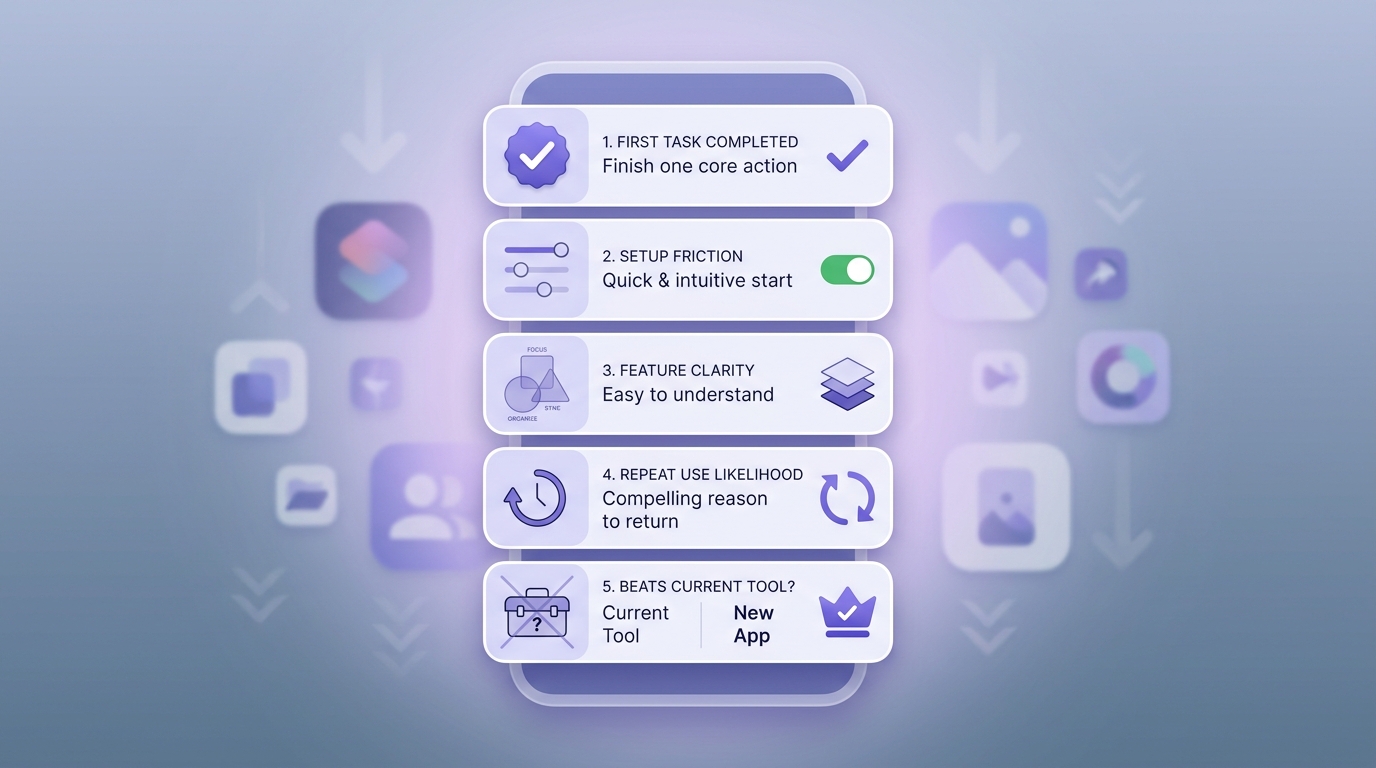
A mobile-friendly checklist block readers can use after installing one of this week's new productivity apps, covering first-task completion, setup friction, feature clarity, repeat-use likelihood, and whether the app beats the reader's current tool.


