
If your app is new, you are fighting two launch problems at once: nobody is searching for you yet, and your store listing has little social proof to convert the people who do find it. App review sites can help bridge that gap by borrowing existing audiences and transferring trust at the moment a user is deciding whether to install, but the impact is uneven and easy to misread as "free traffic." This breaks down what review-site visibility tends to do for early download velocity, what the evidence can and cannot prove, and how to turn a small stream of qualified referrals into measurable lift in App Store and Google Play performance.
Best Way to Get Your First App Downloads for Free goes deeper on the ideas above and adds concrete next steps.
How do app review sites help early downloads?
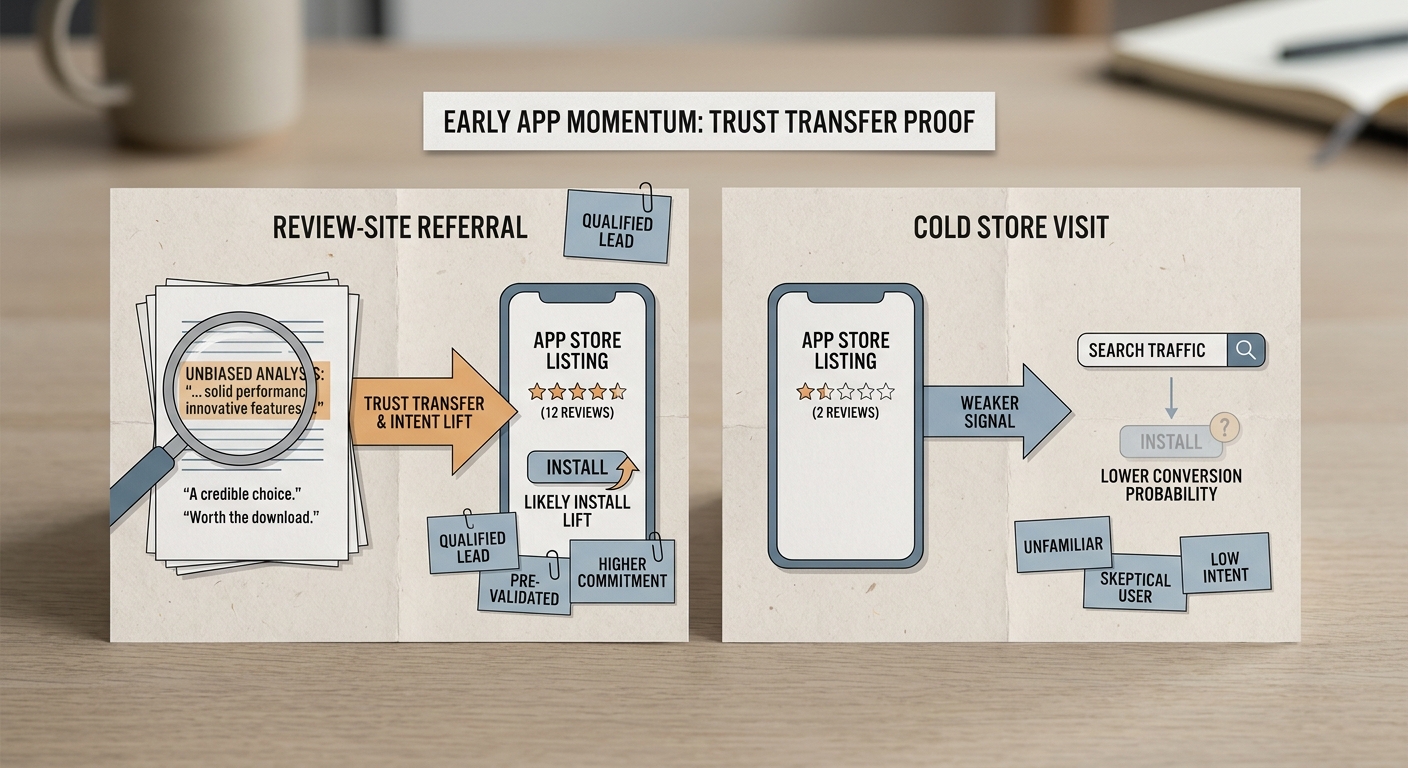
A compact proof block showing a side-by-side comparison of review-site visitors versus cold app store visitors, emphasizing trust transfer, click intent, and likely install conversion lift for a new app with few reviews.
| Entry path | Typical user context | Expected click-to-install intent (illustrative) | Why it happens |
|---|---|---|---|
| Review or comparison page mention | Arrives after use cases, screenshots, pros and cons, and alternatives | Medium to high | Trust is transferred from the publisher, so the store visit is closer to a decision |
| Cold App Store or Google Play listing visit | Arrives with limited context, especially when ratings are low | Low to medium | The user must infer fit from a short listing and sparse social proof |
Explanation: Review-site visitors often arrive after reading enough context to self-qualify.
Interpretation: This is a directional pattern, not a guarantee. The signal to watch is usually CVR and activation rate delta during the publish window, not raw sessions.
Impact: Plan review sites as a launch-week conversion amplifier you can measure via store CVR, activation, and branded search lift, not as a predictable acquisition channel.
What the early signal usually looks like in analytics
- Referral bump within 24-72 hours, then a long tail over 7-14 days (if the post keeps ranking)
- A modest branded search lift after the article gets indexed or shared (sometimes never shows up)
- Store CVR bump during the same window, even if total sessions are modest
- Assisted conversions where the review influenced the decision but did not get credited
When you move from outline to execution, App Store vs Google Play: Where Should You Launch First helps close common gaps teams hit here.
What do app review sites actually do for early downloads?
Why review-site traffic matters before your first 100 reviews
Before you have meaningful ratings, your App Store or Google Play page often converts like an untrusted landing page. Third-party reviews can lend credibility through roundups, comparisons, and category lists that already rank in search and feel pre-vetted.
The practical goal is early download velocity: a small stream of higher-intent users who arrive pre-informed. In practice, this can help your launch week look less random, but it will not fix weak positioning, onboarding friction, or a mismatched audience.
Research scope and evidence limits (read this before you plan around it)
- Attribution is messy by default. iOS privacy and store referrer limits mean you will still do some timing-based inference.
- Editorial timelines are real. Some sites publish in days; others are 2-6+ weeks out. Plan accordingly.
- Pay-to-play exists. Placement fees, affiliate models, or "sponsored review" offers are common. Costs vary widely, so treat pricing as variable and qualify before you invest time.
- Links can be routed or stripped. Fine for users, but UTMs and deep links may not survive.
- Geo mismatch kills performance. If you are only live in certain countries, most global roundups will underperform.
One thing worth noting: the biggest cost is often opportunity cost. If you spend your only launch week chasing coverage, you might delay shipping improvements that would lift CVR more reliably.
A complementary angle worth comparing lives in How to Use LinkedIn to Promote Your Mobile App.
Key data points: how review sites influence discovery and conversion
The three traffic sources that usually show up first
- Roundups comparing 3-10 apps, then pushing readers to "best for X" picks
- Individual reviews ranking for a specific use case and sending problem-aware traffic
- Comparison tables with prominent store buttons that behave like purchase links
The conversion signals worth tracking in the first two weeks
Track what you can actually act on, and record a baseline first.
- Store CVR before vs during/after the mention (segment by geo if possible)
- Branded search lift in App Store Connect and Play Console (directional, not perfect)
- Referral cohort quality: install-to-sign-up, install-to-trial, day 1 retention, or first key action
- Publisher-level splits: which sites send buyers vs curious clicks
A concrete tracking setup (good enough for a small team)
This is a realistic "founder + one marketer" setup that usually takes 2-4 hours if analytics is already in place. If deep links, events, or an MMP are not set up yet, plan 1-2 days including QA across devices.
- UTM scheme for links you control (landing page, press kit, email)
- Example:
utm_source=reviewsite&utm_medium=referral&utm_campaign=launch_week&utm_content=top_pick
- Example:
- Tools
- App Store Connect + Google Play Console for store-side CVR and acquisition baselines
- GA4 for landing page sessions and source breakdown
- AppsFlyer, Adjust, or Branch if you need deeper cohort tracking (expect extra setup and some iOS blind spots)
If a publisher strips UTMs or routes links, fall back to: (1) publish window vs baseline, (2) branded search change, and (3) cohort quality shift. Write down the limitation so you do not "find" signal that is not there.
For tradeoffs, checklists, and edge cases, How to Get Your First 1,000 Users for Your iOS App rounds out this section.
How can you turn review-site visibility into early download velocity?
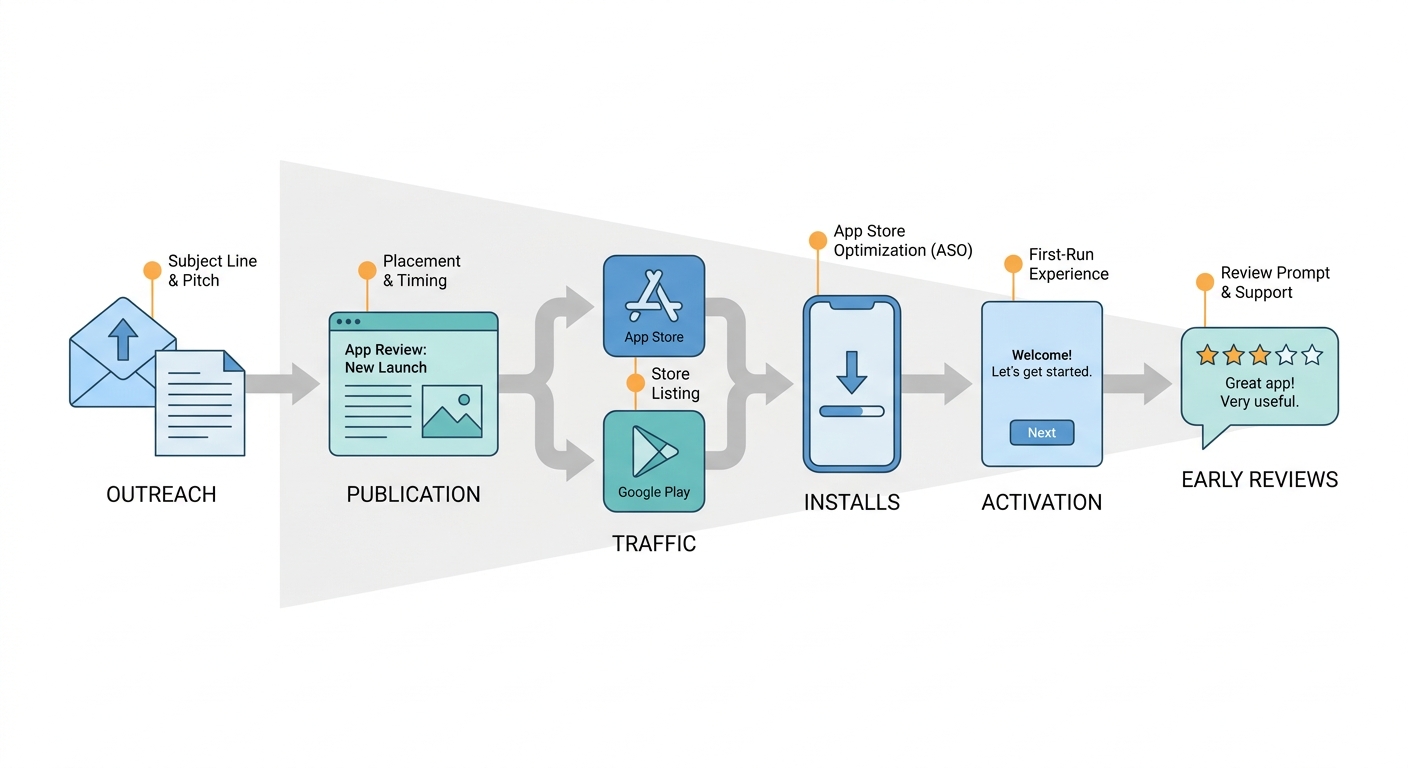
A step-by-step flow from outreach to review-site publication to App Store or Google Play traffic, then to install, activation, and review collection, highlighting where founders can improve conversion at each step.
A compact before/after snapshot (illustrative)
This is the kind of small but useful change we have seen when the placement is strong and the audience fits. Numbers below are illustrative; measure your own baseline.
| Metric (target geo) | Baseline (7 days prior) | Publish window (3-7 days) | What to conclude |
|---|---|---|---|
| Store CVR | 18% | 22% | Conversion lift can matter even if sessions stay small |
| Branded searches | 100/day | 125/day | Indicates awareness spillover, not just click-through |
| Activation rate (key action) | 35% | 38% | If this drops, the "lift" may be low-quality traffic |
How to use review-site coverage to support store optimization
Prep the store listing before outreach
Review traffic is bursty. Expect 2-6 hours to tighten screenshots, first line positioning, and pricing clarity if your assets exist. If you are still creating screenshots or rewriting onboarding, budget a full day or two.
Mirror the promise from article to store
Pull the reviewer framing into your first three benefits and screenshots so the story stays consistent. The tradeoff is you may need to compromise on your ideal brand voice in favor of what the market understood fastest.
Measure spillover, not just clicks
Watch branded search, direct traffic, and store CVR, then sanity-check with activation and retention. Compare against the previous 7 days (or a comparable period) and do not call it a win unless quality holds.
(Process flow: outreach - publication - store visit - install - activation - first review.)
Where the strategy breaks down (common failure modes)
- Low-intent directories inflate sessions without installs, which wastes time and muddies your signal
- Bad placement (bottom of a list, no visible buttons) sends almost no meaningful traffic
- Stale or inaccurate coverage misstates pricing, features, or supported devices, which creates support load and refunds
- Incentive and policy risk: couponing or "pay for review" arrangements can trigger compliance issues depending on platform and publisher rules
- Late publishing means you get exposure after your launch push, when lift matters less
When not to do this
Skip review-site outreach (for now) if any of these are true:
- Your onboarding is still breaking on real devices and you are burning time on support
- Your geo availability or pricing is changing week to week
- You cannot reliably measure activation, so you will optimize for vanity traffic
- You have one engineer and shipping fixes will move CVR more than any placement
A realistic failure mode: an editor asks for paid access to test your app, and your team loses 3-5 days creating coupons, troubleshooting billing, and answering questions. Decide fast if the site matches your target geo and buyer intent; otherwise, politely pass.
What the App Store Review Team Actually Tests reframes the same problem with a slightly different lens - useful before you finalize.
Practical implications: a launch workflow for founders and marketers
A simple outreach sequence for week 0 to week 2 (realistic effort)
Plan 6-10 hours across two weeks if you already have a decent press kit and screenshots. If you do not, add another half day to make assets publish-ready and to QA deep links on both platforms.
Build a tight target list (20-40 sites)
Look for category review sites, comparison pages, and app discovery newsletters where your competitors already rank. Add columns for lead time, geo fit, and pay-to-play so you do not burn launch week chasing impossible slots.
Send a one-angle pitch
Lead with the use case, differentiator, platform (iPhone/Android), pricing and trial terms, and a clean install link. Assume most editors will not take a call, so make the email self-contained.
Follow up once with a ready-to-publish packet
Include 3-6 screenshots, a one-paragraph summary they can copy, and 2-3 bullet "who it is for" examples. Track which placements move store CVR and activation, not just referral sessions.
Example target list row (what "good" looks like)
| Site | Placement type | Lead time | Cost model | Geo fit | Expected intent |
|---|---|---|---|---|---|
| ExampleAppReviews.com | "Best budgeting apps" roundup | 10-21 days | Variable (affiliate or sponsored options) | US/CA | Medium to high (people actively comparing) |
Use this row format to avoid a common trap: spending hours on sites that look legit but cannot publish in your window, or cannot send the audience you need.
Pre-flight checklist before you ask for coverage
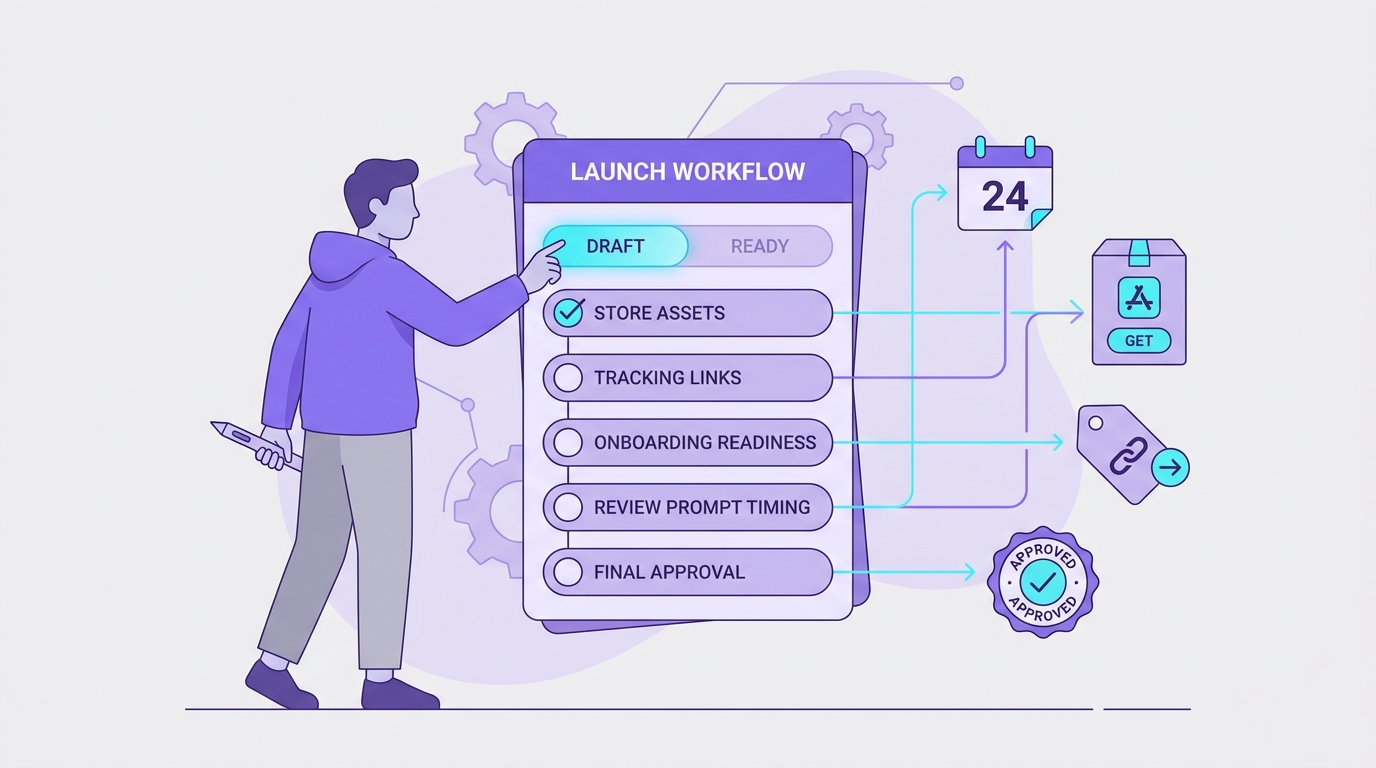
A launch workflow works best when the team treats strategy, assets, timing, and approval as one connected system instead of separate tasks.
- Store assets current (icon, screenshots, subtitle, short description)
- Onboarding and trial flow tested on a fresh device (30-60 minutes)
- Review prompt strategy ready (trigger after value, not on first open)
- Deep links working (both platforms), plus a fallback landing page
- Baselines recorded: store CVR, installs/day, branded searches, key activation rate
- Tracking set for what you control: UTMs on landing pages, GA4 events, MMP deep links if applicable


