
Getting your first app downloads for free is less about clever growth hacks and more about picking a few channels that create momentum fast, with the least setup. This guide ranks realistic week-one methods for brand-new apps, explains when each works best, and shows how to avoid the conversion traps that waste your early clicks.
How to Use Reddit to Get Your First 1,000 App Downloads goes deeper on the ideas above and adds concrete next steps.
What are the fastest free ways to get your first app downloads?
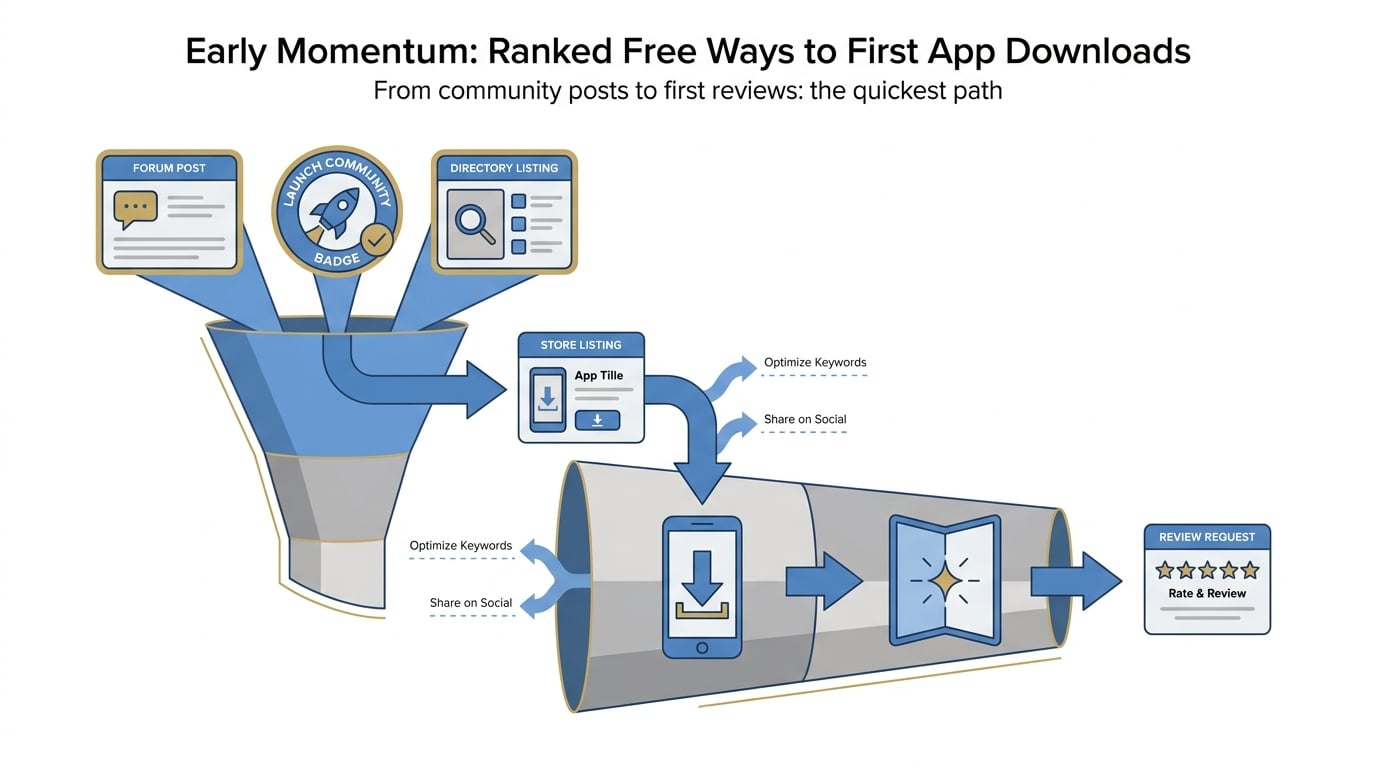
A simple funnel diagram showing the path from community post or directory feature to store page visit, install, first session, and review request.
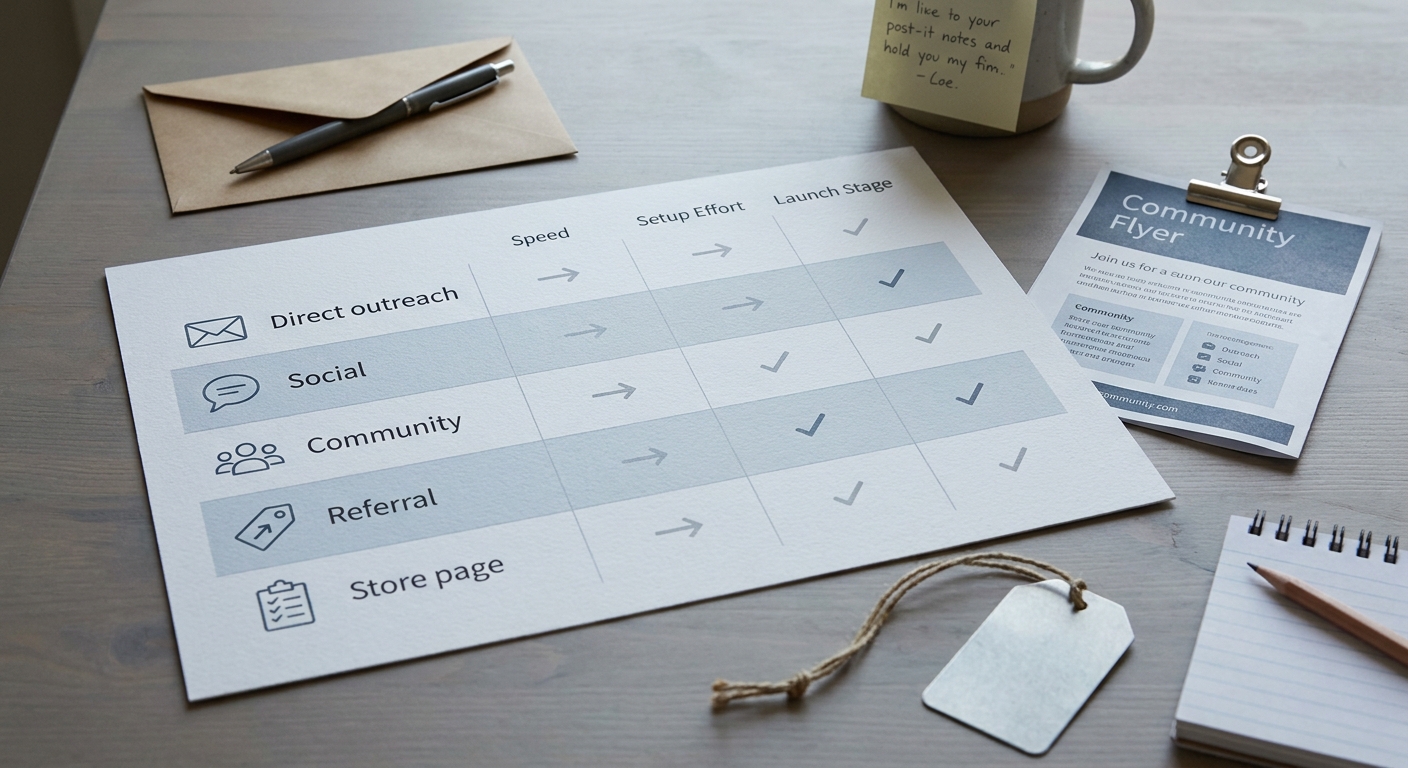
A compact comparison grid ranking the five free first-download methods by speed, setup effort, and best-fit launch stage for a new app.
When you have zero installs, no budget, and no audience, you usually cannot wait for compounding channels to kick in. The fastest free methods share a theme: they send direct, understandable traffic to a store page that can actually convert.
| Rank | Method | Typical time to first installs | Setup effort | Control over message | Best fit launch stage |
|---|---|---|---|---|---|
| 1 | Personal network and direct outreach | Same day to 3 days | Low | High | Pre-launch, Day 1 |
| 2 | Founder story posts in relevant channels | 1-7 days | Low to medium | High | Soft launch |
| 3 | Launch communities and app discovery platforms | Launch day to 7 days | Medium | Medium | Public launch |
| 4 | ASO basics (store search and conversion) | 1-3+ weeks to stabilize | Medium | High | Any stage, especially pre-launch |
| 5 | Partnerships with micro-creators and niche operators | 1-3+ weeks | Medium to high | Medium | Soft launch, public launch |
Explanation: These time ranges are directional estimates based on operator experience across small launches, not a guarantee for every category. The top 3 tend to produce earlier installs because they do not require an algorithm to learn who you are. ASO matters because it can improve store discovery and conversion over time, and sources like AppDrift describe store search as a major install source in many apps and categories, not a universal constant across every niche (AppDrift).
Interpretation: If you are not converting store page visits, adding more traffic mostly adds more bounces. Week one is usually about tightening your promise, screenshots, and onboarding with real users, not chasing scale.
Reader impact: Even 25-100 real users installing, trying one key flow, and telling you where they got stuck can materially improve screenshots, onboarding, and retention. Those improvements make every next post, directory listing, and partnership more likely to convert.
What actually matters in week one
Evaluation criteria for free first downloads:
- Speed to first install: how quickly the channel can produce installs you can learn from and iterate on.
- Setup effort: whether you need polished store assets, or just a direct ask.
- Control over message: whether you can explain the use case clearly (important before you have reviews).
The practical takeaway: pick methods where you can explain the app in one line and get the user to the install page in one tap. Optimize for learning and conversion first, then widen distribution once your store page and onboarding are holding up.
When you move from outline to execution, How Much Money Do Indie Apps Actually Make in 2026? helps close common gaps teams hit here.
What are the best free ways to get your first app downloads?
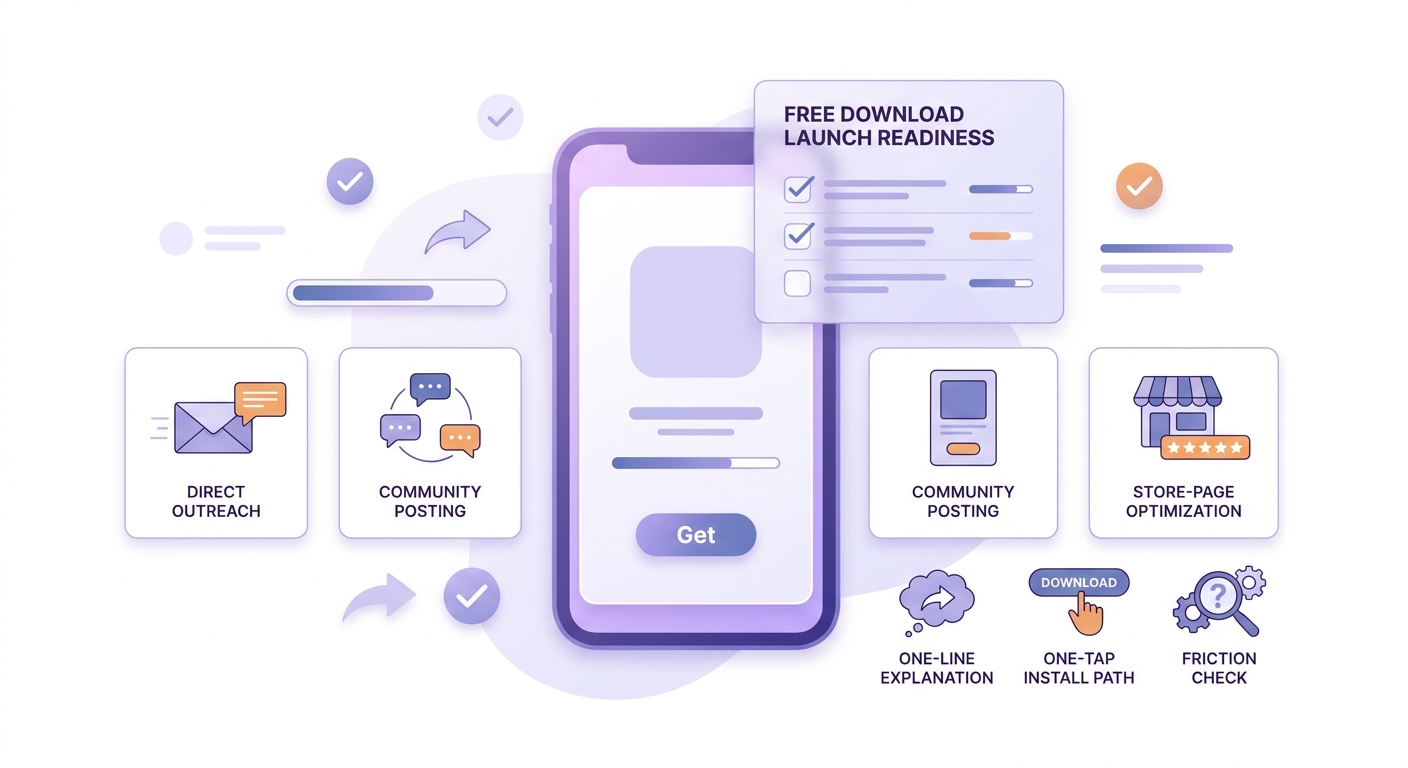
A concise launch-readiness checklist that helps founders choose between direct outreach, community posting, and store-page optimization before asking for free downloads.
This list is ranked for brand-new apps with no budget. Each method can work, but the right pick depends on your category, price point, platform (iOS vs Android), and how much friction exists before the first win.
Before you start, make sure you have the basics in place. Skipping these often makes every channel look worse than it is.
Dependencies checklist (30-90 minutes):
- Store links that open correctly on mobile (and a single redirect page if you need it)
- Install and first-open events (at minimum) in analytics
- A way to test pre-release users (TestFlight or closed testing) if you are not fully public yet
- One place to capture feedback fast (a form, a dedicated email, or a short survey)
1. Start with your personal network and direct outreach
Define a tiny target list (25-50 people)
Pick warm contacts who resemble your intended users or who will give honest, detailed feedback. You are not chasing vanity installs; you are chasing activation and clarity.
Send a specific ask, not a generic announcement
Ask them to do one thing (install and try one flow) and one optional thing (reply with feedback, and only leave a review if they genuinely had a good experience). Keep the message short and include the direct store link.
Collect feedback in a structured way
Ask two questions: "Where did you hesitate?" and "What did you expect to happen next?" This usually beats "Any thoughts?" because it surfaces exact confusion points.
Warm outreach works because early store pages have no social proof, so strangers often bounce quickly. The tradeoff is it is manual, and you can burn goodwill if you spam or oversell.
Realistic effort: plan 60-120 minutes to build the list and write a good message, then 20-45 minutes/day for 2-3 days to follow up and capture feedback.
Common failure modes (and what to do):
- Outreach fatigue or silence: your ask is too broad. Narrow it to one 2-minute task and a single question to reply with.
- Lots of installs, little activation: your first session is confusing. Pause outreach for a day and fix the first-time flow before sending more people in.
- Friends are too nice: add 5-10 "truth-tellers" (people who will actually say "I do not get it") and prioritize their feedback.
Pitfalls and constraints:
- If your app requires a lot of setup, expect lower completion unless you guide them to a single quick win.
- Copy-pasting the same note to everyone tends to produce polite installs and weak feedback.
- Do not incentivize reviews in ways that violate platform policies; keep it user-driven.
2. Post a founder story on the channels your users already read
Lead with the pain, then the before and after
Start with a real moment: the workflow that annoyed you, the cost of the problem, and the specific outcome your app delivers. Clarity beats cleverness.
Use a single call to action and a single link
Send people to one path: the App Store or Google Play listing, or a minimal landing page that routes to the right store. Splitting attention usually costs installs.
Treat comments as part of the distribution
Replies are part of the work. When someone asks "Does it work for X?", your answer becomes the content that convinces the next lurkers to install.
Founder-led posting works because people download apps when they immediately understand the use case, and you can control the narrative before reviews exist. The constraint is you are borrowing attention, so unclear positioning gets exposed fast.
Realistic effort: 60-90 minutes to draft a post and choose one visual, then 30-60 minutes/day for 2-4 days replying.
Common failure modes (and what to do):
- Community rule violations or backlash: read rules first, disclose affiliation, and lead with what you learned building it. If links are restricted, ask for permission or share the link only when requested.
- Attention but few installs: your store screenshots are not doing their job. Update the first screenshot and first line of the description, then re-post later (do not spam the same thread).
- Replies drain your week: timebox responses (for example, two 20-minute blocks/day) and save long explanations for a short follow-up post.
3. Use launch communities and app discovery platforms
Pick 2-3 platforms where your niche actually hangs out
Big launch sites can spike traffic, but niche directories and communities sometimes convert better when your app fits a clear category. HuntHub can help you find relevant launch platforms without guessing (HuntHub).
Launch with assets built for scanning
Your icon, first screenshot, headline, and first two lines of description do most of the work. Assume people decide in seconds.
Plan a lightweight launch-day loop
Post early, respond for a focused window (often 1-2 hours), and drive interested users to one link. If you cannot engage, consider delaying so you do not waste the spike.
Launch platforms can deliver a burst of first-time visitors and backlinks. Fit varies a lot, and many visitors are curious builders rather than your long-term users, so treat it as an experiment.
Realistic effort: 2-4 hours to prep assets and listing text, plus 60-120 minutes on launch day to respond. Results are often spiky.
Common failure modes (and what to do):
- Low intent traffic: tighten your headline and first screenshot to call out the specific user, not the generic category.
- Upvotes without activation: track what users do after install (even a simple "completed first action" event) and optimize for that, not leaderboard position.
- Flagged for self-promo: follow posting guidelines, avoid repeated submissions, and do not game comments with fake accounts.
4. Nail the ASO basics before you chase more traffic
Optimize for store search and conversion, not keywords alone
AppDrift highlights store search as a major install source in many scenarios, which makes visibility and conversion a core lever even without ads (AppDrift). Your job is to show relevance fast with a clear title, readable subtitle, and outcome-driven screenshots.
Make your first three seconds obvious
Many visitors will not read. Your first screenshot should communicate what the app does and who it is for, in plain language.
Iterate like a product, not a one-time checklist
Update screenshots and your first lines of description after each learning cycle from outreach and posts. Conversion can move on small changes, but you often need 2-3 rounds to see a stable trend, especially with low traffic.
ASO helps more of your existing traffic turn into installs, and can improve discovery over time. It is slower than direct outreach, and results vary by category, seasonality, and platform ranking dynamics.
Realistic effort: 2-3 hours for a solid first pass, then 45-90 minutes per iteration. Expect at least 1-2 weeks before you can confidently interpret trends if traffic is low.
Common failure modes (and what to do):
- No measurable change after updates: your traffic volume may be too small to read. Run one more traffic push (a post or directory) to create a bigger sample.
- Keyword chasing hurts conversion: ranking for broad terms can bring mismatched visitors. Prefer fewer, higher-intent phrases even if volume is lower.
- Ratings lag: if you have few reviews, conversion may stay capped. Focus on activation first, then prompt for reviews after a real win.
5. Partner with micro-creators and niche operators
Start with partners who already serve your exact user
Look for small creators, newsletter writers, community hosts, or consultants who talk to your user every week. Relevance beats follower count.
Offer something concrete and easy to try
Give them a clear demo path, a couple of use cases, and any assets they can reuse. If you have an affiliate program, keep it simple and transparent, but do not expect it to carry the partnership.
Run small pilots, then expand what works
Do 3-5 micro-partnerships, learn what positioning converts, then repeat. Most partnerships take at least a couple of back-and-forth cycles to land.
Partnerships can produce high-quality users because trust transfers, but they are a coordination game. You are dependent on someone else's schedule, audience fit, and willingness to promote.
Realistic effort: 2-3 hours to build a partner list and write outreach, then 1-2 hours per partner to coordinate, follow up, and support a post or mention.
Common failure modes (and what to do):
- Creator says yes, then disappears: follow up once, then move on. Keep a pipeline so one slow partner does not stall your week.
- Shoutout drives installs but poor retention: your pitch over-promised or targeted the wrong persona. Tighten the use case and ask the creator to frame it for a narrower audience segment.
- Negotiation overhead: if you are early, prioritize simple swaps (demo access, early features, content help) over complex contracts.
A complementary angle worth comparing lives in The Fastest Way to Make Your First $1,000 From an iOS App.
What mistakes block app downloads the most?
Most "free download strategies" fail because the basics are broken: unclear positioning, weak store pages, and no follow-up. Fix these and every method above gets easier.
The "post and pray" launch pattern
A predictable failure mode:
- You share a vague announcement with no clear use case.
- You send people to a store page that does not explain the app in the first three seconds.
- You do not respond to questions, so interest never turns into installs.
What this means: even a good app can look risky when it has no clear promise and no founder presence. In practice, a simple follow-up loop often matters more than the first post.
Referral prompts that appear too early
- Do not trigger invites before the user reaches a meaningful outcome (activation).
- Keep referral prompts optional and framed as helpful, not mandatory.
- Avoid generic share copy; give users a message that explains the "why" in one line.
One thing worth noting: referrals can be powerful, but only after users feel value. Otherwise you are asking them to risk their reputation for an app they do not trust yet.
Weak store pages that waste every free click
- Screenshots that show UI but not the outcome or first-use experience.
- Descriptions that bury the core benefit under feature clutter.
- No plan to collect early feedback, which keeps the page vague for too long.
A practical approach: use early outreach to identify the one promise users repeat back to you, then make that promise your first screenshot and your first line.
For tradeoffs, checklists, and edge cases, How to Get Your First 1,000 Users for Your iOS App rounds out this section.
A simple week-one plan (so you actually execute)
Here is a plan most solo founders can run without burning out. It assumes 5-8 hours total across the week, plus short daily check-ins. If your app needs heavy content creation (social, workouts, lessons), add time for that or reduce the number of channels.
Day 0-1: make the store page credible enough
Spend 2-3 hours on icon, 3-5 screenshots, and a clear first line. Your goal is not perfect design; it is clarity and a believable first impression.
Day 1-2: warm outreach to 25-50 people
Spend 60-120 minutes sending messages, then 20-30 minutes/day following up. Track replies and confusion points in one doc.
Day 2-4: one founder post in one primary channel
Spend 60-90 minutes writing and selecting one visual, then 30-60 minutes/day replying for a few days. If you cannot reply, delay the post.
Day 5-7: one directory or launch community submission
Spend 60-120 minutes preparing the listing and posting. Treat it as an experiment, not a verdict on your product.
Decision point: if you are getting clicks but low installs, stop promoting and fix screenshots and onboarding first. If you are getting installs but low activation, fix the first-session flow before you chase more traffic.
Ways to Grow Your App Without Paid Ads reframes the same problem with a slightly different lens - useful before you finalize.


