Most app teams treat Substack like a side newsletter and then wonder why it never moves installs, signups, or retention. The bigger shift is that Substack can function as a direct distribution layer where product education, launch narratives, and founder-market insight compound into an owned audience you can activate. This piece shows how to run Substack more like a measurable growth channel, with clear dependencies: audience-market fit, the offer, the landing page, and whether the product is actually ready for new users.
Early proof: what "working" looks like in practice (and how to read it)
| Signal to watch | What you can measure (low lift) | How to interpret it | Reader impact |
|---|---|---|---|
| Qualified traffic | UTM links from Substack to a single landing page + GA4/Mixpanel events | Are readers doing more than opening? If clicks are flat, topic choice, offer, or CTA clarity is likely the issue. | You stop optimizing for vanity opens and start optimizing for intent. |
| Conversion continuity | Landing page conversion rate (signup/install) + deep link performance (Branch/Appsflyer if you have it) | Many teams blame the newsletter when the landing page, app store page, or deep link is the bottleneck. | You spend effort where it actually lifts installs, not where it feels productive. |
| Retention linkage | Cohorts tagged by utm_campaign or referral code | Attribution is never perfect, but directional cohort differences are still useful for decisions. | You can justify continuing only if readers activate and stick. |
The practical takeaway: Substack becomes a growth lever when readers reliably take a next step you can observe, and when your conversion surfaces can handle the traffic. Expect some operational overhead: consistent UTM discipline, event naming, and occasional segmentation cleanup, or your data will get noisy fast.
How to Get Your First 1,000 Users for Your iOS App goes deeper on the ideas above and adds concrete next steps.
Why Substack works best as an app-audience engine
Category: Engagement
Statistic: 35 - 60% open rate
Label: Typical engaged newsletter reads
Context: High intent compared with most social impressions
Category: Conversion
Statistic: 1 - 5% click-to-install re
Label: Readers who tap into your funnel
Context: Email clicks can map cleanly to app store or onboarding
Category: Audience
Statistic: 1000 - 10000 subscribers
Label: Owned email list you control
Context: Direct distribution vs. rented reach on social
The core thesis for app founders
Substack matters for app growth when you treat it as owned distribution, not a publishing hobby. App Store and Google Play discovery is volatile, and social reach is rented. A Substack list gives you repeat contact with people who already raised their hand, as long as deliverability stays healthy.
The strategic goal is to build a launch-ready audience you can activate when you ship. Most issues should map to a funnel outcome like waitlist signups, beta users, referrals, or re-engagement after an update. It will not be perfectly predictable, but it can be measurable and improvable.
What founders usually misunderstand about Substack
- It is not just for writers. App audiences subscribe for product insights, category commentary, and build-in-public updates, if the value is specific.
- A narrow niche beats broad posting because it attracts qualified users, not passersby.
- Subscriber count is a weak KPI. Leading indicators are downstream actions: clicks to onboarding, demos, installs, and replies that reveal objections.
When you move from outline to execution, How to Use Reddit to Get Your First 1,000 App Downloads helps close common gaps teams hit here.
How do you build a Substack that attracts app users?
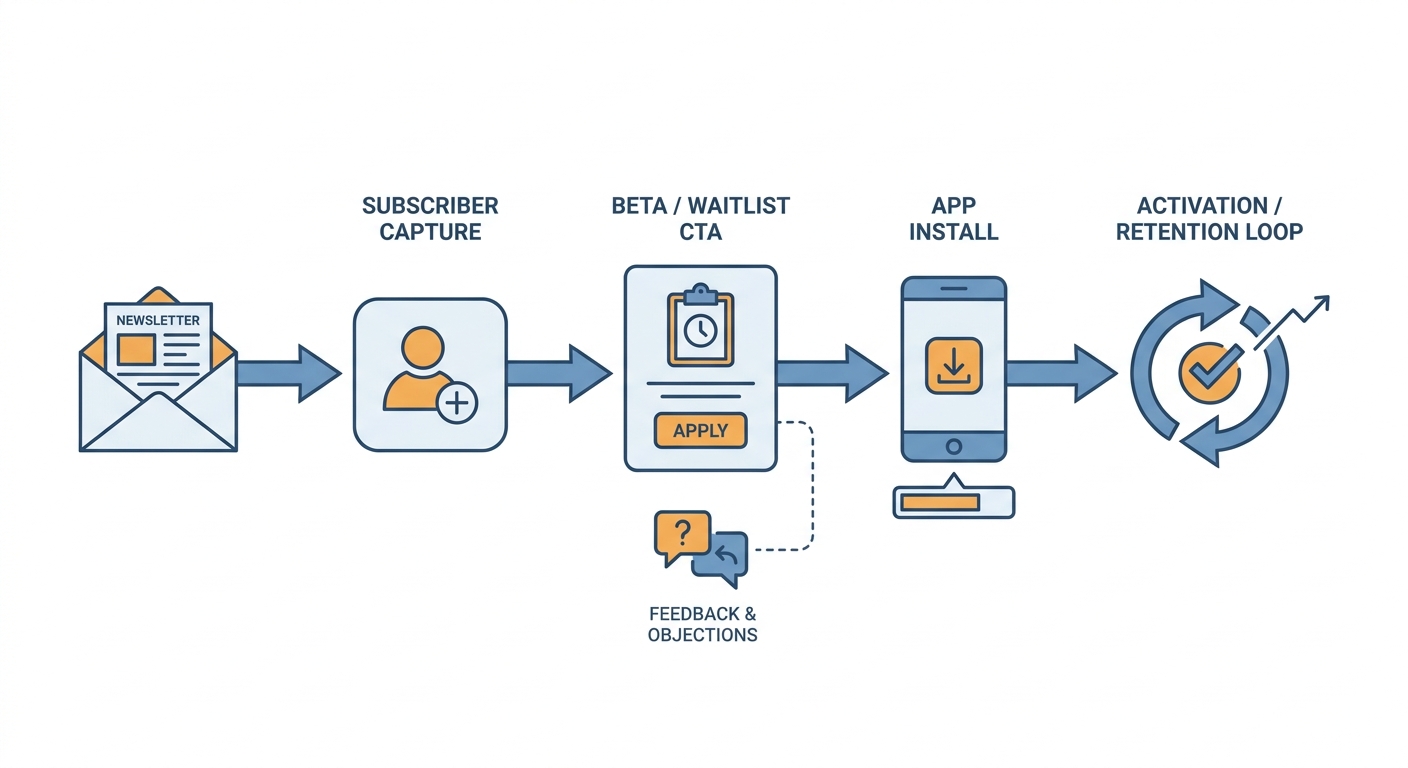
A simple funnel diagram showing Substack post → subscriber capture → beta or waitlist CTA → app install → activation or retention, tailored to app audience growth.
Define the audience around the app problem, not the app itself
Name the job-to-be-done your reader is trying to finish
Position the newsletter around a stubborn workflow or recurring decision, not your roadmap. Product updates mainly help existing users; problem-led writing attracts future users who have not picked a tool yet.
Commit to one topic lane you can sustain
Pick a lane your app can credibly win: mobile productivity, creator monetization, fitness adherence, local discovery. Realistically, a solid issue often takes 2 to 5 hours end to end (outline, draft, edit, links, CTA, analytics), so choose a format you can maintain without burning the team.
Tie each issue to a reader outcome that hints at the app
Aim for a measurable win: save time, reduce errors, ship faster, stick to a habit. The app should feel like the obvious next experiment, not a forced pitch.
Use a simple content funnel that ends in app action
Valuable post
Teach one tactic, template, or teardown. Keep it practical enough that a reader can try it in 10 to 20 minutes, or trust will not compound.
Low-friction capture
Use one clear CTA: waitlist, invite code request, or a feature poll that segments intent. Multiple CTAs per post usually split attention unless you have strong segmentation.
App action and measurement
Track click-through, signup conversion, and activation. Use UTM parameters on every link and keep a simple dashboard (a spreadsheet is fine) to compare posts over time.
Example flow (one concrete model): a post on "weekly meal planning that actually sticks" links to /meal-plan with utm_campaign=substack_weeklyplan, drives install via an app store page, then you measure activation as first_plan_created within 24 hours.
Funnel sketch: Substack post - subscribe - CTA (waitlist or beta) - install - activation - retention.
Mid-article CTA: treat Substack like a product channel
Audit your launch touchpoints and mark every place you could capture an email, then list 10 Substack topics you can repurpose from onboarding, support tickets, blog posts, and social threads. If you cannot commit to a cadence for at least 8 weeks, keep the scope small instead of scaling distribution.
Run the audit
A complementary angle worth comparing lives in Ways to Grow Your App Without Paid Ads.
How do you run Substack like a growth system?
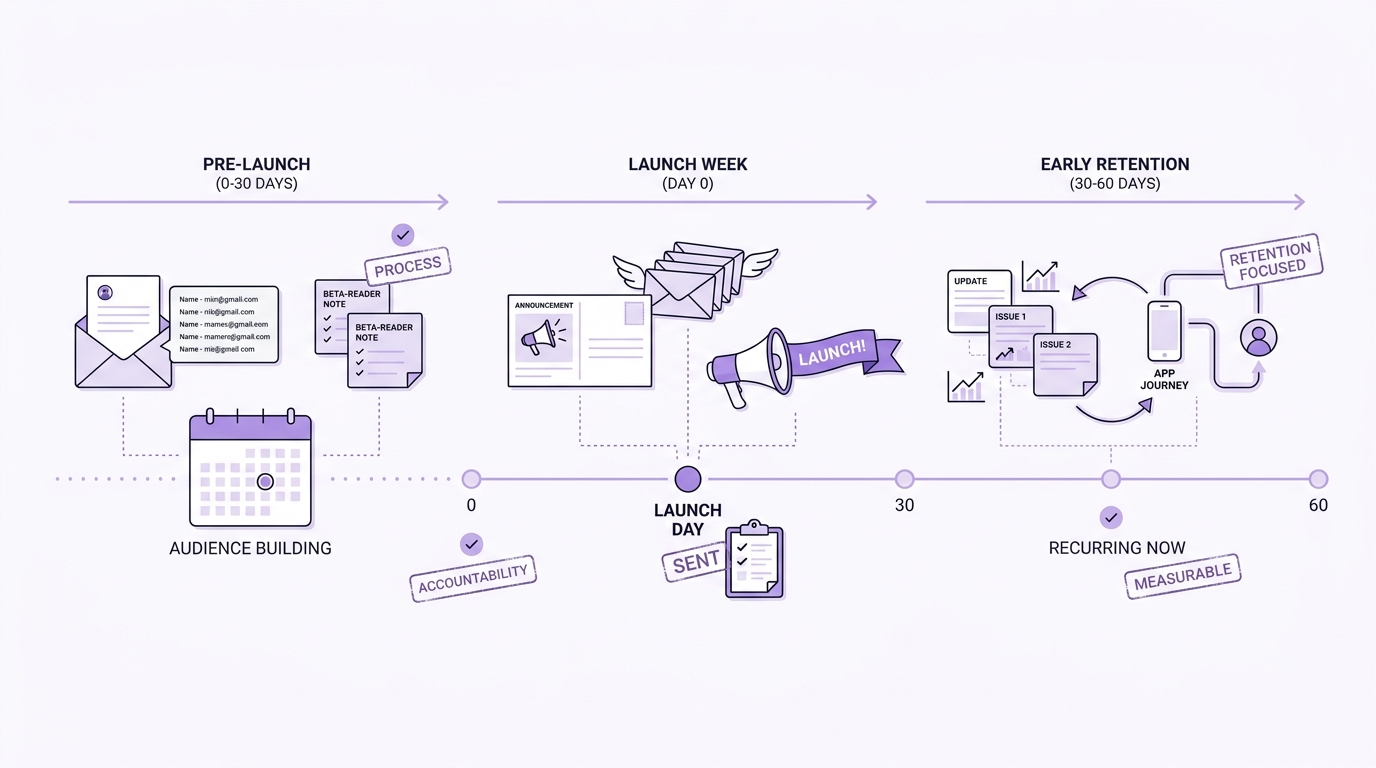
A timeline block showing how a pre-launch app can use Substack for beta recruiting, launch-week announcements, and post-launch retention updates across the first 60 days.
Cadence and segmentation for app-stage teams
- Pre-launch: Ship a lightweight cadence (every 2 to 3 weeks) focused on recruiting the right beta readers, not maximizing volume. Budget 2 to 4 hours per send if you are still finding your voice and offer.
- Early growth: Move to a steadier weekly rhythm once you have repeatable product news (new feature, new template, new integration, new use case). The tradeoff is quality versus consistency, so set an editorial bar you can hit every week.
- Scaling: Segment subscribers so each email maps to an in-app action. Useful cuts include role (founder, ops, dev), device type (iOS, Android, web), use case, or acquisition source, but expect overhead: tagging breaks, partial data, and tooling limits can slow you down.
60-day operating timeline (typical, not guaranteed): day 0 beta call - day 14 early learnings - day 30 launch prep - day 45 launch week sequence - day 60 retention wins and roadmap. If your product is not stable by day 30, prioritize product readiness over newsletter volume, or you will recruit churn.
What to measure so Substack does not become content theater
- Engagement: opens are directional, but watch click-through rate and replies per send.
- Conversion: click-to-signup (or click-to-install) on a single dedicated landing page.
- Activation: the in-app event that indicates value (first project created, first workout logged, first export).
- Retention: cohort retention for Substack-sourced users versus other sources, knowing attribution is imperfect.
One thing worth noting: Substack analytics will not fully reconcile with app analytics. Expect gaps due to privacy, email clients, and cross-device behavior. The goal is directional decision-making, not perfect attribution.
Limits and failure modes to plan for
Substack can underperform even with good writing. Common blockers are deliverability/list fatigue (too frequent, too broad), a weak offer or unclear positioning, and an audience that likes your ideas but is not your ICP for the app.
Also plan for operational dependencies that can quietly cap results: deep links can break after app updates, app store pages can become the real bottleneck, and slow review cycles (or an unfinished onboarding flow) can turn a good send into a churn spike. If onboarding is leaky or pricing is misaligned, Substack may increase traffic without improving activation.
Final CTA: build a measurable first 8-week plan
Pick one audience segment, one topic lane, and one conversion surface (one landing page). Then run 8 weeks of sends with UTMs, a simple dashboard, and one activation metric so you can decide whether to double down or stop.
Build the plan
For tradeoffs, checklists, and edge cases, The Fastest Way to Make Your First $1,000 From an iOS App rounds out this section.