The launch spike is the easy part: attention concentrates, installs jump, and then the curve often drops faster than teams can measure it. Many apps see Day-1 retention under 30% and Day-7 under 10% in directional benchmark roundups, which is why growth plateaus even when the top of funnel still looks healthy. This article turns that evidence into a post-launch operating plan to find where momentum leaks and improve your odds of a second growth curve driven by activation, retention, and repeatable discovery loops.
How to Launch a Social App and Get Your First 1000 Members goes deeper on the ideas above and adds concrete next steps.
Why app growth often slows after launch week
Category: Retention
Statistic: <10%
Label: Day-7 user retention
Context: Engagement drops quickly after week one
Category: Retention
Statistic: 4 - 6%
Label: Day-30 user retention
Context: Only a small cohort typically sticks long-term
Category: Outcomes
Statistic: 38%
Label: First-pass approval rate
Context: When metadata is complete upfront
| Time window | What typically spikes | What typically drops | Why it matters |
|---|---|---|---|
| Days 0-3 | Installs from PR, featuring, promos | Session frequency per user | Attention is front-loaded, behavior is not |
| Day 7 | Residual installs | Retention often falls to under ~10% directionally (Snoopr, Digia) | A download spike is not yet a growth loop |
| Day 30 | Slow recovery only if discovery and retention improve | Retention often ~4-6% directionally (Appcues) | Without a second curve, CAC can rise over time |
What it shows: Launch visibility often outruns retention, so the curve can turn down within a week.
How to interpret: Use these ranges as a sanity check by category and channel mix, not as a pass-fail score.
Business impact: If D7 and D30 stay soft, promos and paid spend often replace churn rather than compound, raising blended CAC and making revenue less predictable.
When you move from outline to execution, The Rise of Solo App Founders - How One Person Can Compete helps close common gaps teams hit here.
What keeps app growth going after launch?
Launch week is a concentrated acquisition event, not a durable growth engine. After the attention window closes, growth is governed by a smaller set of controllable metrics: store page conversion, first-session activation, cohort retention (D1, D7, D30), monetization conversion (if applicable), review velocity, and re-engagement.
A practical constraint: you cannot optimize all of these at once without slowing shipping. Most teams move faster by picking one bottleneck per 1-2 week cycle and treating the rest as monitoring.
Evidence scope and uncertainty
- Benchmarks vary by category, pricing model, geography, and launch mix; treat them as directional.
- App Store and Google Play differ in ranking dynamics, review effects, and experiment tooling.
- Public sources aggregate across many apps and time windows, which can hide small-sample effects and outliers.
- The focus here is weekly-operable levers, not precise third-party statistics.
A complementary angle worth comparing lives in How to Get Your First 1,000 Users for Your iOS App.
Prereqs, typical effort, and when this fails
| Item | Prereqs | Typical effort | When this fails or stalls |
|---|---|---|---|
| Cohort retention and activation readouts | Clean event names across iOS and Android, source attribution you trust | 0.5-2 days to validate and fix basics | Low volume (small cohorts), inconsistent events, missing source data |
| Onboarding and activation changes | Ability to ship a release, QA coverage, crash monitoring | 1-3 engineering days per iteration plus release overhead | Changes bundled with unrelated features, regressions, or slow review cycles |
| Store experiments (ASO) | Enough impressions, creative capacity, store experiment access | 2-4 weeks per iteration if samples are small | Traffic too low for significance, weak positioning, high keyword competition |
| Lifecycle messaging | Consent flow, segmentation, deliverability | 3-7 days for a first pass, longer to tune | Low opt-in rates, spam complaints, generic blasts that annoy users |
For tradeoffs, checklists, and edge cases, Ways to Grow Your App Without Paid Ads rounds out this section.
Key data points: where launch momentum usually leaks
Activation and retention are usually the first bottleneck
Use the proof block above as a reference point, then make retention diagnosable.
- Define activation as a specific event. Example: activation = account created plus first value action completed (for fitness: "completed first workout") in the first session.
- Measure first-session drop-off by step. Permissions, signup, paywall, tutorial, first value action. Track completion per step, not just overall bounce.
- Separate curiosity installs from real demand. Compare cohorts from launch PR vs search or referral. If one source retains much worse, you may have expectation mismatch, not just product issues.
Operational caveat: if you are under a few dozen installs per day, week-to-week swings can be noise. In that case, pair cohorts with qualitative inputs (reviews, support tickets, session replays) and avoid overreacting to small deltas.
Store page conversion and reviews shape visibility
Store performance is the bridge between impressions and installs, but it has real constraints.
- Run store experiments, expect slow learning. If impressions are low, tests can take weeks or never reach significance.
- Track review velocity as a rate. Reviews per 100 installs and rating trend is more actionable than total reviews.
- Plan a realistic cadence. One ASO iteration every 2-4 weeks is common once you include creative, localization decisions, and store review time.
Risk note: rating prompts can backfire if they trigger during friction (paywall, bugs, failed login). Watch for a spike in 1-2 star reviews and be prepared to roll back quickly.
Acquisition mix determines how long the spike lasts
Press-driven installs often decay fastest because attention is rented. Paid can scale, but if retention is weak it pushes CAC up as you keep buying low-quality demand. Community and referral loops can decay slower, but they usually require product work (sharing hooks, moderation, incentives) and do not appear overnight.
One thing worth noting: if product-market fit is still unclear, channel tuning will not fully fix retention. The practical move is to use cohorts to learn faster and keep spend conservative until you see repeatable payback.
Best Way to Get Your First App Downloads for Free reframes the same problem with a slightly different lens - useful before you finalize.
Interpretation: the operating loop that turns spikes into durable growth
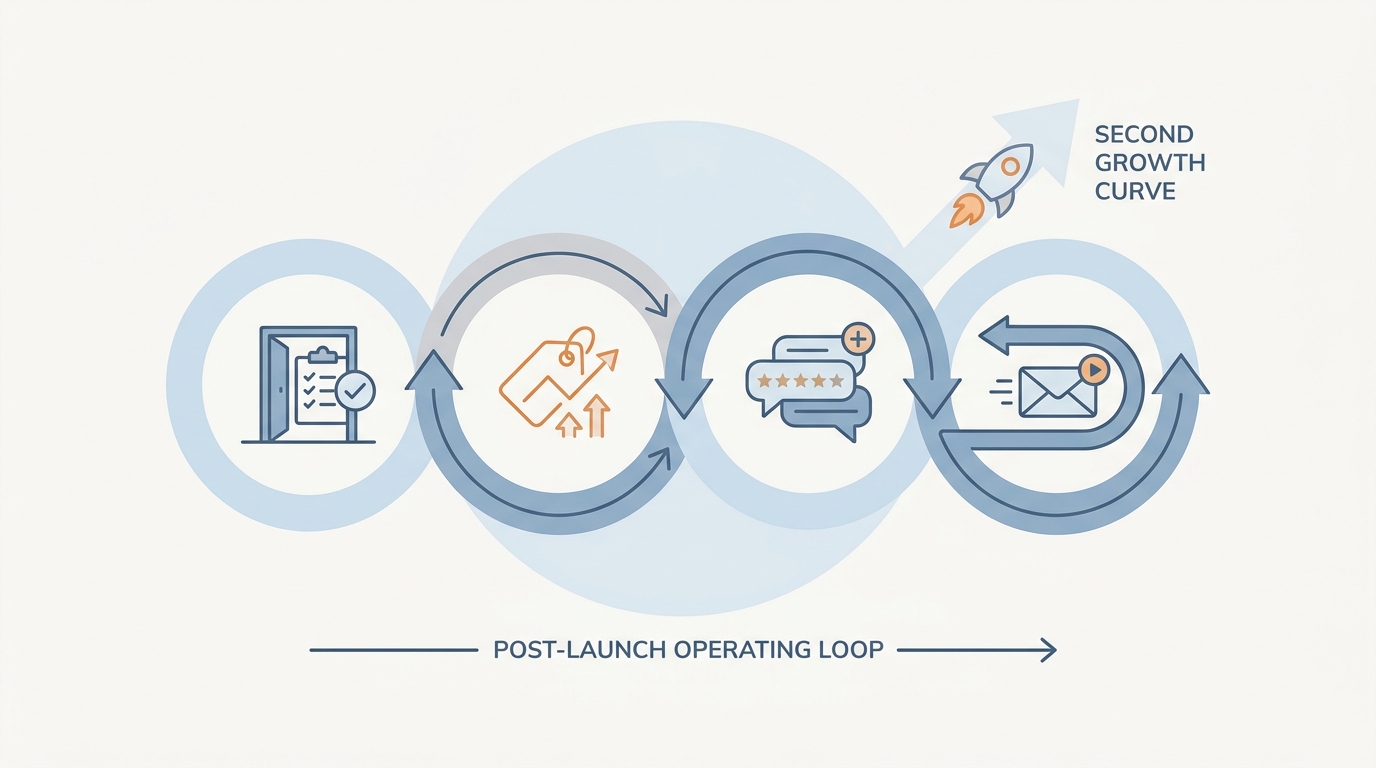
A simple process diagram showing the sequence from activation fixes to store optimization, review collection, and re-engagement loops that extend app growth after launch.
Fix activation before you scale acquisition
Treat activation as the gate before you add channels or budgets. If users do not reach first value quickly, more installs typically amplify churn and muddy channel performance.
Audit the first-session path
Time to first value, number of steps, and where prompts interrupt progress. Expect 2-4 hours to map the path and pull funnel data, plus 0.5-2 days if events are missing or inconsistent.
Reduce friction where users hesitate
Defer noncritical prompts, simplify choices, remove dead ends. Tradeoff: less data capture and personalization in the short term, so decide what you can live without for a week or two.
Validate with cohorts and release health
Check activation rate and D1 retention by app version and source. Pair changes with crash-free users, startup time, and login error rates because a single regression can overwhelm any onboarding improvement.
Rebuild discovery with ASO, updates, and social proof
After rankings cool, discovery becomes a relevance and conversion game. Plan for iteration, not a one-time rewrite.
- Refresh metadata around post-launch search terms, not PR keywords
- Ship updates that justify new screenshots, clearer "what's new", and renewed featuring pitches
- Strengthen social proof with well-timed rating prompts and proof points that match your top queries
Constraint note: ASO gains depend on impressions, keyword competition, and conversion. If traffic is low, start with clearer positioning and onboarding, then target a small set of high-intent keywords you can realistically rank for.
What is the 30-day plan for keeping app growth alive?
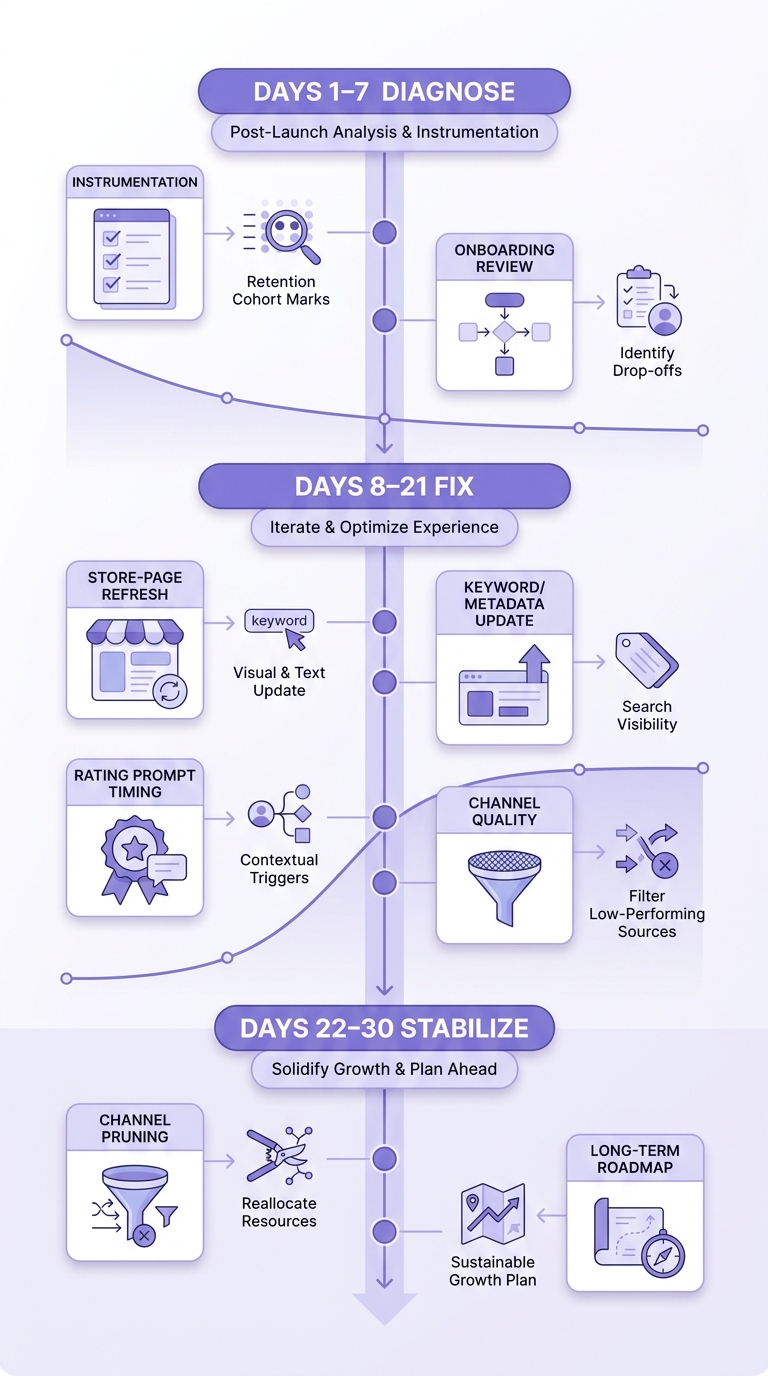
A timeline block that maps the first 30 days after launch into diagnose, fix, and stabilize phases, with checkpoints for retention, onboarding, store updates, and channel quality.
First 7 days: diagnose the leak
Pull cohort basics and validate instrumentation
Confirm events for install, first open, activation, and key value actions. Budget 0.5-2 days for cleanup before you trust conclusions, especially across iOS vs Android.
Check store conversion and release health first
A sharp view-to-install drop can be messaging mismatch. Elevated crashes, slow start, or login failures can also suppress retention and reviews, so scan release health before changing acquisition.
Segment by launch channel quality
Compare activation and returning users by source. If one channel brings volume but no repeat use, the blocker is often expectation-setting (store page, ads) rather than awareness.
Days 8-14: ship one activation fix and one ASO iteration
- Ship a small change to the biggest onboarding drop-off (remove a step, defer a permission, simplify a choice). Expect at least 1 engineering day plus QA and release overhead.
- Update one store asset set (icon or first two screenshots) and tighten the first-line value proposition. Factor in design time and store review delays.
- Decision point: if D1 improves but D7 does not, you likely fixed friction but not the ongoing job-to-be-done, content depth, or habit loop.
Pitfall: paywall or pricing tests can cause short-term revenue dips even when they help retention. Use guardrails (revenue per install, refund rate, support volume) and avoid stacking multiple monetization changes in the same week.
Days 15-30: build the second curve (measured, not heroic)
- Add one re-engagement loop (push, email, in-app) tied to a user trigger, not a calendar blast. Expect at least a week to tune timing and copy, and do not assume high push opt-in rates.
- Implement a rating prompt after a success moment and monitor both rating trend and complaint volume.
- Keep spend conservative until you see directional improvement in D7 cohorts; otherwise you can pay to scale churn.
Dependency note: lifecycle messaging needs consent, segmentation, and basic deliverability monitoring. If you do not have that stack, start with in-app prompts and store improvements while tooling is set up.