Launching a social app is rarely a product problem - it is a momentum problem: you ship, people peek in, and the room still feels empty, so they do not come back. Founders and builders get stuck chasing downloads when what actually matters is getting enough of the right people active at the same time to create conversation, retention, and a reason to return. By the end, you will have a step-by-step launch workflow to seed activity, recruit your first core members, and build a repeatable path toward 1,000 members (without pretending there is a single guaranteed playbook).
How to Get Your First 1,000 Users for Your iOS App goes deeper on the ideas above and adds concrete next steps.
Why is the first 1,000 members the real launch milestone?
A social app can be fully functional and still feel broken when there are no posts, no replies, and no familiar faces. Cold traffic (App Store, Google Play, most ads) decides fast whether the room is alive, and they leave if it is not.
"1,000" is not magic. It is a practical proxy for "enough density" in a narrow niche so posts reliably get seen and answered. Depending on your niche, time zones, and posting frequency, you might feel momentum at 300 or need 2,000+.
What 1,000 members should prove is simple: one engaged niche plus one repeatable acquisition path. If you have 1,000 signups but no replies within hours, the milestone is not doing its job.
When you move from outline to execution, Best Way to Get Your First App Downloads for Free helps close common gaps teams hit here.
Early proof: what a workable social app launch looks like
Category: Retention
Statistic: 15 - 30%
Label: 7-day return (joined users)
Context: Early retention: are users getting a real win?
Category: Outcomes
Statistic: 38%
Label: First-pass approval rate
Context: When metadata is complete upfront
Category: Speed
Statistic: 4 hrs
Label: Median fix time
Context: After a store rejection notice
The table below is a directional, internal-style benchmark for your first cohort (not an industry average). Use it to diagnose where your launch is breaking, not to grade yourself against a universal standard.
| Funnel step (first cohort) | Directional target | If it is weak, it often means | What to do in the first 7 days |
|---|---|---|---|
| Invites sent -> joined | ~20-40% | Targeting or promise is fuzzy, join flow has friction | Tighten the niche + simplify invite and install steps |
| Joined -> first post (or core action) | ~20-40% | Onboarding does not point to a clear first move, feed looks empty | Add a single "do this first" path + seed 10-20 starter posts |
| Posts -> at least 1 reply within 24 hours | ~40-70% | Not enough overlap online, prompts are too broadcast-y, nobody is hosting | Schedule reply coverage + ask questions, not statements |
| 7-day return (joined users) | ~15-30% early | No clear win, notifications are noisy or absent | Use lightweight reminders tied to real activity, not generic pings |
Interpretation: ratios matter more than absolute numbers. If joins rise but posting and replies do not, distribution is outrunning onboarding clarity or niche fit.
Reader impact: if replies-per-post is weak on day 3, do not "market harder" on day 4. Reduce invites, tighten the segment, and commit to fast responses until threads reliably get answered.
Mini example (how to apply this fast):
- If replies per post < 0.5 by day 3, pause new invites for 48 hours, post 1 targeted prompt/day, and guarantee host replies within 2-4 hours during your niche's peak time.
- If joined -> first post < 15%, simplify onboarding to one action and add 3-5 "copy this" prompt templates in the composer.
A complementary angle worth comparing lives in How to Use Reddit to Get Your First 1,000 App Downloads.
How do you launch and reach your first 1,000 members?
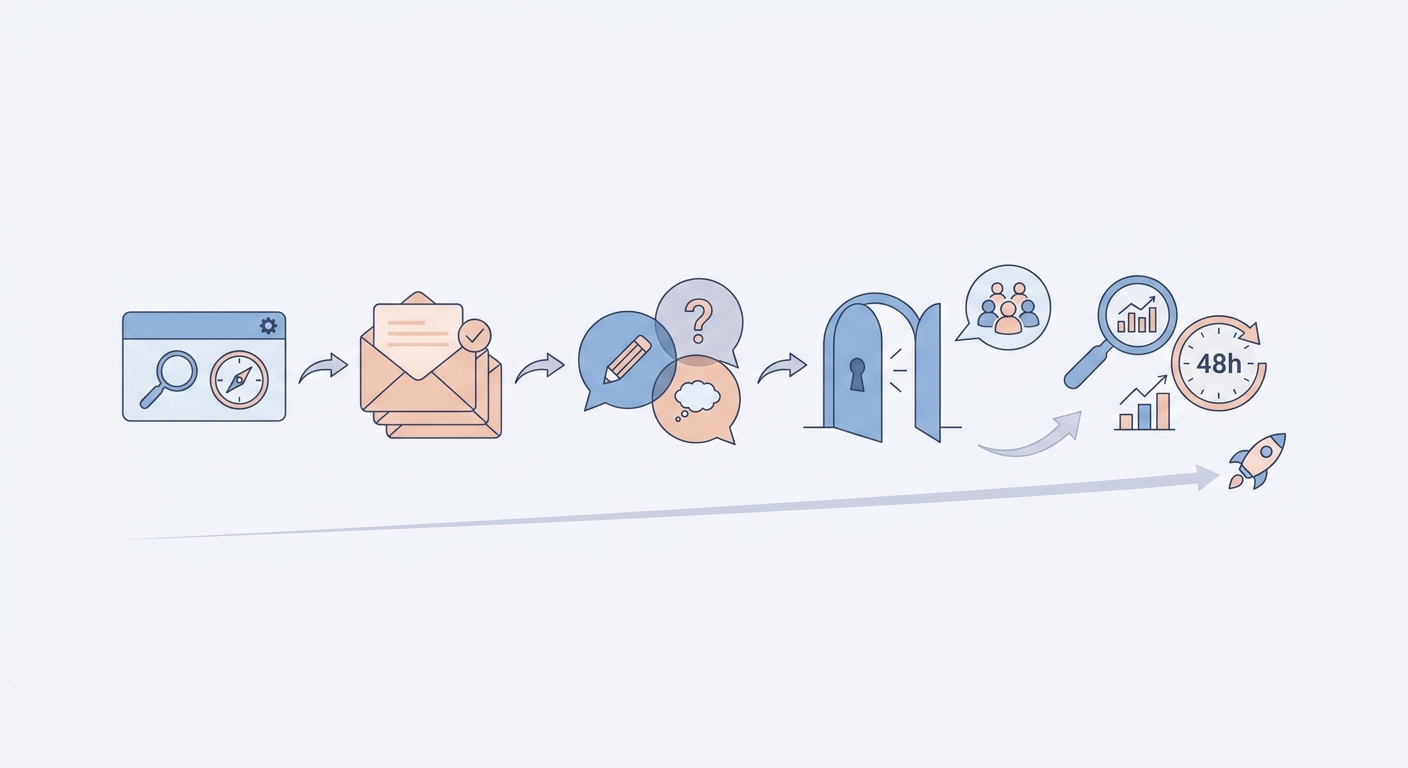
A simple process diagram showing the launch flow for a social app: define niche, build invite list, seed starter conversations, open access, and monitor replies during the first 48 hours.
Write one clear member promise
If you launch for "everyone," you usually get weak conversations and confusing onboarding. Write a one sentence promise like "A community for local runners to find routes and meet up on weekends." You are selling a specific outcome, not features.
Pick one audience segment you can reach this month
Choose a segment you can actually access in the next 2-4 weeks (a group chat, a subreddit, a Slack, a meetup list, a creator audience). Avoid picking two segments that do not overlap because it splits posts and reduces replies.
Define the first repeated outcome
Decide the first action you want repeated: ask for advice, trade tips, organize events, share progress, find partners. If you cannot name the first outcome, you cannot design the first feed, prompts, or notifications.
Plan for real ops work (so the room feels hosted)
Social apps do not fill themselves early. Expect manual effort until norms and loops exist, and expect that it can feel repetitive.
- Time expectation (week 1): plan 60-120 minutes/day replying, welcoming, and prompting, plus 2-3 hours once to prep starter content and rules. If you cannot cover that, recruit 1-3 moderators or community hosts.
- Seeding expectation: you will likely need 10-20 starter posts plus a daily prompt for the first week to prevent empty feeds.
- Constraints: if your niche spans time zones, reply coverage is harder. You may need scheduled "office hours" or co-hosts to avoid long gaps.
- Operational risks: mod burnout is real, and notification fatigue can increase churn. Start with fewer, higher-signal notifications and rotate hosting shifts if possible.
Fix the bottleneck before you scale
Most early growth problems are one bottleneck, not all of them. Do not add a new channel until the weakest ratio is improving.
Common failure modes (and what to change first):
- Invites convert but posting is low - tighten the promise, shorten onboarding, and add a single obvious first action.
- Posting exists but replies are low - focus on overlap hours, ask questions, and guarantee host replies so nobody posts into silence.
- Replies exist but return is low - make the "win" clearer, and keep notifications tied to real activity (not generic pings).
For tradeoffs, checklists, and edge cases, What to Do in the First 48 Hours After Your App Goes Live rounds out this section.
Which growth channel should you use for the next 30 days?
After the initial push, growth stalls when you keep switching channels. Pick one repeatable lane for the next 30 days and run it consistently, even if it is not glamorous.
Every channel has constraints. Choose the one you can execute weekly with your current time, access, and product maturity.
| Channel | Weekly effort (typical) | Main risk | Best when |
|---|---|---|---|
| Founder-led outreach | 2-5 hours | Time cost, inconsistent follow-through | You need tight targeting + fast feedback |
| Niche community posting | 1-3 hours | Getting banned if you self-promote | You can contribute genuinely and invite with a clear benefit |
| Creator partnerships | 2-6 hours (plus waiting) | Unpredictable results, scheduling delays | A creator truly serves your niche and will use the product |
| Email list | 1-2 hours (if you have it) | Slow if you do not have a list | You already have permissioned reach |
| Referral loop | 4-10 hours upfront | Low-quality invites, fraud, room dilution | Members are getting clear wins worth sharing |
Decision point: pick the channel you can execute consistently, not the one that sounds biggest. A small channel you can run every week can beat a big one you touch once.
One more thing worth noting: over-inviting can backfire. If you bring in too many low-intent members before conversations are stable, you can dilute the feed and increase churn.
Execution checklist for the first 1,000 members
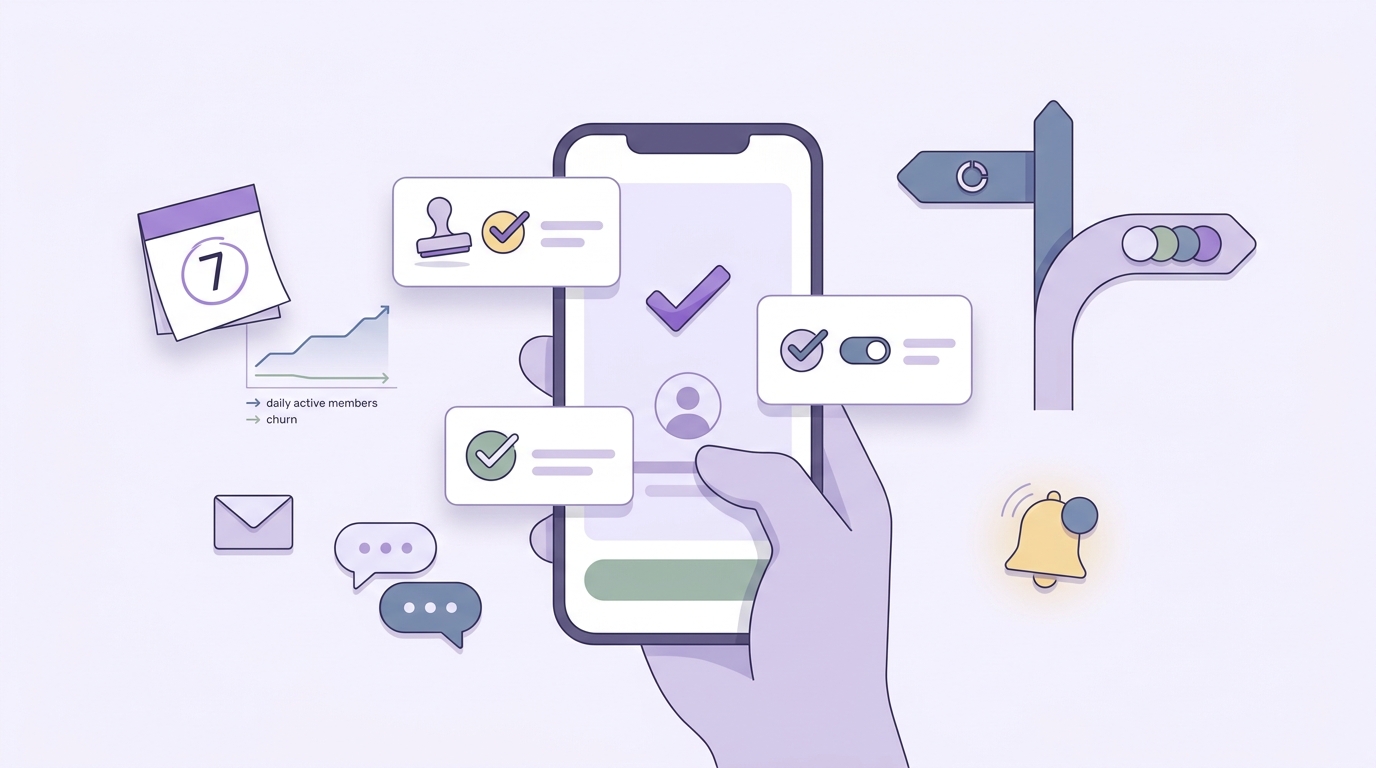
A mobile-friendly checklist for the first week after launch, covering onboarding checks, daily outreach, activity monitoring, and deciding when to scale beyond the first niche.
Pre-launch checks (half day to 1 day)
- Verify onboarding, signup, and push notifications in production builds. Test cold start, permission prompts, and login recovery.
- Pre-seed starter content: 10-20 posts, clear moderation rules, and a 1-minute welcome message that tells members what to do first.
- Test the invite flow end to end: link click -> install -> open -> join -> first post. Fix any step that adds confusion or delay.
Launch-week follow-through (daily)
- Reply fast during your niche's peak hours. Welcome new members by name when possible, and ask a simple question that makes replying easy.
- Check daily: joins, first post rate, replies per post, and next-day return.
- If one segment converts better, keep the app unchanged and adjust only the invite message for the weaker segment.
Realism note: if you are doing founder-led community, you will feel this week. If you cannot keep response times under a few hours, reduce invites until you can cover the room, or set expectations (for example, "hosts reply nightly").
- When to scale (usually week 2+, sometimes later)
- Scale after you see repeat conversations and stable activation, not just signups.
- Expand to the next audience or channel once the first cohort returns without you pushing every thread.
- Ask for invites after a member gets a clear win, not at signup.
Instrumentation detail (keep it simple): track activation and retention in PostHog or Mixpanel with one funnel and two ratios: joined -> first_post within 24h, replies_per_post, and D7 return. You do not need perfect analytics on day 1, but you do need enough to tell whether you have a conversation loop.