
Paid acquisition gets expensive fast, and most apps hit a ceiling once they have already messaged everyone in their own audience. Cross-promotion with adjacent apps can be a practical way to find higher-intent users without making ad spend the only lever. This guide shows how to pick partners, structure placements and offers, and run a first test you can actually evaluate.
| Early proof (directional) | What it is | What it means | What you should do next | Potential business impact |
|---|---|---|---|---|
| Unity Jam City case study | A reported cross-promotion setup that increased install volume when run with more structure (Unity) | Cross-promo can move installs if partner fit, placement inventory, and tracking are solid; it is not a guaranteed uplift | Use this as motivation to test: run 1-2 small swaps with clean measurement and a clear stop rule | You may see lower cost per activated user than some paid channels, but outcomes vary by genre, baseline paid efficiency, and placement quality |
Explanation: case studies show what is possible when a partner swap is treated like a real channel (not a casual banner trade).
Interpretation: the lever is usually placement quality plus audience match, not the mere fact that it is "partner traffic."
Reader impact: you can validate cross-promo in 1-2 tests without betting the roadmap, as long as you measure activation and keep a stop rule.
Best Way to Get Your First App Downloads for Free goes deeper on the ideas above and adds concrete next steps.
Why do app cross-promotion partnerships matter?
Category: Savings
Statistic: 32%
Label: Lower rework cost
Context: By catching issues earlier
Category: Cost
Statistic: $2 - $8 per install
Label: Typical paid install CAC range
Context: Baseline cost when buying traffic via ads
Category: Cost
Statistic: ≈$0 - $1 per install
Label: Partner-swapped installs (marginal)
Context: Often driven by placement swaps vs. direct media spend
Paid ads are still a great tool, but costs tend to rise as you scale and attribution can get messy, especially on iOS with SKAdNetwork. Cross-promotion swaps trusted distribution instead of renting attention.
In practice, cross-promo usually brings less volume than ads, but can bring better intent when the partner is genuinely adjacent. The goal is not "free growth." The goal is another repeatable input to activated users.
What makes a partnership worth pursuing
- Adjacency with shared intent: overlap in the job-to-be-done, not direct competition
- Similar readiness: both teams can promote in the next 2-6 weeks (shipping delays are common)
- A placement you can control: in-app card, onboarding step, email block, or push (with consent and brand fit) (PickFu)
- Reasonable quality bar: decent reviews, clear onboarding, and a product your users will not regret installing
Tradeoff: tighter match usually means smaller reach. For early tests, that is fine. You are buying clarity, not vanity volume.
CTA: Start small with a partner pipeline
Pick 10 adjacent apps, shortlist 3, and ask for one measurable placement test.
Start your partner pipeline
When you move from outline to execution, 5 Proven Monetization Models for iOS Apps in 2026 helps close common gaps teams hit here.
How do you find and launch the right app partner?
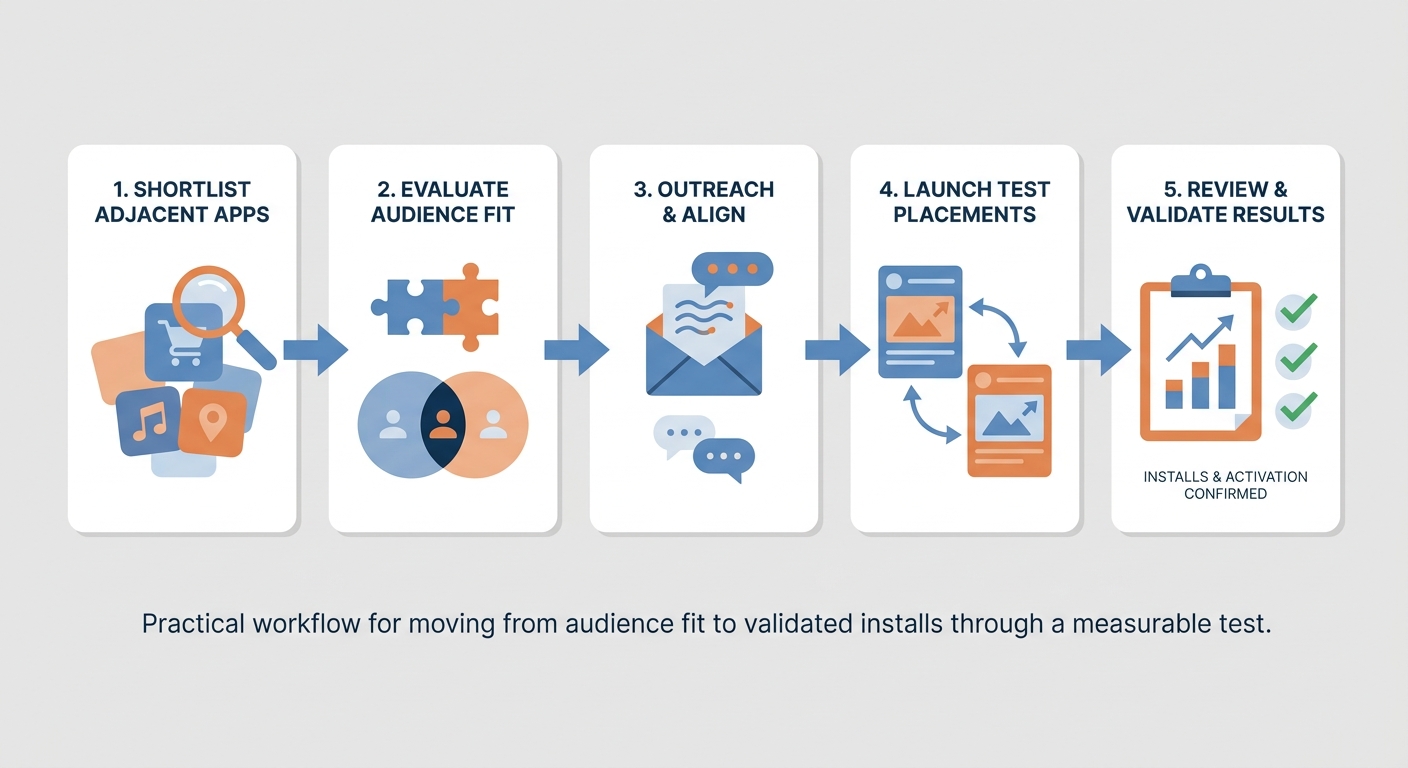
A step-by-step workflow from shortlist to outreach to test launch to metric review, with arrows showing how an app partner exchange moves from audience fit to validated installs.
Build a shortlist you can actually contact
Start with 10-20 realistic candidates and expect 30-60 minutes to build the first list. Use App Store and Google Play search in adjacent categories, then skim screenshots and recent reviews to understand who the app is for and what users say they need.
Capture: app name, overlap hypothesis, likely placement type, and a draft offer angle (trial extension, template pack, onboarding checklist). A tight list beats broad outreach because it reduces back-and-forth and improves reply rates.
Qualify fit before you pitch
You are looking for signs they can drive valuable installs, not just clicks.
- Product health: recent updates, stable ratings, active reviews
- Audience compatibility: geo, device requirements, and pricing model are not wildly mismatched
- Operational feasibility: they can implement a placement (or insert an email block) without a major roadmap fight
- Measurement reality: you can agree on what "success" looks like with imperfect attribution
Plan for logistics. A simple swap can still take 2-6 weeks once you include creative, QA, approvals, and scheduling.
A concrete example workflow (what a first test can look like)
| Element | Example you can copy |
|---|---|
| Placement | In-app card shown on day-2 after a user completes a key action |
| Offer | "Free template pack" or "Unlock feature X walkthrough" (no discount required) |
| Target metric | Activated users per 1,000 impressions (plus day-1 retention if you can) |
| Test window | 10 days, with a stop rule if activation is below your baseline |
This kind of placement is small enough to ship without heroics, and specific enough to diagnose where things broke (impressions, clicks, first open, activation).
Run a narrow test and measure it honestly
If your analytics and deep links already exist, expect 3-8 hours for creative and tracking setup. If you need new events, QA across devices, or store listing updates, it can stretch into 1-2 weeks.
Prereqs:
- Partner-specific deep link (or tracked link) and a defined landing experience (Branch, Firebase Dynamic Links, or an MMP link)
- One primary metric (usually activated users, not raw installs)
- A clear test window (typically 7-14 days) and a stop rule
Track the funnel you can observe: impressions - clicks - first opens - activation. Name partner events consistently (for example partner_install and partner_activated) so you can compare tests later.
A complementary angle worth comparing lives in Should You Publish Your App Yourself or Hire Someone?.
Constraints and failure modes (so you do not overread results)
- Attribution is directional: SKAN noise, MMP config, and consent rates can blur lift, especially on small tests.
- Partner delivery risk: placements launch late, ship smaller than promised, or get deprioritized when their roadmap changes.
- Creative and landing mismatches: a good click-through can still produce low activation if the first screen is confusing.
- Inventory quality varies: not all in-app surfaces are equal; some drive curiosity clicks that churn fast.
- Opportunity cost: even a "small" test pulls product, marketing, and QA time away from core roadmap work.
For tradeoffs, checklists, and edge cases, How to Launch a B2B Mobile App on App Store rounds out this section.
Mistakes that make app-to-app cross-promotion fail
Choosing a big app instead of a relevant one
Big reach with low intent can look like growth and still be a net negative. Broad placements often drive curiosity clicks that churn fast, which can distort your retention read and make the partnership hard to repeat.
Quick filter: if you cannot explain the overlap in one sentence (who they are, what they are trying to do, and why your app helps right then), do not run the test yet.
Trading traffic without a clear offer
- Tie the swap to one action: try a feature, redeem a code, or complete a specific workflow
- Avoid generic banners and vague copy that pull low-quality clicks
- Write partner-specific messaging for in-app vs email vs social audiences
Constraint: partner brand teams may reject aggressive copy or discounts. Bring a "no discount" version so you can still ship.
Measuring only installs (and calling it a win)
Installs are easy to count and easy to misread.
- Track one activation event and day-1 retention if you can
- Separate results by placement type (in-app, email, social) to learn what actually worked
- Set a kill rule: if clicks are high but activation is weak, stop or change the offer
If a partner under-delivers, reconcile what shipped vs what was promised, then either reset terms for a second test or walk away. Do not "average it out" across partners or weeks and pretend it was a channel win.
Ways to Grow Your App Without Paid Ads reframes the same problem with a slightly different lens - useful before you finalize.
What should you check before your first app partnership?
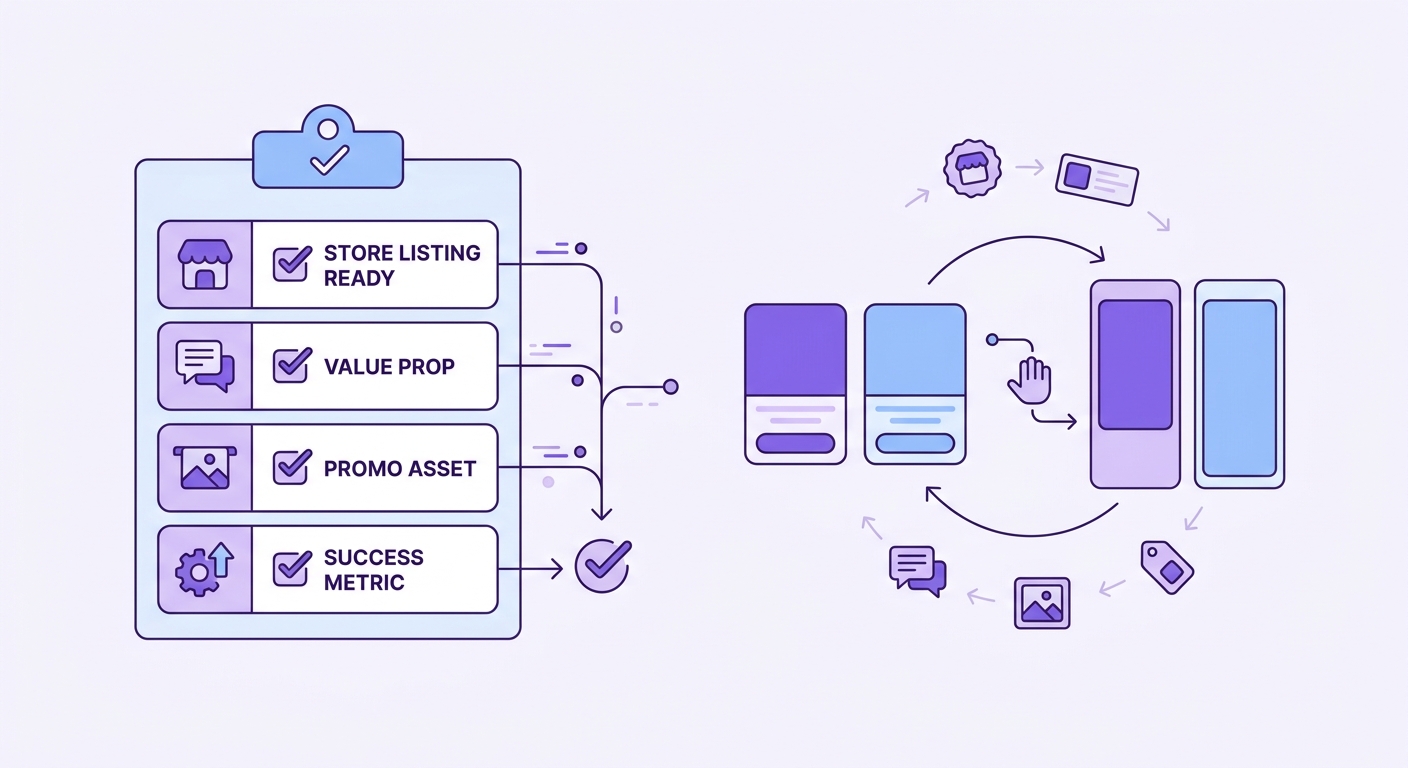
A mobile-friendly checklist of outreach readiness items for app cross-promotion, including store listing quality, partner value proposition, promo asset, and success metric.
Pre-flight checks before you contact a partner
- Store listings are conversion-ready (clear screenshots, tight first line, no broken deep links)
- One-sentence value prop that fits their user moment
- One placement asset ready (banner/card/email block) plus one variant
- One deciding metric (activated users per 1,000 impressions is often more honest than raw installs)
| Checklist item | Why it matters |
|---|---|
| Store listing polish | Prevents partner traffic waste and improves conversion |
| Single deciding metric | Makes the test easier to judge and repeat |
Post-launch review and next actions
- Review the funnel early (first 48-72 hours) to catch broken links, wrong destinations, or low impressions
- If installs are fine but activation is weak, adjust the offer or onboarding before blaming the partner
- If clicks are low, renegotiate placement or swap creative; placement and messaging can change outcomes significantly (PickFu)
- Document what worked: audience, offer, creative, placement, and timing
CTA: Turn one test into a repeatable playbook
Run one 7-14 day swap, write down the funnel numbers, then repeat only if activation holds.
Run your first cross-promo test


