
Getting your app built is only half the battle. The harder part is earning discovery in the app store, where ranking signals, competitor moves, and review sentiment change faster than most indie teams can track manually. This ranked roundup compares the best App Store Optimization (ASO) tools of 2026 so you can pick one that fits your workflow and run measurable, repeatable listing improvements.
App Store Optimization in 2026: What Actually Moves the Needle goes deeper on the ideas above and adds concrete next steps.
Does ASO actually work?
Benchmark snapshot (directional, based on hands-on workflows)
| What we tested (inputs) | How we checked it (method) | What we saw (interpretation) | Reader impact |
|---|---|---|---|
| Tracking 20 keywords across iOS + Google Play | Weekly rank check every Monday, 1 metadata change per week, 4-week log with notes on competitor updates | After a single change, about 6-9 of 20 keywords moved 3+ positions week over week, but several reversed the next week | You avoid overreacting to noisy swings and only double down when movement holds for 2 checks |
| Competitor context for 3 close rivals | Keyword gap scan + side-by-side metadata views, refreshed biweekly | Gap views are most useful for saying "not yet" to head terms and picking adjacent intents where your app can plausibly rank | You spend less time chasing unrealistic keywords and more time shipping focused updates you can defend |
| Review monitoring for the last 100 reviews | Weekly 15-minute triage with simple tags (bugs, pricing, onboarding, performance), plus alerts for rating dips | Review ops can lift conversion, but only if you can act on themes within your release cadence | You catch issues early enough to fix and communicate, instead of discovering them after installs stall |
This is directional, not a promise of uplift. Category volatility, store experiments, and low data volume can easily swamp signal, especially if you have low impressions or only a few reviews per month.
What this means: the biggest win is not a guaranteed ranking boost. It is a tighter feedback loop you can keep up with as a small team, so you make fewer random changes. In practice, expect 60-120 minutes to set up your first tracking set, then 30-60 minutes per week to maintain it.
When you move from outline to execution, App Store Keywords: The Only Guide You Actually Need helps close common gaps teams hit here.
How we ranked the best app store optimization tools
What we judged each ASO tool on
Keyword tracking reliability (App Store + Google Play)
- Stable history and clear before/after comparisons
- Enough context to interpret volatility (not just a chart)
Competitor analysis depth
- Metadata and positioning comparisons
- Keyword gaps that help you pick realistic targets for your current authority
Review monitoring workflows
- Rating change visibility and useful alerts
- Lightweight tagging so themes can feed roadmap and release notes
Value for money (for indie founders)
- Usable without a dedicated growth team
- Transparent limits (keywords, competitors, history, alerts)
These criteria mirror how 2026 ASO platforms tend to differ: some lean keyword intelligence, others lean review ops, and a few cover everything (often with cost or complexity tradeoffs). For broader market context, see roundups from ASO World, AppFollow, and AppDrift.
Why indie founders need a narrower shortlist than enterprise teams
Enterprise teams can justify broad platforms because they have specialists to run them. Indie founders usually do not, so setup speed, dashboard clarity, and alert quality beat feature sprawl.
One thing worth noting: the cheapest tool can still be expensive if it adds overhead. Plan for onboarding time and at least one release cycle (often 2-4 weeks) before you judge ROI.
A complementary angle worth comparing lives in ASO Without Guessing: A Practical Keyword Workflow for Indie Founders.
Top picks at a glance: the best ASO tools ranked by use case
Quick comparison table
| Rank | Tool | Best for | Strongest signal area | Main tradeoff | Indie fit cue |
|---|---|---|---|---|---|
| 1 | AppTweak | Balanced ASO: tracking + competitor research | Keyword intelligence + competitive insights | Premium tiers can be overkill if you only track a small set | Best if ASO is a weekly habit |
| 2 | AppFollow | Review monitoring and rating recovery | Review ops + sentiment workflows | Not a full replacement for deep keyword research | Best if reviews and ratings swing installs |
| 3 | Appfigures | Budget-friendly ASO testing | Practical tracking with lightweight research | Less depth than premium suites for opportunity discovery | Best for early validation without heavy spend |
These tools are consistently mentioned across 2026 ASO roundups, but they stand out for different reasons. Adjacent platforms (Sensor Tower, ASOdesk, MobileAction, and others) are covered in guides from ASO World, AppFollow, and AppScreenMagic.
How to read the rankings before you buy
This list is ranked by practical fit for indie discovery work, not by pretending there is one universal best platform. Your best choice depends on your bottleneck: keyword clarity, competitor context, or review-driven conversion.
The practical takeaway: a tool is only "best" if it saves you time and changes what you ship next week. Also, the loop needs enough data: if you have very low impressions, a tiny keyword set, or minimal reviews, results will take longer to interpret.
For tradeoffs, checklists, and edge cases, Top 5 Ways to Monetize Your First iOS App rounds out this section.
Ranked recommendations: the best App Store Optimization tools for 2026
Tool #1: AppTweak - best overall for founders who need keyword tracking plus competitor analysis
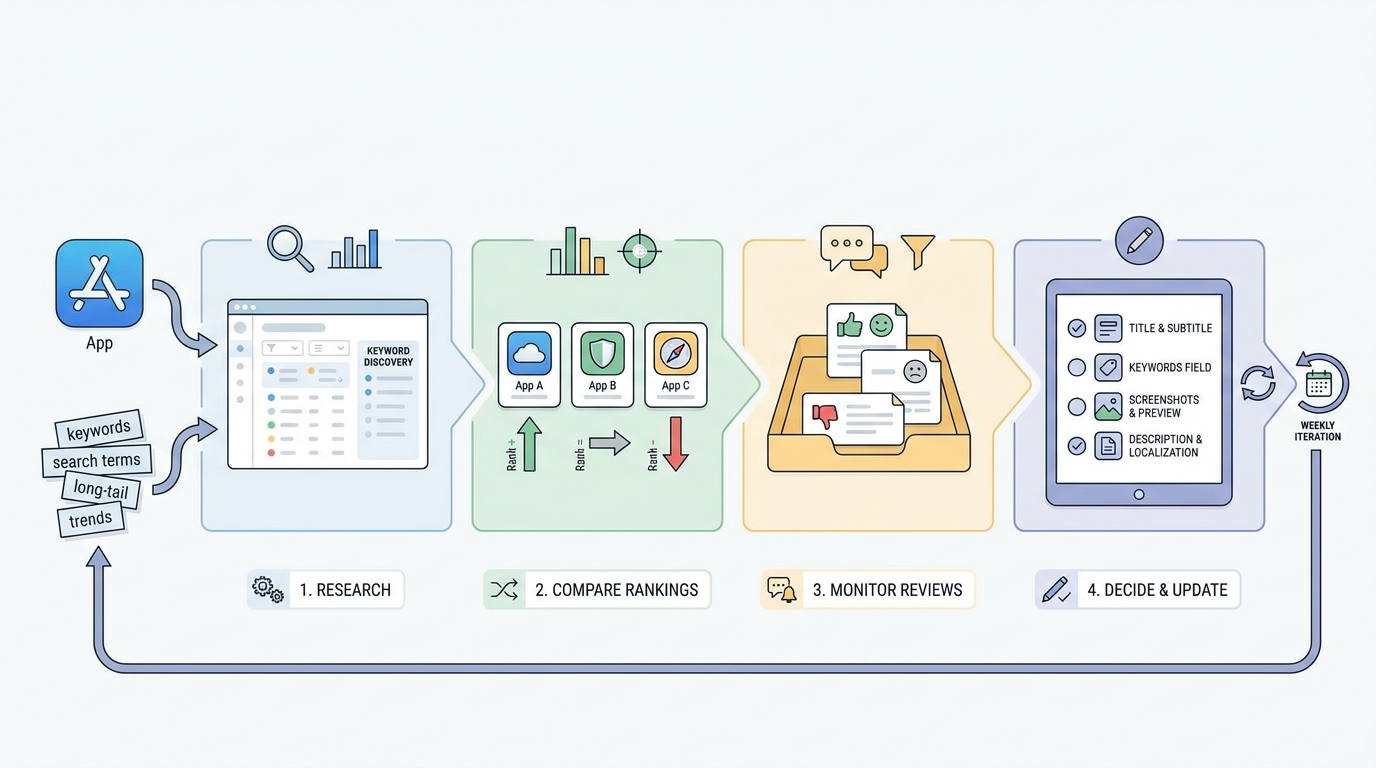
A process diagram showing how a founder uses an ASO tool to research keywords, compare competitor rankings, monitor reviews, and decide what metadata to update next.
Best for
- Founders who want one place to research keywords, track rankings, and sanity check competitors.
Strengths
- Strong keyword discovery and tracking across App Store and Google Play.
- Competitor context that helps you decide whether a keyword is worth pursuing.
Limitations and dependencies
- Key features and limits vary by tier, so confirm tracked keywords, history depth, and alerts before committing.
- Rank signals are noisy (seasonality, featuring, algorithm shifts), so treat week-to-week movement as directional unless it persists.
- If you ship infrequently, you will learn slower because you run fewer tests.
Effort expectations
- Initial setup: 60-90 minutes for 20-40 keywords and 3-5 competitors.
- Ongoing: 30-60 minutes per week to review movement and plan one change.
Tool #2: AppFollow - best for review monitoring and rating recovery
Best for
- Apps with enough review volume that rating dips or recurring complaints can meaningfully affect conversion.
Strengths
- Fast visibility into themes that should drive fixes, replies, and release notes.
- Alerting that helps you catch sudden rating shifts.
Limitations and dependencies
- Not a full replacement for deep keyword research, so some teams pair it with another tool.
- If you only get a few reviews per month, trends will be slow and actionability will be limited.
Tool #3: Appfigures - best budget option for early-stage ASO testing
Category: Outcomes
Statistic: 38%
Label: First-pass approval rate
Context: When metadata is complete upfront
Category: Coverage
Statistic: 4
Label: Top ASO use cases covered
Context: Keyword tracking, competitors, reviews, and indie value
Category: Shortlist
Statistic: 7
Label: Frequently cited ASO platforms
Context: AppTweak, Sensor Tower, AppFollow, Appfigures, ASOdesk, MobileAction, AppDrift
Best for
- Bootstrapped teams validating a small set of target keywords before scaling efforts.
Strengths
- Straightforward onboarding and practical tracking for simple experiments.
- Lightweight competitor checks that help you avoid obvious keyword traps.
Tradeoffs
- Less depth for advanced opportunity discovery and long historical analysis.
- Limits can bite as you expand tracking, so check the upgrade path early.
How Automated Publishing Tools Cut Time to Launch reframes the same problem with a slightly different lens - useful before you finalize.
A simple weekly ASO workflow you can actually maintain
Here is a practical loop you can run without a growth team. It will not eliminate volatility, but it gives you a repeatable way to learn. To keep it honest, assume you need at least a few hundred impressions per week (or a longer measurement window) before conversion changes mean much.
Track weekly: impressions, conversion rate (store listing to install), rank distribution (top 3, top 10, top 25), and rating trend.
| Step | Time | Tool | Output |
|---|---|---|---|
| Build your baseline (20 keywords, 3 competitors) | 60-120 min once | AppTweak (or similar) | Keyword list + current ranks + competitor notes |
| Ship one metadata change | 30-60 min per update | Store console + your notes | One controlled change (title/subtitle/short description/keywords) |
| Check ranks and conversion | 20-30 min weekly | ASO tool + store analytics | Week-over-week movement + conversion trend |
| Triage reviews and tag themes | 15 min weekly | AppFollow (or similar) | Top 1-2 themes to fix or explain in release notes |
| Maintain a one-page changelog | 10 min weekly | Doc or sheet | Date, change, hypothesis, result, next action |
Example change I have actually seen work: swap a vague subtitle like "All-in-one planner" to a specific intent like "Weekly habit tracker and planner" and watch whether long-tail ranks and conversion move over the next 2 Mondays. If it spikes once and drops the next week, treat it as noise until it holds.
Failure modes to plan for: seasonality, featuring, major competitor updates, and store algorithm shifts can swamp your signal. If you cannot ship at least one update every 2-4 weeks, your learning loop slows down and tool value drops.
How to choose the right ASO tool for your app store growth stack
Match the tool to your biggest discovery bottleneck
Keyword discovery and rank visibility
Choose this if you are unsure what to target or whether your last update helped. You are paying for clarity and history, not certainty.
Competitors outranking you
Choose this if similar apps keep winning and you need realistic keyword alternatives. This depends on your category dynamics and how often competitors update.
Ratings and reviews hurting conversion
Choose this if installs are soft despite impressions. Metadata helps discovery, but it cannot fully offset persistent product complaints.
Check the hidden costs before committing
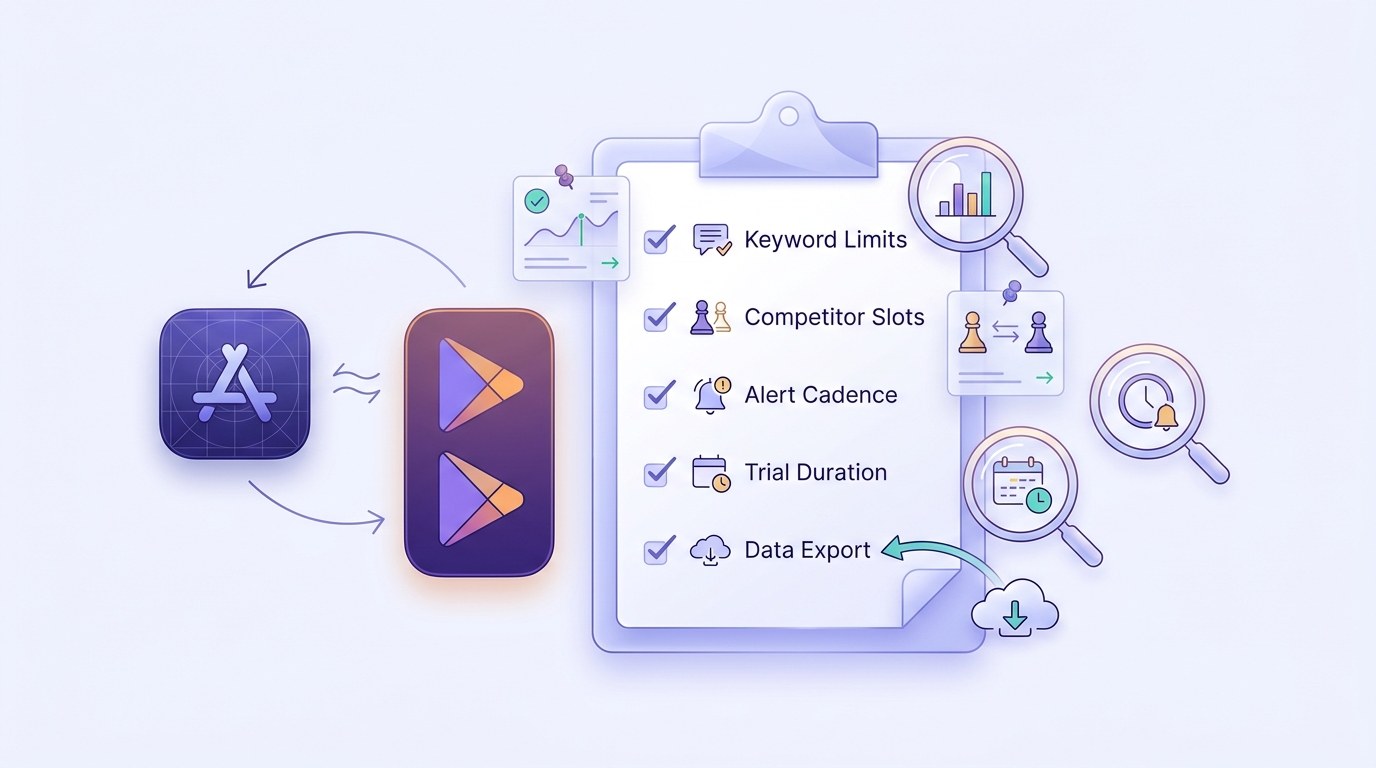
A practical checklist of purchase checks for ASO tools, including App Store and Google Play coverage, keyword limits, competitor slots, review alerting, and trial requirements.
- Coverage for App Store vs Google Play (and feature parity)
- Keyword and competitor limits, plus history depth
- Alert cadence you can actually respond to
- Export and lock-in risk if you churn
- Trial realism: can you run at least one update cycle (often 2-4 weeks) before deciding?


