
If you feel like every other app in the App Store suddenly turns your photos, videos, voice, or text into something instantly shareable, you are not imagining it. In 2026, AI remix apps are showing up more often in charts, ads, and "top" lists. This write-up breaks down the store mechanics behind that movement, where the real product and model work lives, and how to compete without betting your whole roadmap on hype.
| Early proof (directional) | What we observed | What it likely means | Practical impact for you |
|---|---|---|---|
| Store packaging converges across winners | Before-after screenshots lead; preview video hits the "wow" in seconds | The App Store often rewards clear outcomes over complex tools | Your listing can carry more of the "explain value" work than onboarding, if the result is visually obvious |
| Momentum clusters around new drops | Review bursts and rank moves often follow effect releases and cultural moments | Release cadence can matter as much as model quality | Plan for ongoing effect ops, not a one-time launch |
| Monetization matches intent peaks | Trials, weekly passes, or credits gate export/HD when users like the output | Paywalls work best at "I want to share this" | You can monetize without long education, but support load and refunds climb if output quality is inconsistent |
| Tailwind is real but noisy | Category growth shows up in rising AI app submissions and consumer spend in multiple industry reports (directional and method-dependent; see Data.ai and Sensor Tower coverage) | More demand, but also more competition and sameness | Expect CAC volatility, creative fatigue, and faster commoditization than in slower categories |
Interpretation: this is not proof that any specific remix app will win. It is evidence that the format (fast transformation plus sharing) fits how people browse the store right now. Reader impact: if you can reliably produce a shareable result in under a minute on average devices, you might get efficient acquisition at times, but you inherit operational dependencies immediately (App Review latency, model variance, safety policy shifts, and compute costs).
AI Music Apps Are Exploding - 5 Worth Trying in June 2026 goes deeper on the ideas above and adds concrete next steps.
What makes AI remix apps the App Store story of 2026?
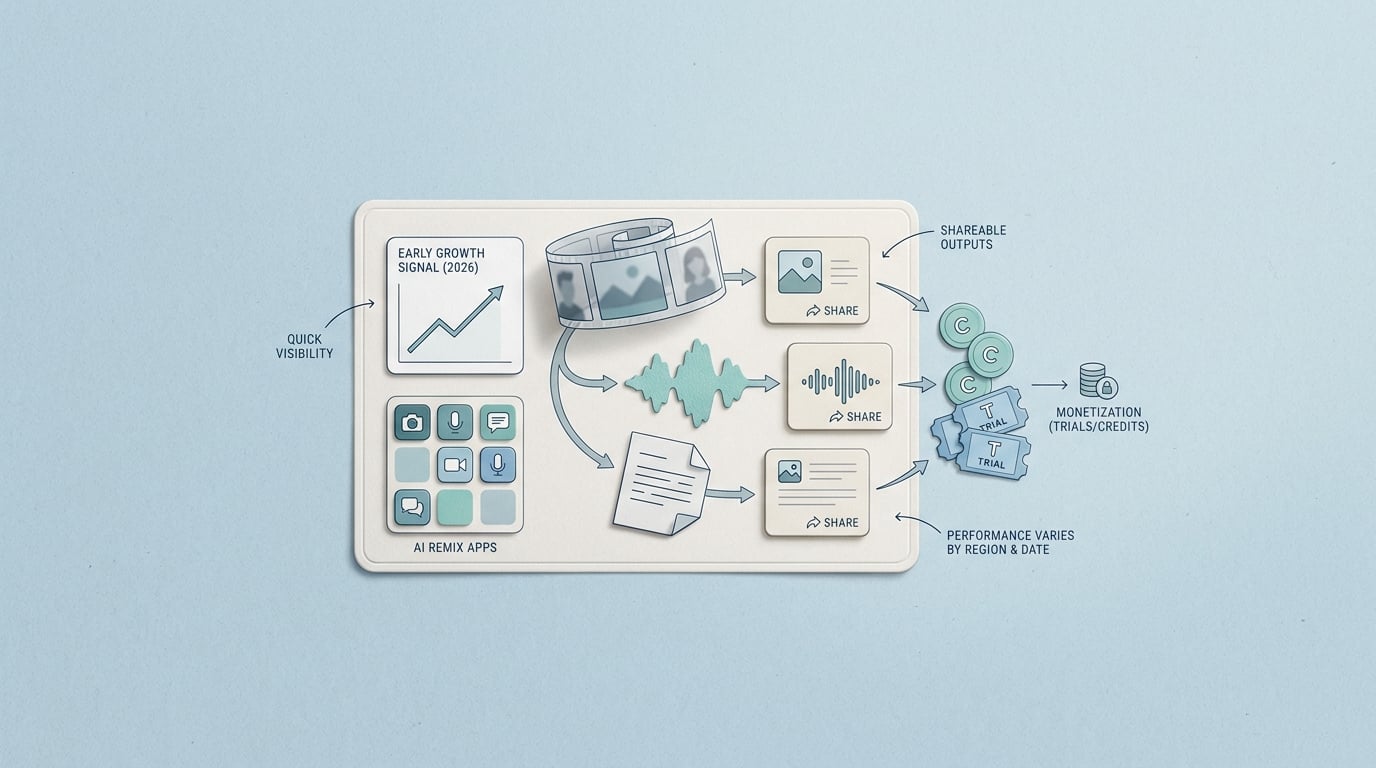
A compact benchmark-style callout showing the directional pattern for AI remix apps: quick App Store visibility, high shareable output appeal, and monetization via trials or credits, with a note that metrics vary by region and date.
What we mean by "AI remix apps"
Category: Momentum
Statistic: +84% YoY
Label: New app submissions (Q1 2026)
Context: AI-enabled tools are a major driver of launch volume
Category: Monetization
Statistic: $4B+
Label: GenAI IAP revenue (H1 2026)
Context: Paywall + variants turn previews into repeat purchases
Category: Mechanics
Statistic: 5 steps
Label: Typical remix-app funnel
Context: Upload → preview → paywall → share → return
- Consumer apps that turn existing inputs into new, shareable outputs: photo-to-avatar, photo-to-video, voice changers, meme remixers, caption/script generators.
- Not enterprise copilots or generic chat, because discovery and retention dynamics are different.
- Not basic filters either, since the commercial hook is transformation and novelty, not incremental editing.
- In practice, success comes from a tight loop of: store page clarity, first-session speed, and output shareability.
Scope and evidence limits (and why that matters)
This is a comparative market read, not a census. Charts move daily, results vary by region and seasonality, and you cannot infer retention from rank alone.
One thing worth noting: if your growth plan depends on a cultural moment, you are also dependent on timing, App Review latency (often 24-72 hours, sometimes longer), and platform policy shifts. Those constraints can turn a great idea into a missed window, so build buffers and fallback launches.
When you move from outline to execution, 7 Breakout Android Apps Making Waves in June 2026 helps close common gaps teams hit here.
What should you watch in the App Store?
| Store-side indicator | Remix winners tend to show | Operator action (realistic) |
|---|---|---|
| Ranking momentum | Sharp climbs after shareable trends | Ship in waves; keep a "ready to submit" build because App Review can take days |
| Review pace | Bursts after new effects drop | Plan a cadence you can sustain (often 1 meaningful drop/week for small teams; 2/week is doable but intense) |
| Paywall design | Clear trial, weekly pass, or credit framing | Test 2-3 paywall variants; expect 7-14 days of noisy data before you trust it |
| Page clarity | Before-after above vague AI claims | Lead with transformations, not model names; use PPO, but do not overfit tiny samples |
Pitfall: it is easy to misread a chart spike as product-market fit. Sometimes it is a short-lived trend plus a strong listing, and retention has not caught up yet.
A complementary angle worth comparing lives in How to Publish an AI-Powered App on App Store in 2026.
Why do remix apps win attention, and where do they fail?
Outputs users can understand quickly
Common "fast to understand" outputs:
- avatar swaps (you as a character, pro headshot, meme format)
- stylized portraits (anime, studio lighting, fashion looks)
- animated selfies (short reactions)
- clip remixes (short video restyles, captions, templates)
- voice transformations (style shifts with guardrails)
In practice, your product page has about 3-5 seconds to communicate the outcome. If users must read to understand value, conversion usually loses to simpler entertainment and creator apps.
The funnel structure most remix apps use (with real tradeoffs)
Fast intake
Upload a photo, short clip, or voice sample with one clear first choice. Expect a few days to a couple weeks of UX iteration and instrumentation to reduce drop-off, especially across older devices.
Controlled preview
Deliver a free sample via watermark, low-res, or limited credits. The tradeoff: weak previews reduce trust; generous previews can spike your GPU bill, especially if users retry multiple times or spam variants.
Paywall at peak intent
Gate export, HD, or more variants behind subscription or credits when users like the output. Plan for failure paths: generation errors, moderation blocks, and "looks nothing like me" complaints are where refunds and 1-star reviews come from.
Retention loop
Use variants, seasonal packs, and share flows to create repeat sessions and organic installs. This is where the hidden work lands: a content calendar, QA across devices, and sometimes human review for edge cases.
When remix works vs when it does not
| Situation | Remix tends to work when | Remix tends to fail when |
|---|---|---|
| User intent | user wants a result to post now | user is browsing and you cannot deliver a wow quickly |
| Output quality | first result is consistently good | generation is slow, inconsistent, or uncanny |
| Unit economics | you cap usage or price credits to match compute | GPU costs overrun because video/voice runs are underpriced |
| Differentiation | you own a niche (style, community, workflow) | you are a clone with the same effects and same paywall |
| Compliance | consent and safety are designed in | takedown risk is high (impersonation, minors, likeness, copyrighted styles) |
For tradeoffs, checklists, and edge cases, New Health and Wellness Apps Released in May 2026 rounds out this section.
Why this category can scale (and what can break it)
The App Store often rewards instant proof: one before-after frame or a 5-second preview demonstrates value without explanation. More abstract AI tools usually need onboarding to prove utility, which adds friction on the store page and in the first session.
Virality helps, but it is not free growth. CAC can spike when the trend cools, and if generation latency climbs (queues, peak traffic, device/network issues), conversion drops fast because users bounce before they see the output.
Failure modes worth planning for:
- Latency and reliability: if first output takes 60-90 seconds or fails often, the funnel leaks. You may need queues, progress UI, smaller preview models, and retry limits.
- Policy or trust events: a single viral misuse can trigger takedowns, payment disputes, or PR issues. You need reporting, blocks, and fast response, plus time to maintain it.
- Cadence burnout: each drop requires design, tuning, QA, and sometimes localization. If you cannot sustain it, retention often collapses after the first spike.
What I see fail (and we learned the hard way): shipping "100 effects" at launch with shallow differentiation, then having no time to improve the top 5 users actually want. It looks impressive, but it usually hurts focus and output quality.
How the App Store Algorithm Works in 2026 reframes the same problem with a slightly different lens - useful before you finalize.
Practical implications: how founders and publishers should respond in 2026
What to ship on the App Store page first
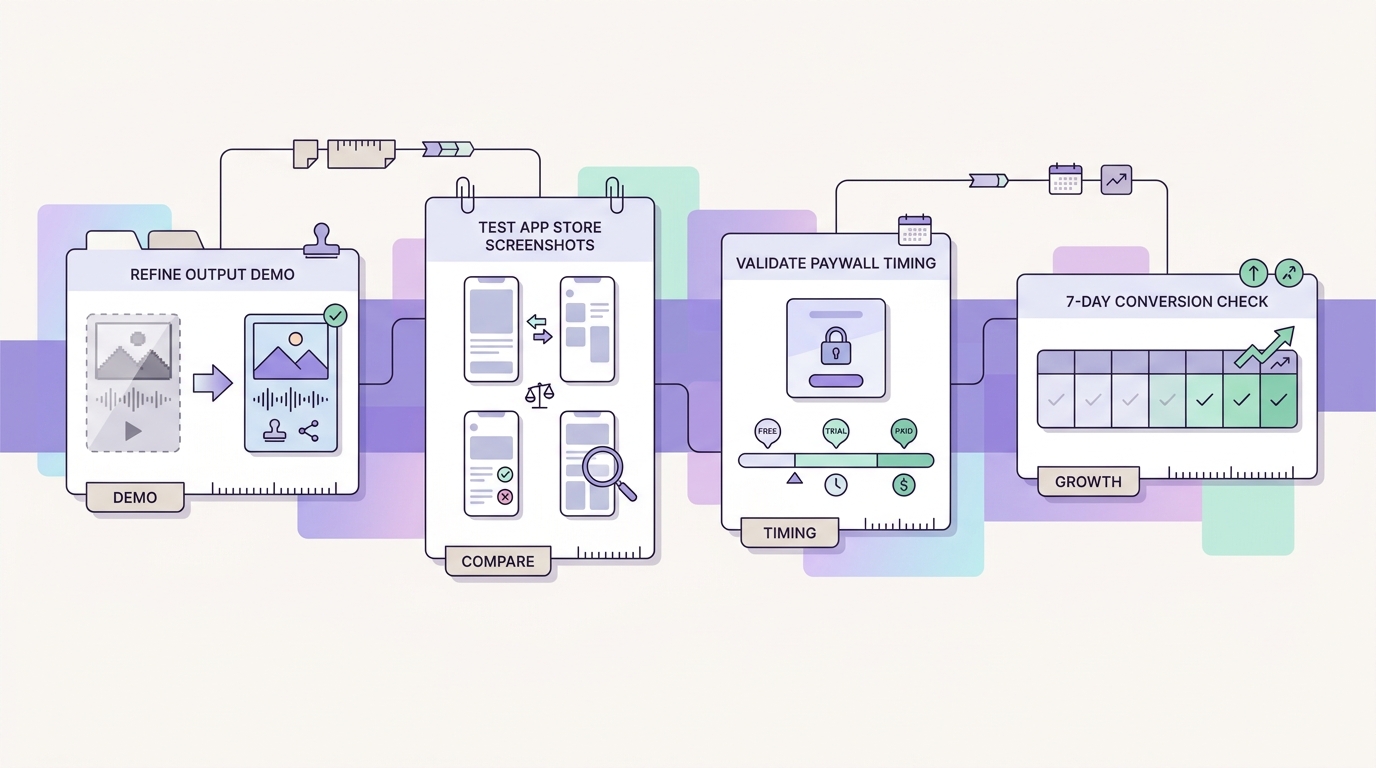
A short launch-readiness timeline for App Store publishers showing the sequence: refine output demo, test screenshots, validate paywall timing, and run a 7-day conversion check before scaling.
- Lead with before-after screenshots showing the transformation, not the workflow.
- Add a 5-8 second demo clip that reaches the final output fast.
- Write a one-line outcome promise (the strongest single remix result you deliver).
- Run a 3-second mobile test: can a cold viewer explain the result instantly?
- Message hierarchy: output, speed, shareability, then model details.
Launch-readiness timeline (realistic for a small team)
| Day | Focus | Pass condition |
|---|---|---|
| 1-2 | Output demo | Clear in 1 sentence; first output under ~30-45 seconds on average devices (measure it) |
| 3-5 | Screenshot/PPO test | One variant wins on install intent; do not overfit small samples |
| 6-7 | Paywall timing | Paywall after first success; refund and complaint triggers tracked |
| 8-14 | Reliability + cost | Failure rate and cost per successful export are stable enough to scale traffic |
Dependencies: App Review delays can shift this schedule, and PPO results vary by country. If your app depends on a trend, build extra buffer or have a simpler update you can push faster.
Monetization choices worth testing (with constraints)
- Subscription: best when users remix weekly; add usage caps so compute does not eat margin.
- Weekly pass: fits bursty trends; watch churn, chargebacks, and review sentiment.
- Credit bundles: usually the cleanest match for variable compute (especially video and voice); keep packs simple.
- Hybrid: subscription plus credits for heavy jobs; protects margins, but adds pricing complexity and support overhead.
Decision point: if you cannot predict compute cost per successful export within a reasonable range yet, start with credits or strict caps before scaling spend.
Need a practical teardown of your listing and first-run funnel?
I can review your product page, onboarding, paywall timing, and share loop with a 7-14 day experiment plan.
Request a launch teardown
Deep-dive: ops you cannot ignore
Cadence is not just "ship more." It is design, prompt/model tuning, QA, and sometimes localization each cycle. For many small teams, a sustainable pace is 1 strong drop per week or every two weeks; faster is possible, but it will compete with reliability work and sleep.
Here is the thing: the operational tax shows up fast, even at modest scale. Plan on at least a few hours/week for support and refunds once you have paid traffic, plus an on-call plan for outages (even if it is just "one founder with alerts").
| Risk or dependency | What it looks like | Mitigation (practical) |
|---|---|---|
| App Review latency | you miss a trend window | keep a ready-to-ship build; use staged rollouts; have an evergreen drop schedule |
| Model drift or vendor changes | quality shifts, pricing changes | version models; track quality metrics; keep a fallback model and pricing buffer |
| Infra incidents | queues, timeouts, failed exports | retries with limits; status page; degraded mode (lower res preview) |
| Safety policy tightening | rejected updates, removals | consent flows, reporting, and clear prohibited content; budget time for policy work |
| Refund and chargeback spikes | "doesn't look like me" | set expectations, show preview limits, log failures, and fix top complaint paths |
Compute costs swing with video length, resolution, and retries. Track cost per successful export and failure rate from day 1, and assume you will need rate limits, queues, and fallbacks.
Moderation is a real line item for face and voice. At minimum, plan for consent prompts, blocked terms, abuse reporting, and a response process, plus tooling to review edge cases.
If you want to compete here without gambling on hype, start with a focused niche and a measurable first success moment.
Build one transformation users will share, then earn the right to expand.
Get the niche selection worksheet


