
May 2026 brought a fresh wave of health and wellness launches, but the hard part is figuring out which new apps are actually worth your time, data, and subscription budget. This ranked roundup cuts through the noise with an operator-style shortlist across coaching, lab result tracking, and sleep and recovery. By the end, you will know the top picks for your goal, what each one does best, and the realistic tradeoffs to consider before you install.
5 Sleep Apps That Actually Work in 2026 goes deeper on the ideas above and adds concrete next steps.
What makes these May 2026 app launches different?
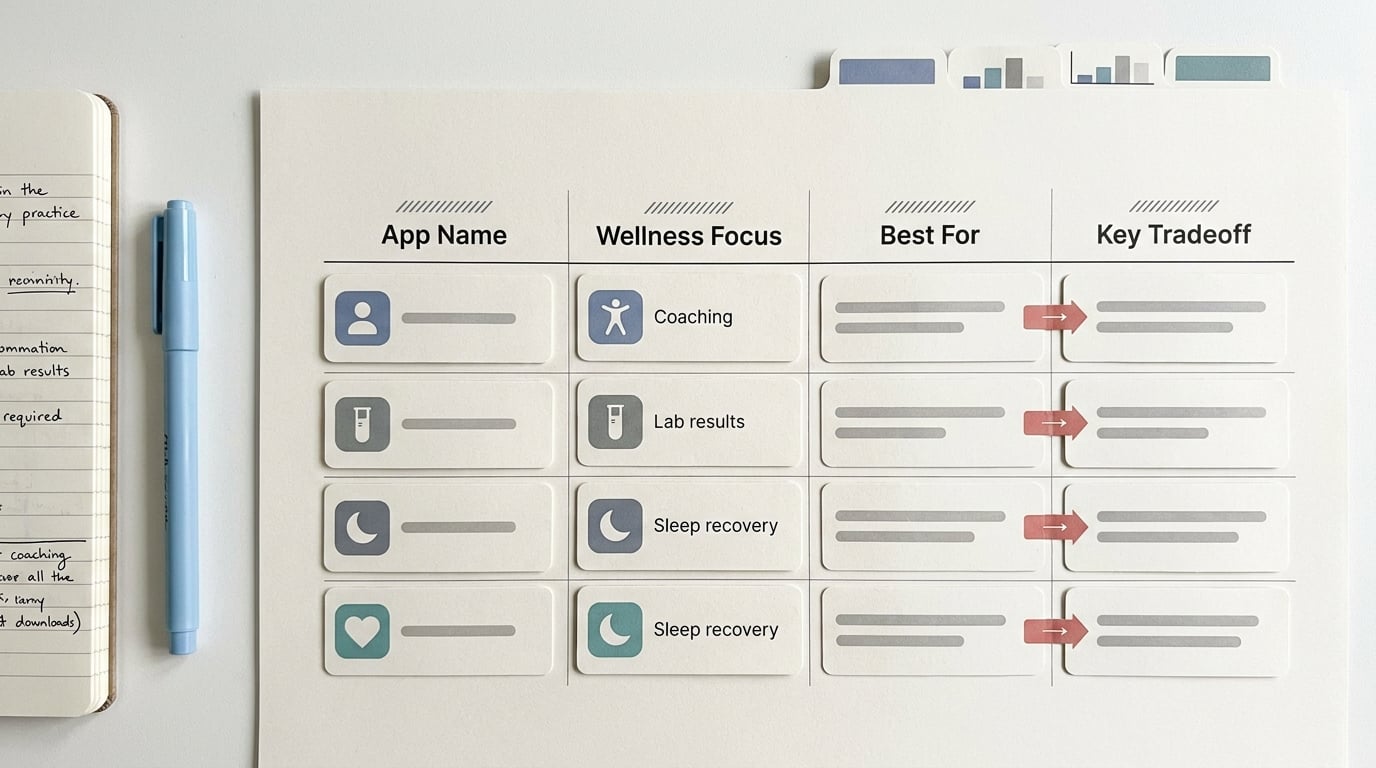
A compact editorial comparison table showing the top new health and wellness apps released in May 2026, with columns for app name, wellness focus, best for, and key tradeoff.
Benchmark snapshot (what changed in May 2026)
| App | Primary job to be done | Required dependency | Reader impact if it fits |
|---|---|---|---|
| Google Health | turn health signals into simple coaching prompts | permissions and connected data sources (phone, wearables, services) | fewer day-to-day decisions, but only if you keep data connected (source) |
| MyLabcorp | help you understand lab results and track trends over time | Labcorp test results in the system; you still need clinician context for decisions | faster clarity and better questions for your doctor, not a replacement for care (source) |
| Oura (Ring 5 + app) | translate sleep and recovery data into next-day guidance | ring hardware + enough nights of wear for baselines | actionable recovery nudges, with upfront cost and time to calibrate (source) |
Here is the thing: these launches lean harder into "next best action" instead of just showing charts. That is useful, but it also makes the dependency story unavoidable: permissions, consistent wear, and sometimes a subscription. The practical takeaway is to pick based on what you can realistically sustain for 7 to 14 days, because that is when the signal-to-noise ratio usually gets better.
When you move from outline to execution, Best Single-Purpose Apps for Getting Things Done in 2026 helps close common gaps teams hit here.
What changed in May 2026 and why does it matter?
How we screened the May 2026 releases
- Included only apps that launched in May 2026 or shipped a meaningful May 2026 refresh that changes the day-to-day experience (for example, Google Health on May 19, MyLabcorp on May 20, and Oura's late-May ring and insights launch).
- Ranked by use-case fit, onboarding clarity, and whether the product supports one concrete daily behavior (sleep, stress check-ins, understanding labs, recovery decisions).
- Excluded vague "feel better" apps that cannot explain what you do in 5 minutes a day, what success looks like in a week, and what data they actually use.
Top picks at a glance
| App | Core category | Best for | Why it stands out in May 2026 | Tradeoffs to expect |
|---|---|---|---|---|
| Google Health | coaching and insights | habit coaching and summaries | coach-style framing + consolidation push | ecosystem lock-in risk; insights vary by connected data |
| MyLabcorp | lab tracking | understanding labs and trends | more consumer-friendly interpretation and trend views | limited beyond labs; not medical advice |
| Oura (Ring 5 + app) | sleep and recovery | wearable-led recovery planning | upgraded signals and guidance | requires ring; device and subscription cost; needs data runway |
Practical reality check (effort, constraints, and common failure modes)
| What to plan for | Typical range | Why it matters | If this is a problem, do this instead |
|---|---|---|---|
| Setup time | 20 to 45 minutes | permissions, preferences, integrations, and notifications determine the experience | pick one app and one goal; skip optional integrations at first |
| Data runway | 7 to 14 days | baselines stabilize and recommendations get less jumpy | start when you can be consistent for a week, or do a lighter app first |
| Ongoing time | 2 to 5 minutes per day | the value comes from repeating one loop, not exploring features | disable most notifications; keep one daily check-in |
| Failure modes | varies | missing data, noisy alerts, overconfident insights | treat outputs as suggestions; sanity-check with your body and clinician |
A complementary angle worth comparing lives in Top AI Coding Assistants for Mobile Developers in 2026.
Which are the best new health and wellness apps in May 2026?
Category: Prevention
Statistic: 5.2x
Label: More issues caught early
Context: Before formal store review
Category: Strength
Statistic: AI-powered
Label: Health Coach for guidance
Context: Core strength: personalized coaching prompts
Category: Ideal User
Statistic: Daily check-ins
Label: Best for stress-prone routines
Context: Ideal for users who want lightweight mindfulness nudges
1. What is the best May 2026 pick for sleep and recovery?
- Pick: Oura (Ring 5 + updated app) for people who want recovery signals that influence tomorrow's choices, not just a sleep score (source).
- Most useful in practice: bedtime consistency nudges, readiness-style trends, and prompts that encourage a lighter day when your signals look off.
- Tradeoffs and dependencies: expect 7 to 14 nights before patterns stabilize, and results depend on wearing it most nights. If you are unsure about comfort or subscription costs, try a 1-month test window (or borrow a wearable habit first) before committing.
2. What is the best May 2026 pick for coaching and daily habit guidance?
- Pick: Google Health app (revamped from Fitbit) if you want structured coaching prompts and summaries that reduce decision load (source).
- How it tends to work best: one small loop you actually do daily (2 to 5 minutes), like a morning check-in and one suggested action.
- Tradeoffs: coaching quality depends on what you connect and how clean that data is. If you are privacy-sensitive, start with the minimum permissions and add integrations only if you see a clear benefit.
3. What is the best May 2026 pick for understanding labs and health trends?
- Pick: MyLabcorp if your real problem is "I got lab results and do not know what to do with them," and you want trend tracking in one place (source).
- What it is good for: turning results into clearer questions and watching trends over time, especially if you repeat panels.
- Important constraint: labs are context-dependent. Use it for interpretation support and recordkeeping, not to self-diagnose or change meds without a clinician.
For tradeoffs, checklists, and edge cases, How to Build a Long-Term Update Strategy for Your App rounds out this section.
How should you choose between these May 2026 wellness apps?
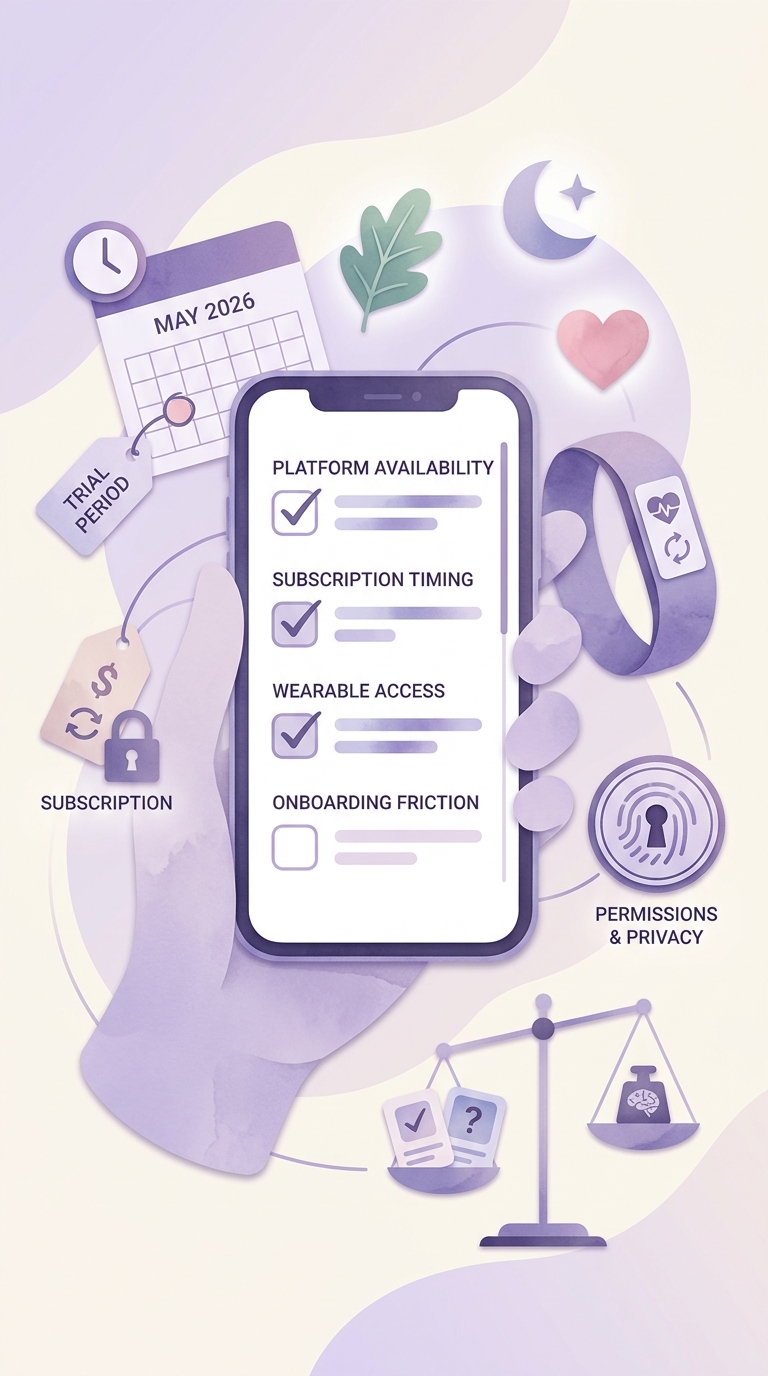
A mobile-friendly checklist for evaluating a new May 2026 health or wellness app before installation, covering platform availability, subscription timing, wearable access, and onboarding friction.
Match the app to the bottleneck (not the feature list)
If your goal is sleep consistency, choose sleep-first
You are buying a nightly loop. If wearing a ring most nights is a dealbreaker, do not force it; pick something you will reliably use.
If decisions are the bottleneck, choose coaching-first
Coaching helps when you already know the basics but struggle to execute daily. Give it a week to tune goals and notifications before judging.
If you are trying to understand health numbers, choose lab-first
Lab tracking shines with repeat tests and trend visibility. The practical dependency is access to results and a clinician relationship for what to do next.
A simple 7-day test (try without overcommitting)
- Pick one outcome (for example: consistent bedtime, fewer stress spikes, or clearer lab questions).
- Do the minimum setup (skip extra integrations and optional notifications).
- Check progress on day 7: did it change a real behavior, or did it just add data?
Concrete example (sleep-first, 10 minutes upfront, 2 minutes daily):
- In Oura, turn off all notifications except one bedtime reminder.
- Track one metric for the week: bedtime variance (how far you drift from your target).
- On day 7, look at the weekly trend and decide if the prompt changed your behavior, not just your dashboard.
Try the 7-day test plan Takes about 10-15 minutes to set up and 2-5 minutes a day; results depend on consistent input and are not medical advice. Use the 7-day test plan
5 Proven Monetization Models for iOS Apps in 2026 reframes the same problem with a slightly different lens - useful before you finalize.
Want help choosing based on your constraints?
You can get to a solid pick faster if you start with constraints (device you already own, privacy comfort, budget, and how many minutes a day you will realistically give it). Availability, pricing, and features can change, and the right answer may be "wait 2 weeks" if the rollout is still settling. Use these tools to support decisions, then loop in a clinician for anything diagnostic or medication-related.
Get a quick best-fit shortlist Share your goal, budget, device, and time per day (5 minutes max) and I will suggest a likely best-fit trial plus a minimal setup; based only on what you share, not medical advice. Request a quick rec


