
Android app discovery is noisy in 2026: the Play Store is crowded, "AI" labels are cheap, and the apps that actually stick are the ones that fit your workflow and your phone's constraints. This ranked roundup is a practical shortlist of 7 June 2026 breakout-style Android app categories, plus a fast test to see whether any specific app you find in that category deserves a permanent install. Expect tradeoffs, setup time, and a few dependency caveats, because the same app can behave differently by device, region, OEM skin, and Android version.
Top 7 Mobile App Analytics Tools Ranked for 2026 goes deeper on the ideas above and adds concrete next steps.
Early proof
Proof snapshot (what changed in June 2026 and why it matters)
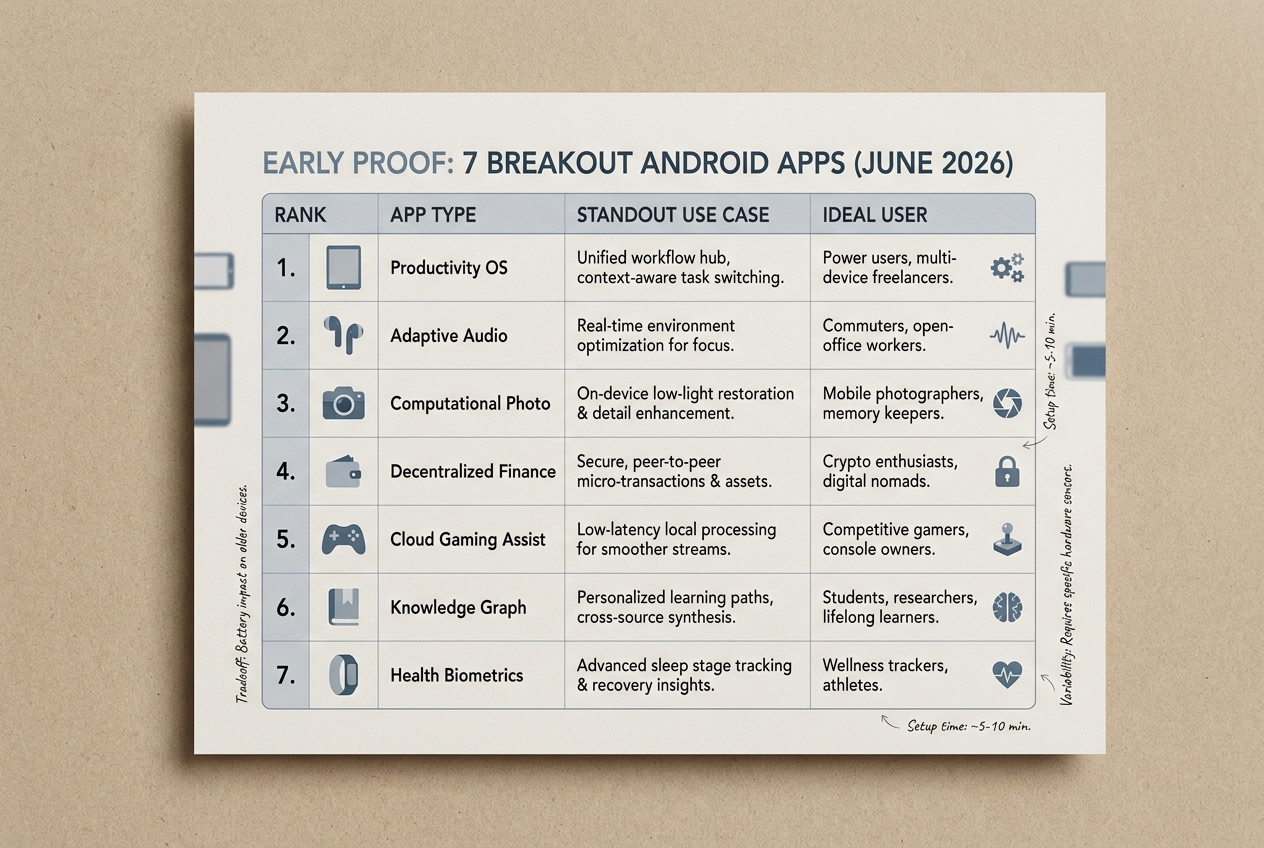
A compact comparison table summarizing all seven breakout Android apps in June 2026 with columns for rank, app type, standout use case, and ideal user. The visual should make the shortlist scannable at a glance and support the early proof block.
| Proof signal (directional) | Explanation | Interpretation | Reader impact |
|---|---|---|---|
| June 2026 Pixel Feature Drop + Google System updates shipped user-facing changes | Ongoing platform updates raise expectations for onboarding, permissions, and UI patterns. They can also unlock new OS capabilities apps can use, with OEM and region variability. Sources: Beebom, TechNerdiness | "Breakout" often means "fits the new baseline" more than "is famous." Apps that feel fast and predictable tend to benefit. | You can judge faster: if it takes 20+ minutes to get one clear win or it asks for broad permissions up front, it is less likely to survive week one. |
| Android coverage of agentic AI and widget-first flows is increasing | Some new Android experiences emphasize assistant-style actions and widget surfaces. Source: TechCrunch | Expect more apps to pitch automation, but you still need verification and guardrails. | Plan 10-15 minutes for first-run setup, then a quick check of notifications, background activity, and export controls before committing. |
| Open-source releases continue to move quickly | F-Droid update streams highlight frequent iteration and new releases, but "new" does not automatically mean "safer" or "better supported." Source: F-Droid updates | Momentum can show up as shipping cadence, not hype. | If you care about control and transparency, you have viable options, but expect fewer integrations and more manual setup. |
Note: these proof signals support ecosystem trends (platform updates, UX patterns, open-source cadence), not the performance of any single app. The takeaway is how to evaluate faster, not a guarantee that a specific app will "break out" for you.
What this means in practice: this roundup is optimized for time-to-value and operational reality (permissions, battery, export friction), not viral buzz. If an app name below reads like a new brand, treat it as an illustrative example of a category unless you verify it in your own Play Store region.
When you move from outline to execution, Top Productivity Apps That Hit #1 on App Store This Month helps close common gaps teams hit here.
Selection criteria for these 7 Android breakouts
- Feels useful within a week (not a month): You can test the core loop in 5-15 minutes, then confirm it holds up over 2-3 days.
- Fits modern Android constraints: Reasonable permissions, controllable notifications, and no obvious battery abuse (as best you can tell without deep tooling).
- Clear tradeoffs: Ads, subscriptions, missing features, and data collection are visible early.
- Editorial ranking: Ordered by June 2026 fit and practicality, not objective scoring or verified popularity.
A complementary angle worth comparing lives in Best Cross-Platform App Development Tools Ranked 2026.
Top picks at a glance
| Rank | App type | Standout use case | Ideal user | Realistic watchouts |
|---|---|---|---|---|
| 1 | Widget utility | One-tap home screen actions | Busy operators | Setup time, launcher overlap, widget clutter |
| 2 | Creator tool | Faster short-form edits | Mobile creators | Export/paywall friction, storage use |
| 3 | Notifications utility | Smarter notification control | Minimalists | Needs notification access, tuning required |
| 4 | Local discovery | Nearby events and plans | Social planners | Uneven city coverage, location dependency |
| 5 | Finance tracker | Spend snapshots and alerts | Budgeters | Bank connectivity, privacy comfort level |
| 6 | Habit and health | Lightweight routine nudges | Routine builders | Notification fatigue, data sensitivity |
| 7 | Privacy tool | Permission audit and hygiene | Cautious users | Limited by Android version and OEM skin |
For tradeoffs, checklists, and edge cases, 10 Best No-Code Mobile App Builders This Year rounds out this section.
The 7 breakout categories (ranked)
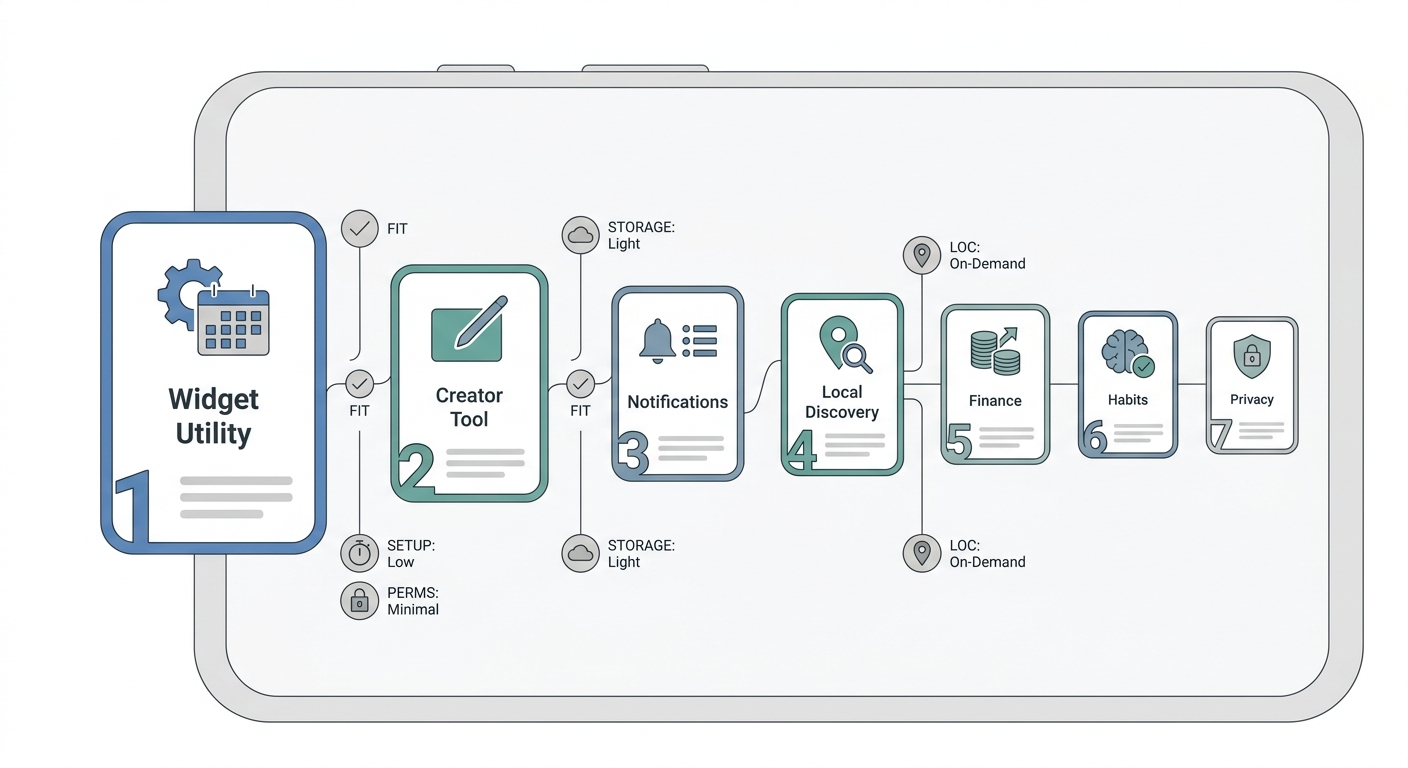
A simple process diagram showing how a reader should move from the top-ranked app to the niche picks by matching each Android app to a specific need: productivity, creation, utility, lifestyle, or social discovery. It should visually reinforce editorial ranking by fit, not hype.
Rank #1: Widget utility for fast, repeatable actions (illustrative)
- Best for: People who want fewer taps for repeat actions.
- Overview: A widget builder (example: "Ava Widget Studio") that turns notes, timers, checklists, and shortcuts into one-tap home screen flows.
- Real effort: Expect 10-25 minutes to build 2-3 widgets that match what you already do daily.
- Constraints: Widget reliability depends on your launcher and OEM background limits. One failure mode is widgets not refreshing because battery optimization or "auto start" is off.
Rank #2: Creator workflow for short-form publishing (illustrative)
- Best for: Anyone shipping consistent clips (founders, educators, creators).
- Overview: A mobile editor (example: "ClipFlow") built for batching recording, captions, and reusable templates.
- Real effort: Budget 30-90 minutes to produce one publish-ready clip the first time, including learning the export flow.
- Constraints: Watch for paywalled exports, watermarking, and storage growth from media caches. On mid-range phones, thermal throttling can turn "fast edit" into a slow session.
Rank #3: Smart notification manager (illustrative)
- Best for: People drowning in pings but still needing critical alerts.
- Real effort: 10-20 minutes to create rules, plus a few days of tweaks.
- Risk: If you over-filter, you can miss time-sensitive messages. Start with low-stakes apps first, then expand.
Rank #4: Local events discovery (illustrative)
- Best for: Finding one thing to do this week without scrolling endlessly.
- Real effort: 5-10 minutes to set filters, then a quick weekly check-in.
- Dependency: Coverage varies heavily by city and venue. Location permissions help, but they also increase data exposure and battery use.
Rank #5: Spend snapshot app (illustrative)
- Best for: Daily awareness, not full accounting.
- Real effort: 15-30 minutes to connect accounts and categorize, plus occasional maintenance.
- Failure mode: Bank sync can break during outages or security re-auth, and notifications can lag. Treat alerts as helpful signals, not a source of truth.
Rank #6: Habit check-ins (illustrative)
- Best for: Lightweight nudges that do not require a full planner.
- Real effort: 10 minutes to set 1-3 habits and reminder times, then adjust after a week.
- Tradeoff: Too many reminders becomes noise. If you rely on reminders, also confirm the app is not being killed in the background.
Rank #7: Permission audit tool (illustrative)
- Best for: A monthly privacy and hygiene sweep.
- Real effort: 10 minutes to review permissions and revoke what you do not need.
- Dependency: Results vary by Android version and OEM skin, and some settings are buried (or renamed). On certain devices, you may need to whitelist the tool from battery optimization to keep monitoring reliable.
Top 10 Mobile App Development Tools You Need in 2026 reframes the same problem with a slightly different lens - useful before you finalize.
How do you choose the right breakout Android app?
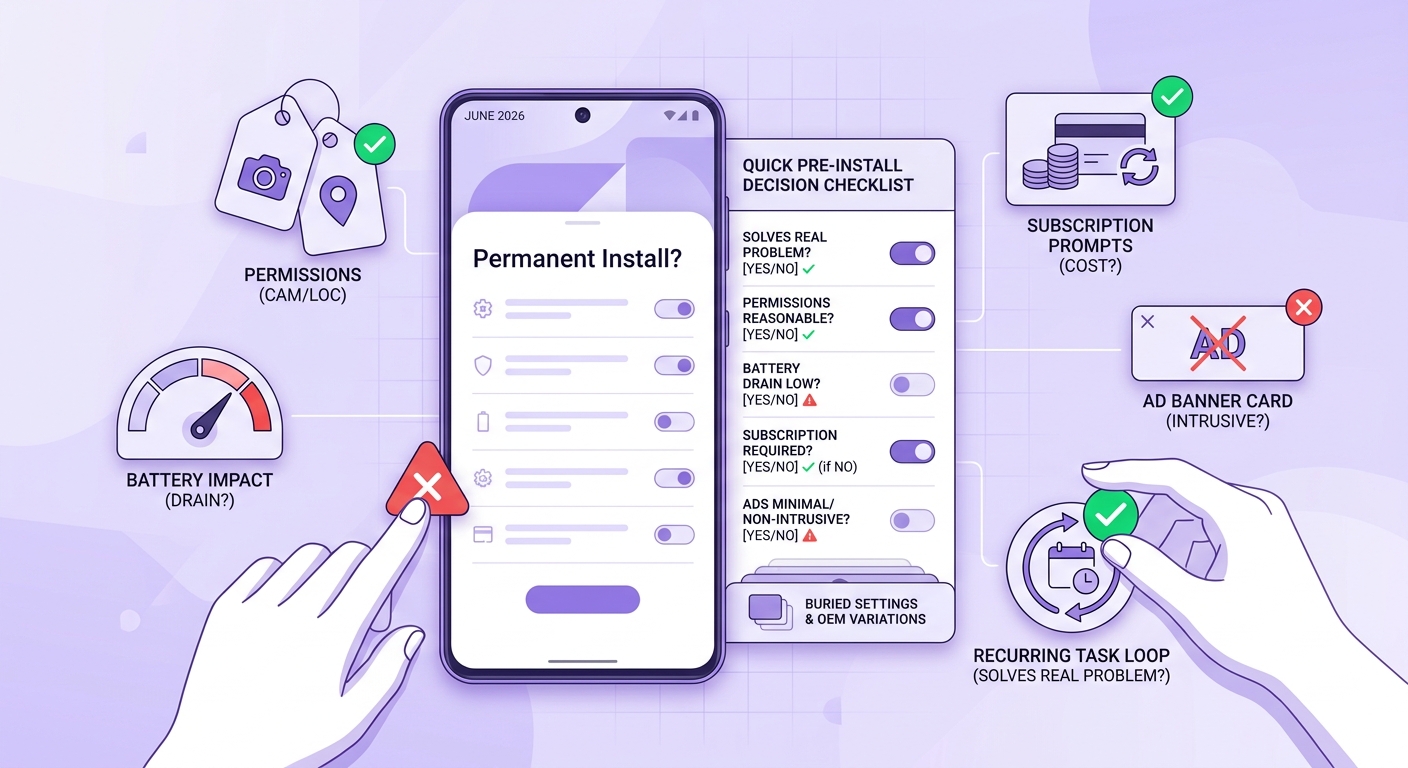
A mobile-friendly checklist of the key checks readers should run before keeping a breakout Android app in June 2026, including permissions, ads, battery impact, subscription prompts, and whether the app solves a real repeat task.
Decision checklist (2 minutes before you install)
- What job is it replacing? Name the current app or workaround.
- What is the keep metric? Target something measurable, like: reduce notifications by ~30% in a week, publish 1 extra clip/week, or save 5 minutes/day.
- What is the cost? Permissions, subscription, ads, and time to configure (assume 10-30 minutes for most apps).
- What is the exit plan? If it fails, uninstall and remove granted permissions the same day.
A simple install-and-test routine for June 2026 (10-15 minutes + a next-day check)
Install and time the first win (3-5 minutes)
Start a timer. If you cannot reach the core feature within 3-5 minutes (not counting optional sign-in), onboarding is probably heavier than it needs to be.
Permission and notification audit (3-5 minutes)
Deny anything you cannot justify yet (contacts, precise location, phone). If it breaks, decide whether that permission is worth the tradeoff for your use case.
24-hour sanity checkpoint (2 minutes now, 2 minutes tomorrow)
Today: note starting battery % and notification count. Tomorrow: check Android Digital Wellbeing for pickups/notifications and Settings - Battery - Battery usage for weird spikes. A practical target: less than ~3-5% overnight battery delta attributable to the app, and no surprise notification volume.
Paywall and export check (2 minutes)
Test the one thing you will need weekly (export, share, automation, backup). If it is locked, decide now whether it is worth paying or replacing.
Pitfalls to watch for: silent trials, aggressive notification defaults, "free" features that only work with full permissions, and region-specific limitations (especially finance and local discovery).
Install-and-test checklist
A reusable 10-minute script (permissions, battery, notifications, paywalls, uninstall criteria).
Get the checklist
Why does this roundup matter now?
Here is the thing: you do not need seven new installs. You need one app that measurably improves your day while staying within your privacy, attention, and battery limits.
If you treat "breakout" as a hypothesis and run a quick test, you end up with fewer zombie apps and fewer surprises. The tradeoff is a bit of upfront work (usually 10-15 minutes plus a next-day check) to avoid a week of slow burn annoyance.
Want help picking the first app to test?
Reply with your phone model, Android version, and your main bottleneck (notifications, creator workflow, budget, habits, or local plans).
Send your setup


