
Organic App Store growth in 2026 is less about a clever keyword trick and more about proving, repeatedly, that your listing and product deserve to rank. This guide breaks ranking into observable signals you can measure and turns them into a plan most teams can run over a 2 to 6 week cycle. Expect iteration, and expect slower readouts in low-traffic niches.
App Store Optimization in 2026: What Actually Moves the Needle goes deeper on the ideas above and adds concrete next steps.
What actually moves App Store ranking in 2026?
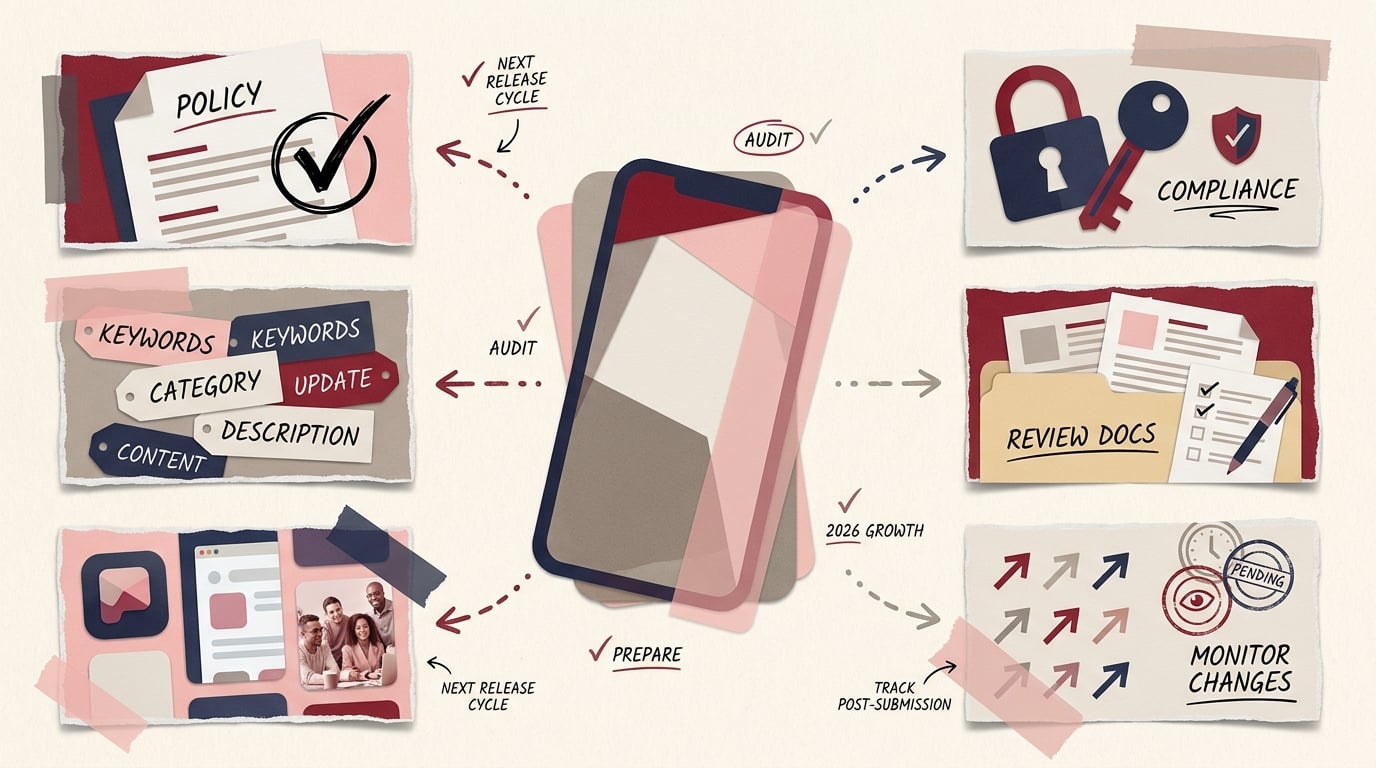
A practical 2026 App Store checklist: audit policies, tighten metadata, update app assets, verify compliance, prepare review-ready documentation, and monitor changes after submission.
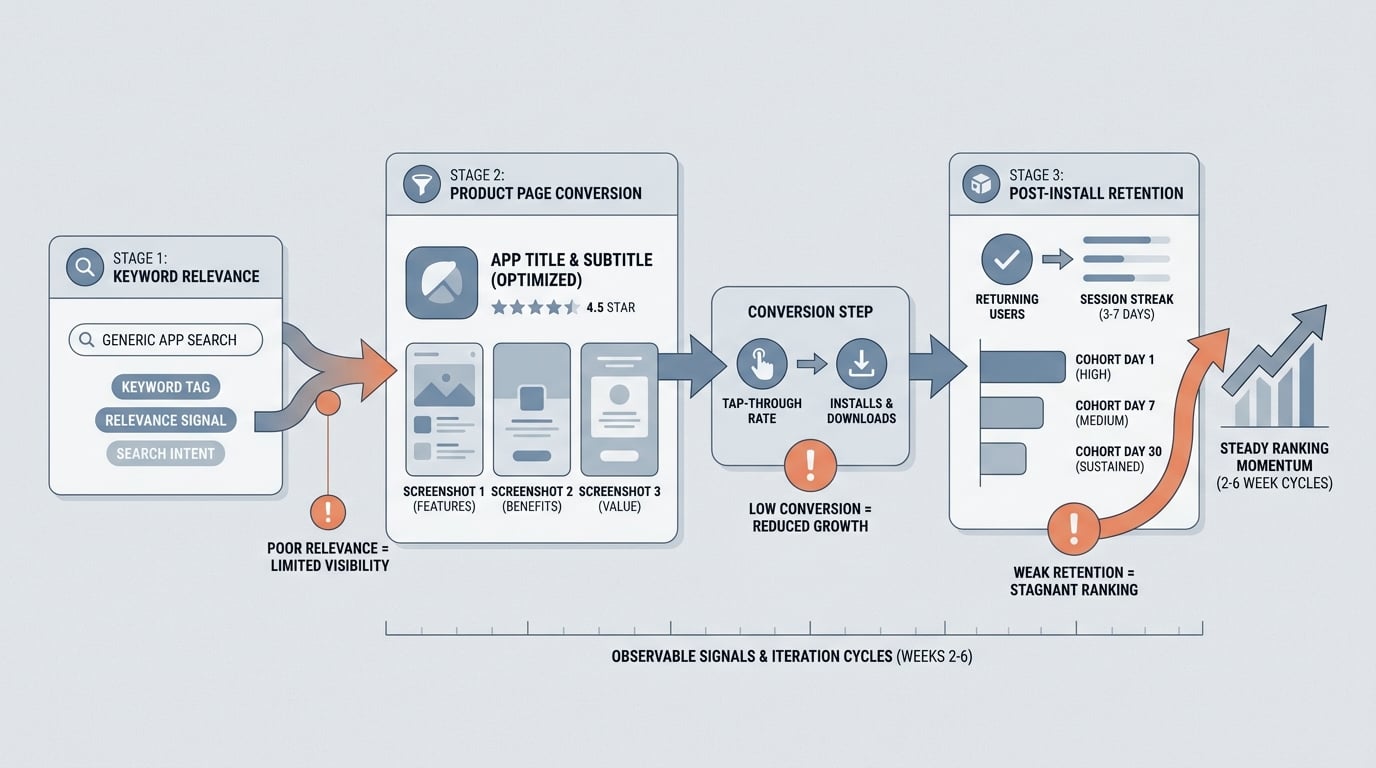
A step-by-step process diagram showing how App Store visibility likely moves from keyword relevance to product page conversion to post-install retention, with notes that weak performance at any stage can cap ranking momentum.
The goal is practical: identify which observable signals most consistently align with better App Store visibility in 2026, then translate that into actions a team can complete in the next 2 to 6 weeks. This is not a claim about Apple’s proprietary ranking formula, and weights can shift without notice.
This write-up combines Apple-facing public guidance and widely observed market behavior with practitioner patterns documented in industry analyses, especially the split between textual relevance and behavioral relevance (for example, AsoWorld and Appdrift). Scope is App Store search, browse, charts, and featured surfaces in 2026, not Google Play, and not paid acquisition optimization.
Operational limits matter. Performance differs by category, country, and competitiveness, so treat the conclusions as operating hypotheses and validate them against your own App Store Connect and product analytics.
When you move from outline to execution, App Store Keywords: The Only Guide You Actually Need helps close common gaps teams hit here.
Early proof: the signals that tend to show up first
Category: Outcomes
Statistic: 38%
Label: First-pass approval rate
Context: When metadata is complete upfront
Category: Discovery
Statistic: ↑ strongest early lift
Label: Search relevance + tap-through
Context: Title/subtitle/keywords (plus screenshot caption text) drive matching and taps in search results
Category: Outcomes
Statistic: ↑ compounding rank press
Label: Conversion, installs, retention
Context: Product page conversion, install velocity, and post-install engagement increasingly outweigh raw keyword matching
Early proof block (directional). The table summarizes signals that repeatedly correlate with visibility gains across App Store surfaces, based on observable ranking behavior and 2026 industry syntheses (for example, Appeak, AsoWorld, and Appdrift).
Interpretation. Relevance tends to determine eligibility, while tap-through, conversion, and post-install quality often determine whether visibility holds.
Reader impact. If you only change metadata, you may enter more queries, but rankings usually stabilize when the listing promise and first-run experience match.
Constraint. Low-volume keywords and small geos often need longer test windows (2 to 4+ weeks) to avoid false positives.
| Signal (observable) | Where it shows up | Likely role (not Apple-confirmed) | Practical takeaway |
|---|---|---|---|
| Text relevance (title, subtitle, keyword field, and on-page text) | Search eligibility | Strong gating signal for being considered | You usually cannot sustain rankings on irrelevant queries just by converting well |
| Tap-through rate (impressions to product page views) | Search results and browse lists | Indicator of listing appeal for a query | If you rank but do not get taps, position often drifts down |
| Product page conversion (views to installs) | Product page | Indicator of match quality and trust | Improving match on a narrow cluster can outperform broad targeting over time |
| Install velocity (rate and consistency) | Search, charts, some browse | Reinforcing signal, especially when sustained | Spikes can help briefly, but consistency tends to be more repeatable |
| Post-install quality (retention proxy, ratings trend, crash-free sessions) | Indirectly across surfaces | Durability filter, per practitioner consensus | Weak quality can cap momentum after a strong launch |
Placement note for production: Visual 1 (stat_cards) should be inserted after this subsection.
A complementary angle worth comparing lives in Top 5 Ways to Monetize Your First iOS App.
What should you measure and change first?
Here is the thing: most teams lose time by changing many surfaces at once and then arguing about what caused movement. You will learn faster if you pick one keyword cluster, one listing hypothesis, and one quality guardrail per cycle.
Below is a practical workflow using Apple’s own tooling plus one product metric set. It is not instant: expect 2 to 6 hours to set up and audit, 3 to 10 days for creative production and review, and 1 to 3+ weeks for a stable readout (longer if traffic is low).
Pick a single intent cluster to diagnose
Use App Store Connect - App Analytics (Impressions, Product Page Views, Units) and choose 5 to 15 keywords that share the same intent, not just high volume.
Measure the funnel where ranking pressure shows up
Track Impressions - Product Page Views (TTR) and Product Page CVR (Units per Product Page View) per territory, then note where you get seen but not clicked, or clicked but not installed.
Run one focused Product Page Optimization test
In App Store Connect - Product Page Optimization, test one change that fits your bottleneck (for example, first screenshot message, caption clarity, or preview video), and plan for a 2 to 4 week window if your baseline traffic is modest.
Add one post-install guardrail before you scale
Monitor crash-free sessions (or crash rate) plus a retention proxy such as D1 and D7 in your analytics stack; if these worsen, ASO gains often fade or become expensive to hold.
One thing worth noting: some on-page elements (for example, screenshot captions and Custom Product Pages) are discussed by practitioners as potential inputs or indirect levers, but Apple does not publicly quantify their ranking weight. Treat them as conversion and intent-matching tools you can measure, not guaranteed ranking drivers.
Placement note for production: Visual 2 (process_diagram) should be inserted after this subsection.
For tradeoffs, checklists, and edge cases, Best App Store Optimization Tools Ranked rounds out this section.
What is the 30-day ASO checklist?
Assume this takes coordination: 2 to 6 hours for analysis and planning, 1 to 2 design cycles for assets, and at least one release window to observe post-install impact. If your release train is slow, you may need to run listing tests first and save onboarding changes for the next sprint.
30-day checklist (keep it narrow):
- Audit metadata for relevance and readability in your top markets (do not optimize for a keyword you cannot credibly satisfy).
- Pick 1 to 2 keyword clusters where you already have partial visibility, then tighten the listing promise to match that intent.
- Use App Store Connect to find where taps are high but installs are low, then focus creative on trust and clarity, not novelty.
- Run one iteration on first-impression assets (icon, first screenshots, caption clarity), not a full redesign.
- Track quality guardrails for the same window: ratings trend, crash-free sessions, and a retention proxy (D1 and D7 if available).
- Align onboarding with the store promise so the first session validates what the user thought they downloaded.
Where teams usually waste effort:
- Chasing high-volume keywords without checking TTR, CVR, and post-install quality first.
- Creative optimized for clicks that overpromises and leads to lower conversion, worse ratings, or higher churn.
- Over-testing in low-traffic markets where results are too noisy to call inside a week.
Placement note for production: Visual 3 (checklist_block) should be inserted after this subsection.
When and How to Update Your App Without Hurting Rankings reframes the same problem with a slightly different lens - useful before you finalize.
Conclusion: a realistic operating model for 2026
A credible 2026 ASO motion looks like a loop: pick a narrow intent cluster, improve tap-through and conversion, protect post-install quality, then scale to adjacent clusters once performance holds for a few weeks. The constraint is time and cross-functional coordination, so you will usually learn faster with fewer changes per cycle and clear ownership of measurement.


