By spring 2026, I was watching our app climb in visibility while the bank balance barely moved. Every new install carried real costs, and only a thin slice ever paid. With a small team and a strict runway, we needed monetization that improved cash flow without wrecking retention or slowing shipping to a crawl. This case study breaks down what we changed, what it took (time, tooling, tradeoffs), and what I would watch for if you try something similar.
How Much Should You Charge for Your App in 2026? goes deeper on the ideas above and adds concrete next steps.
Early proof: the app was getting installs, but not enough profit
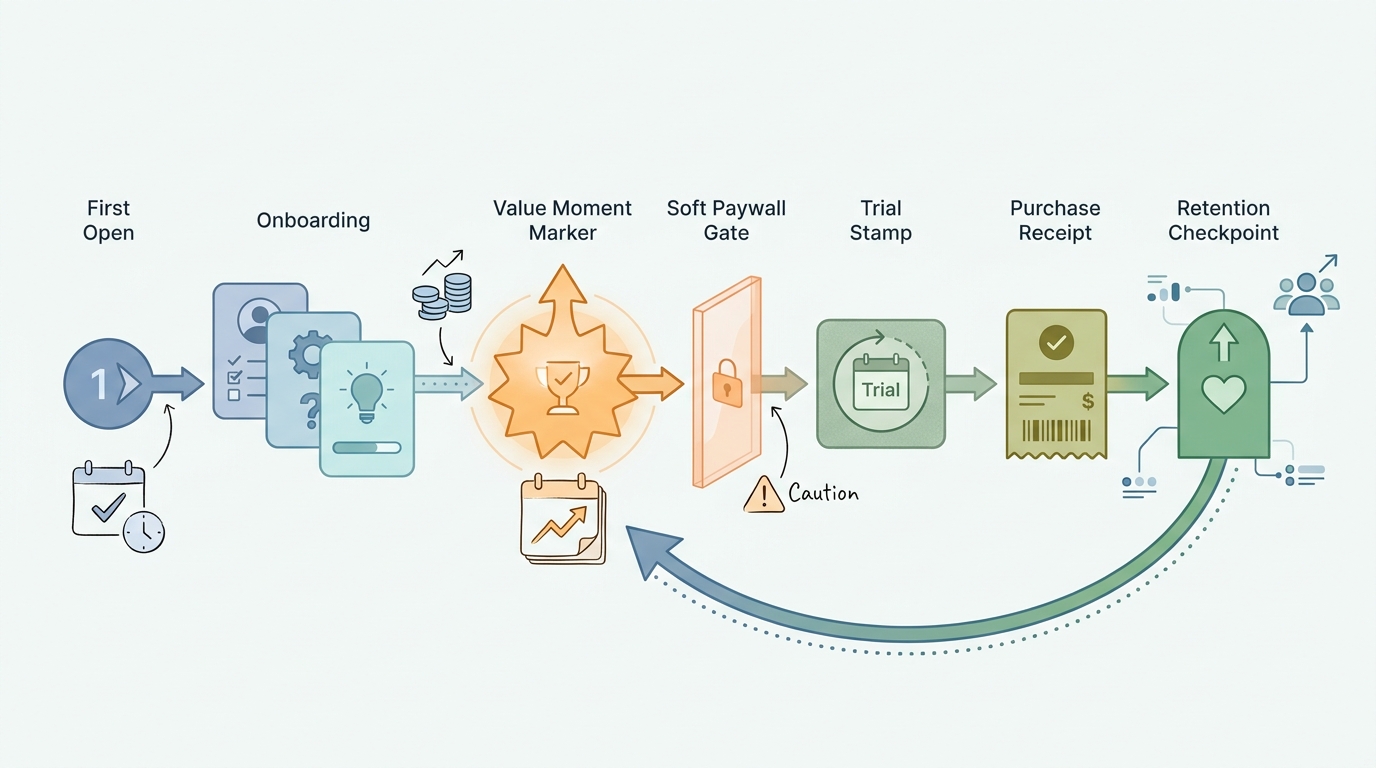
A step-by-step process diagram showing the app’s progression from first open to value moment, paywall, trial, purchase, and retention checkpoint. It highlights the decisions the founder made to introduce monetization after demonstrated value, not at first launch.
Category: Scale
Statistic: ↑ → ↘ (intentional)
Label: Install growth trend
Context: Growth was deprioritized until unit economics improved
Category: Monetization
Statistic: inconsistent → steadier
Label: Revenue per user
Context: Monetization changes reduced volatility across cohorts
Category: Unit economics
Statistic: too long → improved
Label: Payback period (days)
Context: Days until contribution margin covers CAC - better, still monitored
| Metric (internal, directional) | Mar 2026 (before) | May 2026 (after) |
|---|---|---|
| Install growth | rising | flatter on purpose |
| Revenue per user | inconsistent | steadier |
| Payback period | too long to scale | improved, still watched closely |
- Explanation: This is internal direction-of-change, not a promise of results. Payback here means days until contribution margin covers CAC.
- Interpretation: The improvement was likely driven by (a) asking for payment after a clear value moment and (b) better cohort and channel measurement.
- Reader impact: If your app feels "busy" but cash flow stays flat, this pattern is worth testing: shift paywall timing, then use payback (not installs) to decide what growth is worth buying.
When you move from outline to execution, How Much Money Do Indie Apps Actually Make in 2026? helps close common gaps teams hit here.
Why were downloads not turning into profit?
In early 2026, I treated installs and daily actives as traction. Sessions were steady, support emails were positive, and the app felt useful. But value was not tied to a payment moment, so usage did not reliably translate into revenue.
"Free" was not free for us. Each cohort added hosting, APIs, and support load, and those costs showed up before revenue did.
Where the acquisition math broke
The numbers below are rounded ranges from our internal dashboard (varies by channel, geo, and week). They show the pattern, not a universal CAC.
| Metric (per new user) | Mostly organic month | More paid-dependent month |
|---|---|---|
| CAC | ~$0 | ~$2 to $3 |
| First-month revenue | low cents range | low cents range |
| Payback | slow | not viable |
Once store discovery leveled off, paid growth became the main lever. That turned payback into a gate for almost every decision, because "more installs" often meant "faster burn."
Constraints that shaped the solution
- Team bandwidth: one engineer, so changes had to ship in stages (weeks), not a rebuild (months).
- Reputation risk: no aggressive paywall or ad overload that could spike reviews negatively.
- Data latency: store reviews and learning periods add delay. Expect a few days to 2 weeks per release, plus time to gather enough post-release data to trust.
A complementary angle worth comparing lives in The Fastest Way to Make Your First $1,000 From an iOS App.
How did we rebuild the app around revenue?
We stopped optimizing for total users and picked one target metric: payback period (using contribution margin, not gross revenue). We set a 45-day experiment window for paywall and pricing with weekly checkpoints and a rollback plan if ratings or D7 retention dipped.
The tradeoff was real: we paused some feature work to get measurement and monetization right. For us, that was about 2-3 weeks of focused effort, plus ongoing upkeep.
Choosing the revenue mix (and when hybrid is worth it)
Run a usage audit before picking a model
We pulled about 30 days of events and grouped actions by repeat frequency, time saved, and support load. Budget a few hours to query and a day to sanity-check definitions, especially if your event names are messy.
Separate casual users from power users
Casual users wanted quick wins and low commitment. Power users returned multiple days per week, exported results, and asked for advanced features, which made premium feel like an upgrade tied to behavior.
Use hybrid only if each stream maps cleanly to a segment
We avoided stacking subscriptions, ads, and one-off purchases on the same person. Subscriptions served power users; a one-time upgrade covered occasional users. The constraint: hybrid adds entitlement edge cases, analytics complexity, and more support tickets.
Pricing and paywall logic (what we actually watched)
- Tested a modest monthly entry price, an annual anchor, and a shorter free trial (instead of guessing).
- Moved the paywall to right after a user completed a meaningful workflow, not on first open.
- Watched conversion, churn, refunds, and review sentiment across two release cycles before rolling out broadly.
One thing worth noting: paywall timing can backfire. If you gate too early, you may see short-term conversion lift followed by cancellations, refunds, and ratings drop a week later.
Monetization checkpoint Map revenue mix against retention and payback, then pick one metric to baseline before changing pricing. Build your monetization checkpoint
For tradeoffs, checklists, and edge cases, 5 Proven Monetization Models for iOS Apps in 2026 rounds out this section.
How do you test monetization changes safely?
We condensed the work into three stages, but it was not linear. Store review timing, sample size, and attribution noise created false positives and weeks where we could not call a test.
The 3-release workflow (compressed)
Instrument the money flow
We used RevenueCat for subscriptions/entitlements and Amplitude for product analytics. Expect ~5-10 engineering days to get events consistent, plus 1-2 hours per week to maintain dashboards and fix edge cases.
Redesign the user journey
We delayed the premium prompt until after the first core win. That can reduce impulsive trials and increase intent, but it also means fewer people ever see the paywall, so top-line conversion may look worse before unit economics improve.
Iterate on channels and store listing
We updated store copy to describe the paid outcome (not a feature list), reallocated spend toward better trial-to-paid cohorts, and paused channels that missed payback even when top-of-funnel looked strong.
Minimum instrumentation and the one dashboard that mattered
Event taxonomy (minimum viable):
paywall_viewed(placement)trial_startedpurchase_completed(SKU, price, period)renewal_successandrenewal_failedcancellation(if possible: voluntary vs billing issue)refund_issuedcore_value_completed
| Dashboard view | Why it mattered |
|---|---|
| D1 and D7 retention by cohort | Detect paywall damage and onboarding issues |
| Paywall view to trial start | Paywall clarity and placement effectiveness |
| Trial to paid, plus refunds | Intent quality, not just conversion |
| Contribution per user | Translate behavior into economics |
| Payback estimate by channel | Decide what growth is worth buying |
Dependencies and risk notes:
- Attribution limits: iOS privacy and messy MMP data can make channels look better or worse than reality. Treat early reads as directional until tracking stabilizes.
- Low volume: small cohorts can make tests inconclusive for weeks. If you do not have enough traffic, prioritize bigger changes with clearer signal, or extend the window.
- Pricing power varies by category: some categories simply cannot support high subscription pricing without retention work. In those cases, ads or one-time purchases may be more realistic.
- Policy and reviews: Apple/Google review delays and policy constraints can slow iteration, especially around trial messaging, price changes, and paywall language.
Top 5 Ways to Monetize Your First iOS App reframes the same problem with a slightly different lens - useful before you finalize.
Outcomes and lessons: better unit economics, still not magic
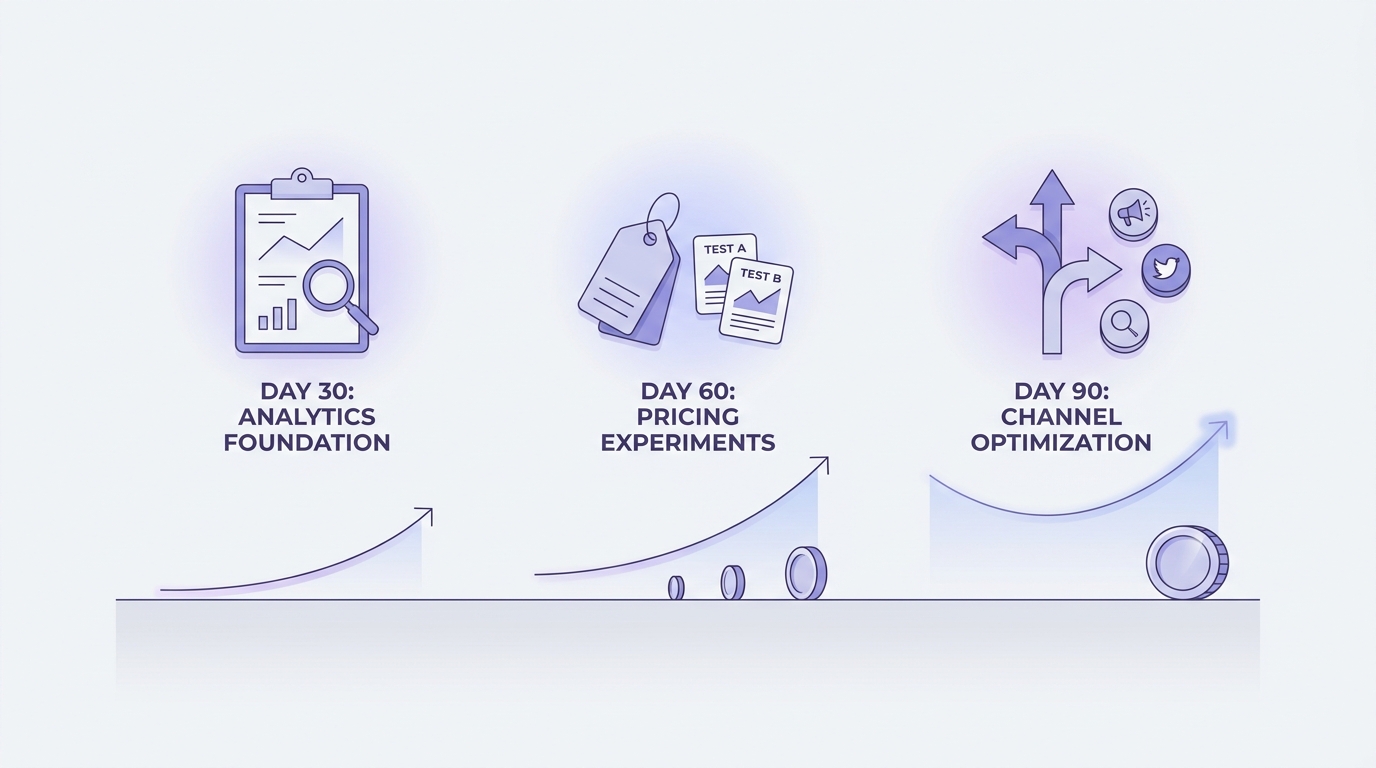
A compact timeline of the rollout across 30, 60, and 90 days, showing when analytics was set up, when pricing tests shipped, and when channel adjustments started to affect profitability. It emphasizes that the result came from staged execution over a quarter, not a single launch week.
We did not flip a switch to "profitable." We got closer to reinvestable unit economics for parts of the business, and clearer signals about what was not working. Results will vary with volume, category, pricing power, and channel mix.
| Metric (internal, directional) | Before rollout | After ~90 days | What it meant |
|---|---|---|---|
| Trial to paid | lower | higher | Cleaner intent, fewer accidental trials |
| Monthly margin | negative | improved, still tight | Costs slowed relative to revenue |
| Churn | high | still a constraint | Retention remained the limiter |
| Acquisition mix | narrow | still narrow | Ongoing channel risk |
Realistic timeline (not guaranteed): ~3-5 weeks to get analytics credible, another 4-8 weeks to reduce pricing noise, and 8-12 weeks to see channel mix effects if volume is sufficient. Seasonality, store review, and paid learning periods can add 2-4 weeks.
Practical takeaways:
- Start with payback and contribution margin, not downloads, before scaling spend.
- Treat monetization like product work: instrument, ship, review, repeat.
- Protect the trust threshold. Short-term conversion spikes are not worth long-term review damage.
Plan the next 90 days Build a focused 90-day plan around one primary revenue metric, then align listing, pricing, and retention work to support it. Plan your next 90 days