
Founders usually expect app review delays to come from bugs, screenshots, or subscription copy. A recurring source of launch friction starts earlier: the gap between what the app actually does and what the team declares in App Store Connect or Google Play Console. This article breaks down the most common pre-launch disclosure mismatches, why they happen, and how to catch them before submission week turns into rework week.
Early proof: a practical mismatch map
The table below is not a market-wide dataset. It is an operational pattern map based on common launch-prep failure points, combined with platform disclosure requirements from Apple and Google and directional research contexts such as PTKD and PrivPRISM. Treat it as a diagnostic, not a statistical claim.
| Failure point | Where it starts operationally | Where it becomes visible later | Likely impact |
|---|---|---|---|
| Missing third-party SDK data | Engineering adds analytics, attribution, crash, chat, auth, or ad SDKs without disclosure review | App Store Connect, Google Play Console, policy mismatch, reviewer questions | Under-disclosure and follow-up requests |
| Incorrect tracking declarations | Team treats analytics, attribution, and ads as one category | Apple privacy labels, ATT logic, reviewer scrutiny | Inconsistent privacy answers |
| Incomplete Google Play Data Safety forms | Team reuses old templates or broad policy text | Google Play Console review, public Data Safety section | Inaccurate collection or sharing disclosures |
| Unclear account deletion flow | Deletion exists only via support or partial backend tooling | Store review, support tickets, user complaints | Trust loss and launch delays |
| Stale privacy policy language | Product shipped new features, vendors, or permissions without policy update | Public policy page, store listing consistency checks | App behavior and policy drift |
Interpretation: review usually exposes an upstream process mismatch rather than creating a new problem. If a disclosure looks wrong in a store console, the root cause often sits in release management, vendor oversight, or unclear ownership.
Reader impact: this is useful because the fix is rarely "write better form answers." For a simple app, a focused review may take a few hours. For a more complex app using ads, location, accounts, subscriptions, or user-generated content, it often becomes 1 to 3 days of cross-functional work across engineering, product, support, and sometimes legal or compliance.
Writing a Privacy Policy That Actually Passes App Store Review goes deeper on the ideas above and adds concrete next steps.
Why do app privacy mismatches happen before review?
Most launch-stage privacy problems are not legal-theory problems. They are operating-model problems. Product changes, SDK additions, store console forms, and privacy-policy updates are often managed in different places by different people, so drift becomes easy.
This analysis is intentionally narrow. It looks at pre-launch mismatches across app behavior, App Store Connect privacy details, Google Play Data Safety answers, and the public privacy policy, using Apple and Google platform guidance plus directional research contexts such as PTKD and PrivPRISM. It is not legal advice, not a market-wide census, and not a claim that every mismatch causes rejection.
One thing worth noting is that Apple and Google do not always frame disclosures in exactly the same way. A disclosure that feels reasonable in one ecosystem can still be incomplete in the other. That ambiguity is normal, but it increases the value of documented owner decisions instead of assumptions made during submission week.
When you move from outline to execution, We Analyzed App Launch Delays: Why Mobile Apps Don’t Go Live on Time helps close common gaps teams hit here.
How can you tell your app privacy answers do not match the product?
SDK inventory drift is often the first under-disclosure problem
The most commonly overlooked SDK categories are analytics, attribution, crash reporting, support chat, authentication providers, ad networks, and feature flags. These tools help teams ship faster, but they can quietly change the app's data footprint.
The usual failure mode is simple: engineering adds or updates an SDK, nobody triggers a disclosure review, and the store forms and privacy policy stay unchanged. That is why a vendor-by-vendor data map is usually more reliable than broad statements like "we only collect basic analytics."
Tracking declarations break when teams merge analytics, attribution, and ads
Apple tracking answers often go wrong because teams collapse different behaviors into one label. Product analytics, attribution measurement, cross-app tracking, and ad network use of identifiers may sound related, but they do not always map to the same disclosure outcome.
The reviewer-facing symptom is inconsistency. Identifiers appear in the app or SDK stack, ATT-related logic exists, and the submitted tracking answer says something narrower or broader than the implementation. In practice, a useful check is to list every identifier used by the app and its SDKs, then compare each one against the planned Apple disclosure before submission.
A complementary angle worth comparing lives in The Privacy Policy URL Trap: What It Must Include to Pass Review.
The five disclosure mistakes founders make before launch
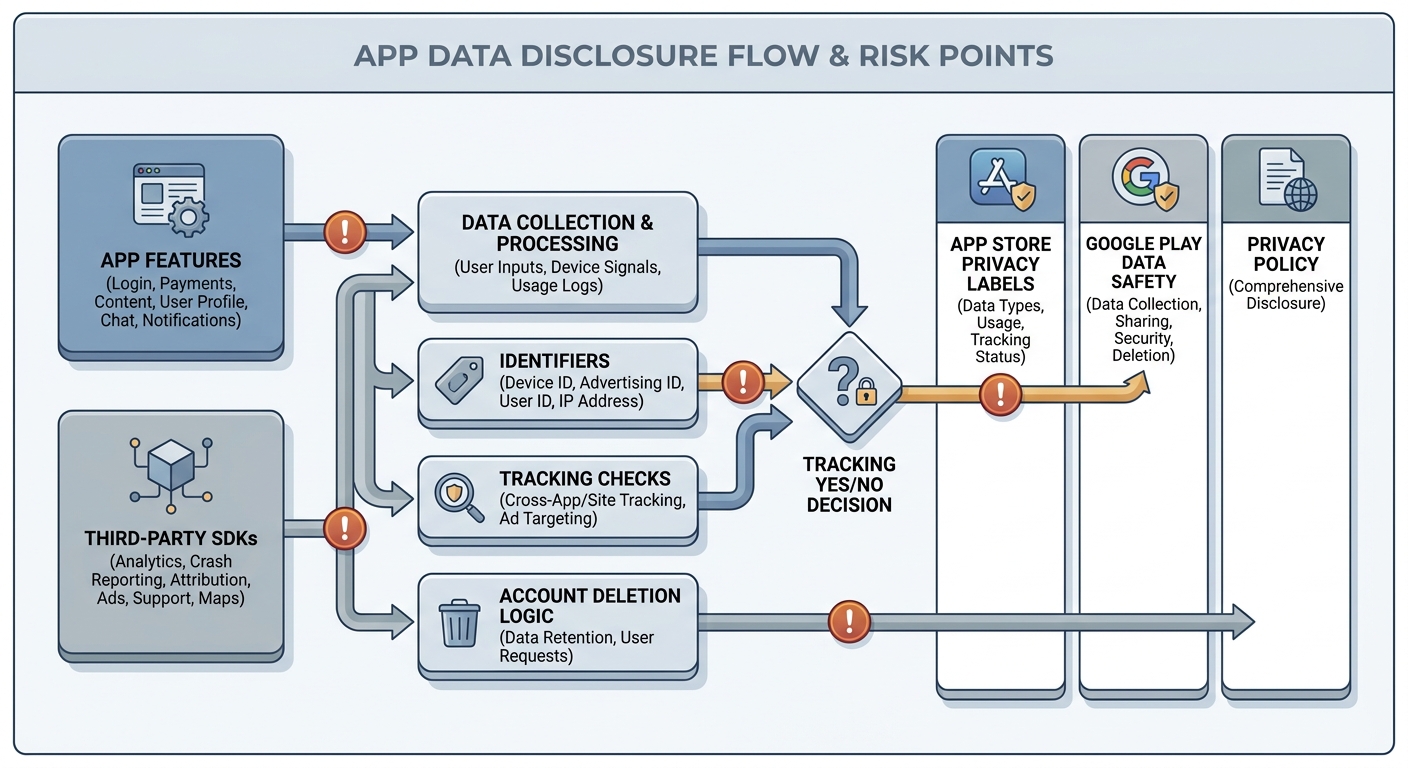
A process diagram tracing app features and third-party SDKs through data collection, identifiers, tracking logic, App Store Connect privacy labels, Google Play Data Safety answers, and privacy policy outputs, highlighting where under-disclosure usually happens.
1. Hidden SDK collection
Founders often describe first-party product behavior accurately, then miss what analytics, attribution, crash, or support vendors are doing around the app. That can create a privacy label mismatch even when the product description feels honest internally.
The tradeoff is speed versus visibility. SDKs reduce build time and add useful capabilities, but each new vendor adds review overhead and dependency risk. If vendor documentation is vague, outdated, or changes over time, someone still needs to make and defend the disclosure decision.
2. Incorrect tracking declarations
Tracking declarations often break because teams never separate analytics from advertising or attribution behavior. Once that distinction is blurred, answers can become too broad, too narrow, or internally inconsistent.
This is also an area where interpretation gets messy. Apple may focus on how identifiers are used and linked, while internal teams may think in terms of business intent instead. When in doubt, document the logic behind the answer and confirm it with the people who own SDKs, growth tooling, and monetization.
3. Incomplete Google Play Data Safety answers
On Google Play, the common error is not always false disclosure. It is often incomplete disclosure. Teams reuse a stale template, answer from memory, or rely on privacy-policy language that does not map cleanly to actual collection, sharing, and security practices.
These fixes are not always quick. Some answers require confirming retention, optionality, encryption, or third-party sharing with vendors or internal owners. If nobody has that information readily available, a short console task can turn into a multi-day coordination job.
4. Unclear account deletion flow
A support email is not the same as a clear deletion experience if store expectations and user trust both point toward a visible path and real backend execution. The issue is not just UI. It often touches identity, support workflows, database handling, and vendor systems.
This is where hidden effort tends to appear. A deletion flow may look done from a product perspective but still require backend work, support playbooks, or vendor review to be operationally credible. In some cases, teams also discover exceptions like billing records, fraud controls, or legal retention needs, which can make "delete everything immediately" an unrealistic promise.
5. A privacy policy that describes an older version of the app
This drift usually appears after shipping new location features, subscriptions, AI functionality, payments, or a new support or analytics vendor. The app changes, but the public policy URL and console answers stay tied to an earlier product state.
Treat privacy policy updates as release-management work, not as a one-off legal artifact. A stale policy may not always block launch, but it weakens trust and can trigger avoidable reviewer questions when other disclosures are already borderline.
How should founders audit app privacy declarations before submission week?
A workable audit does not need to be heavy. It does need clear owners, current build visibility, and enough time to resolve issues that are not just copy changes. Some fixes are form edits, while others require backend changes, vendor clarification, or legal input.
Inventory the shipped build
List every SDK, permission, account system, and data-touching feature in the current build. Do not rely on memory, old forms, or assumptions about what was removed.
Map data types to disclosure surfaces
Match each data type and identifier to Apple privacy labels, Google Play Data Safety questions, and the public privacy policy. This is where hidden gaps usually become visible.
Verify edge cases with owners
Check account deletion, ATT-related tracking, retention assumptions, and partner sharing with product, engineering, support, and legal or compliance if needed. If nobody clearly owns an answer, you have identified a launch risk.
Run a final consistency pass
Compare the live build, console answers, and public policy URL line by line. The goal is not perfect paperwork. It is one coherent description of how the app actually behaves.
A simple timing model helps teams plan realistically:
| Timing | What to verify | Reality check |
|---|---|---|
| 7 days before | Freeze SDK list, confirm vendor docs, test account creation and deletion paths | Best window for fixes that need engineering or vendor input |
| 3 days before | Review App Store Connect and Google Play answers against the build | Good for wording gaps, risky for major backend changes |
| 1 day before | Verify policy URL, in-app deletion entry point, feature flags, ad toggles, analytics changes | Useful as a final check, but too late for structural fixes |
What good looks like operationally
Good privacy disclosure work usually looks boring. There is a current SDK inventory, a named owner for store answers, a release step for policy updates, and a lightweight escalation path when a vendor or edge case is unclear.
The business impact is straightforward. Fewer mismatches usually mean fewer reviewer questions, less launch-week churn, and better credibility if users inspect your policy or deletion flow. Still, no process removes all ambiguity, especially when product behavior, vendor practices, and platform interpretation are all moving at once.
Reviewer outcomes also remain somewhat probabilistic. Two teams with similar implementations can still get different levels of scrutiny depending on app category, reviewer focus, geography, or how clearly the submission materials explain edge cases. The practical takeaway is not to expect certainty, but to reduce avoidable inconsistency.
If you are planning a release, the standard is not perfection. It is whether your build, store answers, and public policy tell the same story without forcing reviewers or users to guess. That level of consistency is achievable for most teams, but only if someone owns it before submission week.
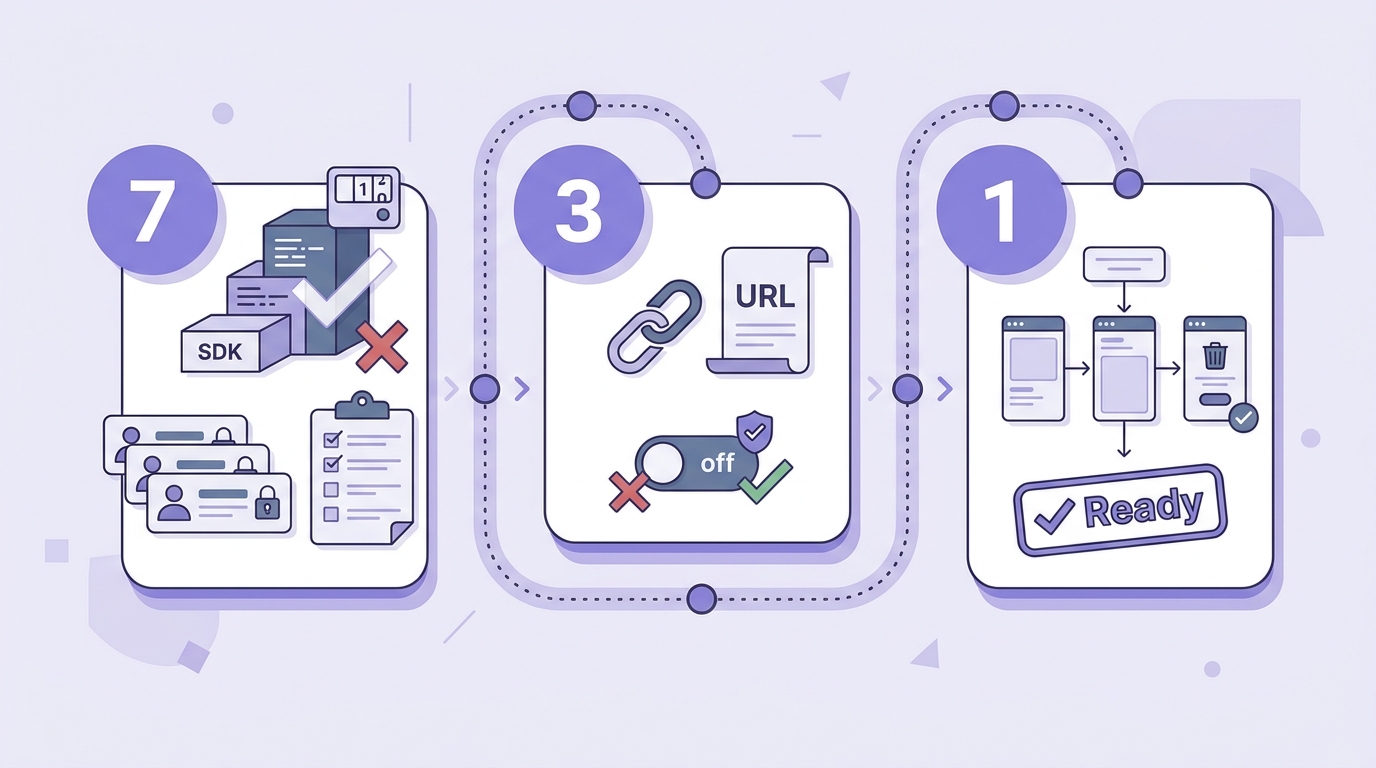
A three-stage pre-submission timeline showing the exact checks to run 7 days, 3 days, and 1 day before launch across SDK inventory, App Store Connect privacy labels, Google Play Data Safety answers, privacy policy URL, and account deletion flow.


