If Apple rejected your app under Guideline 5.1.1 for a privacy-label mismatch, expect metadata and policy fixes to take 24 - 72 hours and SDK or binary changes to take multiple engineer-days to a few weeks depending on QA and legal review. This short playbook shows what we measured, the exact mismatches that trigger rejections, and a prioritized plan you can apply immediately to shorten re-review cycles.
How to Fix App Store Guideline 5.1.2 Data Use and Sharing Rejection goes deeper on the ideas above and adds concrete next steps.
What common privacy-label mismatches trigger Guideline 5.1.1?
Category: Baseline
Statistic: ~60%
Label: Apps with label-policy mismatch
Context: Directional rate from Froxi’s internal sample
Category: Outcomes
Statistic: 38%
Label: First-pass approval rate
Context: When metadata is complete upfront
Category: Speed
Statistic: 24 - 72 hrs
Label: Typical re‑review turnaround
Context: Common window after resubmission (varies by case)
Most rejections in our sample were metadata-policy inconsistencies rather than deep technical privacy defects.
Research goal, scope and limits
Goal - Find the common content mismatches that trigger Apple Guideline 5.1.1 rejections and produce immediately actionable fixes.
Scope - Directional audit of 30 Froxi-managed iOS rejections flagged 5.1.1 between January and June 2026 across utilities, finance, and lifestyle apps.
Limits - Small sample, Froxi client bias, US and EMEA heavy; treat percentages as operational benchmarks, not population statistics.
Key metrics snapshot (directional sample)
| Metric | Directional value | Practical meaning |
|---|---|---|
| Mismatch frequency | ~60% (n = 30) | Label lists a data category not described in the policy |
| Top missing disclosure | Third-party sharing | Label shows sharing but the policy lacks a sharing section |
| Re-review timeline | 24 - 72 hours | Typical turnaround for metadata-only corrections |
Interpretation - In this sample the fastest fixes were policy text and App Store metadata updates. The practical takeaway is that a focused checklist and one careful policy edit will often restore compliance quickly. Caveat - if an SDK actually collects new data, expect code work, QA, and a longer review path.
When you move from outline to execution, How to Fix App Store Guideline 5.1.1 Privacy Rejection helps close common gaps teams hit here.
Why does Apple issue Guideline 5.1.1 rejections for privacy-label mismatches?

A process diagram that maps the top mismatch types (Missing category, Missing sharing clause, SDK collection mismatch) to immediate actions (Edit policy, Update App Privacy label, Remove/replace SDK) with estimated effort (minutes/hours) annotated.
Apple rejects when App Privacy metadata, the published privacy policy, and runtime behavior are inconsistent.
Reviewers check three things: the App Privacy form in App Store Connect, the privacy policy URL you publish, and the app or SDK behavior they can observe. If any of those disagree, reviewers will flag 5.1.1.
Top mismatch types to check first
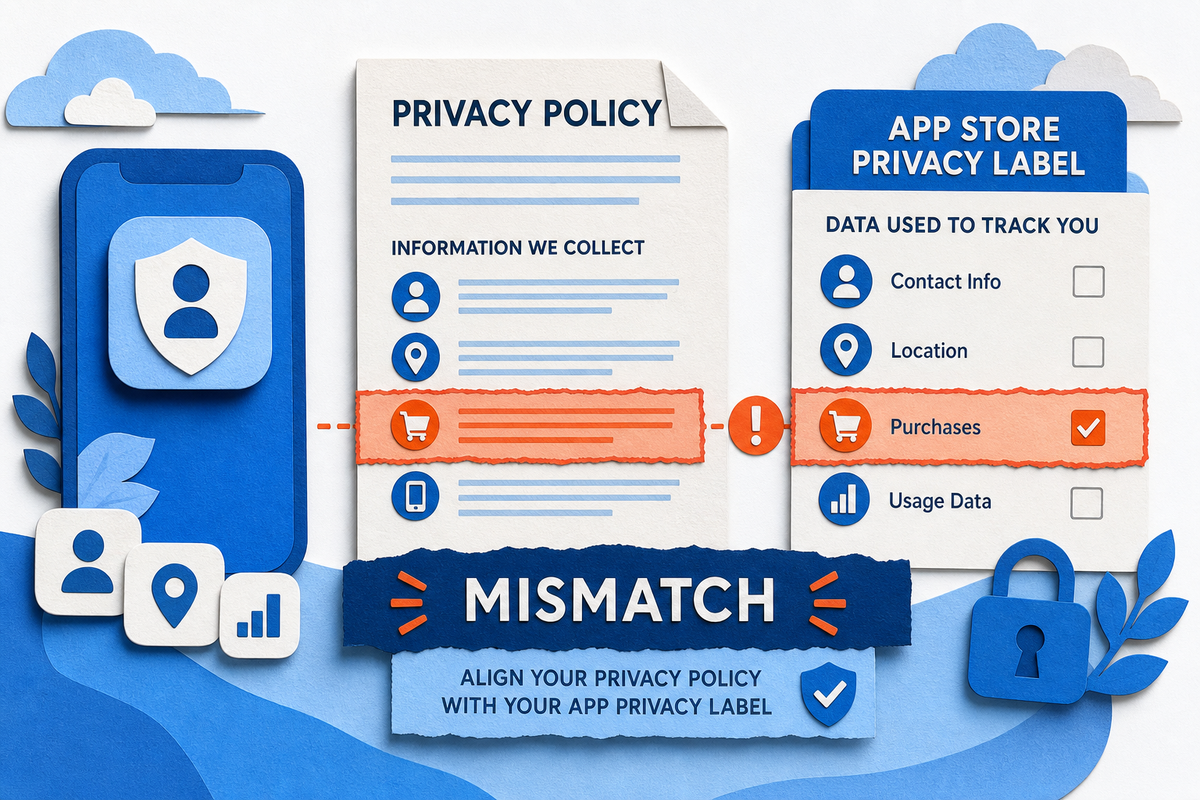
- Missing data category in the policy but selected in App Privacy - either remove the label or add a clear policy line.
- Label shows data is shared with third parties but the policy lacks a sharing section - add named partners or clear purpose statements.
- Policy claims "device-only" while included SDKs collect telemetry - run an SDK inventory and update both policy and label.
What this means - Start with the easiest-to-verify items: named data categories and explicit sharing disclosures. Those are low-effort and fix most avoidable rejections.
A complementary angle worth comparing lives in The Privacy Policy URL Trap: What It Must Include to Pass Review.
How do I fix the privacy policy and App Privacy label mismatch?

A step-flow visual that walks through the remediation steps in App Store Connect: inventory → policy update → label update → metadata notes → resubmit, with checkpoints for 'metadata-only' vs 'binary required' and expected time-to-review.
Map reality, update the policy, reconcile App Privacy fields, and choose metadata-only resubmission when no binary changes are needed.
Fixing the privacy policy (quick wins)
Inventory actual collection
Create a concise data map listing each SDK, endpoint, and the data types collected. Use SDK docs and a short network trace or runtime permission checks to confirm.
Add purpose and sharing lines for each data category
For every data type in your map, add a one-line purpose and whether it is shared. If you share with vendors, name them or link to vendor privacy pages when practical.
Publish a single authoritative policy URL
Host the policy on HTTPS, include a version and publication date, and ensure App Store Connect points to that exact page.
Fixing the App Privacy Label in App Store Connect
Update Data Types to match the inventory
In My Apps > App Privacy, pick the exact categories that reflect your inventory and keep "Used for" purposes aligned with policy text.
Only toggle "Data Shared" when the policy references third parties
If you mark data as shared in the label, the policy must mention sharing partners or give a clear functional description. Mismatched toggles are a common immediate cause for rejection.
Pick the correct submission path
Use metadata-only updates when no binary changes are required; plan 24 - 72 hours for re-review. If an SDK change is needed, budget several engineer-days to a few weeks for dev, QA, and review.
For tradeoffs, checklists, and edge cases, How to pass app store review guideline 4.3 spam? rounds out this section.
What operational tradeoffs matter when remediating 5.1.1?
Text fixes are fast; SDK or binary changes take measurable engineering time and may delay review.
Remediation effort versus risk - If the mismatch is purely textual, expect under a day of work for a small team to update policy and metadata. If an SDK is the root cause, removing or replacing it can take 3 - 10 engineer-days plus QA and a longer review window. Factor in legal review time if you must name vendors.
Evidence for reviewers - Use App Review notes to state the exact changes: policy URL, policy version/date, and which App Privacy fields you updated. Clear, factual notes reduce back-and-forth but cannot guarantee single-pass approval.
Practical failure modes - hidden SDK telemetry, reviewer inconsistency across regions, and caching of privacy pages can produce surprises. If unsure, run a short network capture, a privacy scanner, and include those findings in your review notes.
One thing worth noting - Naming vendors reduces ambiguity for reviewers but can trigger procurement or legal concerns. If naming is impossible, give clear functional descriptions and link to vendor privacy pages where practical.
Writing a Privacy Policy That Actually Passes App Store Review reframes the same problem with a slightly different lens - useful before you finalize.
Final CTA
If you want help, book a short review or request the preflight checklist to speed re-approval.