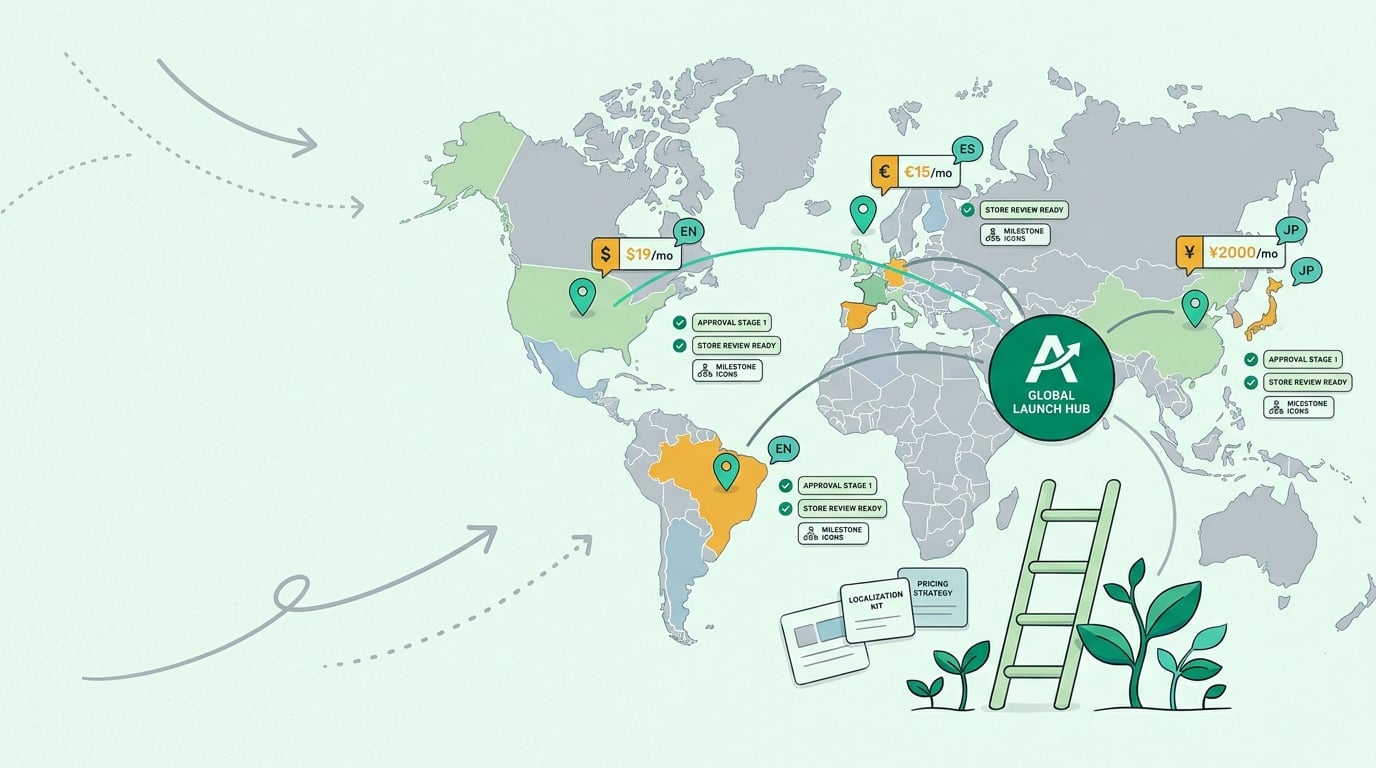
Launching in multiple countries sounds like a simple switch, until you hit inconsistent pricing, half-localized store pages, and review delays that cascade across regions. This guide gives you a practical, repeatable workflow to choose wave-1 territories, align regional pricing, ship minimum-viable localization, and stage a rollout you can actually support on day one.
App Store vs Google Play: Where Should You Launch First goes deeper on the ideas above and adds concrete next steps.
Early proof: what a coordinated multi-country launch really requires
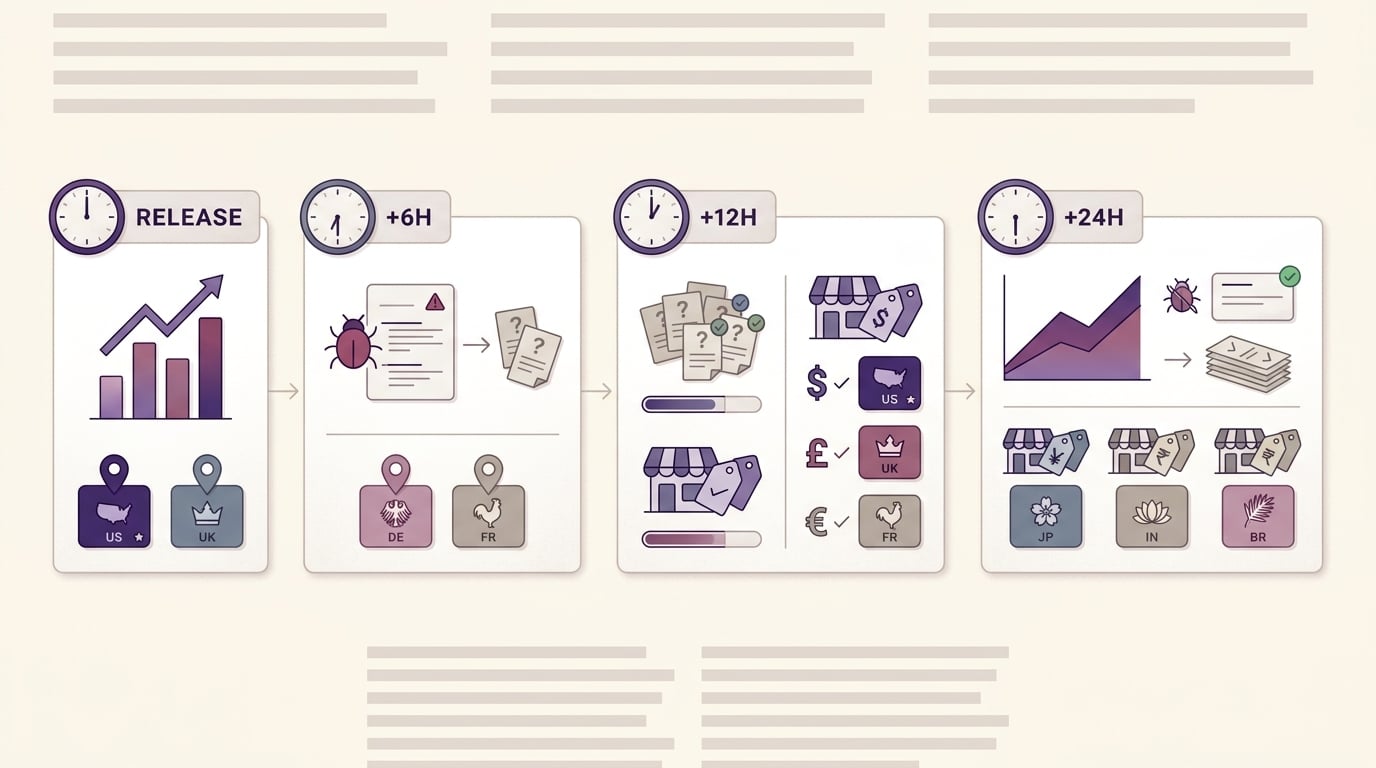
A launch-day timeline showing the first 24 hours after release across multiple countries, with checkpoints for install volume, crash reports, support tickets, and storefront price verification.
Category: Outcomes
Statistic: 38%
Label: First-pass approval rate
Context: When metadata is complete upfront
Category: Speed
Statistic: 4 hrs
Label: Median fix time
Context: After a store rejection notice
Category: Scope
Statistic: 0 - 175+ territories
Label: Territories to enable at launch
Context: Availability is set per country/region before release
| Area to align | What you set up | A realistic "ready" signal (illustrative gates, not universal) |
|---|---|---|
| Territories and timing | App availability per country (App Store Connect, Play Console) | Wave-1 list locked 3-5 days before release so metadata, support, and pricing are not moving targets |
| Pricing and billing | Price tiers, currencies, subscriptions, promos | Storefront price spot-check for every wave-1 country, plus a test purchase per platform where feasible |
| Localization and compliance | Store metadata, screenshots, age rating, disclosures | Minimum store localization shipped for wave-1, and review-sensitive fields completed before you submit |
Interpretation
- Multi-country is mostly coordination: scope, pricing, and storefront assets need to line up.
- "Ready" means fewer self-inflicted changes, not control over store review timing.
Impact for you
- You are more likely to avoid day-one pricing surprises that drive complaints or refunds.
- You reduce last-minute metadata churn that can trigger re-review.
- Support load is easier to forecast because wave-1 scope is stable.
When you move from outline to execution, Publishing at Every Stage: How App Store Strategy Changes as You Grow helps close common gaps teams hit here.
Why not launch in one country first?
This is for founders and small app teams launching iOS, Android, or both who want to publish in more than one country on day one, especially for paid apps, subscriptions, or IAP.
The goal is not a perfect global strategy. The goal is a credible wave-1 launch where storefronts look intentional, pricing does not surprise buyers, and your team can respond when something breaks.
What goes wrong without a rollout plan
- Price tiers drift across regions, and you ship storefront prices you would not choose on purpose
- Store metadata stays in one language, lowering trust in non-native markets
- Territory-specific rules (age rating, tax display, content policy) create review delays or force rework
Expected effort (so you can plan honestly)
Wave-1 prep is usually days, not hours, because it is cross-functional and includes waiting time.
| Workstream | Typical owner | Realistic effort for a small team |
|---|---|---|
| Territory scope and timing | Founder or PM | 1-2 hours, plus 1-2 async check-ins |
| Pricing audit and verification | PM or growth | 0.5-1 day (more if you have many IAP items) |
| Store localization (1-3 languages) | Marketing + translator | 1-3 days, depends on screenshot workflow and translator SLA |
| Compliance + review-sensitive fields | Ops + sometimes legal | 0.5-2 days, longer if legal review is needed |
Tradeoff: you can go faster by localizing less, but conversion and support load often get worse. The practical play is "minimum credible", not "minimum possible".
A complementary angle worth comparing lives in Top 5 Ways to Monetize Your First iOS App.
How do you launch an app in multiple countries at once?
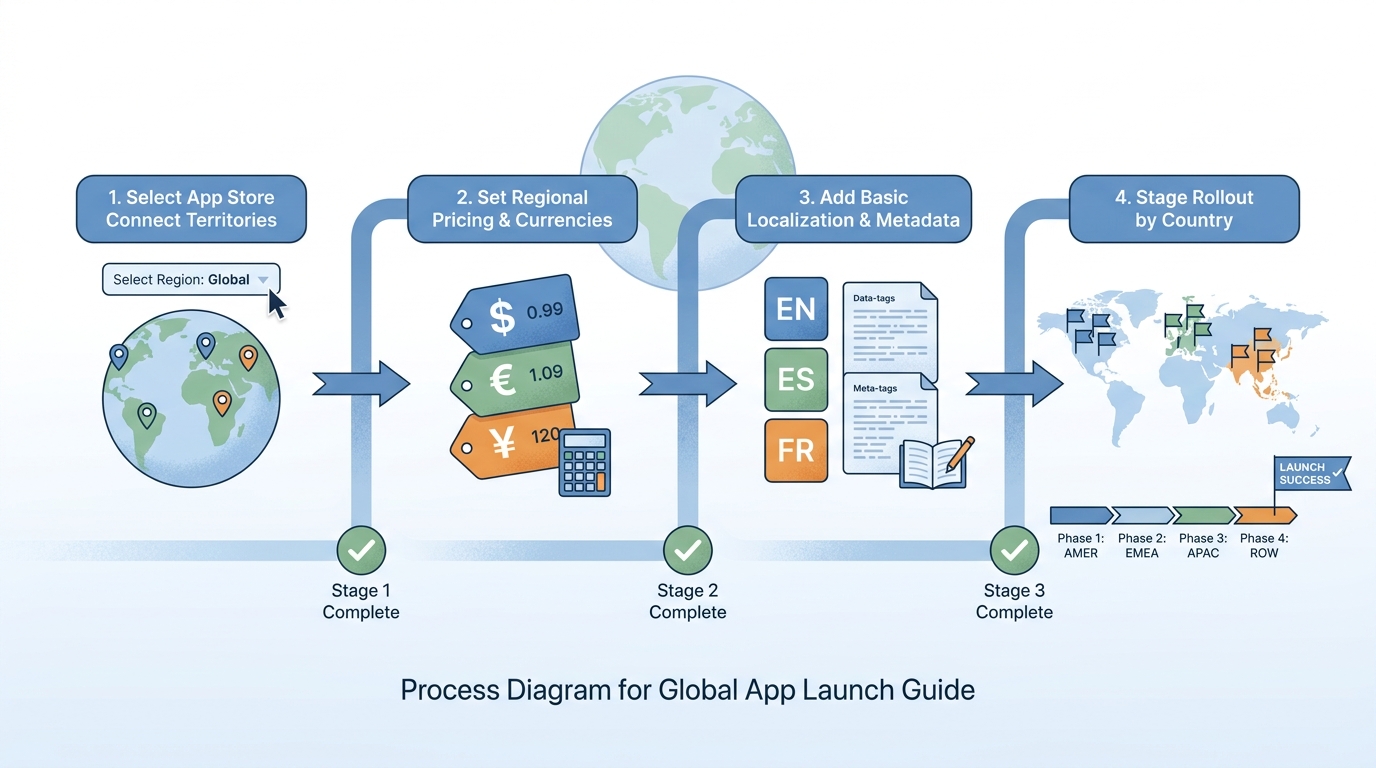
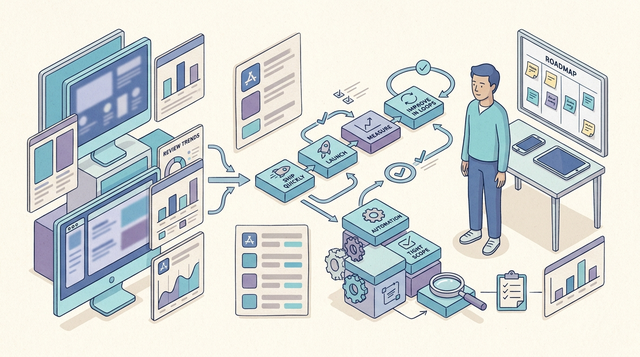
A process diagram showing the sequence from selecting App Store Connect territories to setting regional pricing, then adding basic localization, then staging the rollout by country.
1. Pick your wave-1 territories (do not start with "everywhere")
Define wave-1 with operational constraints
Start with markets you can actually support: languages you can cover, time zone overlap, and places where you can handle billing questions. On iOS you control this via App Store Connect availability settings (Apple documentation).
Common failure mode: launching where your support coverage is effectively "next day", then getting negative reviews you cannot respond to quickly.
Cluster territories by intent
Use three buckets: primary revenue, secondary growth, and low-risk tests. This keeps scope sane while still giving you learning across different market types.
Constraint: marketing calendars and PR often force a smaller wave-1 than you want. If promo is scheduled in a country, either include it in wave-1 or adjust the promo plan.
Lock the list before heavy asset production
Lock wave-1 before you finalize screenshots and translations. Otherwise you waste time localizing countries you will not launch, or you scramble to add languages after creative is already scheduled.
Dependencies: translator turnaround, screenshot owner availability, and any legal review. Add 1-2 business days of buffer for back-and-forth.
2. Set regional pricing and currency logic (and verify what users see)
Choose anchor price points
Pick a base price you actually want to defend, then map it to sensible outcomes across wave-1 countries. Do not assume your home price converts fairly everywhere.
Failure mode: you end up unintentionally "premium" in one region because rounding and tax-included pricing push you past a psychological threshold.
Validate subscriptions and IAP per market
On Google Play, understand how multi-currency configuration affects displayed prices (Google Play documentation). On iOS, pricing tiers and storefront behavior can differ by market, so do a final pass on displayed pricing (a practical guide: PricePatch).
Dependency caveat: test accounts and payment methods. In some countries you will not be able to complete a clean purchase test without local cards, local IPs, or a teammate in-region. Plan for spot-checks plus a smaller set of real purchase tests.
Sanity-check final storefront prices before submission
Do a country-by-country spot-check for wave-1. If you are marketing a launch promo, confirm it is consistent everywhere you plan to promote it.
Realistic effort: budget 10-20 minutes per platform for a tight wave-1 (5-10 countries), longer if you have multiple subscription options or many IAPs.
Pitfalls and edge cases to plan for:
- Tax-inclusive regions can make "same tier" feel mismatched
- Currency rounding can create awkward price points
- Promo timing can drift across platforms if you do not schedule and verify it
3. Ship minimum-viable localization (and decide release strategy)
Localize the trust surfaces first
For wave-1, minimum viable localization is usually: app name (where needed), subtitle, description, key screenshots, and any first-run text that blocks understanding. Store-only localization is faster than full in-app localization, but users judge you on first run too (Apple internationalization).
Risk: translations that are "correct" but wrong for subscription terms. If you sell subscriptions, have someone bilingual (or your translator) do a quick second pass on pricing and renewal language.
Pick staged vs immediate release based on support capacity
If you have limited support coverage, stage the release (or stage market expansion by cluster) so you can catch billing confusion, onboarding issues, or a bad translation before it multiplies.
Tradeoff: staged rollout reduces blast radius, but complicates marketing and attribution. Align on what you will say publicly so you do not promise availability where the app is not live yet.
Set a country-level checkpoint
Review performance by territory, not just blended totals. That is how you catch "pricing feels off in one country" versus "the product is failing everywhere".
Operational burden note: translations are not one-and-done. Expect follow-up work each release, especially for screenshots and subscription copy.
For tradeoffs, checklists, and edge cases, What Founders Should Know Before Their First Submission rounds out this section.
What should you monitor before expanding to more countries?
Make monitoring country-specific. Otherwise, one problematic market hides inside your blended averages.
Tools that usually cover 80 percent of the need:
- Crash and stability: Firebase Crashlytics or Sentry (watch crash-free sessions by country)
- Store performance: App Store Connect Sales and Trends; Play Console Acquisition (watch conversion rate by country)
- Support load: Zendesk, Intercom, or email (track tickets per 1,000 installs by country)
A compact set of rollout gates you can reuse:
| Gate | Where to measure | Hold expansion if you see |
|---|---|---|
| Stability | Crashlytics/Sentry by country | Crash-free sessions drop below your normal baseline in a specific market |
| Billing health | Store refunds and support tags | Refund rate or "charged wrong amount" tickets rise in one region |
| Support capacity | Ticket volume by time zone | You cannot respond within your promised window for wave-1 time zones |
| Store accuracy | Manual storefront checks | Wrong price, wrong language, or missing disclosures in a marketed country |
One thing worth noting: some issues only show up after scale (device mix, payment methods, carrier billing). In practice, plan for 24-72 hours of monitoring before you expand wave-2, and longer if you are changing pricing or promos.
How to Set Up In-App Purchases on iOS the Right Way reframes the same problem with a slightly different lens - useful before you finalize.
Common mistakes that make multi-country launches messy
- Changing pricing or metadata late: can trigger re-review or break scheduled marketing assets
- Over-expanding language coverage: more locales increases translation coordination, QA, and update overhead
- No fallback support path: even a simple localized help article or form reduces frustration
- Assuming review timing is predictable: approvals and policy enforcement vary; add buffer days, especially around holidays
What can still go wrong even with a good plan: a store review can stall in one region, a payment method you could not test can behave differently, or a translator can miss a nuance in billing language. The best mitigation is small wave-1 scope, buffers, and clear rollback options (pause a country, revert a promo, update copy).
Practical compromise: for wave-1, localize the top trust surfaces and the first-run blocker screens. Invest in deeper help center localization in wave-2 once you see traction and know which countries are worth ongoing maintenance.