
Shipping a mobile app means shipping a privacy policy that reviewers and users can access and understand. Writing one from scratch is slow, and missing disclosures (analytics, ads, account data) can trigger store-review questions and delays. This roundup ranks five mobile-friendly privacy policy generators so you can pick a tool, produce a usable draft faster, and reduce avoidable back-and-forth.
Does Your App Need a Privacy Policy? (Yes - Here's Why) goes deeper on the ideas above and adds concrete next steps.
Early proof: compact ranking snapshot (directional)
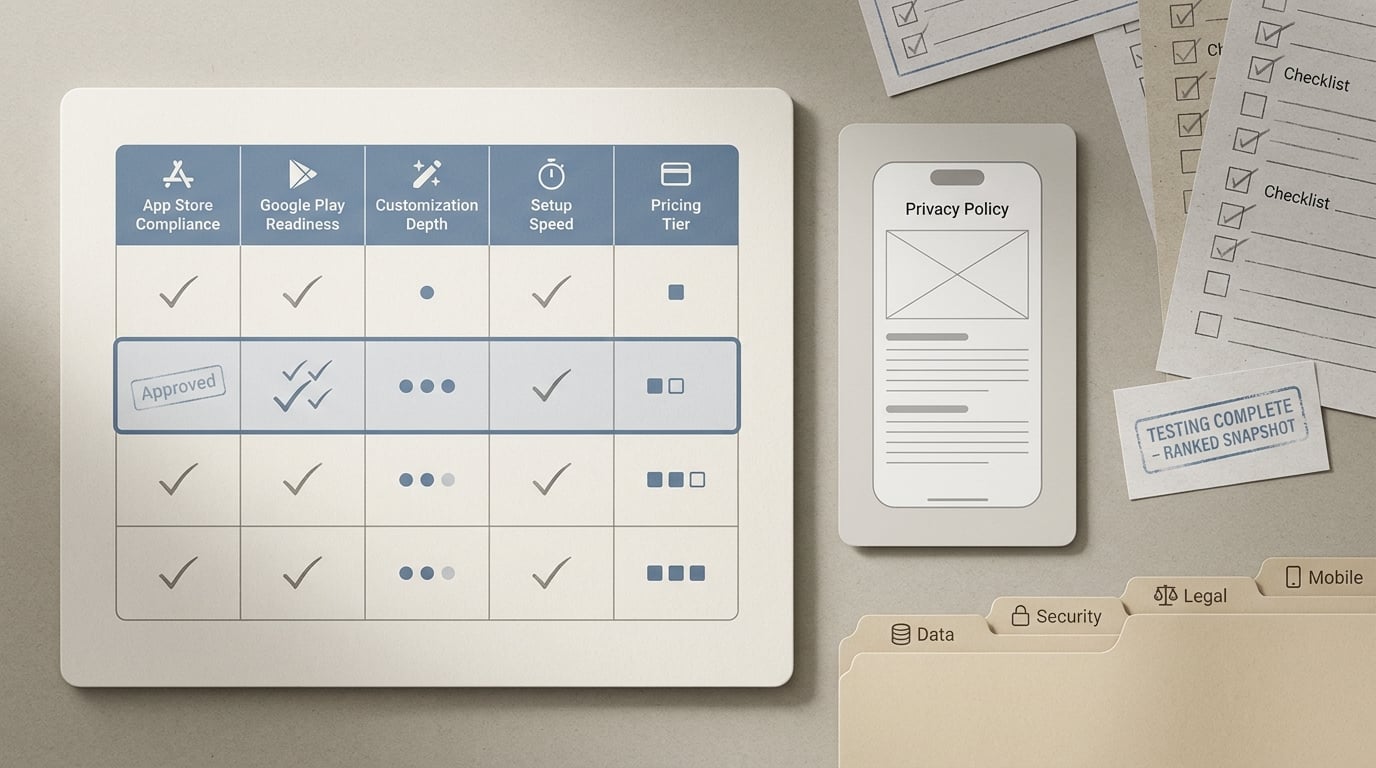
A compact comparison table showing five privacy policy generators ranked for mobile apps across App Store compliance, Google Play readiness, customization depth, setup speed, and pricing tier.
The table below is a scan-first snapshot based on publicly described product positioning and workflows (not performance, legal review, or store-approval testing). Use it to pick a starting point, then verify the output against what your app actually ships.
| Rank | Generator | Compliance fit for mobile apps | Setup speed | Customization depth | Pricing signal (high level) | Best for |
|---|---|---|---|---|---|---|
| 1 | PrivacyPolicyGen.io | Strong mobile positioning, app-oriented pages | Fast | Medium to high | Paid oriented | Most apps needing a speed-to-completeness balance |
| 2 | PolicifyAI | Strong for multi-region and jurisdiction-aware output | Medium | High | Paid oriented | Apps with complex obligations or multi-market launches |
| 3 | PrivacyPage | App-specific generator positioning | Fast | Medium | Mixed, often freemium patterns | Straightforward app output with moderate edits |
| 4 | PolicyFlyer | App generator focus with AI workflow | Fast | Low to medium | Free-first positioning | MVPs that need a quick draft and can accept limits |
| 5 | PolicyGen | App generator framing, free entry | Very fast | Low | Free | Ultra-lean launches where simplicity beats nuance |
Interpretation (how to use this):
What was measured
Directional comparison of what each vendor appears to optimize for (speed, mobile fit, clause control) based on public product descriptions, not an independent compliance audit.
How to read the table (decision rule)
If you have basic analytics and accounts, start with a fast tool with editing control. If you run ads, attribution partners, multiple regions, or handle sensitive categories, prioritize clause control even if setup takes longer.
Reader impact (realistic planning)
Teams often generate a first draft in 30-75 minutes if they already have an accurate SDK list and feature list. Plan another 45-120 minutes to cross-check App Store Connect and Google Play Data safety, plus internal review time (and sometimes counsel) for ad-supported, kids-adjacent, health, finance, or multi-region apps.
When you move from outline to execution, App Privacy Policy Generator - What You Need Before App Store Submission helps close common gaps teams hit here.
Why do mobile teams use privacy policy generators?
Generators are useful because store reviewers mainly care about consistency: your policy, your in-app behavior, and your store disclosure forms should tell the same story. A generator can speed up the first draft and reduce blank-page time.
Here is the thing: generators only reflect what you tell them. If your SDK inventory is incomplete, or a partner SDK changes behavior across versions, you can still end up with policy drift and store questions.
A complementary angle worth comparing lives in Writing a Privacy Policy That Actually Passes App Store Review.
The 5 best privacy policy generators for mobile apps (compact notes)
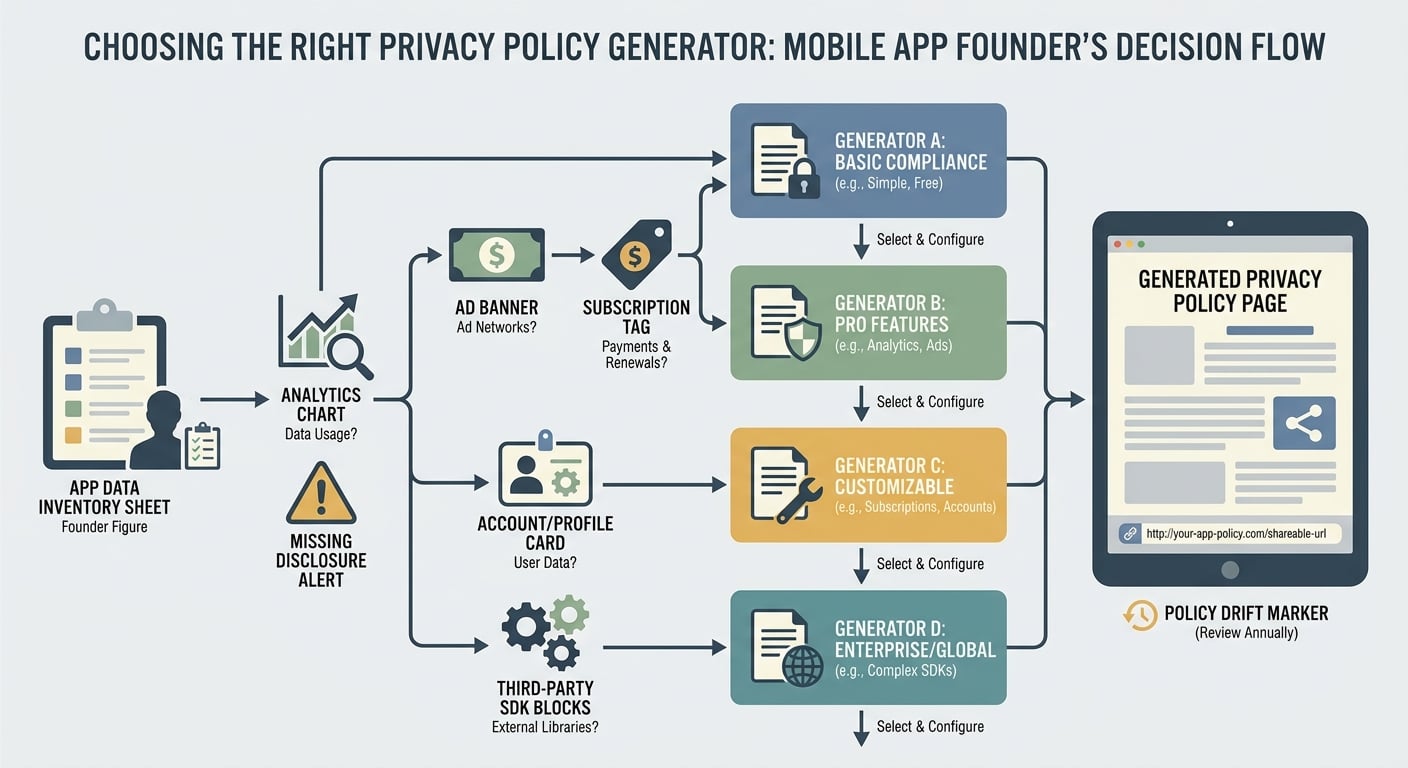
A simple decision flow showing how a mobile app founder moves from app data inputs to the right privacy policy generator based on analytics, ads, subscriptions, and need for customization.
1) PrivacyPolicyGen.io
PrivacyPolicyGen.io is positioned around mobile app legal pages and tends to balance speed with app-specific wording.
- Best for: standard consumer apps with analytics, crash reporting, basic auth
- Watch for: manual edits for retention, deletion, and partner-specific ad sharing
- Output: policy text and a publishable page or URL depending on plan and workflow
2) PolicifyAI
PolicifyAI is a stronger fit when you need more control over clauses, jurisdictions, or disclosure detail.
- Best for: multi-region launches, ad-supported apps with multiple partners
- Watch for: more decisions means more review time and more internal alignment
- Output: more configurable text intended to be tailored and reviewed
3) PrivacyPage
PrivacyPage is a middle-ground option for app-focused output with moderate customization.
- Best for: teams that want a clean baseline, then do a focused edit pass
- Watch for: you may need to add specific sharing language for ads and attribution
- Output: straightforward policy draft you can host or publish
4) PolicyFlyer
PolicyFlyer is best treated as a speed tool for early-stage apps.
- Best for: MVPs with limited collection and minimal third-party sharing
- Watch for: free-first workflows can limit clause specificity or export options
- Output: quick draft that may require later replacement as the app matures
5) PolicyGen
PolicyGen is positioned as a very fast, simple baseline.
- Best for: prototypes, internal tools, ultra-lean launches with minimal data use
- Watch for: low nuance becomes risky once you add ads, attribution, or more regions
- Output: basic policy text that often needs heavier editing to match store forms
For tradeoffs, checklists, and edge cases, The Privacy Policy URL Trap: What It Must Include to Pass Review rounds out this section.
A practical workflow to reduce store-review back-and-forth
Prerequisites (what you need before generating)
- SDK inventory you trust (30-90 minutes for small apps, longer for legacy builds)
- iOS: check SPM packages and CocoaPods (Podfile.lock), plus any manual frameworks
- Android: export Gradle dependencies (including transitive ones you rely on)
- Feature checklist (10-20 minutes): login, subscriptions, ads, analytics, crash, push, location, UGC
- Target regions and audience: US-only vs multi-region, and whether kids could reasonably use the app
Dependency note: if you cannot confidently answer "which SDKs are in the build shipped to users," expect delays. Someone on the engineering side usually needs to help.
Workflow example: SDK inventory to store forms to updated policy
Build an SDK inventory sheet (single source of truth)
Create a simple spreadsheet with: SDK name, vendor, purpose, data types, whether data is linked to identity, and a link to vendor docs. Checkpoint: 0 "unknown" SDKs before you generate the policy draft.
Generate a draft policy from the inventory
Budget 30-75 minutes depending on SDK count and regions. Common miss: ads and attribution partners added late, or "diagnostics" SDKs forgotten because they are transitively included.
Cross-check against store disclosure forms
Complete or re-check App Store Connect privacy and Google Play Data safety using the draft as a guide. Budget 45-120 minutes, plus internal sign-off if your disclosures affect product wording (for example, deletion timelines and data sharing purposes).
Publish, then set a drift-control rule
Put the policy URL in your store listings and in-app settings. Practical checkpoint: policy updated within 24 hours of any SDK change, or before the next submission if internal review takes longer. This is the most reliable way to avoid "policy says X, build does Y" flags.
Common failure modes (plan time for these)
- SDK behavior changes across versions: re-check after analytics or ads upgrades.
- Regional consent requirements: CMP, opt-out, and purpose language can vary by market.
- Ad partner disclosures: partners may require specific wording or links.
- Internal review lead time: security, privacy, or legal review can add days, not hours.
How do you choose the right privacy policy generator?
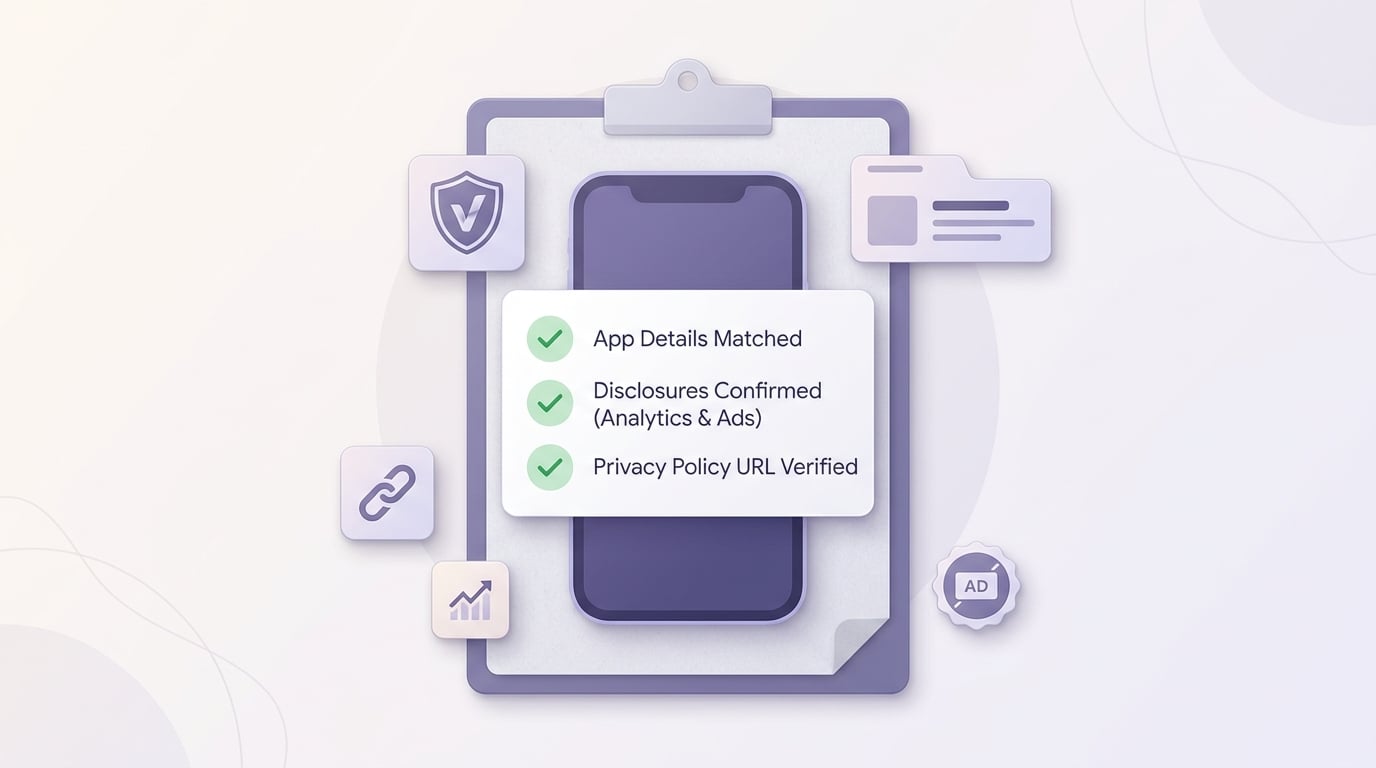
A mobile-friendly checklist of the final submission steps: matching app details, confirming disclosures for analytics and ads, and verifying the privacy policy URL works before App Store and Google Play review.
Use your data footprint and review constraints as the decision filter.
- Simple apps (basic analytics, email capture, push): prioritize speed plus editability. Start with PrivacyPolicyGen.io or PrivacyPage.
- Ad-supported apps (ad SDKs, attribution, measurement partners): prioritize clause control and partner-specific sharing language. Consider PolicifyAI if you need more customization.
- Subscription apps: confirm retention and deletion promises match your actual support and backend workflows.
- Sensitive data or kids-adjacent features: treat generator output as a draft and budget for review (often including counsel).


