
SOC 2 tends to show up right when your app starts selling into larger accounts, integrating into serious platforms, or touching data customers consider sensitive. The confusing part is people talk about it like a certification or a security stamp. It is neither. By the end of this write-up, you should be able to decide if SOC 2 is a practical revenue enabler for your app right now, what auditors actually test, and what a realistic path looks like for a small team.
| SOC 2 element | What it is (evidence) | What it maps to in an app team |
|---|---|---|
| Independent SOC 2 report | Auditor attestation about controls for a defined system | A buyer-friendly artifact for security reviews and procurement |
| Security (baseline) | Controls to protect systems against unauthorized access | MFA, least privilege, secure SDLC, logging, incident response |
| Availability (optional) | Controls supporting uptime and resilience | Monitoring, backups, restore testing, on-call procedures |
| Confidentiality (optional) | Controls that limit access to sensitive data | Data classification, encryption, access reviews, secure sharing |
| Processing Integrity (optional) | Controls that ensure systems process data accurately | Change controls, QA, validation, job monitoring, error handling |
| Privacy (optional) | Controls related to personal data handling | Privacy notices, data subject workflows, retention, deletion |
Explanation: This table translates SOC 2 language into the artifacts buyers and auditors typically request.
Interpretation: SOC 2 is not "we are secure." It is "within this scope, we can show consistent, audited operational behavior." Your scoping choices decide what you must run repeatedly and prove.
Reader impact: If deals are blocked on trust, a SOC 2 report often reduces security back-and-forth by giving buyers a standard artifact. It rarely eliminates questionnaires, and some buyers will still ask for extras like a pen test summary, architecture notes, or evidence for something outside your scope.
The Founder's Complete App Publishing Checklist goes deeper on the ideas above and adds concrete next steps.
What is SOC 2 and why do buyers ask for it?
Category: Outcomes
Statistic: 38%
Label: First-pass approval rate
Context: When metadata is complete upfront
Category: Time
Statistic: 6 - 12 months
Label: Typical Type II test window
Context: Type I is point-in-time; Type II tests operating effectiveness
Category: Scope
Statistic: 5 trust criteria
Label: Security + 4 optional criteria
Context: Availability, Processing Integrity, Confidentiality, Privacy
SOC 2 is an AICPA attestation framework delivered as an auditor-issued report about your controls, not a government mandate or a one-time certification. For most app companies, Security is the baseline Trust Services Criteria, with others added when customers care about uptime, confidentiality, or privacy expectations (see RiskWatch and SOC2Auditors.org).
Buyers often care for procedural reasons: SOC 2 helps them approve a vendor without taking on career risk. In practice, it is a way to standardize vendor assurance, not a claim that you are breach-proof.
Typical demand signals:
- Security questionnaires explicitly ask for a SOC 2 Type II report (or equivalent assurance).
- A platform, marketplace, or integration partner needs vendor assurance before production access or listing.
- Deals stall because you cannot produce consistent evidence for access control, change management, or incident handling.
- Procurement wants a standardized artifact to reduce repeated evaluations across vendors.
When you move from outline to execution, Everything You Need to Know About Apple and Google Developer Accounts helps close common gaps teams hit here.
What auditors test (and where teams underestimate effort)
SOC 2 is an evidence game: who had access, what changed, how incidents were handled, and whether the process is repeatable (see SOC2Auditors.org controls mapping). Strong engineering helps, but auditors mostly care about consistency plus artifacts.
Common evidence areas for app teams include:
- Access control: MFA, least privilege roles, joiner-mover-leaver workflow, periodic access reviews
- Change management: tickets or pull requests tied to releases, approvals, testing evidence, rollback expectations
- Logging and monitoring: audit logs for admin actions, alerting, escalation paths
- Backup and recovery: schedules, retention, and restore tests with recorded results
- Incident response: policy, incident records, post-incident follow-ups
- Vendor management: vendor inventory and review cadence for those with data access
One thing worth noting: auditors sample. A single missed access review month or a log retention misconfiguration can turn into a finding that delays your report and creates extra back-and-forth.
Type I versus Type II for app teams
The difference is what the auditor is attesting to and how much operational history you must show (see RiskWatch and Glocert International).
| Report type | What is tested | What it proves to a buyer | When it is usually sufficient |
|---|---|---|---|
| SOC 2 Type I | Control design at a point in time | Controls are defined and implemented as of a date | Early procurement conversations, some partner requirements |
| SOC 2 Type II | Design plus operating effectiveness over a period (often months) | Controls are consistently followed, not just written | Larger enterprise deals, ongoing vendor risk programs |
Type II is often more persuasive, but timelines depend on auditor availability, your observation period, and how clean your evidence is. If your tools are messy, you can lose weeks reconciling access lists, old logs, and ownership across systems.
A complementary angle worth comparing lives in How to Publish Your Bubble Mobile App: Launch Without Review Loops.
What is a realistic SOC 2 timeline and process?
SOC 2 cost is mostly coordination and evidence, not pure engineering. For a small team, the hidden work is recurring tasks (access reviews, vendor reviews, incident logging) plus staying organized when the auditor asks for exports on a deadline.
A realistic path often looks like this:
Gap assessment and scoping (1-3 weeks)
Define the "system" (products, infrastructure, data stores, and workflows) and compare current practice to expected controls. Smaller scope reduces burden, but too-small scope can frustrate buyers if it excludes what they care about (often your production app and core data stores).
Remediation and control hardening (2-8 weeks)
Close gaps like MFA enforcement, shared accounts, missing access reviews, weak change control, or undocumented incident response. Tradeoff: tightening controls can slow day-to-day work initially, especially if the team is used to informal admin access.
Evidence collection during the observation period (typically 2-6+ months)
Operate controls consistently and collect artifacts as you go: tickets, access review logs, incident records, vendor assessments. Common failure modes: an owner misses a recurring review, evidence lives in six places, or an auditor requests a specific export you cannot reproduce.
External audit and report delivery (2-6 weeks, depends on auditor)
The auditor samples evidence and validates that controls operated as described. Dependencies: auditor schedules, your response speed, and how quickly you can produce exports often move timelines more than engineering work does.
Realism note: plan for ongoing load after you "finish." Many small teams end up spending 2-6 hours per month on reviews and evidence hygiene, plus a heavier burst (often 10-30 hours) during audit fieldwork. Costs vary by auditor, scope, and readiness, but your biggest cost drivers are usually audit fees plus internal time spent cleaning up identity, ticketing, and logging.
For tradeoffs, checklists, and edge cases, Everything You Need to Know About Apple and Google Developer Accounts rounds out this section.
Concrete implementation details (examples auditors accept)
Here are compact artifacts that usually work if they are consistent and repeatable. The goal is not fancy tooling, it is being able to export proof on demand even when you are busy shipping.
One end-to-end workflow example (small team friendly)
| Control area | Example setup | Evidence auditors usually accept | Cadence metric to stick to |
|---|---|---|---|
| Identity and access | Google Workspace or Okta for SSO + GitHub SSO + AWS IAM roles | SSO/MFA settings screenshot or config export, user list export, role assignments | Access review monthly (named reviewer, date, changes) |
| Change management | GitHub PRs + Jira or Linear tickets | Ticket linked to PR, approval record, deploy record (CI log or release) | 100 percent of prod changes tied to a ticket/PR |
| Logging | AWS CloudTrail + app logs to a central sink (CloudWatch, Datadog, or similar) | Log retention configuration, sample admin action log entries | Retention 90+ days (or your policy), alert routing tested |
| Backups and recovery | Managed DB snapshots + documented restore steps | Backup policy/config export and one restore test ticket | Restore test quarterly (even a small, manual one) |
| Incident response | PagerDuty or Opsgenie + a lightweight incident doc template | Incident record, timeline, follow-ups tracked in tickets | At least one tabletop or small drill per year if you have low incident volume |
Practical takeaway: pick one system of record for evidence (often your ticketing tool), and treat evidence capture like part of the work, not an afterthought. Otherwise you will pay the tax later when the auditor asks for something you cannot reconstruct.
Pitfalls to watch:
- Evidence gaps from tool migrations (old GitHub org, new ticket system, lost logs).
- Admin actions happening outside your normal workflow (manual production changes with no ticket).
- Scope mismatch (buyers care about a feature or environment you excluded).
- Auditor sampling surprises (they may ask for a random month you did not expect).
Froxi AI vs Agencies: Which Gives Founders More Control? reframes the same problem with a slightly different lens - useful before you finalize.
Should your app get SOC 2 now?
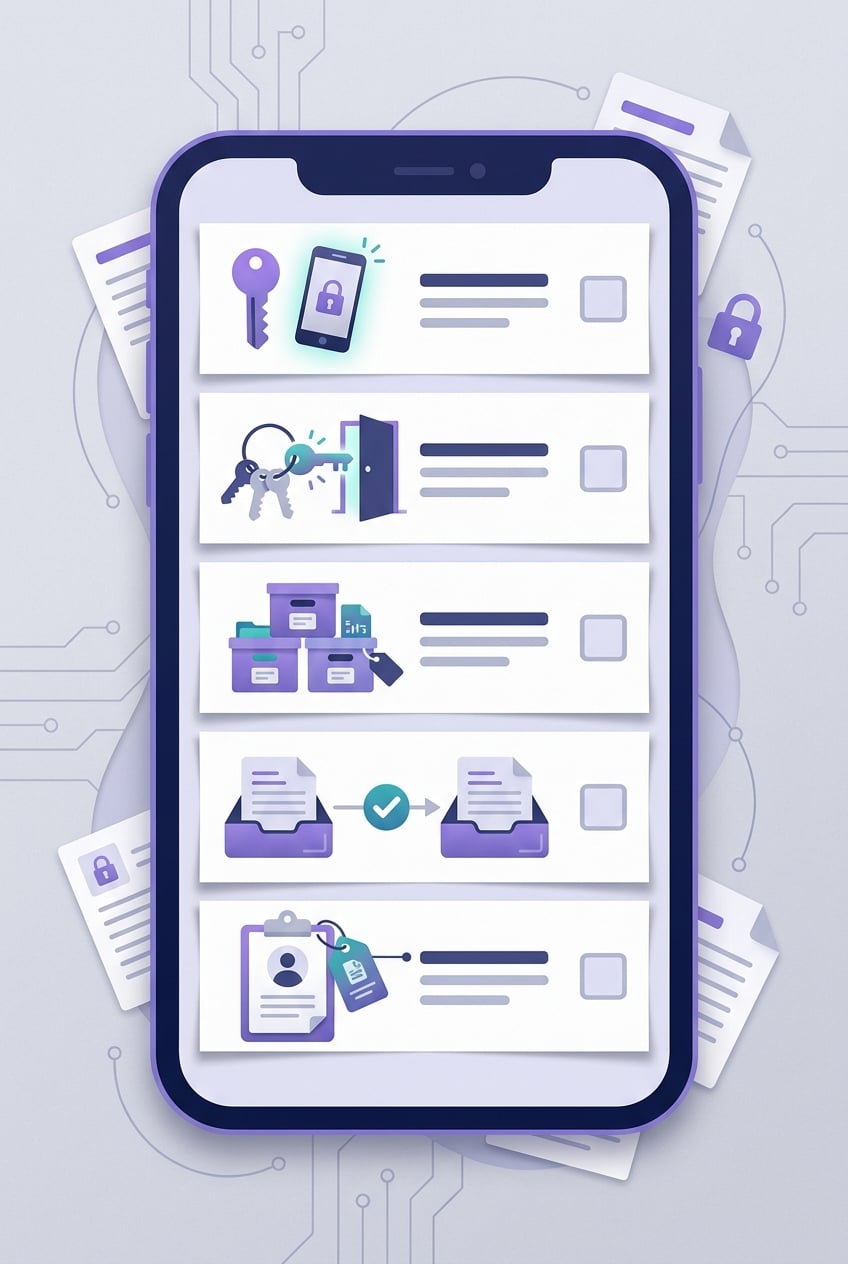
A mobile-friendly checklist block for app founders covering MFA, least-privilege access, data inventory, backup verification, and assigning an evidence owner before deciding to pursue SOC 2.
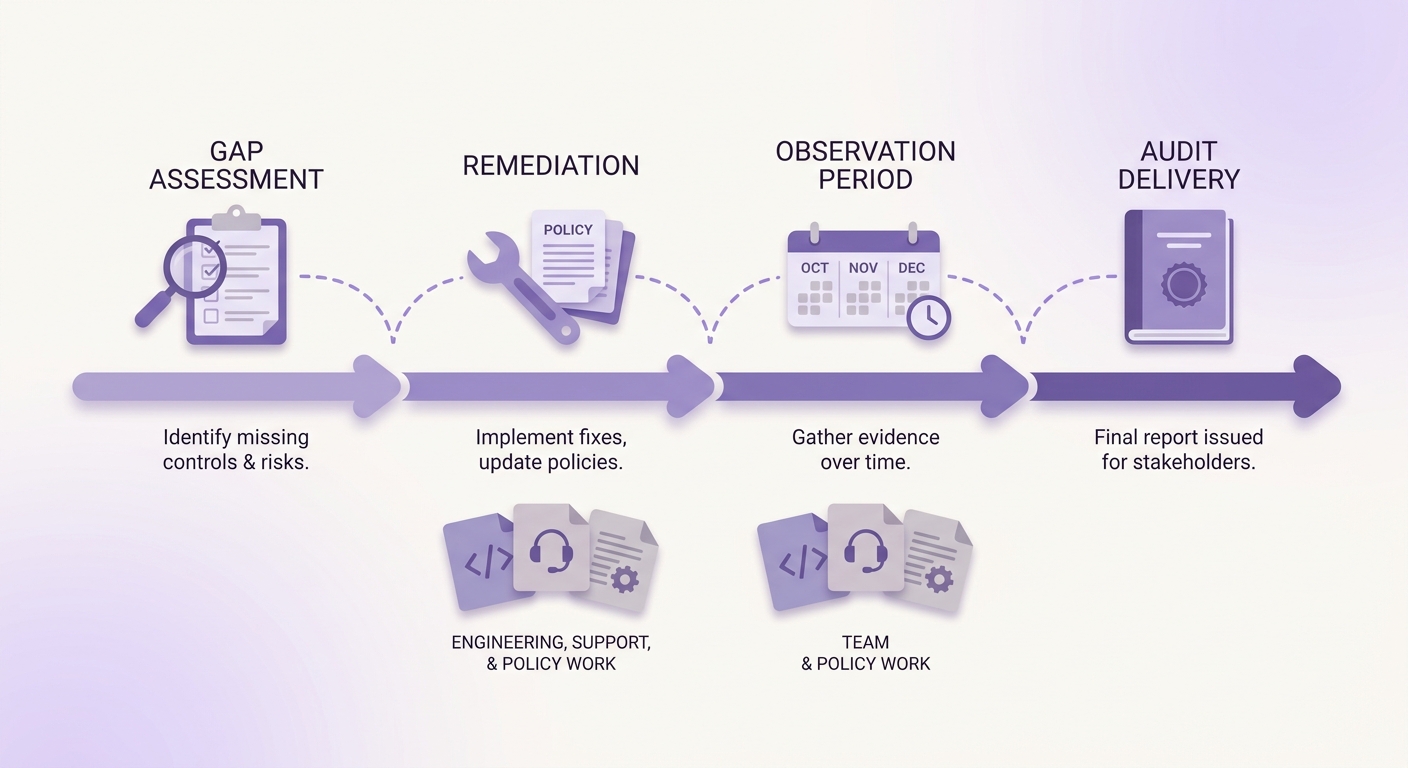
A simple timeline showing the typical app SOC 2 path: gap assessment, remediation, observation period, and audit delivery, with emphasis on where engineering, support, and policy work usually overlap.
SOC 2 is worth it when it reduces friction in how you acquire and retain customers, and when you can sustain the controls without burning out the team. Treat it as a go-to-market enabler plus an operating system change, not a badge.
Decision triggers that often justify SOC 2:
- You sell to mid-market or enterprise buyers who run formal security reviews.
- Your app handles sensitive data in the buyer's eyes (customer data, financial workflows, health context, employee data, or high-impact internal operations).
- A partner, marketplace, or integration program requested a SOC 2 report as a launch or expansion requirement.
- Deal cycles are lengthening due to security and procurement back-and-forth, and a report would reduce repeated explanations (not necessarily eliminate questionnaires).
Common reasons teams overbuy or underprepare:
- Overbuying: starting SOC 2 before you have a pipeline where it measurably helps. The cost is ongoing process overhead every month.
- Underpreparing: assuming strong engineering is enough, then getting stuck on policies, recurring reviews, and evidence trails.
A simple readiness checklist for the next 30 days:
- Inventory systems that store or touch customer data (app databases, analytics, support platforms, cloud storage, CI/CD, identity provider).
- Enforce MFA for cloud accounts, admin consoles, code repos, CI, support tools, and your password manager.
- Remove shared admin accounts and define least-privilege roles with a clear offboarding process.
- Verify backups exist and run at least one restore test (even if it is manual and small).
- Stand up basic incident response: who is on point, how incidents are logged, how follow-ups are tracked.
- Assign a single internal owner for policies, evidence capture, and auditor coordination (often ops, security, or an engineering manager).
Expected outcome: you can answer "what is in scope, who owns the controls, and where is the evidence stored" without scrambling.


