
When you try to plan a multi-city work trip between launches, the slow part is rarely searching. It is coordinating decisions across people, policies, and shifting schedules without missing a fare rule or cancellation window. This is the app-first workflow we switched to in 2026, what it realistically saved on one trip, and where a human agent still earns their fee.
| Early proof snapshot (internal benchmark, first planning pass) | Before (agent-assisted flow) | After (app-first stack) |
|---|---|---|
| Time to get to bookable options | ~48 hours calendar time | ~70 minutes active work |
| Handoffs | 2-3 back-and-forths | 0-1 internal check-in |
| Visibility into fare and change rules | Mixed, often summarized | Higher, but still manual review needed |
| Weak spot | Latency when constraints change | Judgment calls on connection risk and fine print |
Explanation: These timing notes are from one internal trip planning pass (not third-party stats) for a 10 to 12-day Tokyo to Seoul style itinerary for four teammates, with shifting meeting dates and a strict budget. The "~70 minutes" was the first usable shortlist, not the entire booking process. Interpretation: Apps compressed the quote cycle because we could iterate constraints in real time, but they did not remove responsibility for reading fare classes, baggage fees, and hotel cancellation language. Impact: We moved faster and coordinated better, but we still needed manual checks to avoid a risky connection and to confirm policies directly on airline and hotel sites.
The Future of App Publishing: Where AI Agents Are Taking It goes deeper on the ideas above and adds concrete next steps.
What trip problem made us switch to apps?
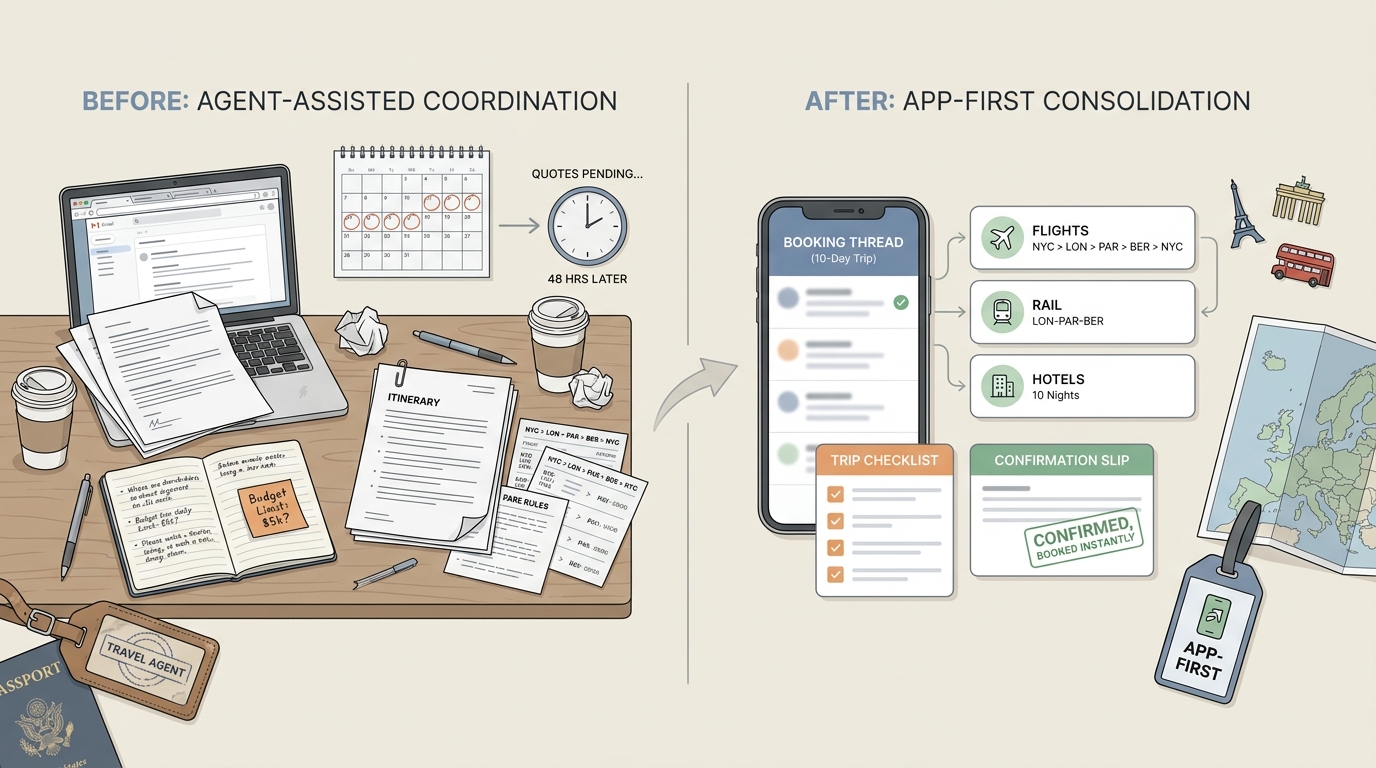
A before/after proof card showing the same 10-day trip planned by a travel agent versus planned through apps in 2026, with fewer coordination steps, faster quote turnaround, and one clear booking thread on the app side.
The trip that exposed the bottleneck
In early 2026, our ops lead Maya had to book a multi-city work trip for four people with meetings that could move by a day and a hard budget ceiling. The old move was familiar: email an agent, wait for options, then reconcile flights, hotels, rail, and transfers over a thread.
What broke was the latency, not the agent. Each new constraint (arrive before noon, refundable hotel, avoid tight connections) restarted the loop, and fares moved while we waited. We went app-first so Maya could run the same decisions live, keep one shared plan, and stop re-explaining context.
Why app-first felt faster (but not always easier)
Apps make the first 80 percent faster: search, alerts, and itinerary import. The last 20 percent is still human work: policy interpretation, edge cases, and disruption planning.
One thing worth noting: app-first shifts effort from "waiting on someone else" to "owning the workflow." If your trip is high stakes (wedding, investor meeting) or involves visas, an experienced agent can still save time when plans change mid-trip.
When you move from outline to execution, Best Single-Purpose Apps for Getting Things Done in 2026 helps close common gaps teams hit here.
What still makes booking hard without a travel agent?
Budget, timing, and change-risk constraints (the real requirements)
- Budget ceiling: about $1,200 all-in for flights plus checked bags, which ruled out many basic fares once fees were included.
- Time window: depart after work, arrive before the first meeting, and avoid overnight layovers.
- Must-avoid traps: hotel rates with unclear cancellation language and surprise property fees.
- Change risk: return leg might shift by a day, so flexibility mattered more than the cheapest ticket.
- Tradeoff we accepted: pay a bit more (roughly $100 to $200 per traveler) for clearer change rules and fewer failure points.
What apps still do not solve (and the dependency you should name)
Apps surface options quickly, but they do not remove edge cases like inconsistent fee disclosures, airport-to-rail transfers, or confusing rate rules. We added one explicit verification step: confirm fare class, baggage, and cancellation rules on the airline and hotel sites before paying.
Operational caveat: app-first planning is faster only if you assign an owner. Someone still has to monitor alerts, handle schedule changes (IRROPS), and keep documentation for support escalations or disputes. If your team is already stretched, the "saved time" can show up as context switching instead of a clean win.
Decision criteria for choosing the app stack (roles, not brands)
| Role | What to look for | Common pitfall |
|---|---|---|
| Search and price monitoring | Alerts, bag fee visibility, date grid | Cheapest fare hides change and bag costs |
| Booking flexibility | Clear fare class rules, change timelines | "Refundable" labels that exclude fees or taxes |
| Itinerary consolidation | Auto-import, share link, offline access | Cross-app sync breaks when confirmations change |
| Disruption monitoring | Gate changes, alternate routing suggestions | Push alerts without actionable rebook steps |
| Support | Human escalation path, clear policies | Support queues that cannot modify partner bookings |
A complementary angle worth comparing lives in 7 Breakout Android Apps Making Waves in June 2026.
Which apps can replace most travel agent tasks?
Apps replaced most of our agent workflow for straightforward bookings and coordinated decision-making. They did not replace an agent in scenarios like same-day changes, multi-ticket itineraries, groups with different loyalty programs, or strict corporate policy enforcement. Also, savings are not guaranteed: fares can rise while you iterate and compare.
Step 1: Narrow the trip with search and price tools (45 to 90 minutes)
Discover viable routes, then lock a real budget
We started in Google Flights to see which airports and dates were realistic, then set two fare alerts for two windows (primary and fallback). We sanity-checked total cost with bags and likely seat fees so the "budget" was not a fantasy number.
Make one explicit risk decision (connections vs savings)
We set a minimum connection buffer (90 minutes for international connections, more if a terminal change was involved) and treated anything tighter as "only if we can miss the first meeting." Apps help you compare tradeoffs quickly, but you still have to decide what failure you can live with.
Shortlist stays with cancellation clarity, not just reviews
We prioritized properties with clearly stated cancellation timelines and payment terms. If a rate rule looked ambiguous, we treated it as non-refundable until proven otherwise.
Step 2: Do the manual sanity check (15 to 30 minutes, do not skip)
This is where app-first goes from "fast" to "safe." For us, that 15 to 30 minutes typically included: ~10 minutes verifying fare class and baggage rules on the airline site, ~10 minutes confirming the hotel cancellation language and taking policy screenshots, and ~5 to 10 minutes checking the tightest transfer (terminal change, immigration, last-train timing).
- Confirm fare class, baggage, and change rules on the airline site.
- Confirm hotel cancellation policy on the property page or a major OTA page, then screenshot it.
- Check transfer time for the tightest connection, including terminal changes and immigration.
This is the hidden work an agent often absorbs. App-first only works if you assign this step to a specific person and give them uninterrupted time.
CTA: Get the checklist we use before clicking Pay
A one-page, app-first booking checklist to reduce missed rules, risky connections, and refund surprises.
Send me the checklist
For tradeoffs, checklists, and edge cases, AI Remix Apps Taking Over the App Store in 2026 rounds out this section.
What the trip proved, what broke, and what I would do next
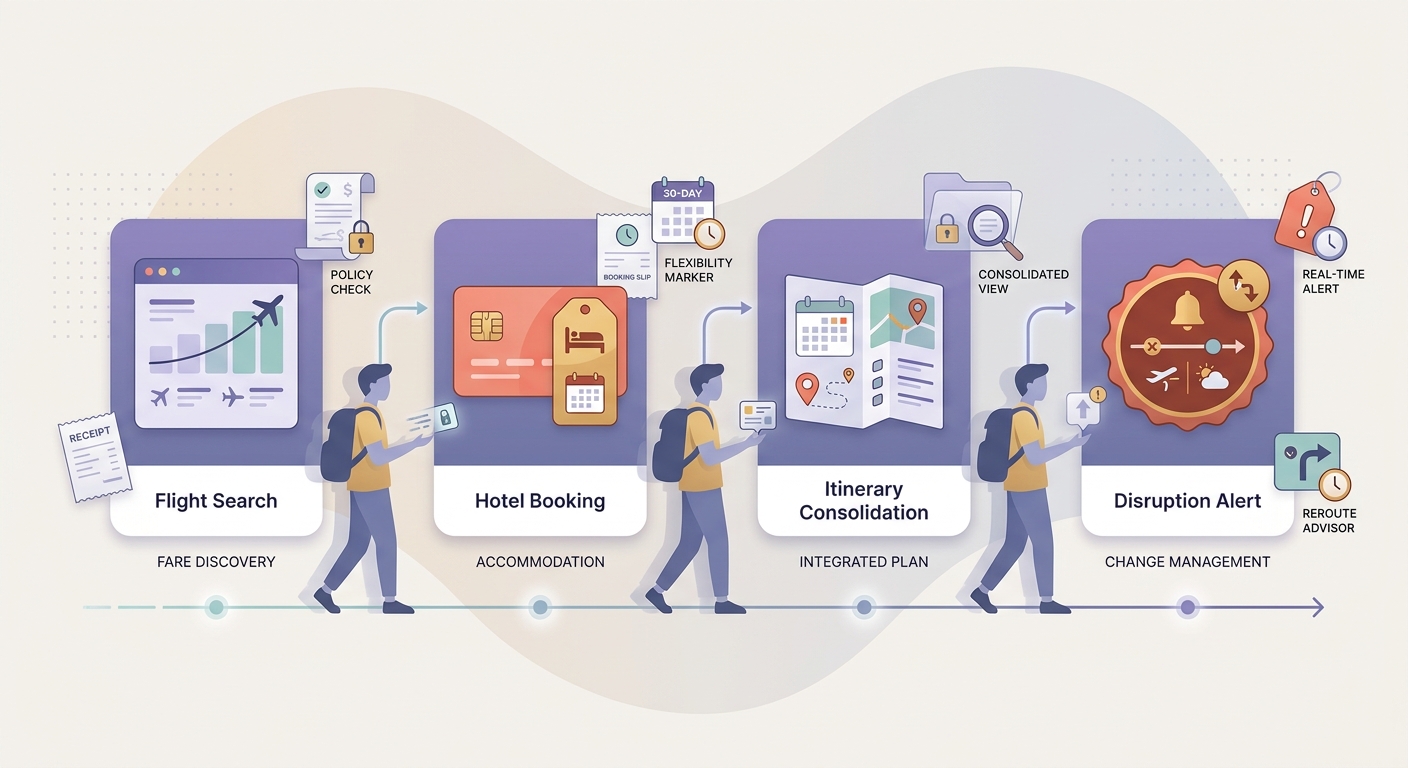
A compact trip-planning timeline showing the traveler moving from flight search to hotel booking to itinerary consolidation and then to change alerts, with each step replacing a separate travel-agent touchpoint.
The measurable outcome (with realism)
Planning time dropped, but not to zero. We went from multiple back-and-forth cycles to roughly 2 to 3 hours of focused work spread across a day.
What those 2 to 3 hours actually were: 30 to 45 minutes building a route grid and fare alerts, about an hour building and sharing a shortlist in one doc, 20 to 30 minutes doing policy screenshots and transfer checks, and the rest in quick teammate confirmation pings. We also spent 5 to 10 minutes per day for a few days monitoring alerts and schedule-change emails until everything ticketed and settled.
Tradeoff: apps replaced most of the agent workflow, not the accountability. If nobody owns final review and ongoing monitoring, app-first can fail faster than agent-assisted planning.
The friction points to plan around (failure modes included)
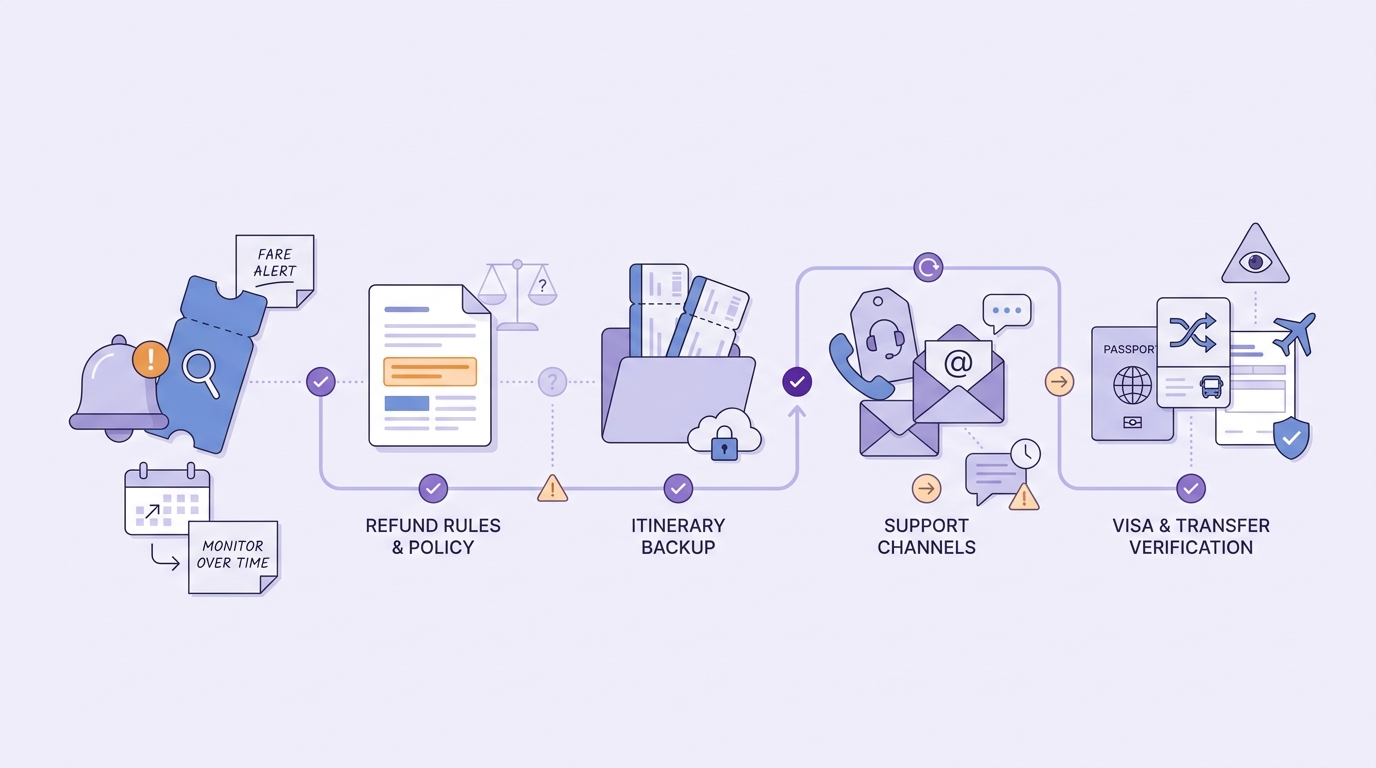
A practical checklist for readers validating whether apps can replace their travel agent in 2026, covering fare alerts, refund rules, itinerary backup, support channels, and visa or transfer verification.
- IRROPS and rebooking: schedule changes can strand you in support queues. Keep airline direct channels, loyalty numbers, and booking references in one place.
- Third-party booking pitfalls: some deals make changes harder and refunds slower. If flexibility matters, booking direct is often worth the extra cost.
- Multi-ticket risk: self-transfers can look cheaper but add real missed-connection exposure. If a miss would blow up a meeting, pay for a protected itinerary.
- Sync drift: itinerary apps can lag behind reality when segments change; treat them as helpful, not authoritative.
- Price movement while iterating: the more you compare, the more you risk fares moving. Set a decision deadline and a maximum acceptable price.
The practical takeaway: use apps for speed and shared context, then build a boring backup plan for support and documentation when plans change.
CTA: Build your app-first workflow
If you want a repeatable setup, start with one owner, one checklist, and one test trip, then iterate based on what broke.
Build your app-first workflow
AI Music Apps Are Exploding - 5 Worth Trying in June 2026 reframes the same problem with a slightly different lens - useful before you finalize.