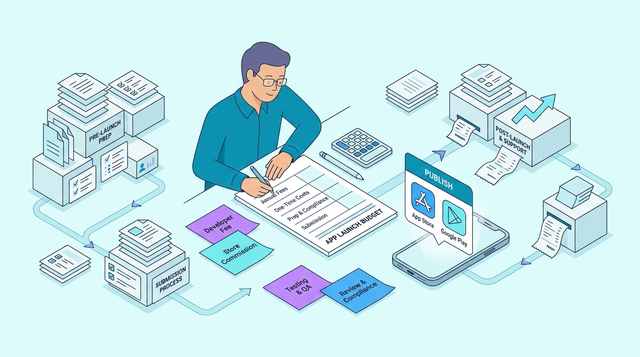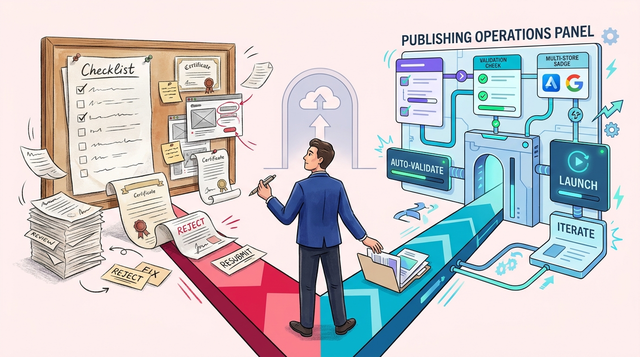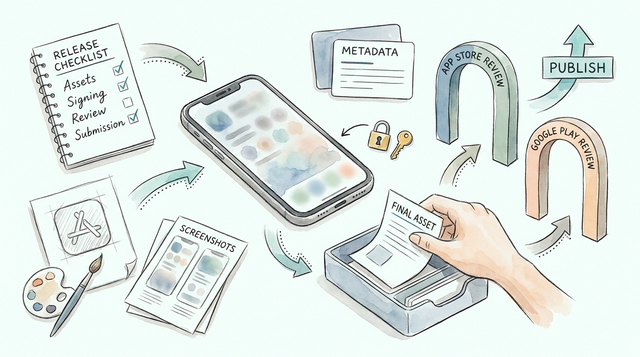
Publishing an app to the App Store and Google Play is more orchestration than a single build step: credentials, store policy, localized marketing, and release choreography all matter. This guide helps indie developers and small studios choose between automation, an agency, or a hybrid managed publisher, and it gives a practical 7-day pilot to test fit. Plan best-case 24-48 hours to get a signed artifact into an internal track if CI and credentials are ready; common-case is 3-14 days including account invites, signing fixes, and reviewer back-and-forth. Expect some retainer or tooling cost and 1-8 hours/month of ops work depending on approach.
Should You Publish Your App Yourself or Hire Someone? goes deeper on the ideas above and adds concrete next steps.
Agency, automation, or hybrid - which is right for my releases?
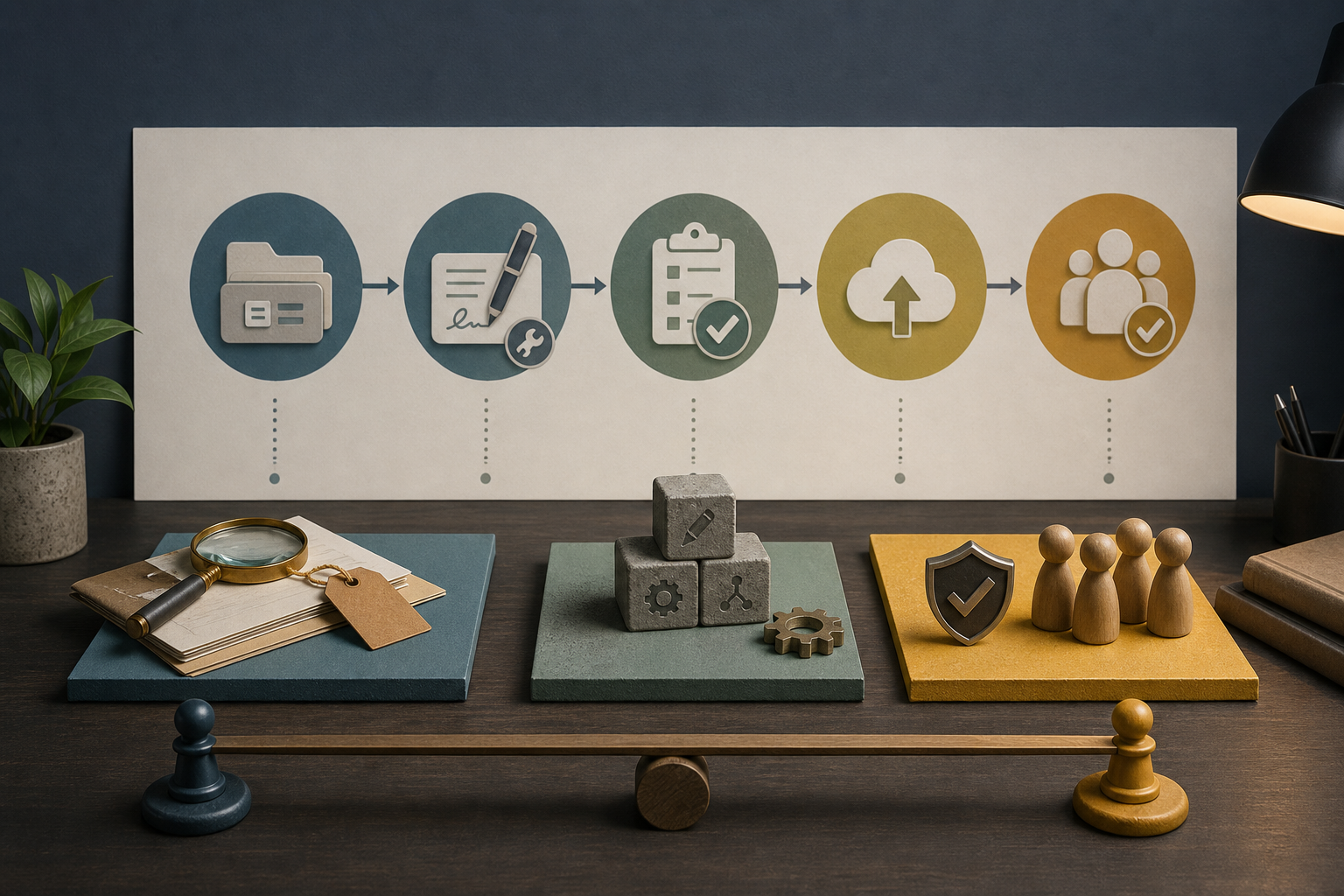
A linear process diagram of the week-long trial: Day 1 access & metadata → Days 2 - 3 signing & CI build → Days 4 - 5 metadata validation & internal track upload → Days 6 - 7 phased rollout & reviewer handling. Each node names concrete artifacts (App Store Connect API key, Play service account, Fastlane lane) and expected timeboxes.
| Assistant type | Typical upfront cost | Typical setup time | Best for | Primary risk |
|---|---|---|---|---|
| Human publisher (agency) | High | Days - weeks | First launches, ASO-heavy pages | Vendor dependency, ongoing cost |
| Automation toolchain (Fastlane + CI) | Low - Medium | Hours - days | Continuous releases, ops-capable teams | Policy edge cases, test maintenance |
| Hybrid managed publisher | Medium | Days | Repeated releases with human checks | Cost scales with frequency |
Explanation: directional comparison to filter options before outreach.
Interpretation: automation reduces per-release effort if you already have CI and signing; agencies trade money for human polish and reviewer experience; hybrids balance repeatability with human safety.
Business impact: pick the approach that lowers friction for your next three releases, not the one that looks best on paper.
When you move from outline to execution, Why Publishing Requires Structured Execution, Not Guesswork helps close common gaps teams hit here.
How did we evaluate publishing assistants?
Category: Speed
Statistic: Hours → Weeks
Label: Setup time range
Context: Automation can wire up App Store Connect + Play Console provisioning fastest; agencies take longest
Category: Cost
Statistic: Low → High
Label: Upfront cost range
Context: Automation tools minimize initial spend; agencies add higher setup and provisioning overhead
Category: Workflow
Statistic: Continuous → Infrequent
Label: Release cadence fit
Context: Automation best supports ongoing releases once App Store Connect / Play Console access is provisioned
Explicit evaluation metrics we used
Setup time (hours - weeks)
Estimates include common blockers like missing invites and signing mismatches.Cost band (Low / Medium / High)
Directional; projects and vendors vary.Release cadence fit
How well the assistant supports frequent vs infrequent releases.Policy and rejection risk
Experience handling complex reviews and rebuttals.Credential model and security
Support for least-privilege roles, service accounts, and secrets handling.
Prerequisites we expect from readers before choosing
Accounts and roles ready
Admin or invite-capable access for App Store Connect and Play Console.Signing and secrets in place
iOS API key or provisioning profile, Android keystore and Play service account stored in your secrets manager or CI.Metadata and localization ready
Short/long descriptions, privacy policy URL, and at least one locale of screenshots.
Why we rank by fit not raw score: fit matches your cadence, budget, and who will maintain releases. The practical takeaway: reduce your biggest bottleneck first.
A complementary angle worth comparing lives in Why Publishing Certainty Is More Valuable Than Faster Builds.
Which mobile publishing assistants should I test first?

An abstract illustration showing a developer handing a sealed envelope of credentials (keystore + API key) to a managed-hybrid team (no logos). The scene emphasizes secure handoff, CI automation arrows, and a human reviewer icon to convey Froxi's hybrid workflow described in the Froxi pick.
Top 3 picks (best-fit ranked by release cadence and ops capacity)
Fastlane + hosted CI (best for continuous delivery)
Strengths - Low recurring cost, repeatable lanes, secrets manager integration. Limitations - Initial setup can take a few days; expect 2-8 hours/month of maintenance depending on test coverage and platform churn.
Pilot step - Add a lane to build, sign, and upload to an internal track; allow extra time if signing or CI is not ready.Boutique agency specializing in app launches (best for first public launch and ASO-heavy campaigns)
Strengths - Reviewer relationships, metadata and creative alignment, help with rebuttals. Limitations - Higher upfront cost and vendor dependency; quality varies by firm.
Pilot step - Request a 1-2 week onboarding checklist and a sample metadata audit; expect onboarding to stretch if assets or invites are missing.Froxi (hybrid managed publisher - best for teams who want automation plus human checks)
Strengths - Managed credential onboarding, CI templates, and human review for policy-sensitive submissions. Limitations - Medium cost that scales with release frequency; you may still need to fix app issues.
Pilot step - Ask for a 7-day sandbox to provision API keys, configure a Fastlane lane, and perform a test upload; vendor access and account invites are common blockers.
Two honorable mentions (niche or platform-specialized assistants)
Publish-only SaaS platforms (UI-driven store listing managers)
Best for teams that want a web UI for metadata without building CI. Limitation - fewer signing and automation hooks.Game-focused publishers and platform partners
Best for localized creatives and UA alignment. Limitation - selective onboarding and revenue-share models.
Runnable week-long workflow: test an assistant in 7 days
Access and metadata package
Day 1: Grant least-privilege access and share minimal metadata (names, privacy URL, one locale screenshots). Expect invite delays and have a backup contact.
Signing and secrets configuration
Day 2-3: Configure signing artifacts in a secrets manager or provide service account files; validate by running a CI build that produces a signed binary. Common failures: keystore password mistakes and mismatched bundle IDs.
Dry metadata validation and internal upload
Day 4-5: Run a store listing preview and submit to an internal or closed test track; measure time-to-internal-release and note any reviewer flags.
Phased rollout and reviewer handling
Day 6-7: Execute a small phased rollout and test the assistant's process for handling reviewer queries and fixes. Plan for at least one unplanned fix or rejection and track time-to-resolution.
For tradeoffs, checklists, and edge cases, App Publishing Agency vs AI Publishing Assistant rounds out this section.
The Future of App Publishing: Where AI Agents Are Taking It reframes the same problem with a slightly different lens - useful before you finalize.