
Shipping open banking in a mobile app is rarely blocked by the API itself. It is blocked by shaky consent UX, uneven bank coverage, and integrations that turn into weeks of edge case cleanup once real users hit real banks.
This ranked roundup compares open banking APIs mobile teams actually ship with, based on practical criteria like authentication flow quality, SDK and docs maturity, data reliability, payment initiation support, and the operational overhead you will own after launch. By the end, you should have a defensible shortlist and a clear best-fit pick for your region, use case, and release timeline, including the non-engineering delays that tend to show up in security, legal, and app store review.
API Security for Mobile Apps goes deeper on the ideas above and adds concrete next steps.
Early Proof
Benchmark snapshot
Mobile teams tend to underestimate how much cost comes from the edges, not the happy path. The gap in real launches is rarely "can we fetch accounts?" and more often "can we ship a consent flow that survives review, supports retries, and stays stable when banks change their UX?"
Below is the criteria snapshot used to rank the APIs in this roundup. It is not a lab benchmark and it is not claiming universal scores. It is a practical proxy for what tends to reduce on-call load, support volume, and app store friction after you go live.
| Criteria | What good looks like for a mobile app | Why it matters after launch |
|---|---|---|
| Coverage | Strong bank reach in your target countries | Fewer "my bank is missing" support tickets |
| Consent flow quality | Clear redirect, deep link return, resilient state | Fewer drop-offs and fewer broken-link bugs |
| SDK support | iOS and Android helpers or proven mobile patterns | Faster implementation and safer upgrades |
| Sandbox strength | Realistic test users, error states, and webhooks | Better QA and fewer production surprises |
| Payment initiation fit | Optional PIS where relevant, with clear UX guidance | Enables funding flows without card dependence |
Explanation: This table reflects the checks I use in mobile integrations: what breaks onboarding, what causes re-auth churn, and what adds hidden ops work once you have real traffic.
Interpretation: Weight the criteria based on your v1. A data-led app should overweight consent UX, token durability, and data reliability. A payments-led app should overweight payment status events, reconciliation hooks, and coverage in the exact corridors you will support.
Impact: A better fit usually means fewer consent-related drop-offs and fewer "connection broke" tickets. A weaker fit can still ship, but expect extra QA cycles, more bank-specific exceptions, and ongoing operational work tied to bank outages, redirect changes, and re-auth churn.
Mini-example (internal and illustrative): instrument a consent completion rate so you can see where users drop. In practice, teams often discover that 1 or 2 high-volume banks drive most failures, which lets you fix the UX and support docs without boiling the ocean.
- Track
consent_startedwhen you launch the provider flow - Track
consent_returnedwhen the deep link returns to the app - Track
connection_readywhen you receive a webhook likeconnected(or equivalent) - Watch
completion = connection_ready / consent_startedby bank and OS version to spot problem banks quickly
When you move from outline to execution, Rising Finance Apps Every Founder Should Know About helps close common gaps teams hit here.
Selection Criteria: What Makes an Open Banking API Worth Shipping in a Mobile App?
What we score for in a mobile build
- Launch-fit coverage: Do you get the countries, banks, and account types your v1 needs, or will you ship with fallbacks and support tickets from day one?
- Consent and authentication UX: Native-friendly handoffs, clear bank selection, and fewer dead ends matter because mobile users abandon quickly when flows feel risky or confusing.
- Token refresh and session durability: Stable refresh behavior and predictable re-auth prompts reduce silent data failures after launch.
- Mobile SDK quality: iOS and Android SDKs (or well-documented mobile patterns) that handle redirects, deep links, and app switching.
- Webhooks and eventing: Reliable events for
connected,disconnected,requires_reauth, and data updates so the app can respond without polling. - Sandbox and testability: Realistic sandboxes and reproducible error states so QA can validate consent, refresh, and recovery flows before App Store review.
- Operational overhead: Support tooling, observability, and a clear error taxonomy so a small team can run it without building an internal connector-ops layer.
Why mobile developers care about more than account aggregation
Account data is the starting point, not the product. In practice, your open banking choice shows up in install-to-signup conversion because the consent screen and bank login flow are where users decide whether to trust you.
Payment initiation changes mobile UX fundamentals. If the API supports pay-by-bank well, you can often replace manual card entry or transfer instructions with a guided, authenticated flow, but you are also signing up for reconciliation, refunds, and customer support workflows that take real time to get right.
One thing worth noting: docs quality affects timelines, but it does not eliminate device QA and bank-by-bank validation. Even a strong provider still requires testing across iOS/Android versions and a small set of target banks before you can responsibly commit to a launch date.
Editorial ranking approach
This roundup is editorially ranked by mobile fit, not by a universal score. We prioritize options that reduce integration risk for small teams, then weigh tradeoffs like broad coverage versus simpler integration. When an API is notably better for EU-first coverage, payment initiation, or account data reliability, we call that out so you can pick the best match for your launch market and roadmap.
A complementary angle worth comparing lives in Best Backend-as-a-Service Tools for Mobile Apps Ranked.
What Are the Best Open Banking APIs for Mobile App Developers?
A pre-launch checklist for mobile developers evaluating an open banking API, including sandbox testing on iOS and Android, consent screen validation, webhook reliability, and release readiness checks for app stores.
Quick comparison table
| Rank (editorial fit) | API | Best for | Standout mobile implementation advantage | Strongest area | Key limitation to watch |
|---|---|---|---|---|---|
| 1 | Stripe Financial Connections | Verification and financial data in a Stripe-first stack | Mature account linking patterns and consent UX designed for real app flows (Stripe) | Account information | Most compelling when you already rely on Stripe products and supported markets |
| 2 | Enable Banking | Straightforward open banking connectivity for business apps | Simple integration surface and a clear API shape for supported markets (Enable Banking) | Broad EU coverage | "Fast to integrate" still depends on bank variance, webview behavior, and vendor review cycles |
| 3 | TrueLayer (PIS-focused example) | Payments-led apps that want pay-by-bank | Payments-first primitives and bank transfer initiation patterns (TrueLayer) | Payment initiation | Refunds, disputes, and payment statuses vary by market, scheme, and bank |
Fastest shortlist for common app goals
- Personal finance app (account aggregation): Start with Stripe Financial Connections if your core flow is linking accounts for balances, transactions, or verification and you want a well-worn mobile consent pattern (Stripe).
- Payments-led app (pay-by-bank and funding): Prioritize a PIS-focused provider like TrueLayer when the product depends on funding, top-ups, or checkout via bank transfer. Treat coverage, payment status events, and refunds as first-class requirements (TrueLayer).
- Team optimizing for a simpler first release: Consider Enable Banking if your goal is to get an end-to-end open banking flow running in your target EU markets, then expand coverage once the feature proves retention value (Enable Banking).
What the early ranking means in practice
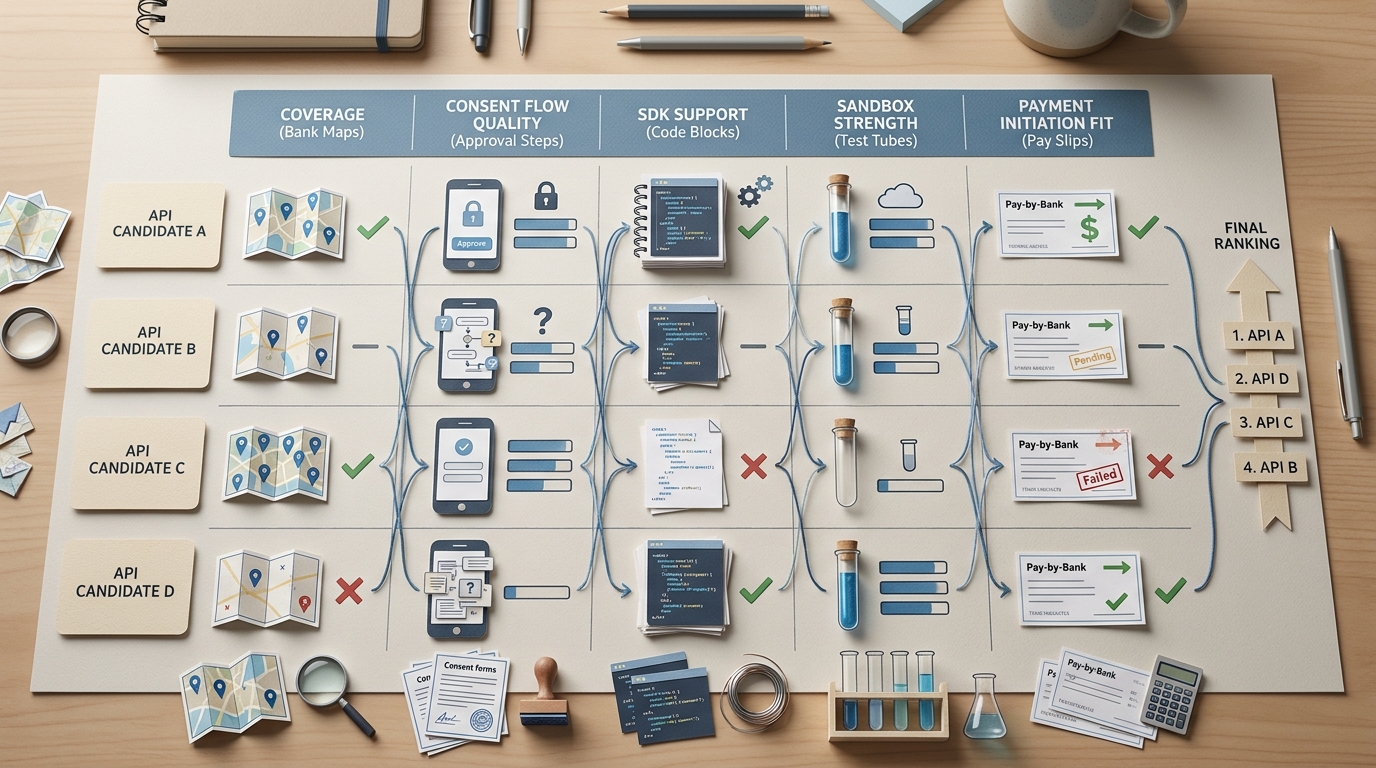
A compact comparison table showing the criteria used to rank open banking APIs for mobile app developers, with columns for coverage, consent flow quality, SDK support, sandbox strength, and payment initiation fit.
Start with the top 2 options that match your launch region and your primary flow (data vs payments). Then filter by sandbox realism and mobile auth flow simplicity before you negotiate for maximum coverage.
A practical constraint: even with a great provider, plan for non-code time like vendor security review, privacy policy updates, and app store review. Those can add 1 to 3 weeks in many orgs, and they often run in parallel with engineering but still affect your ship date.
For tradeoffs, checklists, and edge cases, Top 7 API Tools That Make Mobile Development Faster rounds out this section.
Which Open Banking APIs Are Best for Mobile-Friendly Apps?
Category: Coverage
Statistic: EU/UK-strong
Label: Regional coverage fit
Context: Prioritize where your users’ banks are supported
Category: Implementation
Statistic: Low - Medium lift
Label: Mobile integration effort
Context: Favor clear docs/SDKs to reduce time-to-first-link
Category: Capability
Statistic: Aggregation vs payments
Label: Best primary use-case
Context: Choose based on whether you need account data or pay-by-bank flows
1. Stripe Financial Connections: best overall for Stripe-first mobile teams
- Pick: Stripe Financial Connections (source)
- Best for: Mobile apps that need bank account linking and permissioned account data with lower integration drag.
- Why it ranks #1: It balances docs, consent UX, and day-to-day operability. This often reduces time spent debugging redirects and state handling, assuming your launch markets are supported and you keep the hosted flow close to recommended patterns.
- Strengths:
- Mobile-friendly consent and account linking patterns that are familiar to users.
- Clear docs and a platform model that fits teams already shipping payments or onboarding.
- Practical for common use cases like account verification and reducing manual entry.
- Limitations:
- Often less compelling if your roadmap is primarily pay-by-bank checkout.
- Coverage and product fit can vary by country and account type, so validate against your top banks before you commit.
2. Enable Banking: pragmatic EU connectivity when you want a straightforward surface area
- Pick: Enable Banking (source)
- Best for: Teams shipping EU open banking connectivity where a clean API shape and a manageable implementation are higher priority than squeezing for maximum edge coverage on day one.
- Why it ranks #2: It tends to be easy to reason about, which helps small teams move faster, especially when you are still proving whether open banking improves retention or unit economics.
- Strengths:
- Clear integration surface and simple mental model for the app and backend.
- Useful when you want to ship v1, instrument the funnel, and then expand.
- Limitations:
- "Simple" still means real-world variance across banks, devices, and webviews.
- Expect time for bank-specific testing and for your legal/security process to complete.
3. TrueLayer: strong option when payment initiation is the product
- Pick: TrueLayer (source)
- Best for: Funding, checkout, or top-up flows where pay-by-bank is core to conversion and margins.
- Why it ranks #3: Payments-led primitives can reduce product duct tape when you need payment statuses, user messaging, and operational hooks from day one.
- Strengths:
- PIS-first product shape and workflow patterns that map to real payment UX.
- Better starting point than a data-first provider if the "money moved" event is your north star.
- Limitations:
- Payment statuses, refunds, and disputes are operationally heavy and vary by scheme and market.
- You may need finance ops and support playbooks, not just engineering, before you scale volume.
Top 7 Tools to Build Your App Backend Without Code reframes the same problem with a slightly different lens - useful before you finalize.
How Do You Validate an Open Banking Provider Before Launch?
The thing that eats timelines is not the API itself. It is the mobile edge cases that hit your sprint plan and app review timeline.
Validate mobile primitives early
Confirm iOS and Android SDKs (or proven mobile docs), deep-link return paths, and token refresh behavior across app restarts. Expect 1 to 3 engineering days for a thin vertical slice plus time to get credentials, configure redirect URIs, and pass internal security checks.
Interrogate the sandbox like production
Test consent redirects, data realism, and webhook delivery and retries before building UI around assumptions. Plan at least 2 to 5 QA days to rehearse failure states (bank down, user cancels, re-auth required) across a small device matrix.
Estimate the real engineering days
Budget time for bank connection UX, edge-case handling, QA across devices, and end-to-end testing with your backend. For most teams, the last 20 percent (re-auth, retries, support tooling) takes as long as the first successful connection, and it is where timelines usually slip.
Pre-launch checklist (mobile)
| Check | iOS | Android |
|---|---|---|
| Deep-link return from consent | Verify on real devices | Verify on real devices |
| Token refresh and re-auth | Verify across app restarts | Verify across app restarts |
| Webhooks and retries | Verify idempotency and backoff | Verify idempotency and backoff |
| Sandbox coverage and limits | Document gaps vs production | Document gaps vs production |
Tradeoffs and Risks You Should Plan For (So You Are Not Surprised Post-Launch)
These constraints affect almost every open banking launch, regardless of provider:
- Bank outages and UX changes: Banks change login and consent screens. Expect occasional breakage and plan monitoring and patch cycles.
- Consent drop-off and re-auth churn: Some users will abandon during bank login, and some connections will require periodic re-auth. Your funnel and retention metrics will reflect this.
- Data gaps and field variance: Available fields and transaction descriptors vary by bank. If you rely on categorization or enrichment, plan iterative tuning.
- Payments ops complexity (PIS): Status tracking, refunds, disputes, and reconciliation can be non-trivial. You may need finance ops time and support playbooks, not just engineering.
- Compliance and legal review time: Privacy policy updates, data minimization, and vendor/security reviews can add 1 to 3 weeks depending on your company and regulators.
- Ongoing ops burden: Someone owns alerts, provider tickets, webhook retries, and incident response. In many small teams, plan for a few hours a week at minimum post-launch, with spikes during bank incidents or app updates that affect webviews and deep links.
What I Would Do If I Were Shipping This in the Next 30 to 60 Days
Pick 2 providers that match your geography and primary workflow (data vs payments). Build a vertical slice that includes the real consent handoff, the deep link return, webhook handling, and at least one "requires re-auth" recovery path.
Then test with your top 5 to 10 banks on real devices, not just in the sandbox. That work is not glamorous, but it is where you learn whether you will ship in 4 weeks or spend an extra sprint on cleanup.