
Pre-release security gates stop most routine mobile incidents and can be implemented incrementally; start with secret scanning and dependency checks. This checklist shows high-impact, automatable gates, realistic setup times, tradeoffs, and which checks iOS and Android teams can add within one or two sprints. Expect a short tuning phase and modest ongoing maintenance rather than a one-time fix.
5 Mobile App Security Tools Every Developer Should Know goes deeper on the ideas above and adds concrete next steps.
Why do pre-release gates prevent common mobile incidents?
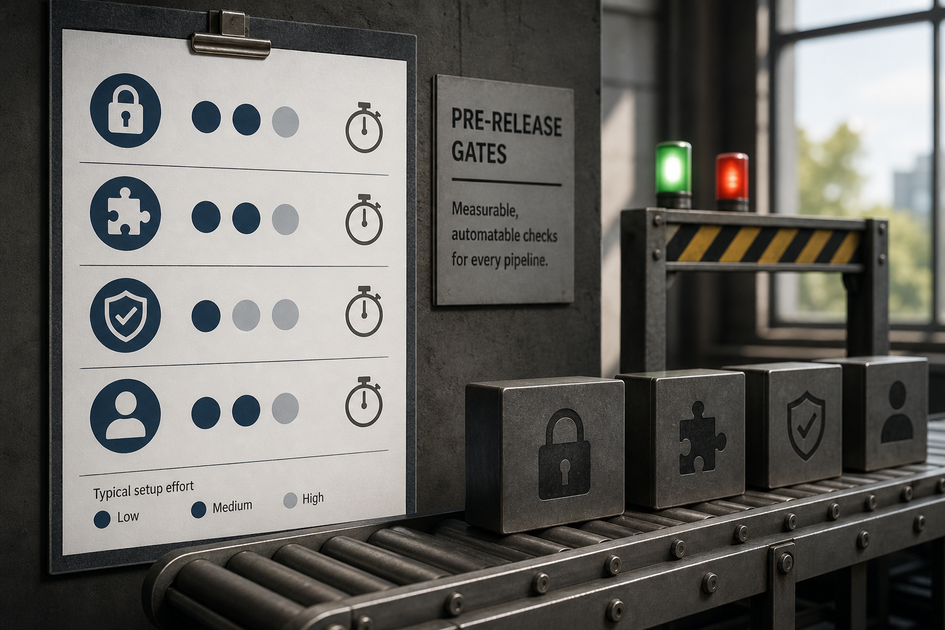
A compact checklist block laid out as CI/CD jobs: Secret scan (Gitleaks/TruffleHog), Dependency scan (Snyk/Dependabot), Build hardening check, Auth smoke tests. Each item shows 'typical setup effort' and 'primary owner' badges for immediate copy into pipelines.
Category: Pre-release failure modes
Statistic: 45 - 55%
Label: Leaked secrets in builds
Context: Easiest to catch pre-release with scanning and build gates
Category: Pre-release failure modes
Statistic: 25 - 35%
Label: Weak authentication flows
Context: Often caught via test accounts, threat modeling, and auth checks
Category: Pre-release failure modes
Statistic: 15 - 25%
Label: Insecure storage / TLS issues
Context: Static analysis + QA network tests flag these before launch
Pre-release gates reduce many common mobile incidents by catching detectable issues before users see them. The directional table below helps prioritize which gates to add first based on frequency and impact.
| Failure mode | Approx. directional share | Why it matters |
|---|---|---|
| Leaked secrets | ~35% | Often detectable in code/artifacts; immediate compromise risk |
| Weak or misconfigured auth | ~25% | Enables account takeover and token abuse |
| Insecure local storage / tokens | ~20% | Device loss and token reuse risk |
| TLS or config mistakes | ~15% | Runtime checks catch many runtime-only issues |
| Other (permissions, supply-chain) | ~5% | Lower frequency but can be high impact |
Explanation and impact: map your last 10 postmortems to these categories in one sprint to validate priorities. Track one dashboard metric: "% releases with any pre-release security block" and review weekly to measure gate effectiveness. These shares are illustrative; your app and dependencies will change the mix.
When you move from outline to execution, How to Secure User Data in Your Mobile App helps close common gaps teams hit here.
What this implies for iOS vs Android teams
Implement platform-specific signing and device checks while enforcing shared PR-level secret scanning and a strict waiver process. In practice:
- iOS: add Keychain checks, code-signing validation, and XCUITest auth flows in CI. (Setup 1-3 days; maintenance 0.5-2 hrs/week; constraint: real-device access, provisioning complexity, and initial farm costs.)
- Android: verify Keystore behavior, mapping/proguard verification, and representative device checks. (Setup 1-3 days; maintenance 1-3 hrs/week; constraint: device-farm variability and OEM differences.)
- Cross-platform: enforce required PR secret scanning, nightly dependency scans, and an owner-signed waiver process. (Setup 1-2 days; maintenance 0.5-2 hrs/week; constraint: false positives and waiver discipline required.)
One thing worth noting: expect developer friction during the first 2-4 weeks as teams tune rules and adjust release habits.
A complementary angle worth comparing lives in Top 5 App Security Tools for Mobile Developers Ranked.
Which pre-release CI/CD gates should I add?
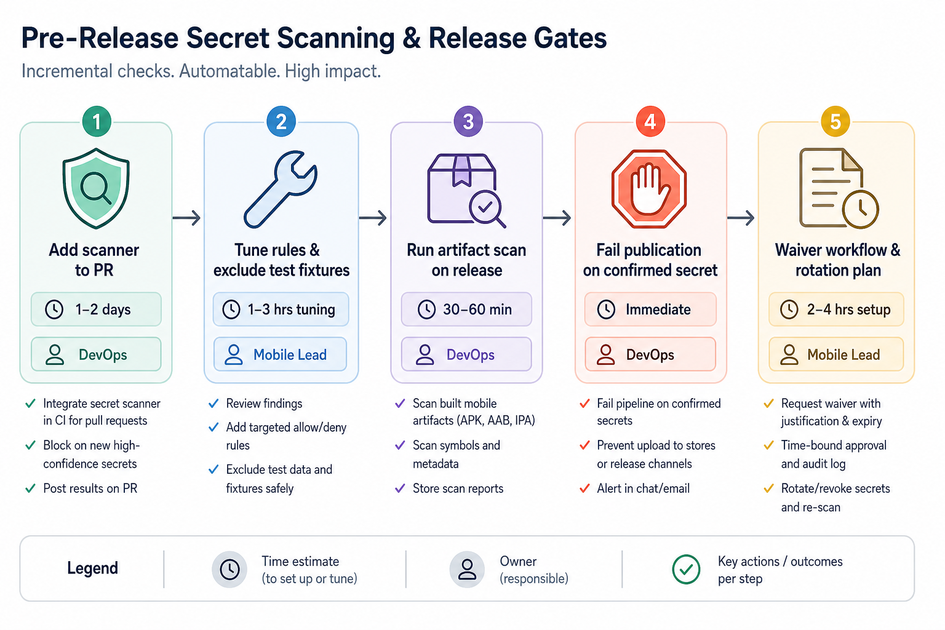
A stepwise process diagram showing 'Add scanner to PR → Tune rules & exclude test fixtures → Run artifact scan on release → Fail publication on confirmed secret → Waiver workflow & rotation plan'. Each step includes expected time (e.g., '1 - 3 hours tuning') and owner (DevOps/mobile lead).
Start with fast PR checks and run heavier tests on release candidates or nightly builds; block promotion until fixes or documented waivers exist.
Automated CI/CD release gates (run on PRs and release candidates)
Secret scanning
Run Gitleaks/TruffleHog on PRs and artifacts; treat confirmed secrets as blockers. (Setup 1-3 days; maintenance 0.5-2 hrs/week; risk: false positives need tuning.)Dependency scanning
Run Snyk/Dependabot and block on critical CVEs unless an owner-signed waiver exists. (Setup 1-2 days; maintenance 0.5-1 hr/week; tradeoff: blocking on upstream patches can delay releases.)Build hardening check
Fail CI for DEBUG flags, dev endpoints, or certificate-bypass flags in release artifacts. (Setup 1-3 days; maintenance 0.5-1 hr/week; edge case: multi-variant builds can mask issues.)Auth test pack
Lightweight auth smoke tests in release pipelines; require green for promotion. (Setup 1-2 sprints to stabilize; maintenance 2-6 hrs/week; cost: device-farm time and flaky test mitigation.)Artifact integrity
Verify signing, mapping files, and upload provenance before publishing. (Setup 1-2 days; maintenance 0.5-1 hr/week; dependency: key management and HSM access.)
Typical setup effort: 1-3 days to wire basic checks; plan 2-8 weeks to stabilize device and artifact tests depending on CI maturity and team bandwidth. Budget CI runtime cost and a sprint of developer time for triage during tuning.
Timeboxed manual checks before final sign-off
Keep manual checks short, owner-assigned, and fail-fast to avoid release delays.
Permission and entitlement review
Product and engineering review requested Android permissions and iOS entitlements; remove or justify sensitive permissions. (15-60 minutes; owner: product + engineering.)
Auth smoke tests
Run a 15-minute checklist on staging: login, refresh, forced-expiry, logout, and account lockout. Fail if tokens leak or misuse is observed. (15 minutes; owner: QA.)
Transport sanity check
Proxy a critical flow to confirm TLS validation and that debug bypass flags are ineffective in release. (15-30 minutes; owner: QA/engineer.)
How should teams implement and tune security gates?
Roll out gates incrementally: secret scanning first, then dependency and artifact scanning, and finally auth tests; expect 2-8 weeks of tuning and ongoing maintenance. Plan for developer time to triage noise, CI runtime costs for artifact and device tests, and a small recurring maintenance effort.
Anti-patterns to avoid
- Unlogged waivers or blanket "skip security" flags.
- Moving checks to manual-only stages without enforced reviewers.
- Relying on flaky device tests as the sole gate.
Common failure modes and mitigations
- False positives: plan a 2-week tuning window and owner triage to avoid waiver fatigue.
- False negatives: schedule periodic artifact rescans and seeded tests.
- CI flakiness: isolate flaky tests, use limited retries, and budget device time.
- Waiver abuse: require owner-signed Waiver.md with expiry and review date.
Integrate secret scanning into PR + release flows
PR-level scanning
Add Gitleaks as a required PR check; tune regexes and exclude test fixtures. (Timeline: 1-3 hours initial tune; monitor 2 weeks.)
Artifact scanning
Scan APK/IPA artifacts in the release pipeline and block publication on confirmed matches. (Timeline: 1-2 days; watch for binary scanning false positives.)
Waiver workflow
Require a Waiver.md committed with an owner signature, expiry, and review date. (Timeline: 0.5-1 day.)
Monitor false positives for 2 weeks and adjust rules; disallow silent waivers.
Auth and session automation: test cases and pass criteria
Deterministic auth test cases
Automate token issuance, expiry simulation, refresh rotation, logout revocation, replay protection, and tamper of stored token via XCUITest, Espresso, or API suites. (Setup 1-2 sprints; maintenance 1-4 hrs/week.)
Pass criteria and metrics
Require auth-tests green for promotion and track "% auth-tests passing" per build; review trends weekly.
Platform specifics
iOS: validate Keychain and secure enclave on real devices. Android: verify Keystore on representative devices and enforce Network Security Config.


