We shipped a visible free-trial subscription so reviewers could complete a purchase flow, then restored paid pricing with a staged server toggle to recover ARPU while limiting user surprise. Below are the exact metrics, constraints, rollout steps, realistic outcomes, and expected effort.
In-App Purchases and Subscriptions: The Complete Publishing Guide goes deeper on the ideas above and adds concrete next steps.
How did early metrics justify using a visible trial to pass review?
Category: Adoption
Statistic: 22%
Label: Installs started a free trial
Context: Indicates strong initial intent without price friction
Category: Outcomes
Statistic: 9% → 14 - 18%
Label: Trial-to-paid conversion (now → target)
Context: Expected lift after restoring pricing post-review
Category: Speed
Statistic: 5 days
Label: Review cleared after trials
Context: Previously blocked before switching approach
A visible free-trial cleared review faster and gave a small, usable trial-to-paid signal that informed a cautious restore.
Metric card - 6-week before/after
| Metric | Before (week 0-2) | After trial launch (week 3) | Post-restore expectation (week 6-8) |
|---|---|---|---|
| Review status | Stalled 12+ days | Cleared in 5 days | N/A |
| Installs → trial uptake | 0% (blocked) | 22% of installs | N/A |
| Trial → paid conversion (30 days) | 0% | 9% measured | Projected 14-18% after restore (target range) |
| Projected first-month revenue | $0 (blocked) | Small from trials | Meaningful ARPU after toggle (expected, not guaranteed) |
What this means - Reviewers need a reproducible subscription path. The visible trial produced testable receipts and an early conversion baseline. The post-restore lift is a projection and depends on messaging, reconciliation accuracy, and normal store/reviewer variability.
Short timeline that mattered
The work fit a tight 6-week cadence with small, discrete milestones and rollback gates.
Week 0-2: design subscription group, map entitlements, add client gating.
Week 3: submit; review cleared in 5 days.
Week 6: server toggle flips; a 7-day notification runs while reconciliation completes.
When you move from outline to execution, Freemium vs Subscription: Which Makes More Money for Mobile Apps helps close common gaps teams hit here.
Why ship with a visible free trial instead of hiding the paywall?

A step flow showing: Submit with trial visible → reviewer tests subscription → launch with RevenueCat entitlement mapping → scheduled server toggle → reconciliation job (App Store/Play API) → user notification → paid entitlements enforced. Each step annotated with the responsible team (product, backend, ops) and monitoring checkpoint.
We used a visible trial because reviewer friction and release deadlines made a temporary, server-controlled approach the least risky path to approval.
Why a free trial was pragmatic
- Reviewers exercise purchase paths; a broken paywall caused rejections.
- Limited dev time before release made a visible trial the simplest review artifact.
- Matching trial presentation across stores reduced reviewer confusion.
Constraints that shaped the restore
- Policy: do not revoke reviewer access or misrepresent terms. Legal sign-off is required.
- Tech: server-side receipt validation and reconciliation must be working before strict enforcement.
- UX: aim to avoid surprising real users; we planned a 7-day notice and clear CTAs.
A complementary angle worth comparing lives in How subscription apps get rejected and how to prevent it iphone.
How did we implement the staged restore and what were the results?
We ran a staged restore: create store trials, map entitlements, schedule a server toggle, reconcile receipts, notify users, then enforce paid access with monitoring and rollback thresholds.
Discovery: what we validated
- Sandbox checks for trial flags, expiries, and reviewer flows in both stores.
- RevenueCat staging and webhook simulations to exercise entitlement transitions.
- Acceptance: expiry detection works, reconciliation error rate below threshold, and conversions usable for planning.
Implementation steps (sequenced decisions you can copy)
Configure store offers
Create matching introductory trials in App Store Connect and Google Play Console; record SKU IDs and group names.
Map entitlements and receipts
Map trial SKU to a 'trial' entitlement and paid SKU to 'subscriber' in RevenueCat or your server. Implement App Store Server API and Google Play Developer API endpoints and test webhooks.
Submit with trial visible for review
Make the subscription UI explicit about trial length and terms so reviewers can exercise the flow and produce receipts.
Schedule and automate the restore toggle
Add a server-side feature flag to switch offered SKUs, trigger reconciliation, and enable paid-entitlement enforcement on a schedule.
Reconcile receipts and notify users
Run reconciliation to validate active trial receipts, determine post-toggle state, and send a 7-day notification explaining enforcement and upgrade options.
Monitor KPIs and define rollback triggers
Track reconciliation success, conversion, and support volume. Roll back if reconciliation failures or support spikes exceed your thresholds.
Process summary
Submission to enforcement followed clear checkpoints and rollback guards.
App submission → reviewer tests trial → RevenueCat mapping → scheduled toggle → reconciliation job → 7-day notification + CTA → enforce paid entitlements. Monitor review clearance, sample receipts, reconciliation success (target >95%), conversions, and support load.
What this cost in practice - About 2 developer-weeks for entitlement mapping and toggle work, plus 1 week for reconciliation job, alerts, and ops/support during the notification window. Expect variance: 1-3 dev-weeks depending on existing infra and store familiarity. Legal reviewed user-facing copy and prepared canned support responses.
For tradeoffs, checklists, and edge cases, Google Play vs App Store Approval Process - What's Different in 2026 rounds out this section.
Outcomes and tradeoffs

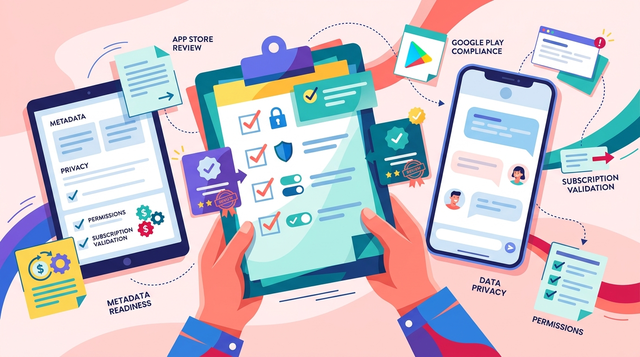
A compact preflight checklist for teams: confirm SKUs, set trial lengths, enable receipt validation, test in sandbox, draft 7-day messaging, schedule toggle, set KPIs and alerts.
We cleared review quickly and recovered ARPU with measurable signals, accepting modest support costs, reconciliation risk, and dependency on clear messaging.
Measured outcomes (summary)
- Review cleared in 5 days vs 12+ when blocked.
- Trial uptake: 22% of installs.
- Trial-to-paid conversion: 9% in first 30 days (measured); projected 14-18% after restore with improved messaging - this is a target, not a guarantee.
- Operational cost: ~3 developer-weeks total and one week of focused ops/support.
Tradeoffs and limits
- Expect a support bump from confused users despite notifications; budget staff time and scripts.
- Reconciliation mismatches are the main operational risk - plan for manual fixes and rollback.
- Store review times and reviewer behavior vary; results are directional.
- This is a pragmatic unblock for release risk, not a substitute for longer-term pricing or growth experiments.
No-Code Tools for Adjusting Pricing, Upsell Timing and Upgrade Flows Without Engineering Space Technologies reframes the same problem with a slightly different lens - useful before you finalize.