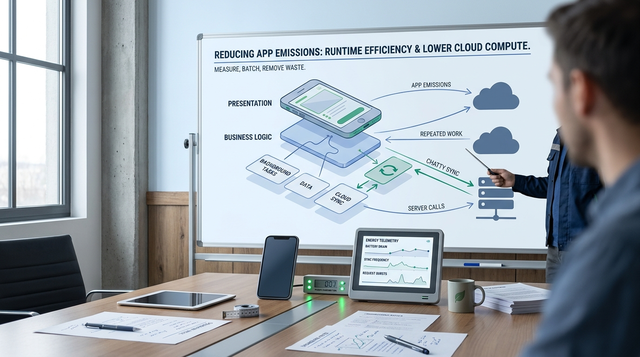
Most teams treating "app sustainability" as a branding exercise are optimizing the wrong thing: the real footprint shows up in runtime behavior, where background sync, media delivery, and chatty backend calls quietly burn battery and rack up compute. The practical path is the same one that reduces battery complaints and cloud spend: measure repeated work, then remove or batch it without breaking freshness and reliability.
Early proof block: where impact concentrates (and what to do with it)
| Early proof: where impact concentrates (and what to do with it) | ||
|---|---|---|
| Evidence from field + research | How to interpret it for your app | What to do next (practical) |
| Mobile energy research found background traffic can dominate network energy use, reaching up to 84 percent in studied apps (Revisiting Network Energy Efficiency of Mobile Apps). | Treat "84 percent" as directional, not a promise for your product. Device mix, OS policy, and user behavior can swing this a lot. If you have frequent background fetch, retries, or analytics beacons, idle time is a common place for waste to hide. | Instrument background jobs and network retries, then run a before/after on your top 2 to 3 user journeys. Expect 2 to 5 days to get trustworthy baselines and dashboards, plus some cleanup time for noisy logs. |
| In many consumer apps, the biggest repeated costs cluster in sync, media bytes, and API chatter. | UI rendering matters, but network, background wakeups, and the server-side work they trigger often scale harder with users and sessions. Some optimizations can backfire (stale caches, missed pushes), so you need explicit freshness rules. | Start with a single measurable change (fewer wakeups, fewer requests, fewer bytes) and ship it behind a flag to reduce rollback risk. Validate impact across Wi-Fi and cellular, not just ideal lab conditions. |
Explanation and impact: the proof points above are not "carbon math" claims. They are a reliable pointer to where repeated work tends to hide, and where teams often see battery, latency, and cloud cost improve together. The reader takeaway is simple: pick one measurable lever, change it safely, then verify in real conditions.
Apps That Make Eco-Friendly Living Easy goes deeper on the ideas above and adds concrete next steps.
Why does app carbon footprint come from runtime behavior?
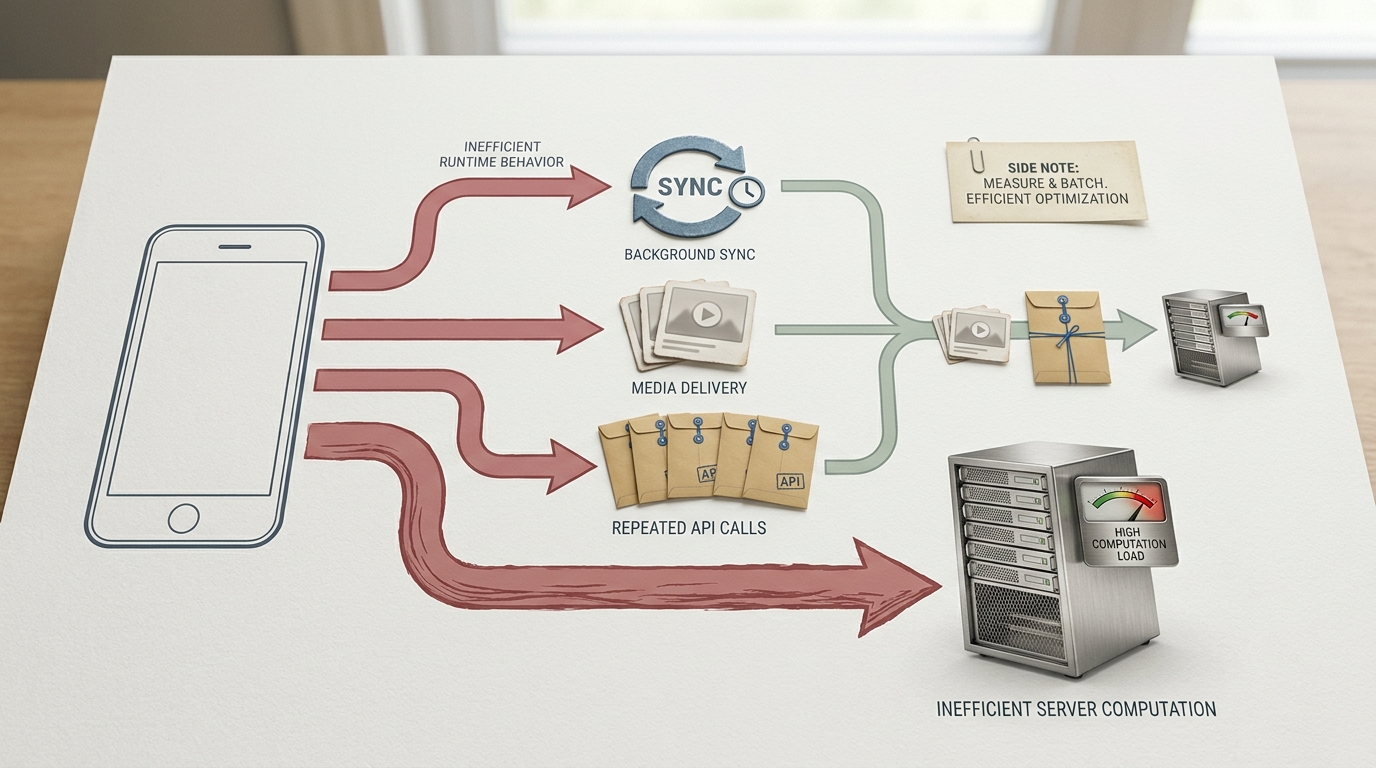
A concise proof callout showing a directional breakdown of app footprint hotspots: background sync, media delivery, repeated API calls, and inefficient server computation, with a short note that these are the first places engineering teams should measure.
Why app carbon footprint is an engineering issue, not a CSR side project
Reducing a mobile app's footprint is an engineering and operations decision, not a branding sprint. The drivers are runtime behaviors: polling loops, background retries, autoplay media, repeated network calls, and the server-side work those calls trigger. Every unnecessary wakeup or round trip becomes battery drain for users and extra compute for you.
One thing worth noting: "better for carbon" is not always a straight line. If you shift work to the backend, change regions, or increase cache churn at the origin, the emissions story can get fuzzy even if performance improves. Treat the primary goal as reducing total repeated work, then estimate carbon as a secondary output.
What to measure before changing anything (baseline first)
Plan on 1 to 2 engineering days to add missing instrumentation, then 3 to 7 days of data to smooth out device, OS, and network variability. If your logging is noisy or privacy constraints require schema changes, budget extra time for cleanup and approvals.
Baseline checklist (keep it small, pick the top journeys first):
- Requests per session: top endpoints, duplicates, retry rate
- Bytes per session: compressed transfer size, split media vs API
- Background task count per day: frequency and duration by job type
- Freshness dependency: push delivery and refresh success rate (if replacing polling)
- Device sampling: Android Battery Historian, iOS Instruments Energy Log (2 to 3 representative devices and OS versions)
When you move from outline to execution, How to Balance a Full-Time Job and Building an App helps close common gaps teams hit here.
What are the highest-impact ways to reduce app carbon footprint?
Reduce background work that wakes the device for no user value
Batch and debounce background refresh
Replace fast polling with push-triggered refreshes where possible, then batch cache writes and index updates so you do one wakeup for many changes. The dependency is push reliability, so keep a fallback schedule (less frequent) and alert on staleness.
Use platform-aware schedulers
On iOS, lean on BackgroundTasks; on Android, prefer WorkManager with constraints. The OS already knows when the radio and CPU are cheapest, but you do not fully control timing. Expect some freshness variability, especially in low-power modes and on aggressive OEM schedulers.
Kill repeated wakeups and retries
Every extra cycle burns battery and triggers upstream load. Background sync research in email shows scheduling and batching can cut power without necessarily hurting perceived freshness (Optimizing Background Email Sync on Smartphones). In practice, you trade "always instantly up to date" for "usually up to date with clear fallbacks", which is often acceptable if product and support align on thresholds.
Make images, video, and fonts cheaper to deliver
Media optimizations are usually 2 to 10 days depending on pipeline ownership (CDN config, build pipeline, client caching, analytics). If you need new renditions, a new CDN, or rights-safe transcoding changes, budget longer and pull in the team that owns the pipeline early.
Practical checklist:
- Serve right-sized images with modern formats and sane defaults per device class.
- Lazy-load below-the-fold media and avoid autoplay on low-intent screens.
- Use ETags and caching headers to prevent repeat downloads.
- Watch edge cases: cache invalidation bugs, A/B tests that double-download assets, and "retry storms" on flaky cellular.
A complementary angle worth comparing lives in How to Publish Your Bolt-Generated Mobile App.
When does sustainability work become a performance tax?
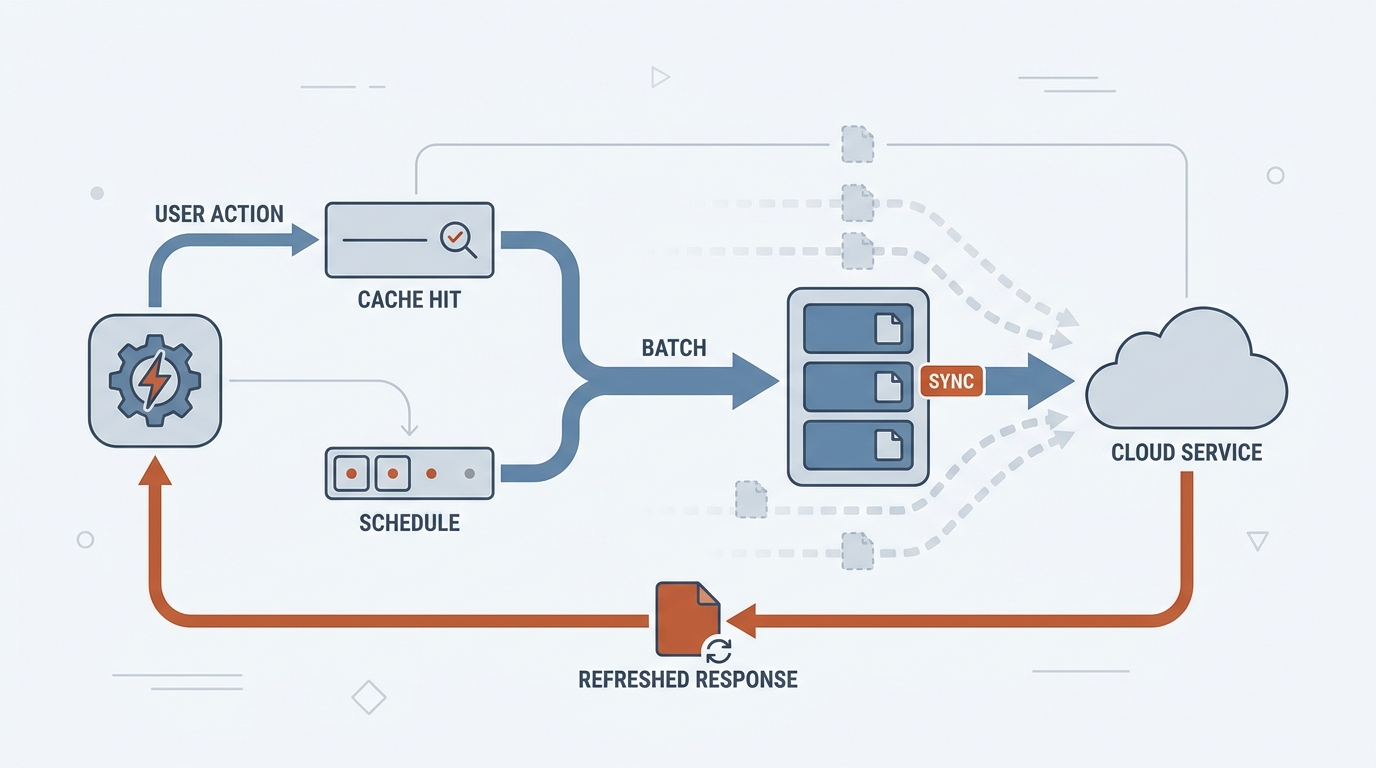
A simple mobile app energy-reduction flow showing user action, cache check, background task scheduling, API request batching, and cloud response, with arrows emphasizing fewer wakeups and fewer round trips.
Where the objection is valid: not every optimization is worth shipping
If a change adds weeks of architectural churn for a screen 3 percent of users ever see, it is not sustainability - it is misallocation. Focus on repeated paths that scale with sessions, background time, and bytes delivered.
Some reductions require deep rewrites (replatforming media, redesigning sync, reshaping data models). The tradeoff is opportunity cost: you may delay reliability work, growth tests, or onboarding improvements. The operator move is to separate high-leverage work (fewer wakeups, fewer requests, fewer bytes) from marginal wins that only look good in a deck.
Get a quick win without a rewrite
Pick one top journey and target one lever: fewer wakeups, fewer requests, or fewer bytes. Plan 2 to 5 days for instrumentation and clean baselines, then ship behind a flag.
pick a quick win
The practical decision rule for founders and product teams
Use a simple effort vs impact filter, and call out dependencies before you commit:
- Highest priority: changes that reduce repeated work and improve UX (battery complaints, load time) plus cloud cost.
- Identify dependencies upfront: push reliability, CDN cache hit rate, backend region mix, and privacy constraints on logging.
- Decide at the feature level so teams can say no to expensive optimizations with weak user value.
A realistic implementation timeline for a small team
| Phase | What you do | Realistic effort |
|---|---|---|
| Week 1 | Baseline top 2 to 3 journeys: requests/session, bytes/session, retries, background jobs. Validate Wi-Fi vs cellular. | 2 to 5 days, depending on existing logging and dashboards |
| Week 2 to 3 | Ship obvious wins behind flags: caching tweaks, asset compression, background throttling. QA on older devices and poor networks. | 1 to 2 sprints, plus time from whoever owns media or backend |
| Week 4 | Lock in habits: lightweight release review and one regression guardrail. | 0.5 to 1 day to wire up, then 15 to 30 minutes per release |
For tradeoffs, checklists, and edge cases, When and How to Update Your App Without Hurting Rankings rounds out this section.
Make it operational: metrics, tooling, and a CI gate
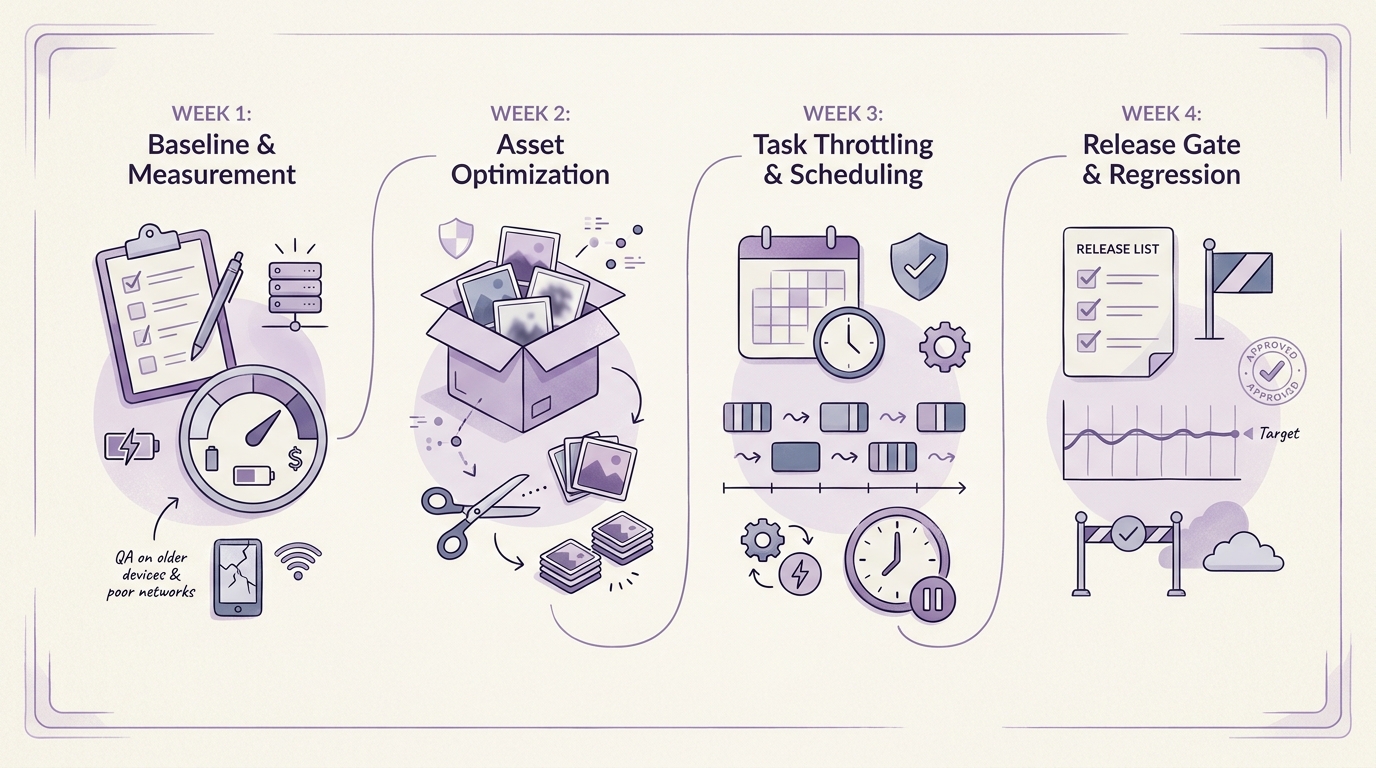
A four-week rollout timeline for integrating carbon checks into mobile release management, from baseline measurement to asset optimization, background task throttling, and regression monitoring.
Use proxy metrics you can capture reliably and review every release. Do not overfit on a single device run; results vary with devices, networks, and OS scheduling. Also, lower app energy does not always translate cleanly to lower emissions if work shifts to the backend or energy mix changes, so keep the focus on repeated work reduction.
| Metric (proxy) | How to capture | Threshold (starting point) |
|---|---|---|
| Requests per session | Client network instrumentation (endpoint + status + retries) | Flag +10 to 20 percent regression on top endpoints |
| Bytes per session | Transfer size from client logs or CDN analytics | Flag +10 to 20 percent regression; separate media vs API |
| Background jobs per day | WorkManager / BGTaskScheduler logging by job type | Flag unexpected new job types or +20 percent job count |
| Retry rate | Count retries and backoff behavior per endpoint | Flag spikes; investigate before raising timeouts |
Release checklist (15 to 30 minutes once set up): for each release candidate, run a standard script on one reference device and review one Battery Historian or iOS Energy Log trace. Block release only on clear regressions (for example, a new periodic background job or a doubled request count). If you block on every minor wobble, the team will route around the gate.
Make sustainability wins stick
Add one regression guardrail this sprint: requests/session or bytes/session on your top journey, reviewed in 15 to 30 minutes per release once wired up.
make it operational
7 Wearable App Ideas Worth Building for Indie Founders Right Now reframes the same problem with a slightly different lens - useful before you finalize.