
Last winter, I was leading ops at a 60-hour-a-week startup job in Austin while trying to ship my first app at night. The pattern was always the same: Monday motivation, Friday guilt, and zero measurable progress.
If your calendar is full and your energy is inconsistent, a side project can keep slipping because it feels optional. What helped me was less about willpower and more about a build system that could survive commute time, family plans, and the occasional week where work blew up.
How to Turn Your App Idea Into a Real Product in 30 Days goes deeper on the ideas above and adds concrete next steps.
Early proof: the schedule that made the app possible
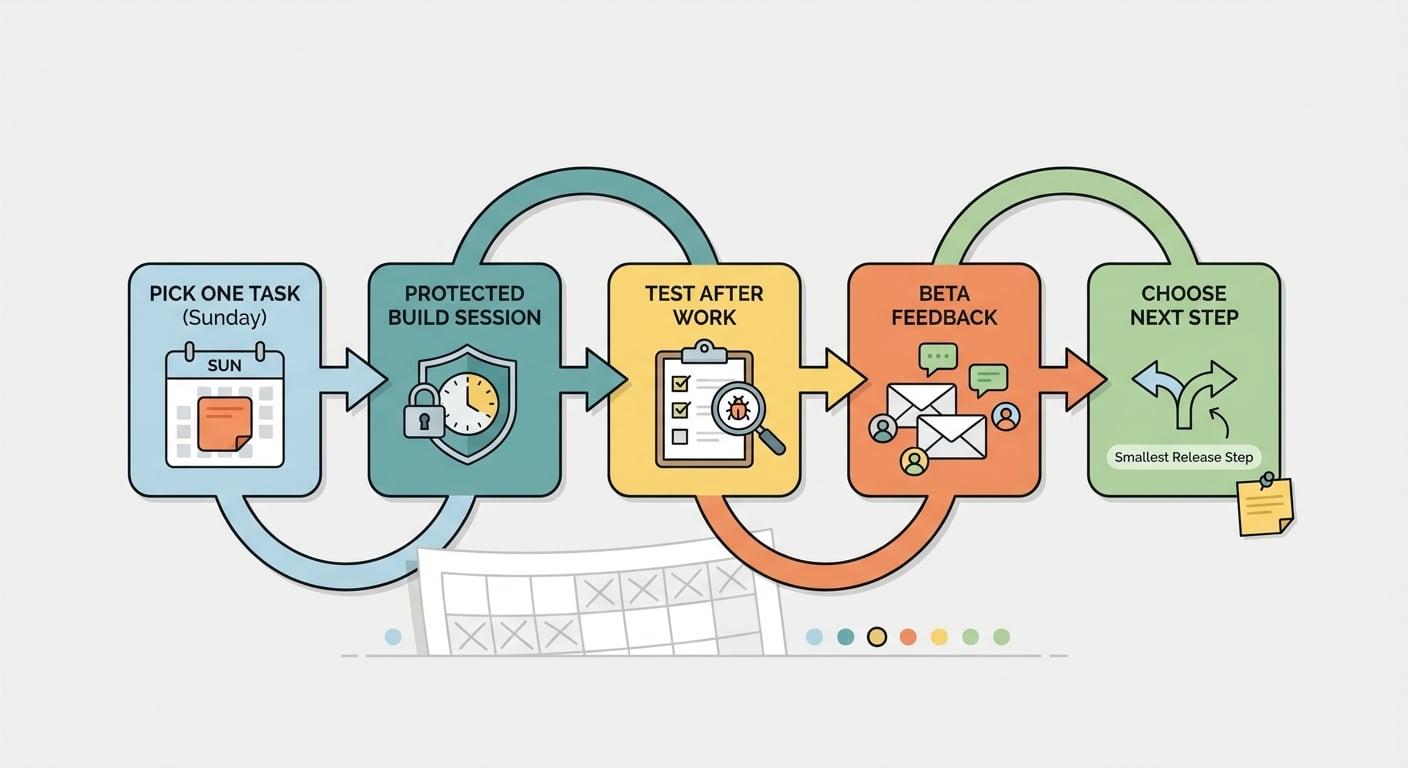
A simple process diagram showing the founder's repeating side-project loop: pick one task on Sunday, build during a protected session, test after work, send to beta users, then decide the next smallest release step.
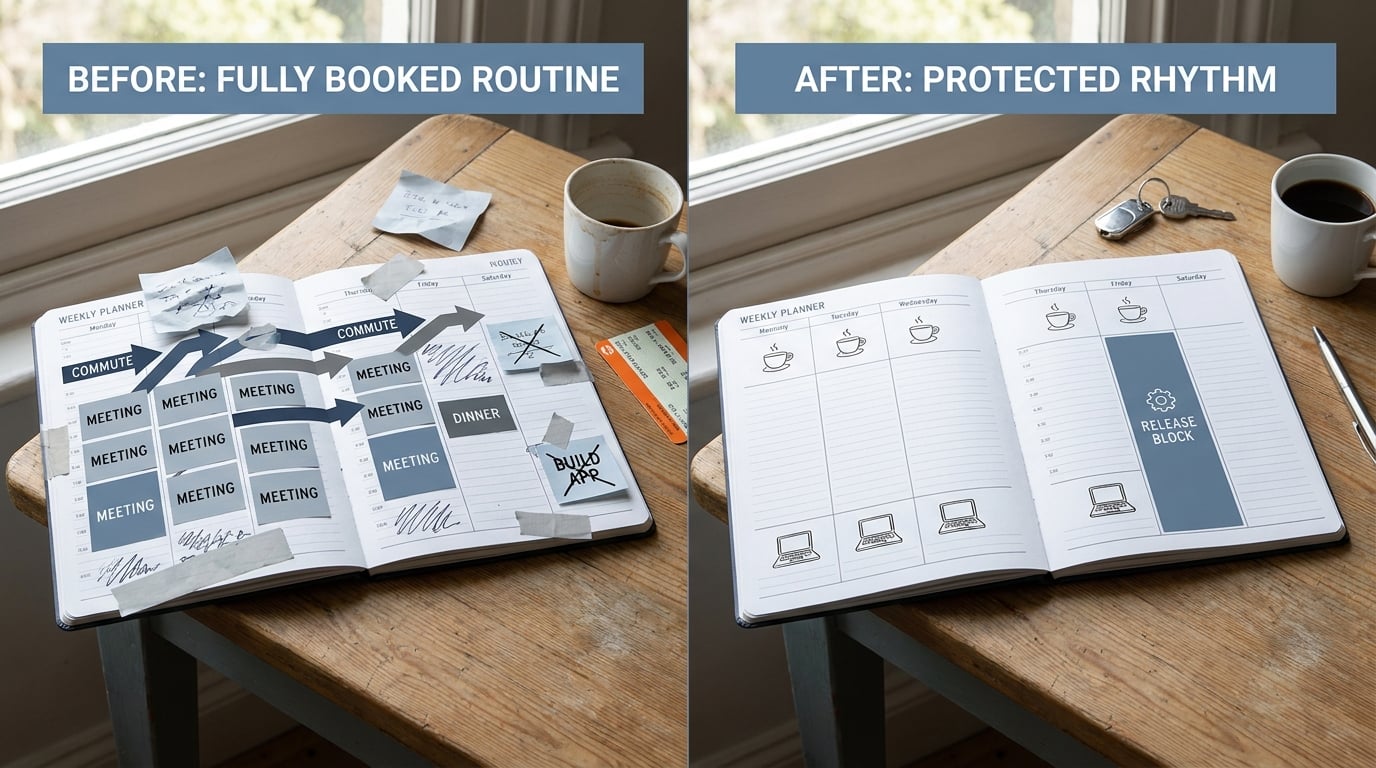
A compact before-and-after callout showing the founder's weekly time shift from a fully booked job-and-commute routine to a protected app-building routine with early mornings, weekday nights, and one weekend release block.
Below is what changed for me when I moved from "whenever I have time" to a repeatable weekly rhythm.
These numbers are from my own tracking across about 4-8 weeks plus qualitative feedback from a small tester group (roughly 8-12 people). Treat them as directional, not a study.
| What changed | Before | After | Why it mattered | Reader impact |
|---|---|---|---|---|
| Weekly build windows | 0-2 scattered hours | 5 planned sessions | Fewer restarts and less context switching | You can predict when you will build, even if some sessions get missed |
| Time blocks | Vague late nights | Tue + Thu 6:30-8:00 a.m., Mon + Wed + Fri 8:30-10:00 p.m., Sat 9:00-12:00 | Work happened before decisions and fatigue piled up | Progress stops depending on "feeling like it" |
| Release packaging | Pushed indefinitely | Weekend block reserved for testing and release prep | Shipping needs a different mindset than building | You reduce the chance of finishing features but never actually releasing |
| Measurable output | "I coded" | Sessions completed + 1 weekly deliverable a tester can touch | Counting sessions is easier than perfect time tracking | You can see momentum week to week and adjust quickly |
| Early validation | No one saw it | Prototype tested by friends/coworkers | Feedback creates direction and urgency | You get signal earlier, before overbuilding |
Interpretation: The app did not get easier. In my case, the schedule reduced drift by making "showing up" the default. Business impact: I went from unpredictable progress to a weekly cadence where testers consistently had something new to try, which reduced slip weeks and made launch prep feel doable.
When you move from outline to execution, The Rise of Solo App Founders - How One Person Can Compete helps close common gaps teams hit here.
Why does a side project keep getting pushed back?
The founder's starting point
At the time, I was a product lead at a midsize SaaS company, the kind of job where your calendar fills up before your day even starts. On nights and weekends I was building a small iOS app for lightweight habit check-ins, mostly to prove I could still ship end to end.
The goal was concrete: reach a usable beta, then submit something real (not perfect) for App Store review. One thing worth noting: store reviews, rejected builds, and last-mile polish are real dependencies, so I treated "launch" as a multi-week process, not a single weekend.
What kept breaking the plan
- Meetings ran late and ate the only time blocks I had mentally reserved
- The 45-minute commute each way made evenings shorter than they looked on paper
- After-work energy was unreliable, especially on stressful days or poor sleep
- Context switching was expensive: half the session was "where was I?"
- I kept postponing the boring parts (testing, release notes, screenshots), which delayed shipping
- When I missed a week, the restart cost was high and morale dropped
A complementary angle worth comparing lives in Publishing Apps Built With Flutter, React Native, or Native.
How do you build an app around a full-time job?
Setting a fixed build window
Pick a repeatable block and protect it
I stopped negotiating with myself daily and picked two early sessions (Tue/Thu, 6:30-8:00) plus a weekend release block. I kept some nights, but I assumed at least one would get blown up by life or work.
Plan once a week, not every session
On Sunday night (20-30 minutes), I chose one deliverable for the week and broke it into 3-5 tasks. This cut decision fatigue and made scope creep obvious.
Keep each session to one build target
Each session had one output: one screen wired, one API call working, one bug closed. If a task could not fit in 60-90 minutes, I split it, because "big tasks" are how sessions quietly die.
A weekly loop you can actually follow
This is what my week looked like when things were working. It is not the only way, and it will change depending on your job, kids, health, and whether you have weekends.
| Day | Primary goal | Typical time |
|---|---|---|
| Sun | Plan deliverable + split tasks | 20-30 min |
| Tue/Thu a.m. | Deep work on the hardest piece | 60-90 min each |
| Mon/Wed/Fri p.m. | Smaller tasks, bugfixes, wiring | 45-90 min each |
| Sat | Test, polish, package, ship to testers | 2-3 hours |
One risk here: over-optimizing the schedule can turn into rigidity and guilt when life happens. Mitigation: define a "minimum week" (for me it was 1 session + 1 tiny deliverable) so the system bends without breaking.
Using a smaller stack and narrower scope
- I cut the app to one user problem and one core flow, then parked everything else in a backlog.
- I picked low-friction tools so setup did not steal half a session.
- I delayed anything that looked like "real startup work" but did not create learning yet: branding polish, extra features, and heavy automation.
Tradeoff: a boring stack can limit flexibility later, and some shortcuts create cleanup work after you learn what users actually need. The upside is you get to feedback faster, which is usually the real bottleneck for a side project.
Shipping in short cycles
The weekly loop became: build in protected windows, do light testing after work, fix sharp edges, then push an update to a small group. This still took real time: I usually budgeted 45-90 minutes per week for packaging, notes, and basic regression checks.
When it mattered, I used TestFlight (iOS) so I had a reviewable artifact, not just a local build. One lightweight metric I tracked weekly was "sessions completed" plus whether testers could finish onboarding without help.
Dependency to call out: App Store review timing and random rejection reasons can break a "weekly release" streak. My fallback was to still ship weekly to testers and treat store submission as a separate cadence.
Free side-project schedule check
Share your current week (work hours, commute, obligations) and your app scope. I will suggest a realistic build cadence and the first deliverable to target.
Get the checklist
For tradeoffs, checklists, and edge cases, How a Solo Founder Prepared Their App for Launch Without Hiring an Agency rounds out this section.
What happens when you treat the app like a real project?
The practical gains
The takeaway was not "work more." It was "reduce restarts." With fewer context switches, I could show up at work fully, then make small, reviewable changes on a more predictable cadence.
It also made planning honest. I could see that some weeks would be slow (deadlines, travel, family stuff), and I built a schedule that degraded gracefully instead of collapsing.
The limits that still remained
- Shipping was slower than a full-time startup, especially on on-call weeks, travel weeks, or when sleep was off.
- I still missed sessions. The system only worked if I protected energy, not just calendar slots.
- Bugs and unknowns happen. If a core task blew up, I would sometimes lose the whole session to debugging.
Concrete failure mode: if I missed 2+ weeks (work crunch, travel), momentum dropped fast and the first session back turned into re-orientation. Mitigation: keep a "restart note" at the end of every session (what changed, what is next, and the smallest next task) and keep one 30-minute recovery session on the calendar to rebase, run the app, and pick a tiny win.
What the next phase looked like
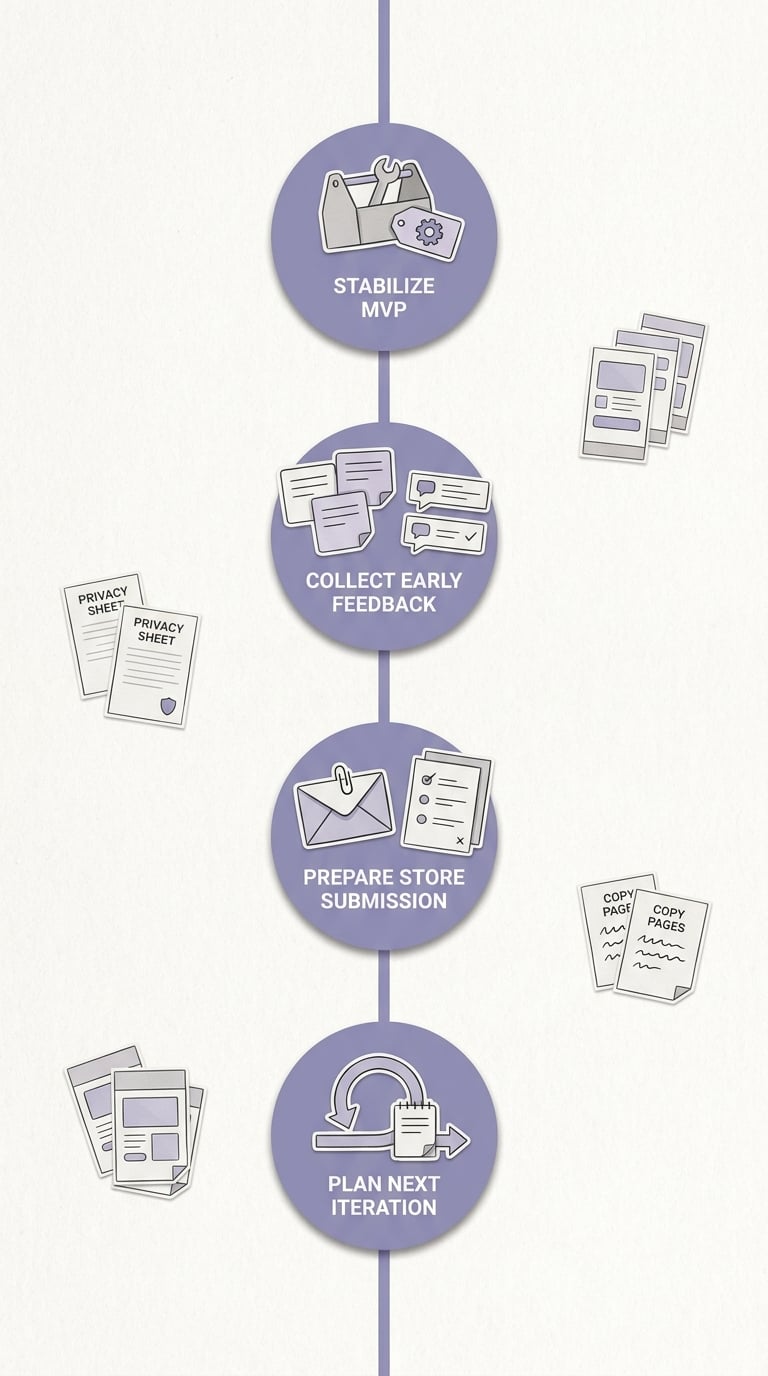
A short timeline block showing the next milestones after the routine worked: stabilize the MVP, collect early feedback, prepare store submission, and plan the next iteration without quitting the day job.
Next milestones (without quitting the job): stabilize the MVP, collect feedback, prep store submission assets (screenshots, copy, privacy details), then tighten onboarding based on where people drop off.
In practice, each stage can take 1-3 evenings, and App Store submission can add another 1-2 weeks depending on review timing, fixes, and whether your metadata is clean on the first pass.
Ship your MVP with less release friction
If publishing overhead is your bottleneck once the app is ready, Froxi helps you package, validate, and submit updates with fewer moving parts.
See Froxi
How to Build a Full iOS App With Cursor AI in a Weekend reframes the same problem with a slightly different lens - useful before you finalize.


