
Most iOS teams only notice App Transport Security when a release candidate suddenly starts failing network calls or App Store review flags an overly broad security exception. ATS is Apple’s default requirement for secure connections, but tightening it often exposes a long tail of legacy HTTP endpoints, third-party SDKs, and media hosts that quietly undermine reliability and risk posture. This walkthrough explains what ATS enforces, where it tends to break apps in practice, and how to enable it with a defensible, minimal set of exceptions so you reduce late-cycle surprises.
Top 5 App Security Tools for Mobile Developers Ranked goes deeper on the ideas above and adds concrete next steps.
Early proof: the audit artifact that usually pinpoints ATS failures quickly
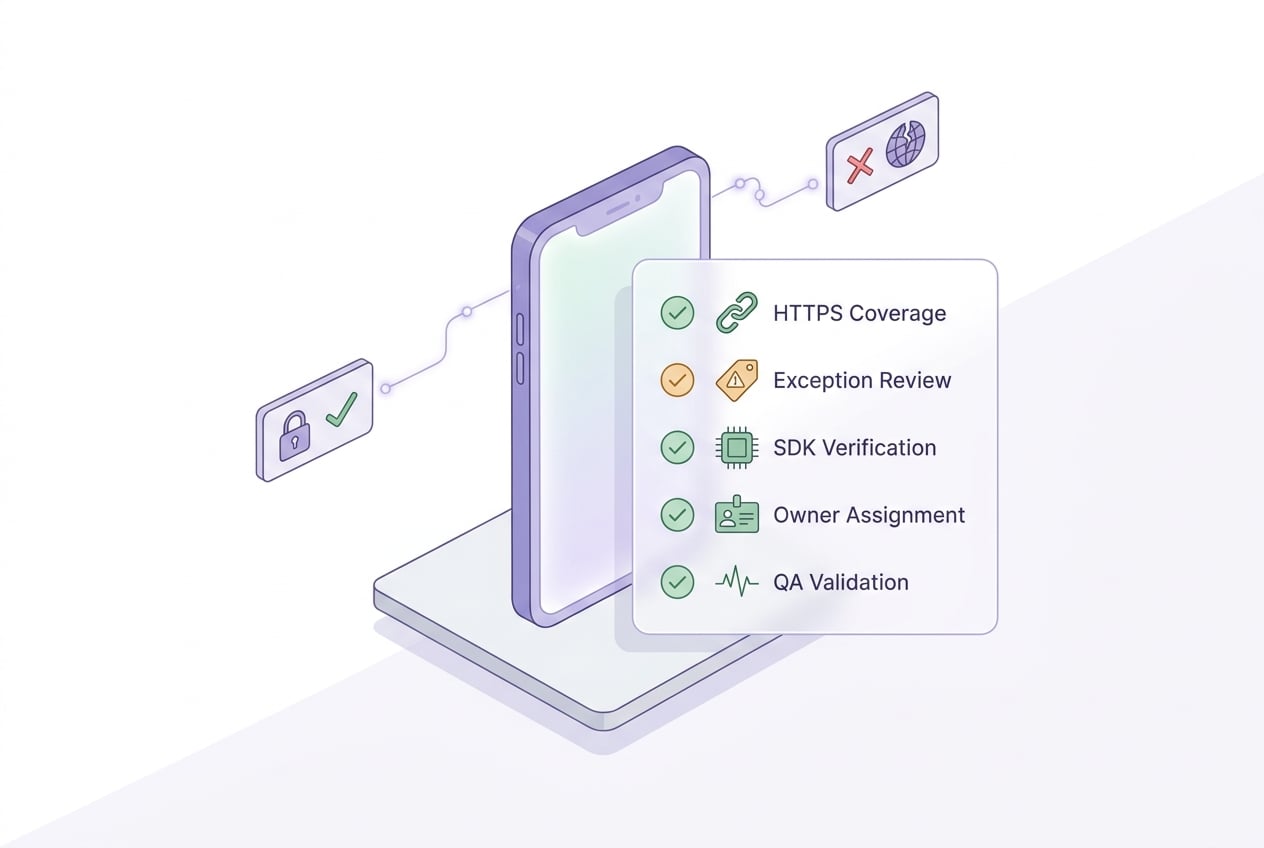
A mobile-friendly checklist block summarizing the final ATS pre-submission checks: HTTPS coverage, exception review, SDK verification, owner assignment, and QA validation before App Store release.
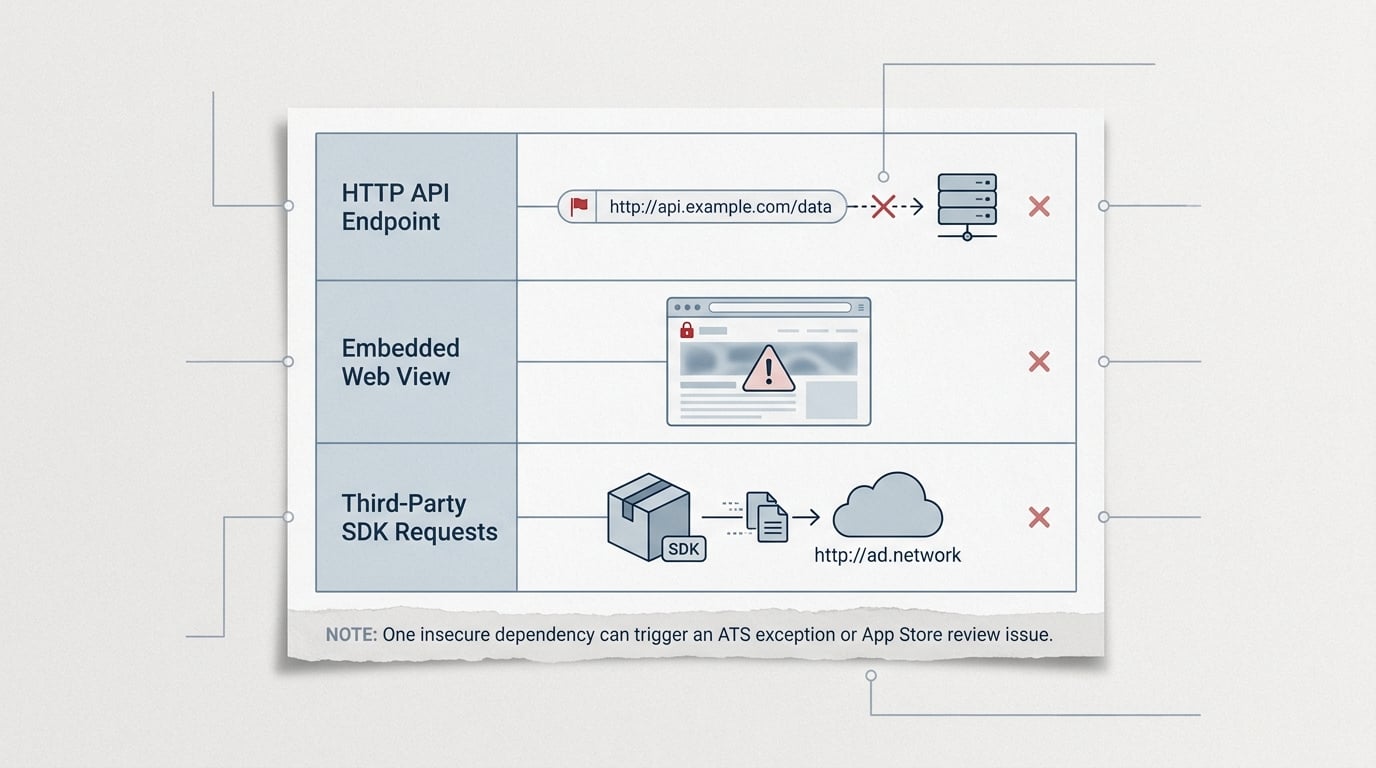
A compact proof block styled as a diagnostic callout showing the most common ATS breakpoints: HTTP API endpoint, embedded web view, and third-party SDK traffic, with a note that one insecure dependency can force an exception or delay App Store review.
| Signal you will see | Fast way to confirm | Typical root cause | Impact if missed |
|---|---|---|---|
| ATS block in device logs | Xcode device console shows ATS denial + hostname | Hidden HTTP call, redirect chain, or TLS mismatch at the CDN edge | QA churn, late hotfixes, possible review questions |
NSAllowsArbitraryLoads present | Info.plist contains a global override | A temporary "unblock the build" change that stuck | Higher scrutiny, larger attack surface, harder compliance reviews |
Vendor or WKWebView traffic bypasses HTTPS | Proxy capture shows third-party domains or mixed assets | HTTP pixels/scripts, captive portal behavior on test networks, outdated SDK endpoints | Broken attribution/ads, layout issues, revenue leakage, schedule risk |
Explanation: ATS denies insecure transport unless you add exceptions under NSAppTransportSecurity in Info.plist (Apple). Apple also documents how to identify the source of blocked connections, which is often the fastest path from "something broke" to the specific host and callsite (Apple).
Interpretation: most ATS work is not "turn on a switch." It is a dependency audit plus a scoping exercise: what can be upgraded to HTTPS quickly, and what must be temporarily exempted.
Reader impact: you can measure progress without guessing by tracking two internal metrics during QA: (1) count of ATS denials seen in your standard smoke test run, and (2) number of exception domains in NSExceptionDomains. Both should trend downward over time. This does not guarantee approval or stability: vendor endpoints and redirect behavior can change after you ship, and App Review outcomes are probabilistic.
When you move from outline to execution, How to Set Up Apple Pay in Your iOS App helps close common gaps teams hit here.
What ATS changes operationally for app publishers
ATS is both a user safety control and a reviewer signal. It pushes apps toward modern TLS and valid certificates, and it makes broad overrides like NSAllowsArbitraryLoads easy to spot in review (Apple).
Here is the thing: "compliant" is not always free. If you have legacy endpoints, embedded web content, marketing redirects, or ad and analytics SDKs with older hostnames, tightening ATS can cause regressions that take real time to isolate and retest.
State the research question and limits
Research question: what changes operationally when a publisher tightens ATS, and where do failures typically emerge across first-party endpoints, third-party SDKs, and content hosts? The analysis uses Apple ATS and debugging guidance plus common vendor notes (for example, ad SDK ATS documentation) (Apple, Google).
Limits: outcomes vary by redirect behavior, certificate chain configuration, CDN edge TLS settings, and how each SDK performs networking. Some exceptions may be unavoidable in the short term; they can still be review-acceptable if they are narrowly scoped, justified, and actively tracked, but review feedback can still require changes.
A complementary angle worth comparing lives in Everything You Need to Know About Apple and Google Developer Accounts.
How do you enable ATS without breaking your iOS release?
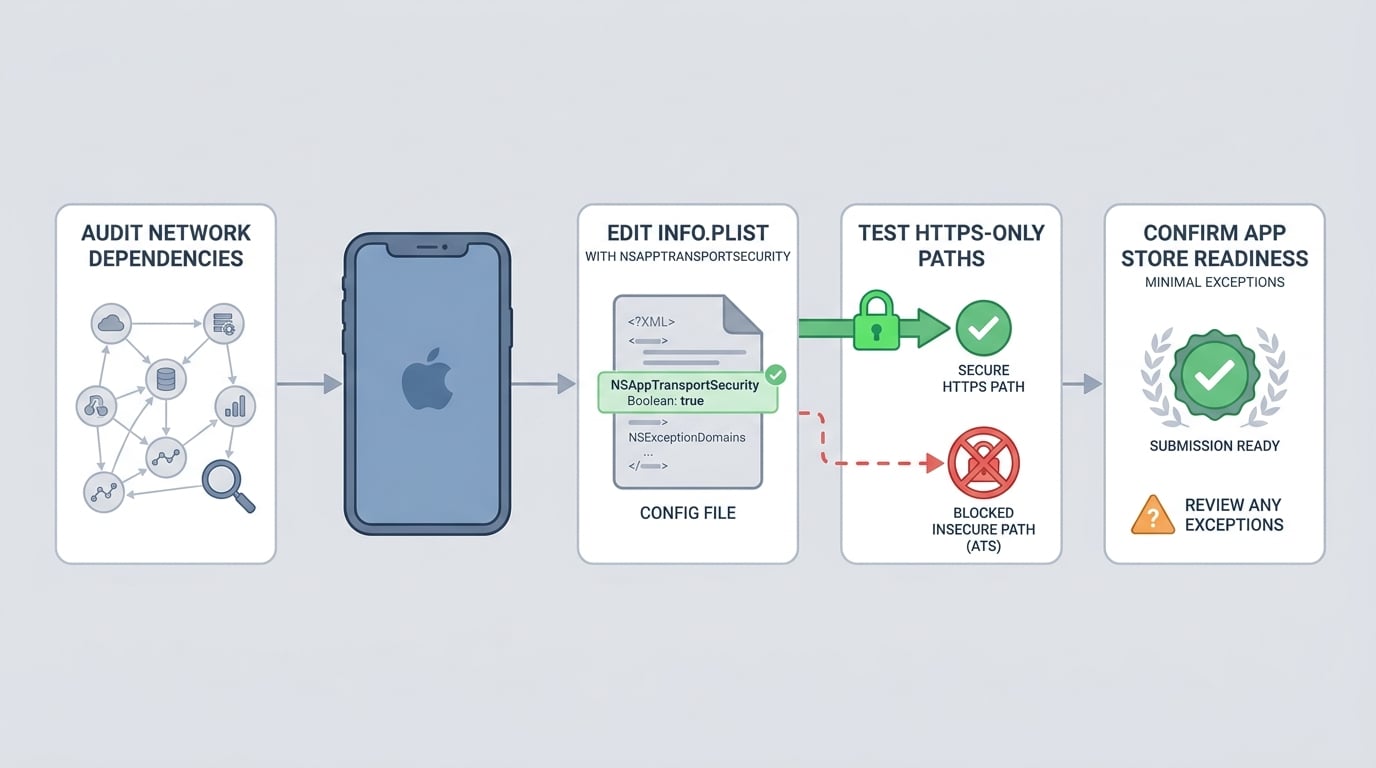
A step-by-step process diagram showing the ATS enablement workflow in Xcode: audit network dependencies, edit Info.plist with NSAppTransportSecurity, test HTTPS-only flows, and confirm App Store readiness with minimal exceptions.
Audit every network dependency first
Effort is usually half a day to 1 day for a small app with a few SDKs, and 1-3 days for larger apps with many SDKs, multiple environments, or embedded web content. Add time if you need to reproduce issues on cellular, behind captive portals, or across iOS versions, because ATS failures can be device and network dependent.
A key dependency is vendor responsiveness. If an ad, attribution, or payments partner needs time to update endpoints or ship an SDK fix, your "clean ATS" timeline can easily stretch beyond a sprint.
Inventory traffic by owner
List every host your app touches: first-party APIs, CDNs, analytics, ads, payments, and embedded web content. Split into "we own it" vs "vendor owns it" so escalation is clear, including who opens vendor tickets and who can approve exceptions.
Find insecure endpoints and likely failure modes
Look for
http://base URLs, redirect chains that land on HTTP, and TLS edge cases. Two common time-wasters:WKWebViewmixed-content surprises (a single HTTP script or pixel can break a page) and post-launch redirect changes (marketing tools and CDNs can add a hop that suddenly fails ATS).Decide upgrade vs exception (time-boxed)
For first-party services, upgrading to HTTPS and modern TLS is the best long-term move, but it may require certificate, CDN, and backend work plus coordinated rollout. For vendors, request updated SDKs or HTTPS endpoints, and treat exceptions as temporary release risk with an owner, a removal date, and a backout plan if review pushes back.
Configure ATS and validate it like a release gate
Configure NSAppTransportSecurity in Info.plist aligned with Apple’s secure transport expectations (Apple). Prefer NSExceptionDomains for specific hosts rather than NSAllowsArbitraryLoads, which expands scope and can increase review scrutiny.
Then test the release candidate on real devices across the flows that matter: login, onboarding, checkout, content feeds, and media playback. Verify with logs and proxy capture that you did not miss secondary traffic such as image CDNs, tracking pixels, or redirectors. One operational caveat: SDK updates can introduce new domains without obvious code changes, so rerun this check after major dependency bumps.
A practical release gate many teams can actually enforce:
- No new ATS exceptions without a ticket, owner, and removal date.
- Zero ATS denials observed during the standard QA smoke suite (record the count).
- If you must ship an exception, it is limited to named domains only and documented for App Review notes if needed.
Concrete tooling example (quick check): run nscurl against a suspicious endpoint to see if it negotiates ATS-compatible TLS.
/usr/bin/nscurl --ats-diagnostics https://example.comIf nscurl fails but a desktop browser "works," that often points to certificate chain issues or TLS settings that are not ATS-friendly across devices.
For tradeoffs, checklists, and edge cases, The Security Risks of Manual App Publishing rounds out this section.
When are ATS exceptions justified?
Exceptions can be justified when you have a real dependency constraint: a vendor has not shipped HTTPS-compatible endpoints yet, a legacy service is scheduled for deprecation, or a domain is only used for a low-risk, non-authenticated resource. The tradeoff is ongoing operational burden: more retesting, more audit surface, and a higher chance of regressions when vendors change infrastructure.
To keep exceptions defensible:
- Prefer per-domain exceptions over global overrides.
- Record why the exception exists, the owning team, and a target removal date.
- Re-audit after SDK updates, CDN changes, or marketing redirect updates.
- Plan for drift: new vendor domains can appear late, and a previously compliant endpoint can change TLS settings at the edge.
How to Protect Your App Store and Google Play Accounts reframes the same problem with a slightly different lens - useful before you finalize.


