
Most mobile teams talk about personalization, then ship a recommendation feed that looks smart in a demo but does not move retention, conversion, or revenue once real users arrive. This write-up sets a practical research goal for a mobile recommendation engine, defines what it should prove with measurable outcomes, and keeps limits explicit. By the end, you will have an evidence-first blueprint for deciding whether recommendations are worth the complexity, what signals to start with, and how to validate impact without getting fooled by vanity lifts.
Top AI Coding Assistants for Mobile Developers in 2026 goes deeper on the ideas above and adds concrete next steps.
What metrics justify personalization before you build?
Category: Engagement
Statistic: +5 - 15%
Label: CTR lift vs generic feed
Context: Early signal that ranking improves relevance fast
Category: Retention
Statistic: +3 - 10%
Label: Repeat opens in 7 days
Context: More users come back when content adapts to them
Category: Revenue
Statistic: +1 - 5%
Label: Conversion lift from recommendations
Context: Downstream impact that supports ROI before a full build
| What you might see in a pilot | Why it moves first | What it does and does not prove |
|---|---|---|
| CTR improves | You can change first-screen relevance quickly | Proves ranking is more clickable, not that retention or revenue improves |
| Repeat opens shift slightly | Users find something worth returning to | Often needs 2-4+ weeks to read clearly, and enough weekly actives |
| Conversion proxy shifts (add-to-cart, subscribe, share) | Better routing to intent items | Can be noisy if inventory, pricing, or checkout has issues |
| Latency p95 stays within budget (example) | The app still feels fast | Proves you can run recs without hurting UX, not that users like them |
Explanation: these are illustrative internal patterns from short-window A-B tests and app reviews, not universal benchmarks. Expect wide variance by catalog size, surface, and how clean your tracking is.
Interpretation: use this table as a plausibility check for running a pilot, not a forecast. If CTR moves but downstream does not, you probably improved curiosity rather than satisfaction.
Reader impact: you can decide whether to invest in a pilot and which metric you will gate scaling on (usually retention or a revenue proxy, not clicks), plus one operational guardrail (latency).
Concrete guardrails you can use as examples (set your own based on baseline measurements):
- Data quality gate (example): pause rollout if under 95% of
item_viewevents include a non-nullitem_idon both iOS and Android. - Retention read (example): do not call it "working" until you have enough WAU to detect movement and you have at least 2-4 weeks of stable traffic (longer if seasonality or campaigns are active).
When proof is weak or misleading
- Thin inventory or slow catalog refresh: CTR can spike early and decay as repeats show up.
- Low-repeat intent: one-off utility apps may not have enough sessions for feed relevance to matter.
- Tracking gaps (especially iOS): missing
item_idor dropped events can create phantom lifts and corrupt training data. - Seasonality and promos: an ongoing sale or campaign can drown out a small recommendation effect.
When you move from outline to execution, Top 5 AI Tools to Generate App UI Without a Designer helps close common gaps teams hit here.
What should a mobile recommendation engine prove?
Why this matters for mobile apps
On mobile, recommendations compete with search and navigation for a few high-attention slots. If you improve relevance without adding friction, you can earn deeper sessions and more repeat opens because users spend less time hunting and more time acting.
The tradeoff is operational. Personalization adds instrumentation work, experiments, QA, content rules, and monitoring, and it usually requires coordination across mobile, backend, analytics, and sometimes data science. If your samples are small, your catalog is small, or your app is mostly one-time tasks, the complexity tax can outweigh the upside.
Scope, data sources, and limits
- Signals assumed: taps, scroll depth, searches, watch or read history, add-to-cart or purchase events, saves, and dwell time from standard mobile analytics.
- Evidence base (directional): retention and engagement guidance from UXCam and Digia, plus ecommerce app context from MobiLoud. Use these as context, not promises.
- Limits to treat seriously: cold start users and items, sparse first-party data early on, and event loss or user-linking gaps due to privacy controls.
- Dependencies that commonly bite teams: stable user IDs (logged-in or server-side), usable item metadata, backend latency headroom, and consistent catalog hygiene.
What a good outcome looks like
- Primary decision metrics: recommendation CTR, conversion proxy (add-to-cart, subscribe, share), session depth, and 7-day retention.
- Product goal: surface the next best item without adding latency or extra taps.
- Success bar: scale only if at least one downstream metric improves (retention or a revenue proxy), with no meaningful regressions in latency, crash rate, or content diversity.
- Explicit failure mode: no significant lift. In that case, either (a) ship the baseline feed and stop, (b) iterate on signals and UI placement for one more test window, or (c) narrow scope to a different surface where intent is clearer (for example, "related items" instead of home).
A complementary angle worth comparing lives in AI App Positioning Without Policy Risk.
Which data points matter most in a mobile app?
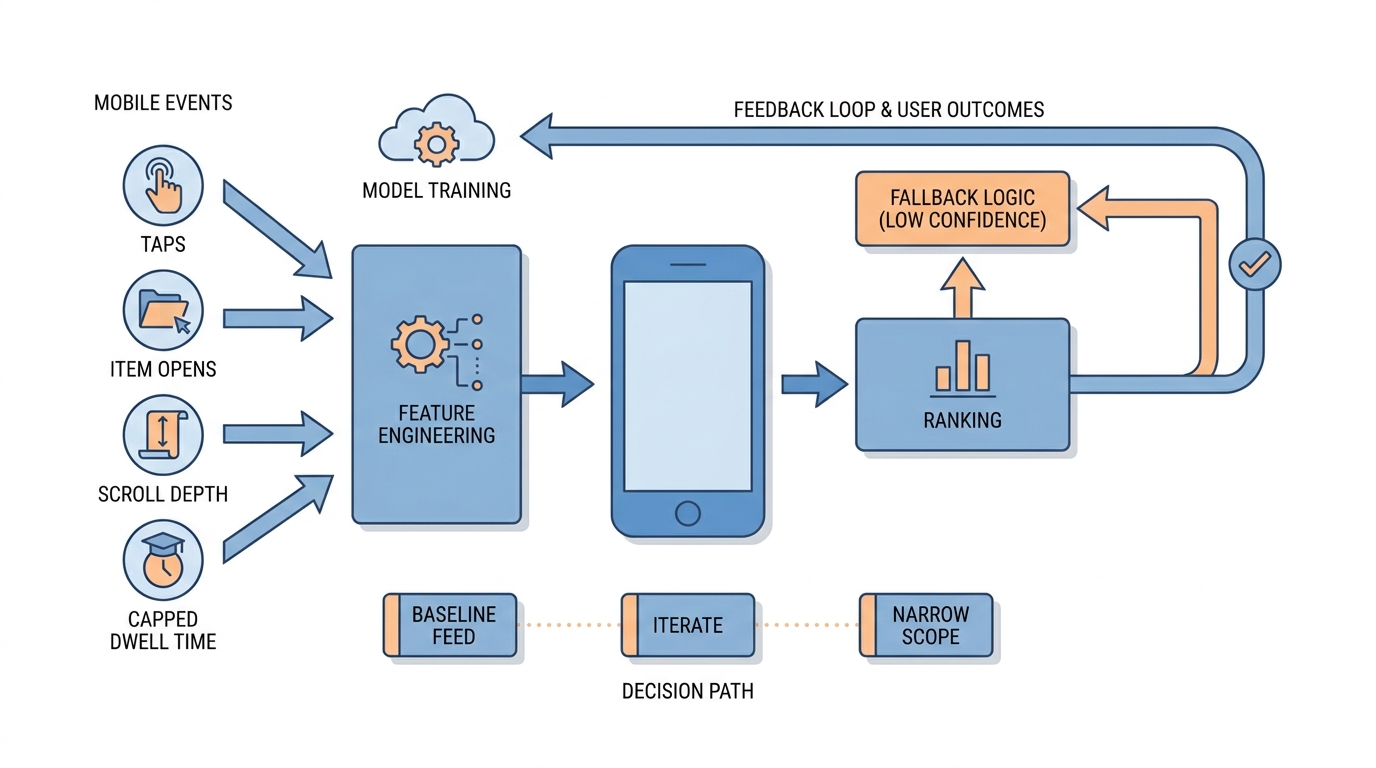
A process diagram mapping mobile event collection into feature creation, ranking, fallback logic, and feedback loops for an AI recommendation engine in a mobile app.
Behavioral signals worth collecting first
- Taps and item opens: clean intent on a small screen; treat as interest, not commitment.
- Dwell time (with guardrails): normalize and cap (example: clamp at 30-60 seconds) to reduce pocket-time noise.
- Search queries and filters: explicit intent; also reveals taxonomy and inventory gaps.
- Purchases, subscriptions, add-to-cart: sparse but decisive; anchor evaluation and revenue impact.
- Skips, quick backs, hides: negative feedback that prevents repetitive feeds and fatigue.
- Naming discipline: align app and analytics on one event dictionary so training and evaluation data is trustworthy.
Planned visual: a process diagram mapping mobile event collection into feature creation, ranking, fallback logic, and feedback loops.
A minimal event schema that keeps you out of trouble
| Event | Required properties (minimum) | Owner who usually supplies it |
|---|---|---|
item_view | user_id, item_id, timestamp, source_surface | Mobile + analytics |
rec_impression | user_id, item_ids[], timestamp, model_version | Backend + data |
rec_click | user_id, item_id, timestamp, model_version | Mobile + backend |
Practical note: if you cannot reliably connect rec_impression to rec_click, your CTR will be hard to trust and your offline evaluation will be misleading.
How to read signal quality, not just volume
More events does not automatically mean better recommendations. In practice, coverage and correctness matter more than raw counts.
Use a few hard gates before you trust any uplift:
- Coverage by platform: example: pause the launch if less than 95% of
item_viewevents include a non-nullitem_idon both iOS and Android. - Segment skew: check whether power users dominate events; if so, your model may over-serve them and disappoint new users.
- Stability: if event definitions change mid-test (taxonomy refactor, new screens), rerun the baseline and restart the experiment window.
For tradeoffs, checklists, and edge cases, Top 7 AI Note-Taking Apps for iPhone in 2026 rounds out this section.
Practical implications: how to ship, measure, and avoid false wins
A simple rollout sequence for mobile teams
Ship a baseline feed first
Start with popularity, recency, and editorial rules so you have a stable control and clean instrumentation. Expect 2-5 days if events already exist; if you need schema cleanup or ID unification, budget 3-10 engineering days plus analytics verification.
Add a hybrid recommender
Layer content-based retrieval (tags, creators, attributes) with a lightweight learned ranker so cold start and sparse catalogs do not stall progress. The hidden work is data QA and offline evaluation; if item metadata is messy, plan on 1-2 weeks of cleanup and backfills.
A-B test one surface
Pick home feed, related items, or post-purchase upsell. Run long enough to observe retention, not just same-session clicks (often 2-4 weeks; longer if weekly actives are low). Expect some on-call and monitoring work during rollout, especially if latency is tight, and plan for at least one mid-test check for logging regressions.
One thing worth noting: someone has to own this. In most teams, product owns success metrics and scope, data owns instrumentation quality and analysis, and engineering owns latency, reliability, and fallbacks. If those owners are unclear, pilots drift and results become hard to act on.
Pilot a single recommendation surface
Get a measurement-first plan (events, success metrics, holdout design) you can run without a platform rewrite.
Run a quick pilot plan
Common failure modes to watch for (and how to mitigate)
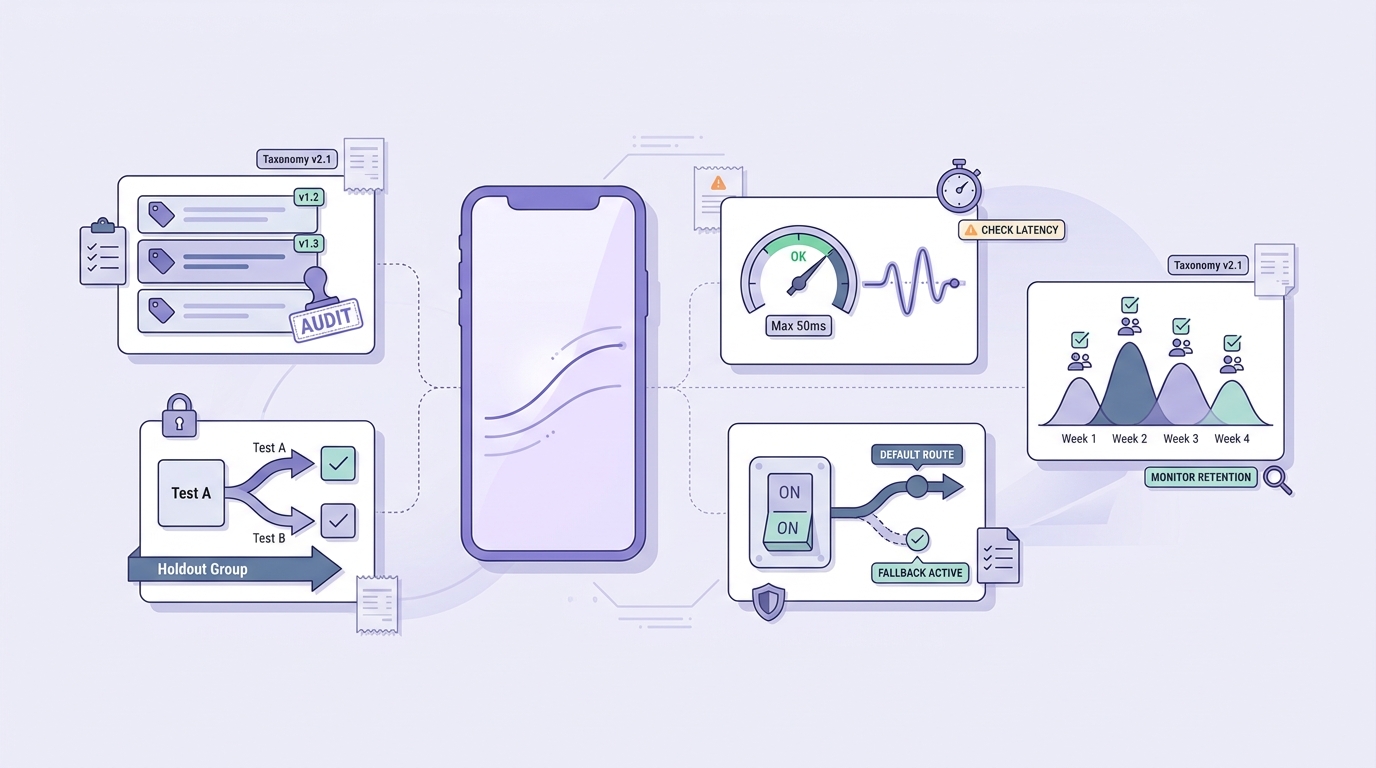
A mobile recommendation launch checklist covering event schema audit, A/B test setup, latency checks, fallback rules, and retention monitoring before scaling the engine.
- Event taxonomy refactor mid-flight: results become incomparable. Mitigation: freeze event names and properties for the test, version changes, and restart the experiment if you must change them.
- Privacy-caused data loss (prompts, OS changes): you may lose critical signals or user linkage. Mitigation: instrument key outcomes server-side where appropriate, use logged-in identifiers when available, and treat early lifts as directional.
- Latency spikes: rec calls slow down the feed and hurt perceived quality. Mitigation: set a budget and fallback to popularity if the service times out. Your p95 target depends on your app, device mix, and network, so measure before you commit.
- Metric gaming: CTR up while revenue per user or returning sessions fall. Mitigation: require at least one downstream metric and add a satisfaction guardrail (quick-backs, hides, or long-term retention).
- Inconclusive test: low WAU, uneven traffic, or a big release during the window. Mitigation: extend the test, simplify to one primary metric, or postpone until traffic stabilizes.
Mobile recommendation launch checklist:
| Area | What to verify | Practical pass/fail |
|---|---|---|
| Instrumentation | Event schema and IDs | item_view has item_id >= 95% on iOS and Android |
| Experiment | Holdout and single surface | One surface only, clean holdout, fixed allocation |
| Performance | Latency and fallback | p95 under budget, timeout falls back to popularity |
| Outcomes | Downstream metrics | Retention or revenue proxy improves with no major regressions |
Sanity-check your data before you personalize
If you share your event schema and one funnel report, I will point out the top instrumentation risks and the one metric I would gate launch on.
Request a quick review
Best Single-Purpose Apps for Getting Things Done in 2026 reframes the same problem with a slightly different lens - useful before you finalize.


