
If every 2026 real estate app claims to be AI-powered, fast, and accurate, the real problem is figuring out which ones actually match your workflow and which are just new wrappers on old search tools. This ranked roundup compares notable apps launched in 2026 across the jobs people actually hire them for: finding homes, qualifying deals, and running agent or investor operations. By the end, you will have a tight shortlist plus the tradeoffs, setup effort, and validation checks to run before you commit your time, data, and trust.
Breakout Food Delivery Apps That Just Launched in 2026 goes deeper on the ideas above and adds concrete next steps.
Early proof
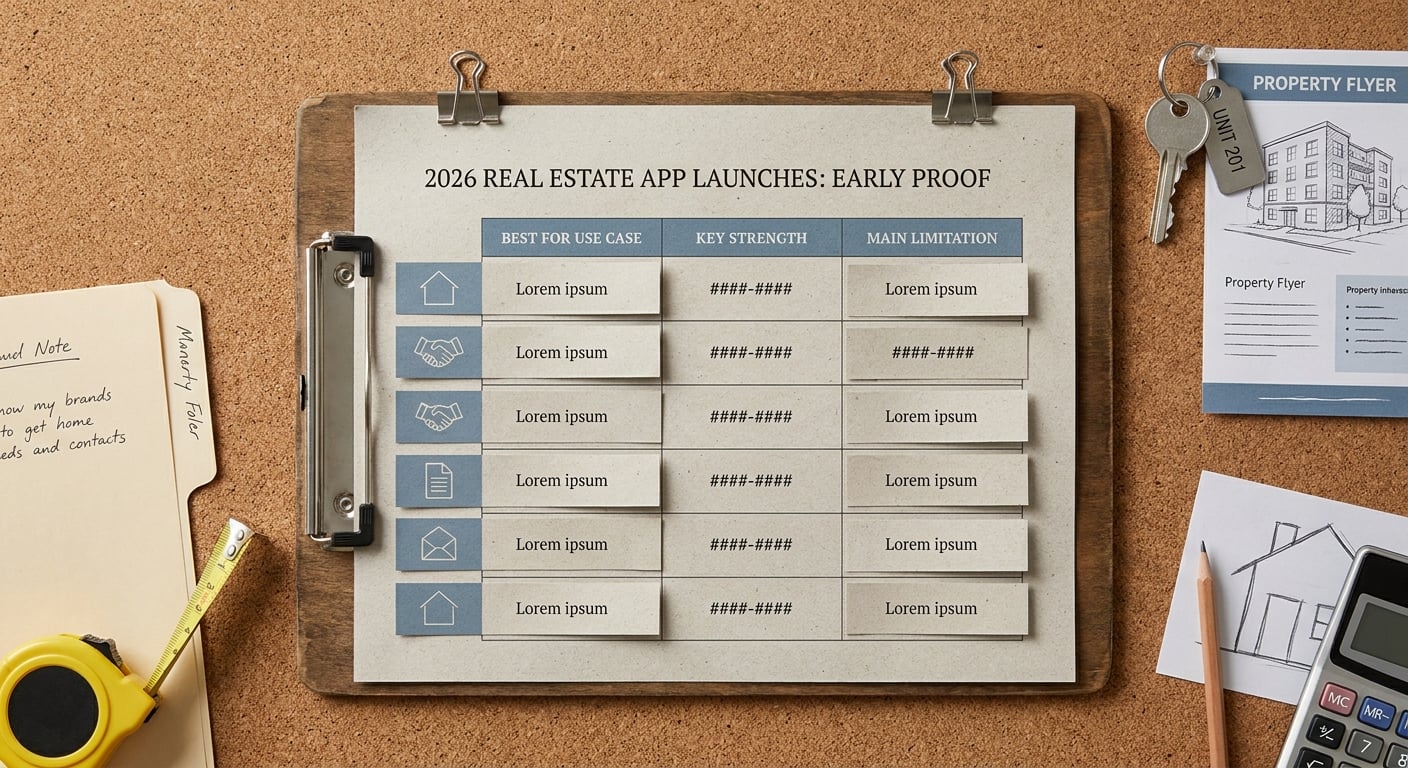
A compact comparison table showing the top-ranked 2026 real estate app launches, with columns for best-for use case, key strength, and main limitation so readers can scan the shortlist quickly.
Benchmark snapshot (10-minute validation table)
| Persona | Metric or proxy to check | What to test in 10 minutes | Expected signal (realistic) |
|---|---|---|---|
| Buyer/relocator | Alert latency + relevance | Create 1 saved search and wait for the next matching listing; compare to another app in parallel | Alerts arrive within minutes to an hour and match your filters most of the time (not perfect) |
| Renter | Contact-to-response time | Send 2 inquiries from the same criteria set | At least 1 reply within a day; longer can be normal in tight markets, slower seasons, or when listings are stale |
| Agent | Speed-to-first-touch + task capture | Import or create 5 leads; run a basic follow-up workflow | You can contact quickly and log next steps without extra admin, after initial setup |
| Investor | Input sensitivity + comp/assumption realism | Underwrite 1 known property with conservative assumptions | Outputs change predictably when you adjust rent, rehab, and exit cap; still needs manual verification |
Explanation: these are directional checks you can run without weeks of use, paid data work, or a full CRM migration.
Interpretation: most 2026 "AI" differentiation shows up as faster next steps (alerts, triage, follow-up), not guaranteed better listing coverage.
Reader impact: if the benchmarks hit, you can often reduce wasted follow-ups and deal screening time, and book tours faster in competitive segments. Results will vary by metro, inventory velocity, and feed coverage in your ZIP codes, so treat this as a first-pass filter, not a final verdict.
When you move from outline to execution, 7 Breakout Android Apps Making Waves in June 2026 helps close common gaps teams hit here.
Method (what counted and how to judge it)
What counted as a 2026 launch
An app qualified if it first became publicly available in 2026, or it underwent a clearly stated major relaunch that functionally created a new product. Press announced launches such as Breezy (Feb 2026), Heasy (Apr 2026), and Frontflip (Apr 2026) meet that bar because they were introduced as standalone offerings rather than routine feature releases (Breezy launch, Heasy launch, Frontflip launch). Recency mattered, but it was not enough by itself.
How the ranking was judged (and what it cannot prove)
| Criterion | What was favored | Practical constraint |
|---|---|---|
| Property discovery | Clear search, filters, map, listing detail | MLS and partner coverage varies by ZIP code |
| Alerts and saves | Timely notifications and relevant matches | OS settings, background refresh, and feed cadence can throttle alerts |
| Workflow value | Tours, messaging, deal analysis, ops features beyond browsing | Workflow tools add setup time and adoption risk |
| Fit by persona | Different weights for buyers, renters, agents, investors | One app rarely wins the whole journey for every persona |
A complementary angle worth comparing lives in New Health and Wellness Apps Released in May 2026.
Top picks at a glance
Quick comparison of the standouts
| 2026 app (editorial pick) | Best for | Standout strength | Limitation to note (operationally) |
|---|---|---|---|
| Breezy | Agents managing leads and follow-up | AI ops layer for outreach and workflow (source) | Plan 30-60 minutes of setup (pipelines, templates, permissions) plus ongoing data hygiene |
| Heasy | Buyers browsing efficiently | Swipe-first discovery for fast shortlisting (source) | Fast shortlisting, but you may still need a second source for tax history, disclosures, or neighborhood context |
| Frontflip | Investors underwriting deals | Fast scenario triage and upside framing (source) | Bad inputs produce confident-looking outputs; verify rents, rehab, and local comps |
Failure modes and dependencies (what breaks, and what to do)
| Dependency or failure mode | What you will see | What to do next |
|---|---|---|
| Coverage gaps (MLS or partner feed) | Missing listings vs another app or your agent feed | Cross-check 2 sources for 5-7 days in your target ZIP codes before committing |
| Notification throttling (OS, battery, background refresh) | Delayed or missing alerts | Adjust notification permissions, disable aggressive battery optimization, and test on WiFi and cellular |
| Low inventory or slow market velocity | Too few alerts to judge relevance in one sitting | Extend the test window to 3-7 days and widen criteria slightly to generate signal |
| Data hygiene issues (agents/teams) | Duplicates, wrong stages, messy notes | Assign a weekly cleanup owner and define lead source rules before blaming the tool |
| Overtrusting automated underwriting | "Precise" outputs that do not match local reality | Use conservative defaults and validate with local comps, rent surveys, and contractor quotes |
Shortlist test (10 minutes)
Install 2-3 apps, run the same saved search, then time alert latency and count how many matches are actually relevant.
Run the shortlist test
For tradeoffs, checklists, and edge cases, Apps That Make Eco-Friendly Living Easy rounds out this section.
What Are the Best Real Estate Apps Launched in 2026?
Category: Speed
Statistic: Seconds
Label: Search & analysis speed
Context: Rank higher if results load fast and insights arrive quickly
Category: Alerts
Statistic: ✓
Label: Useful saved-search alerts
Context: Prioritize apps with actionable, timely notifications over spam
Category: UX
Statistic: ✓
Label: Easy tour request flow
Context: Fewer steps from listing to scheduling improves conversion
Ranked pick #1: strongest overall fit for active home search
- App: Heasy (launch release)
- Best for: Buyers (and some renters) browsing daily who need a fast shortlisting loop.
- Why it ranks: Swipe-first flows reduce friction when you are comparing similar homes across neighborhoods and price bands.
- Constraint to plan for: Budget 2-3 sessions over a week to tune filters and see if alerts are consistent in your ZIP codes and on your device.
Ranked pick #2: best for investors (with underwriting caveats)
- App: Frontflip (release)
- Best for: Deal screening and scenario exploration when you need quick "is this worth deeper work?" signals.
- Tradeoff: It can compress time-to-triage, but it does not remove underwriting work. Plan 30-90 minutes per serious deal to validate rent comps, renovation line items, financing assumptions, and exit constraints using local data.
Ranked pick #3: best for agent workflow (if you invest in setup)
- App: Breezy (launch release)
- Best for: Agents and small teams where the bottleneck is response time, follow-up consistency, and task tracking.
- Realistic effort: Budget 30-60 minutes for initial configuration, then 1-2 weeks of light iteration (templates, stages, handoffs) before judging ROI.
- Risk to manage: Adoption is the make-or-break variable. If lead capture is inconsistent or only one person logs notes, the "ops layer" value will feel uneven.
10 Best No-Code Mobile App Builders This Year reframes the same problem with a slightly different lens - useful before you finalize.
How Do You Choose the Right Real Estate App in 2026?
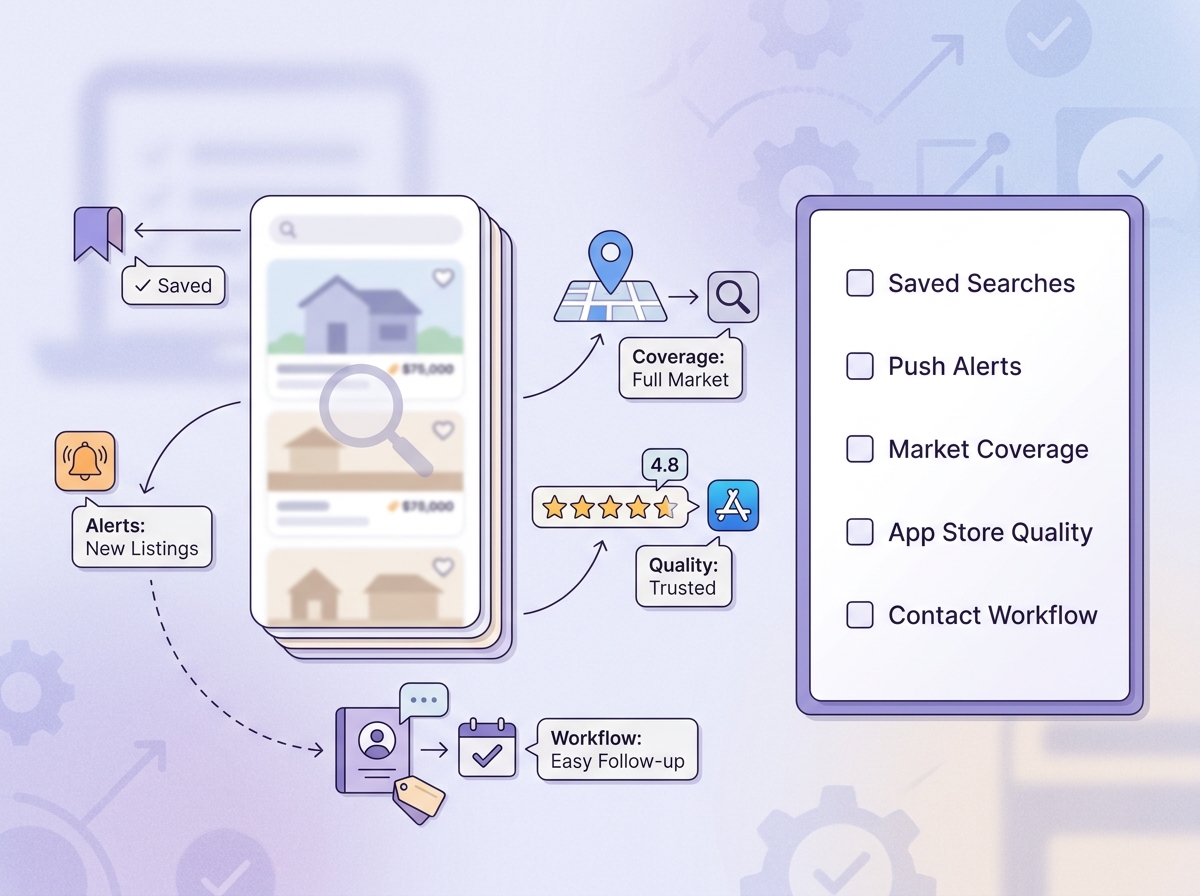
A practical checklist block for evaluating newly launched real estate apps in 2026, focused on saved searches, push alerts, market coverage, app store quality, and contact workflow before a reader installs the final pick.
Run a measurable workflow (10 minutes, then validate over time)
Use one simple artifact so you are not deciding based on vibes. A basic Google Sheet is enough, and a fair test usually takes 10 minutes to set up plus 3-7 days to generate enough alerts and replies (especially in low-inventory areas).
| Score field | How to measure | Pass signal (practical) |
|---|---|---|
| Alert latency (minutes) | Time from listing appearing in-app to notification | Fast enough for your market; often under 60 minutes, but not always possible |
| Alert relevance (%) | Relevant alerts / total alerts from same filter set | 70%+ is a reasonable starting bar after tuning filters |
| Time-to-contact (seconds) | Tap path from listing to message/call | Under 60 seconds without re-entering details |
| Response rate (24-48h) | Replies received within 1-2 days | At least 1 of 2 inquiries gets a response (market dependent) |
| Investor assumption control | Ability to edit key inputs and see outputs change | Inputs are transparent, adjustable, and easy to export or document |
Worked example: investor screens a duplex in Frontflip (fast triage, then verification)
You plug in a known duplex at $520k with $3,400 current rent, then stress-test by dropping rent 7% and increasing rehab from $15k to $35k. If cash-on-cash flips from "works" to "thin," that is the point: the app is showing sensitivity, not certainty. Next, you validate with a quick comp workflow: rent survey using Zillow Rentals or Rentometer, 3-5 sales comps from MLS/Redfin within 0.5-1 mile, and a contractor text quote range for the rehab line item. Log the decision and assumptions in your CRM or sheet so you can revisit if the seller counters.
Match the app to your job-to-be-done
Search-first (buyers and relocators)
Choose this when speed, saved searches, and map filters drive your decision. In practice, the key outcome is booking tours or getting answers before listings go stale, which depends on market pace and your availability to respond quickly.
Agent-oriented (agents and teams)
Choose this if lead capture, client sharing, and follow-up consistency are the priority. Tools like Breezy position themselves around throughput, but the payoff depends on setup quality, team adoption, and clean lead sources (source).
Underwriting-first (investors)
Favor this when you need to screen more deals with fewer spreadsheet cycles. The constraint is accuracy-by-input: if rent, rehab, or comp assumptions are off, the output can still look credible while being wrong.
Pitfalls to avoid (common, fixable)
- Treating "AI" claims as performance guarantees; validate with the metrics table and a 3-7 day window.
- Migrating a team too early; expect at least 1-2 weeks of iteration before judging workflow ROI.
- Ignoring notification settings; OS-level limits can create false negatives that look like data issues.
Compare the top picks
Use the scoring sheet to evaluate Heasy vs Frontflip vs Breezy on latency, relevance, and workflow fit for your persona.
Compare the top picks


