
New delivery apps in 2026 are still won or lost on the same thing: predictable peak-hour reliability under real-world constraints. Early launches did show improvement in some dense neighborhoods, but results were fragile, required hands-on ops work, and did not automatically generalize city to city. This piece breaks down what actually changed, what it typically costs in time and tradeoffs, and what to copy if you are planning a launch with 2026 realities.
7 Breakout Android Apps Making Waves in June 2026 goes deeper on the ideas above and adds concrete next steps.
What did the first 6-10 weeks show?
Category: Speed
Statistic: 10 - 25%
Label: Faster order-to-dispatch time
Context: Launch ops tighten as routing + batching stabilize
Category: Retention
Statistic: +5 - 12%
Label: Higher 60-day repeat ordering
Context: Early retention lift from smoother first deliveries
Category: Reliability
Statistic: 1 - 3 pts
Label: Lower cancellation rate
Context: Fewer missed handoffs and stockout-driven cancels
| Signal (directional) | What changed in early launches | How it was achieved | Reader impact |
|---|---|---|---|
| Fewer late deliveries at dinner peak | Late starts dropped most noticeably 6 pm to 9 pm in dense zones | Tighter zones, simpler dispatch rules, fewer risky stacks | More predictable ETAs, fewer 1-star reviews driven by "ETA shock" |
| Faster order-to-dispatch | Less manual triage, more consistent dispatch | Better prep-time inputs, batching limits, clear escalation paths | Fewer peak hours spent firefighting, fewer avoidable cancellations |
| Modest repeat-order lift (not universal) | Repeat nudged up only where courier density held week over week | Reliability first, promotions second | Stickiness correlated with reliability more than credits alone |
- Explanation: Directional tracking from a small set of early-2026 launches plus operator check-ins (including Maya's 12-location group). What we tracked was mainly dinner-peak late-start rate, cancellation rate, and dispatch-to-pickup delays by zone; this is not third-party audited and the sample is limited by city mix and data access.
- Interpretation: The earliest edge was operational, not marketing. Teams that reduced dinner-peak variance avoided week 1 issues compounding into churn and ticket backlog by week 4.
- Impact: When evaluating a launch, ask if reliability can be sustained with realistic staffing and incentive spend, not whether installs spike on day one.
When you move from outline to execution, AI Remix Apps Taking Over the App Store in 2026 helps close common gaps teams hit here.
What problem do new delivery apps have to solve?
By 2026, users open a new delivery app with one question: will this be as predictable as the incumbent? The first session is brutally evaluative. If ETAs jump after checkout or fees feel inconsistent, many users will not give you a second chance.
Selection and reliability are linked. A launch can look polished but still feel unfinished if inventory is thin where people actually search, and early reviews compound quickly.
The operational bottlenecks that decide week 1 to week 6
- Restaurant onboarding sets the ceiling for selection; courier density sets the floor for ETAs.
- Dispatch and batching logic determines whether peaks degrade gracefully or collapse into late orders.
- Support response time drives refunds, chargebacks risk, and app store reviews.
- Small launch geographies amplify spikes block by block.
- Budget tradeoffs hit immediately: discounting vs courier incentives vs support coverage.
Most teams underestimate the human workload in the first month. Plan for 2-4 weeks of daily ops tuning, plus several dinner peaks per week with an on-call lead who can adjust zones, incentives, and dispatch constraints within the shift, not days later.
Branding and credits cannot fix broken handoffs. In practice, promotions can temporarily inflate volume and expose weak workflows faster by increasing tickets when things go wrong.
A complementary angle worth comparing lives in New Health and Wellness Apps Released in May 2026.
How breakout apps were built for 2026 launch conditions
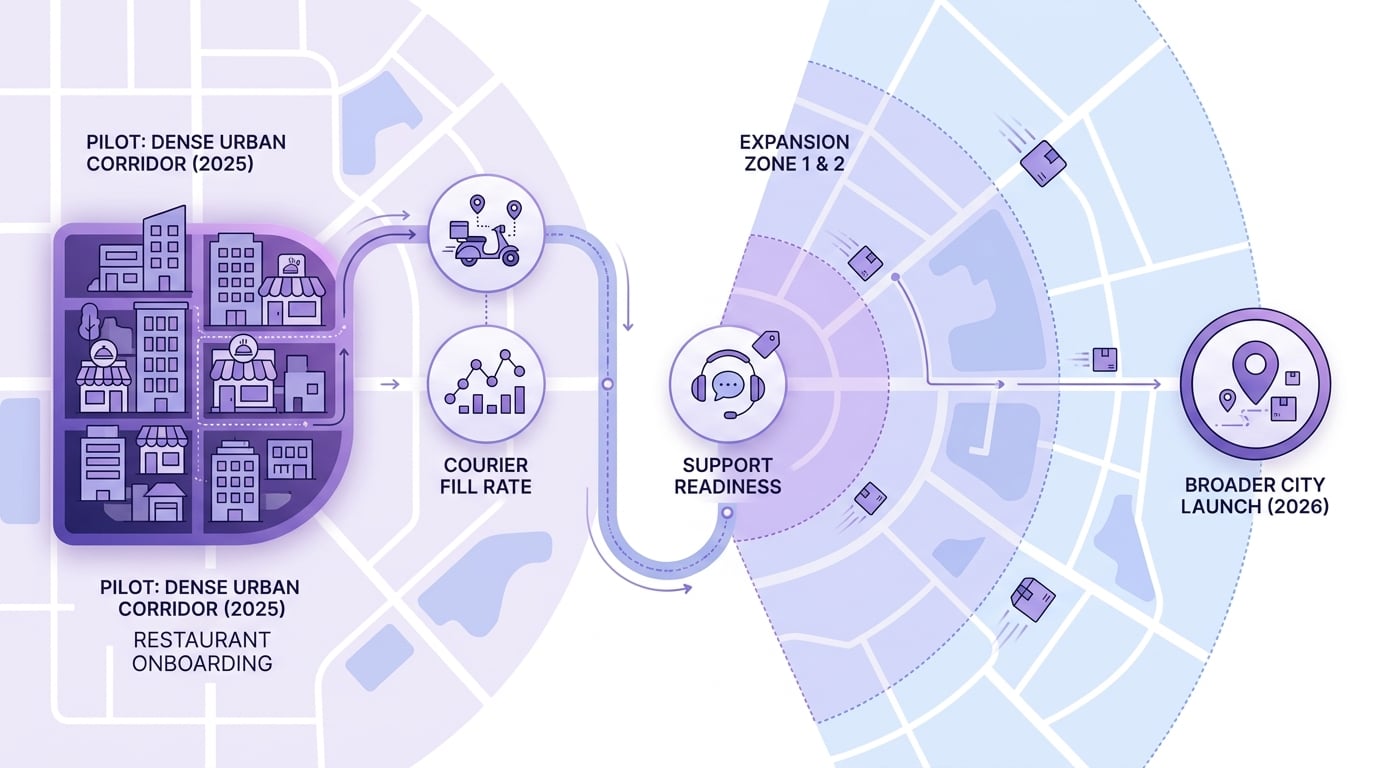
A timeline showing the staged rollout for a breakout 2026 food delivery app, from one dense neighborhood pilot to expanded delivery zones, with checkpoints for restaurant onboarding, courier fill rate, and support readiness.
Choose a first market that can sustain dinner peak
Pick a tight dinner corridor first
Start where evening demand is predictable and trips are short. Many early launches avoided going citywide; they focused on one or two adjacent neighborhoods and expanded only after peak performance stopped wobbling for multiple weeks.
Run a 2-4 week pilot with two metrics
Judge the pilot on operations, not installs. A practical pair is acceptance time and courier fill rate; if dinner peak cannot stay staffed, pause expansion and fix supply before widening zones.
Example targets (illustrative, not universal): courier acceptance time under 2 minutes during 6 pm to 9 pm, and fill rate above 90% in the core zone.
| Week | Coverage | What you are validating | Typical effort |
|---|---|---|---|
| 1 | 1 zone | baseline demand and failure modes | daily ops reviews, manual fixes |
| 2-3 | same | stabilize fill rate and ETA variance | 2-3 dispatch iterations, incentive tweaks |
| 4 | +1 zone | expand only if targets hold | add support coverage for edge cases |
Tune the launch workflow step by step
Onboard restaurants like it is ops, not sales
Normalize menus and modifier groups early so checkout does not create tickets. This is usually tedious work: expect several hours per restaurant to clean menu data, pricing logic, and tax or fee display, plus follow-ups after the first weekend when edge cases appear.
Adjust dispatch for dinner realities
Tighten peak rules, allow stacks only when prep time inputs are stable, and avoid over-optimizing for theoretical shortest paths. You typically trade some delivery density for fewer catastrophic delays, which is often the right early tradeoff.
Staff support with thresholds people can run
Use a ticketing system (Zendesk or equivalent) with macros for missed items, late arrivals, and refund approvals, plus a simple dashboard (Looker, Metabase, or equivalent) tracking cancellations and refund aging.
Practical thresholds often look like: first response within 5-10 minutes during peak, refunds aged over 24 hours flagged, and a backlog cap (like 50-100 open tickets per active zone) that triggers temporary throttles. These targets depend on fraud controls and finance or restaurant signoff requirements, which can slow SLAs unless pre-agreed.
Mini example (dinner peak incident, end-to-end):
| Trigger (6 pm to 9 pm) | Immediate action | Expected effect (directional) |
|---|---|---|
| Fill rate dips below 85% for 15 minutes in Zone A | add +$2 to +$4 per-trip incentive for 60 minutes and shrink zone boundary by 10-15% | fewer unassigned orders, tighter ETAs, fewer cancellations |
| Dispatch-to-pickup p95 exceeds 18 minutes | reduce stacking to max 1, block long-distance offers | less ETA shock, fewer late-starts, slightly higher cost per order |
Assess your market readiness Compare launch readiness across markets with a simple checklist for density, supply, and ops SLAs. Assess your market
For tradeoffs, checklists, and edge cases, 7 AI Video Editing Apps That Make You Look Pro Instantly rounds out this section.
What did early breakout results actually look like?
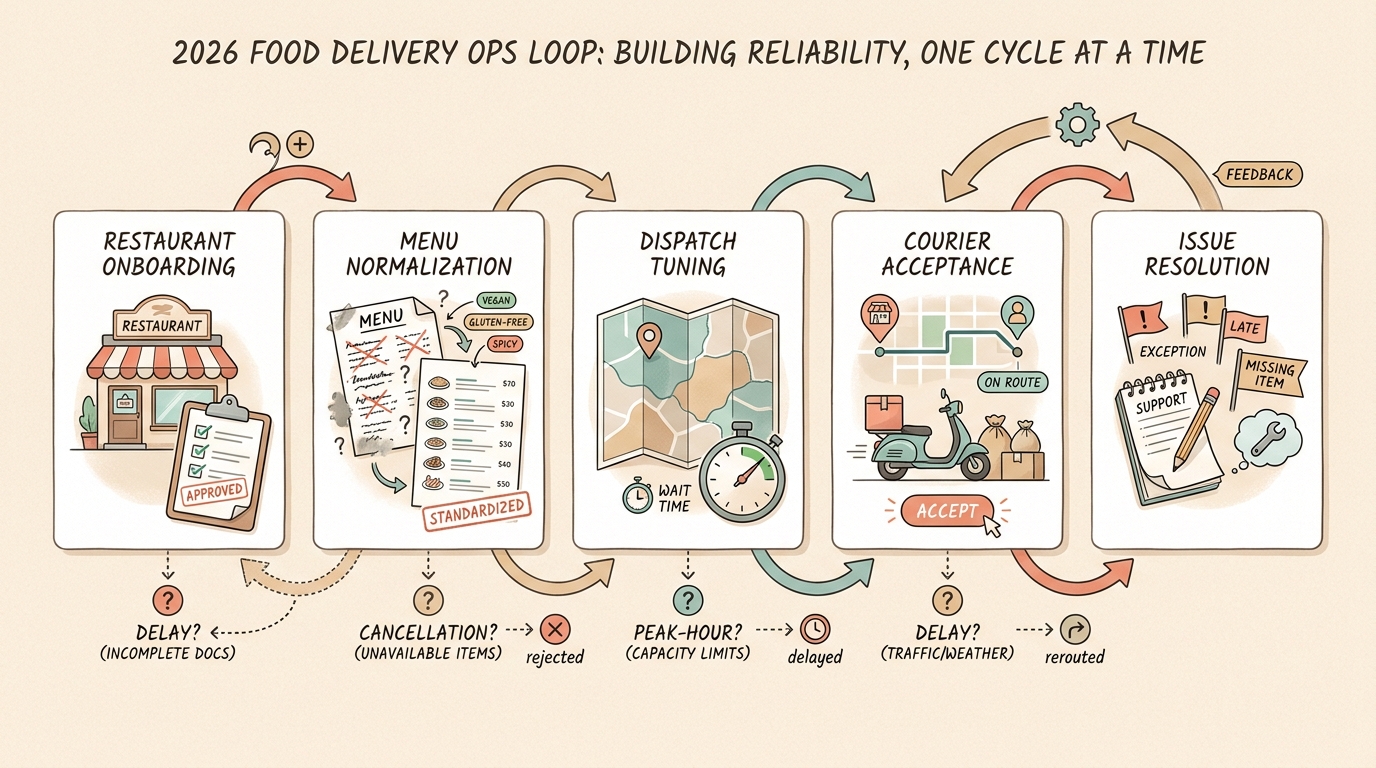
A simple process diagram showing the operational loop behind breakout food delivery app performance in 2026: restaurant onboarding, menu normalization, dispatch tuning, courier acceptance, and issue resolution feeding back into the next launch cycle.
Where the early wins showed up (and why they did not always stick)
- Fewer cancellations after dispatch used real prep times instead of optimistic defaults
- Higher courier acceptance after tighter zones reduced long, low-confidence offers
- Faster restaurant activation when menu normalization was treated as week-1 work
- Smoother dinner peak flow, while growth stayed capped by small radii and thin lunch coverage
These are patterns, not guarantees. Some operators saw initial gains regress when incentives were reduced, when weather or events stressed the system, or when expansion changed trip geometry.
Failure modes to plan for (by lever)
- Promos: demand spikes outpace courier supply, driving late orders, higher refund rates, and worse reviews; promo ROI can look positive short-term while creating support debt.
- Courier incentives: spending can ratchet up if you try to buy your way out of poor zone design; churn can return quickly when bonuses taper.
- Autonomy pilots (robots or drones): pilot reliability can be strong in a constrained area, but scaling depends on permits, curb access, incident response, and partner staffing.
One thing worth noting: even "good" launches typically require 6-10 weeks of iteration before the economics stop moving around. If your plan assumes a smooth curve, you will likely under-budget ops labor and overestimate retention once subsidies tighten.
10 Best No-Code Mobile App Builders This Year reframes the same problem with a slightly different lens - useful before you finalize.
What to do next if you are evaluating a launch
Start with constraints, then work outward:
- Density and supply: do you have enough restaurants and courier availability in a tight corridor to avoid overpromising?
- Unit economics under subsidy: can you model a 6-10 week subsidy period without assuming instant profitability?
- Operational SLAs: what are your refund SLA, support first-response target, and dispatch escalation path?
- Ops cadence: who is on-call for dinner peaks, how often are zone rules updated, and what is your ticket backlog threshold for throttling?
- Dependencies: what breaks if a key restaurant pauses, courier churn spikes, or finance signoff slows refunds?
If your model depends on constrained infrastructure like robots or drones, treat autonomy as a controlled pilot lever, not a default scaling plan. Serve Robotics has highlighted this kind of real-world dependency in its autonomous delivery efforts, including work with White Castle via Uber Eats (Serve Robotics press materials), but those operational constraints vary sharply by city.
Get a launch plan review Pressure-test dispatch, support SLAs, and subsidy modeling against peak-hour reality before you scale spend. Evaluate your launch plan


