
Publishing on Google Play is cheap up front but not free to validate - $25 is the entry cost, not the launch budget. This short guide lists the non-obvious costs, realistic timelines, and the minimum tests you should budget for to know whether Play economics can work for your app.
How Much Does It Cost to Publish an App? App Store and Google Play Fees goes deeper on the ideas above and adds concrete next steps.
What is the cost snapshot to validate on Google Play?
| Item | Typical cost | Mandatory or variable | Why it matters |
|---|---|---|---|
| Developer registration | $25 one-time | Mandatory | Gates access to Play Console; trivial versus launch spend. |
| Google Play service fee | 15% - 30% of revenue | Mandatory | Cuts gross revenue and changes pricing, CAC, and LTV math. |
| Payment processing / merchant fees | ~2.5% - 4% per transaction | Variable | Low-margin IAPs can become unprofitable after fees. |
| Store listing assets | $300 - $2,000+ | Variable | Better creatives raise conversion; expect multiple iterations. |
| Initial UA test budget | $1,000 - $10,000 | Variable | Needed to measure retention and CAC; often the largest blind spot. |
Explanation - short: $25 is real but negligible compared with the cost of validating retention and CAC.
Interpretation - realistic first-month launch run-rate for a simple consumer app is usually low thousands; full validation commonly takes weeks to months.
Business impact - if your plan only budgets $25 you will likely run out of runway before validating unit economics or receiving a reliable payout.
When you move from outline to execution, Can You Publish an AI-Built App to Google Play? helps close common gaps teams hit here.
What are the main cost buckets when publishing on Play?
Category: Mandatory
Statistic: 15 - 30%
Label: Google Play revenue share
Context: Ongoing store cut that affects margins per sale
Category: Mandatory
Statistic: $25
Label: Google Play developer registration
Context: One-time mandatory fee to publish apps
Category: Variable
Statistic: $0 - $10k+
Label: Typical launch ops spend range
Context: Assets, initial UA, and compliance can scale quickly
Plan for three core buckets: merchant and tax setup, launch assets and localization, and at least one UA test budget that proves retention and CAC.
Merchant and tax setup
Expect 1-2 days to create a payments merchant profile, plus up to a few weeks to clear tax forms in some countries. Missing or incorrect forms cause payout delays and cashflow risk.
Launch assets and localization
Good store creatives, a short promo video, and 1-3 localized metadata sets typically take 1-4 weeks to produce and iterate. More languages increase reach but also multiply creative, QA, and support costs.
UA test budget and analytics
Measuring Day-1/7/30 retention and CPI/CAC often takes 4-12 weeks depending on traffic and iteration speed. Plan a minimum pilot of $1k-$3k; expect $5k-$10k if you need cross-market validation.
One thing worth noting: these timelines assume a small team with templates and basic analytics already in place. If you outsource or start from scratch, plan to double time and budget for setup and rework.
A complementary angle worth comparing lives in Everything You Need to Know About Apple and Google Developer Accounts.
What exact steps and fees should I expect on Play?

A process diagram showing the flow from 'Developer account' → 'Merchant/Tax setup' → 'App signing & build' → 'Store listing & localization' → 'Launch UA & measurement' → 'Payouts & reporting', with cost icons on the steps where money is commonly spent.
Setup and publishing follow a short checklist but policies, reviews, or missing docs can add days to weeks of delay.
Developer account and payment
Pay the $25 registration, complete enrollment, and allow 24-48 hours for identity checks in some cases.
Merchant account and tax forms
Link a Google Payments Merchant Account, submit tax documentation (W-8/W-9 or local equivalents), and expect monthly payouts that may include currency conversion and withholdings.
App signing and builds
Enable Play App Signing before first upload; reconfiguring signing keys or fixing CI/build issues can take 1-3 days or longer.
Store listing, creatives, and localization
Prepare screenshots, a feature graphic, and an optional promo video. Treat each new language as another mini-launch requiring copy and creative QA.
Testing tracks and analytics
Use internal and closed tracks first. Instrument Day-1/7/30 retention, cohort LTV, and attribution before any paid UA; poor instrumentation will waste ad budget.
Common failure modes include missing tax forms that block payouts, policy rejections that require product changes, and analytics gaps that create false confidence. These are fixable but often cost time.
What should you test first and how long will it take?
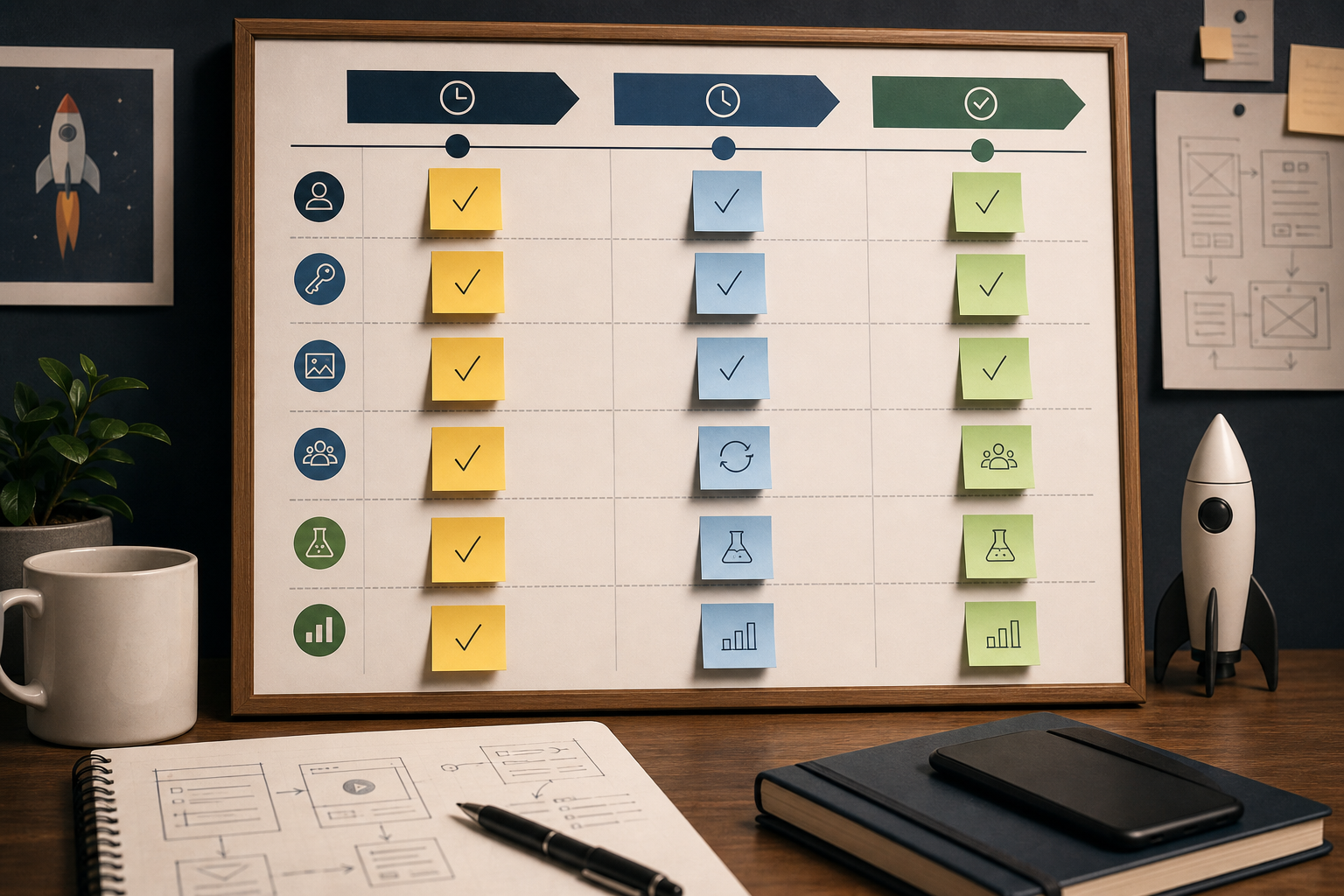
A compact checklist block for pre-launch tasks mapped to a 90‑day timeline: account & merchant setup, app signing, store assets, closed testing, UA test, metrics to track (Day‑1/7/30 retention, CAC, LTV), and sample CTA to download a breakeven template.
Prioritize onboarding and a small UA test that proves Day-7 retention and CAC payback before you scale spend.
Closed/internal test - 1-2 weeks
Validate install flow, analytics, and basic retention with a trusted group to catch obvious bugs and instrumentation gaps.
Small paid UA pilot - 4-8 weeks
Run a focused campaign to measure CPI, Day-1/7 retention, and initial cohorts. Expect 2-4 weeks for stable Day-7 signals and more weeks to assess Day-30 LTV.
Iterate onboarding - 1-6 weeks per cycle
If Day-7 is below target, run onboarding experiments and re-measure. Each meaningful experiment (design, build, recruit traffic, analyze) commonly takes several weeks.
Practical takeaway: reliable LTV estimates typically need one to two quarters of testing and iteration. If you choose faster decisions, accept higher uncertainty and shorter-term signals.
Froxi AI vs Manual Publishing: Risk, Complexity, and Speed Compared reframes the same problem with a slightly different lens - useful before you finalize.
What should you do in the first 90 days?
Use this 90-day plan to reduce surprises and protect runway.
- Register Developer account and set up merchant profile - confirm tax forms processed.
- Enable Play App Signing and upload your signed AAB with a timestamped build.
- Add store listing, screenshots, and one localized language at launch; schedule incremental localizations.
- Configure closed/internal testing, then a staged open beta to catch scale issues.
- Run a 30-90 day UA plan: small pilot, instrument Day-1/7/30 cohorts, and iterate onboarding.
- Reconcile payouts and monitor tax withholdings that affect runway.
Constraint reminder: if your team lacks analytics or UA expertise, include 10-20% extra time and budget for setup, training, or consultancy. Also budget contingency for policy rework or region-specific compliance.
Conclusion
Yes: $25 gets you in, but meaningful validation costs time and money. Add realistic timelines, a small UA budget, and reliable instrumentation before you treat Play as a growth channel.
The implication: weigh tradeoffs between speed, reach, and cost. Policy review, tax processing, and build issues cause intermittent delays; plan for them and prioritize early signals that reduce risk.


