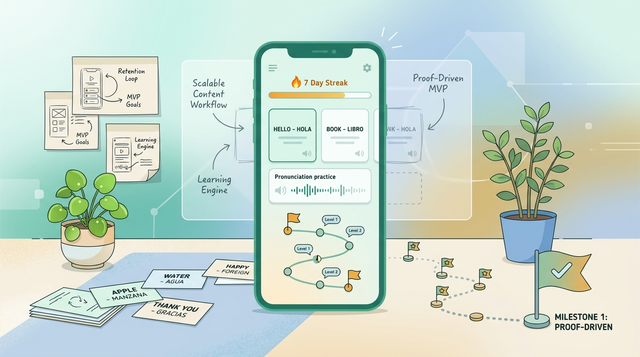
If your educational app is stalling at day-7 retention or users are skimming lessons without finishing, gamification can help, but it is not an automatic fix. Research suggests it can improve engagement and performance on average, yet results vary a lot by audience, subject, and whether mechanics reinforce real learning behaviors instead of just adding rewards. This guide translates that evidence into a practical design and measurement plan you can ship without betting the product on hype.
Early proof (directional, not a guarantee)
Evidence: A meta-analysis on educational gamification reports overall positive effects on learning and behavioral outcomes, with wide variation driven by context and implementation quality (including novelty fade). Source: meta-analysis
Explanation: "Overall positive effects" means the average across many studies trends upward, but individual implementations can be neutral or negative when incentives are off, content is too hard, or the reward arrives too late to reinforce the behavior.
Interpretation: Start with clarity and feedback (progress visibility, next-step guidance, timely results), then add status mechanics only if you can keep incentives aligned with learning outcomes.
Reader impact: If completion and return metrics do not move after a small, well-instrumented change, investigate misaligned rewards, delayed reinforcement, or plain friction in onboarding/content.
How to Publish a Game on App Store - What's Different goes deeper on the ideas above and adds concrete next steps.
What does gamification change in an educational app?
Category: Outcomes
Statistic: +10 - 25%
Label: Lesson completion lift
Context: Directional uplift seen in well-designed gamification studies
Category: Engagement
Statistic: +5 - 15%
Label: 7-day return rate lift
Context: Benchmarked range; results vary by audience and implementation
Category: Retention
Statistic: +8 - 20%
Label: Progression to next module
Context: Indicative range; watch for novelty fade over time
Gamification mostly changes attention and repetition. For example, a streak tied to "complete 1 review set" plus a daily reminder at the learner's usual study time can shift behavior toward consistent practice. The tradeoff is that if the streak is too strict (no recovery), one missed day can create frustration and churn.
Scope matters. This is written for consumer-style mobile learning flows (short lessons, repeat sessions, progression paths), not classroom-only tools or full entertainment games. Plan for iteration: even a solid v1 usually takes 2-3 cycles to tune, and each cycle often needs at least 1-2 weeks of cohort data to judge retention effects.
What counts as gamification here:
- Core mechanics: points, badges, levels, streaks, quests, progress bars
- Not enough on their own: decorative animations or confetti without a behavior change
- Safer default: rewards tied to mastery, completion, and review, not raw activity
- Key risk: users optimize for rewards, not understanding, if incentives are misaligned
When you move from outline to execution, Screenshot Storytelling: Turn 8 Screens into a Conversion Funnel helps close common gaps teams hit here.
Which metrics should shape your gamification design?
Category: Engagement
Statistic: 7-day
Label: Retention cohort checkpoint
Context: Compare baseline vs post-launch after adding streaks/progress bars
Category: Capacity
Statistic: 5.4x
Label: Review throughput
Context: Per reviewer per week
Category: Outcomes
Statistic: +0.3 to +0.8 SD
Label: Typical learning-outcome lift
Context: Meta-analysis reports moderate-to-large effects, but varies by context
Start with a small set of metrics you can trust. If your event taxonomy is messy (or missing quiz outcomes), expect 1-3 days to instrument cleanly, plus time to QA across iOS/Android and confirm numbers in dashboards. If traffic is low or seasonal, expect longer windows to separate product impact from noise.
| Metric | What to measure | Why it matters |
|---|---|---|
| Lesson completion rate | % of started lessons finished | Tests whether mechanics reduce mid-lesson drop-off |
| 7-day retention | % returning within 7 days | Captures habit formation beyond one good session |
| Session frequency | Sessions per user per week | Separates habit from one long session |
| Progress-to-next-module conversion | % reaching next module within 24-72 hours | Indicates forward momentum, not just activity |
| Learning quality (guardrail) | quiz accuracy, pass rate, mastery score | Prevents "more taps, less learning" outcomes |
One thing worth noting: you cannot fully diagnose causes from metrics alone. Use analytics to narrow where the drop happens, then validate with a few interviews, a short in-app survey, or session replays if you have them.
A complementary angle worth comparing lives in How to Use Substack to Grow Your App Audience.
How do you instrument gamification so the data is usable?
Here is a compact example you can copy. It assumes Amplitude or Mixpanel, but any analytics stack works if events and properties are consistent.
Suggested event schema (minimal but useful):
| Event name | When fired | Key properties (examples) |
|---|---|---|
lesson_started | learner opens a lesson | lesson_id, module_id, source (home, notification), difficulty |
lesson_completed | learner reaches end | lesson_id, time_spent_sec, completed (true) |
quiz_submitted | learner submits quiz | quiz_id, score_pct, passed (true/false), attempt_count |
reward_granted | badge/streak/points awarded | reward_type (badge, streak, points), reason (completion, mastery), value |
Practical workflow:
Instrument and QA the critical path
Track the learning actions (start, complete, quiz/review outcome) and the reward event that follows. Budget 30-60 minutes per platform for basic QA in a simple flow, and more if you have multiple lesson types, offline mode, or delayed sync.
Build one primary dashboard plus one guardrail
Put your primary metric (for example, lesson completion or 7-day retention) next to a learning-quality guardrail (accuracy, pass rate, mastery). This is where you catch "more activity, worse learning" before it spreads.
Compare cohorts and annotate changes
Compare pre vs post by weekly cohorts, and annotate releases, exam seasons, pricing changes, and acquisition mix shifts. If you cannot run a clean experiment, treat early results as directional and focus on stabilizing traffic and measurement.
Dependencies to call out: attribution and notification deliverability affect streak loops, and acquisition mix changes can swamp small retention deltas. Also watch for platform differences: iOS and Android notification settings can make "the same" mechanic behave differently.
For tradeoffs, checklists, and edge cases, How to Monetize Your First Mobile App (Step-by-Step) rounds out this section.
How do you add gamification without harming learning quality?
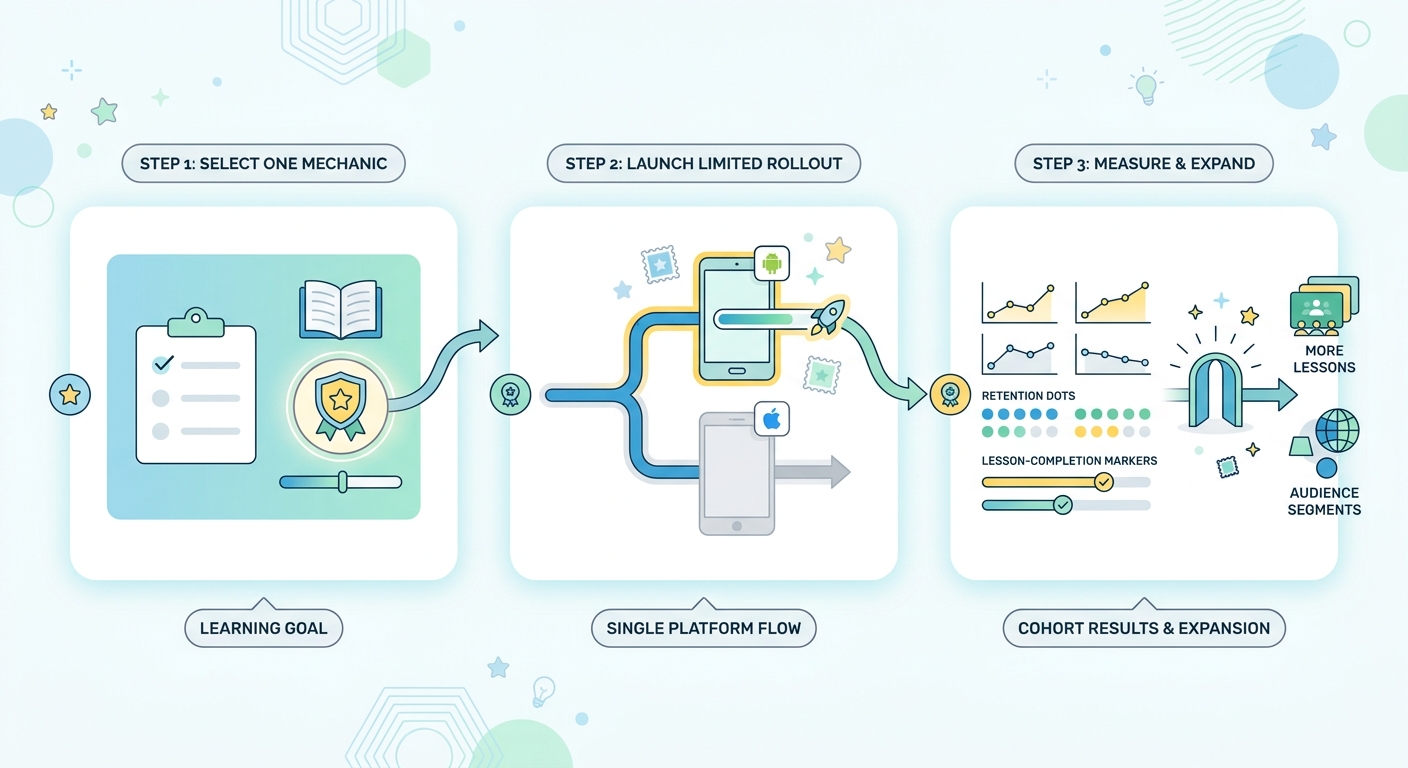
A three-step process diagram showing how an educational app team selects one mechanic, launches it in a single platform flow such as Android or iOS, and then measures cohort results before expanding to other lessons or user segments.
Match mechanics to the learning goal and the learner's emotional experience. If the mechanic adds pressure, clutter, or fake progress, it can backfire even if it demos well.
Use streaks for daily practice
Streaks help when the constraint is habit formation (for example, 5-10 minutes of daily revision). Add a recovery path (grace day, streak freeze, or "2 of the last 3 days") so one miss does not turn into shame or churn.
Use badges for meaningful milestones
Badges work best as closure points: finishing a unit, passing a quiz, completing a spaced review set. Avoid badges for low-effort taps that inflate progress without learning.
Use levels and progress bars for long journeys
Levels fit multi-step courses with prerequisites, and progress bars reduce uncertainty about what is left. Treat leaderboards as optional and cohort-specific since competitive ranking can motivate some users and suppress participation for others.
Design the reward loop around mastery:
- Tie rewards to mastery signals (accuracy thresholds, review completion, weak-topic revisits).
- Give immediate, specific feedback so learners know what improved and why they earned the reward.
- Keep rewards meaningful: frequent enough to motivate, not so constant they become noise.
Tradeoff: mastery-gating can reduce short-term completion, especially if content is too hard or feedback is unclear. If you tighten requirements, plan support (hints, easier review sets, clearer prerequisites) or you risk raising frustration.
Audit your engagement loop
List your top three abandonment points (onboarding, lesson start, post-lesson return), then assign one mechanic to each as a low-risk audit before any redesign.
audit your loop
Ways to Grow Your App Without Paid Ads reframes the same problem with a slightly different lens - useful before you finalize.
How do you roll out and evaluate gamification?
Reduce variables so you can learn without betting the whole product. In many teams, the limiting factor is not ideas, it is clean measurement and time to observe cohorts.
| Step | Owner | Output |
|---|---|---|
| Pick one journey and one platform | PM + Eng | a single flow to change (ex: post-lesson return on iOS) |
| Ship one mechanic only | Eng + Design | small, attributable change with feature flag |
| Run long enough to see cohorts | Data/PM | 2-4 weekly cohorts (longer if traffic is low) |
| Review primary + guardrail metrics | PM + Learning/Content | decision: iterate, expand, or roll back |
| Expand to more surfaces | Team | broader rollout with updated instrumentation |
What to watch after launch:
- Retention improved for the intended cohort (not just a launch-week spike).
- Course progress rose without a decline in accuracy or mastery.
- Reviews or tickets mention confusion, clutter, pressure, or unfair rewards.
Second-order effects are common: more sessions but shorter learning time, higher reminder opt-outs, or better completion with worse quiz outcomes. Build a rollback rule before you ship so you can act quickly if guardrails move the wrong way.
Decide the next experiment
Pick one core metric and one mechanic for the next sprint, write the hypothesis, test window, and rollback rule, then ship the smallest measurable change.
decide the next experiment