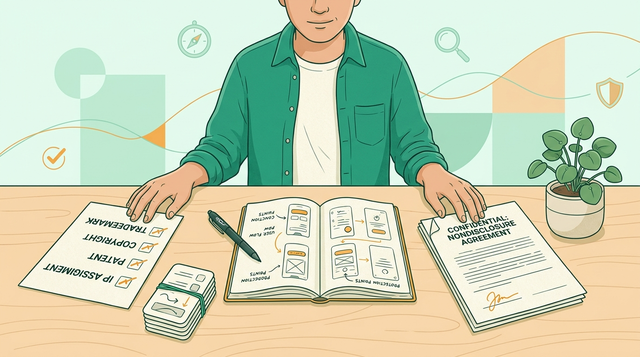
Most founders worry less about building the app than about someone copying it the moment they pitch, post a landing page, or ship to an app store. The hard truth is that a bare app concept is rarely protectable on its own, but the assets that make it real often are - code, brand identifiers, original designs, and sometimes a novel technical method. This walkthrough shows how to break your product into protectable parts and apply a layered IP strategy that reduces copy risk without burning weeks or unnecessary legal spend.
Privacy Made Simple: Map Your App Data Flows in 30 Minutes goes deeper on the ideas above and adds concrete next steps.
What parts of an app idea can intellectual property protect?
Category: Outcomes
Statistic: 38%
Label: First-pass approval rate
Context: When metadata is complete upfront
Category: Speed
Statistic: 4 hrs
Label: Median fix time
Context: After a store rejection notice
Category: Strategy
Statistic: 3 - 5 layers
Label: Asset-by-asset protection stack
Context: Ideas aren’t protected; the specific assets are
| IP tool | Best protects | Timing sensitivity | Practical enforcement signal |
|---|---|---|---|
| Copyright | Source code, UI copy, original visuals | Low, but records matter | Stronger when you can show creation history and ownership (commit logs, files, contracts) (LegalClarity) |
| Trademark | App name, logo, key brand identifiers | High, do this before you scale marketing | Stronger when searches and filings predate broad public brand use (LegalClarity) |
| Patent (often provisional first) | Novel technical method, unique system behavior | Very high, filing before disclosure can matter | Stronger when you file before demos, listings, or press (varies by jurisdiction) (MindInventory) |
| NDA and contracts | What you disclose, who owns contributions | High, must be signed before sharing | Useful as a backstop, but not a substitute for registrations (Cisin) |
What this proof is: a practical map of which IP tools attach to app assets (code, brand, method, disclosures), based on common practitioner guidance.
How to interpret it: there is no single "protect my idea" button. You get leverage from (a) owning the asset and (b) being able to prove dates and scope.
Reader impact (mini workflow): if launch is in 14 days, spend the next 7 days on (1) IP assignment + clean repo history, (2) basic trademark screening before you push the name into ads or partnerships, and (3) a disclosure plan for demos and store pages. This will not prevent all copying, but it improves your options for takedowns, a rebrand decision, or counsel support later.
When you move from outline to execution, Should You Publish Your App Yourself or Hire Someone? helps close common gaps teams hit here.
What intellectual property can protect an app idea?
A bare app concept is usually weakly protected because law tends to reward specific expression, not a general feature list or market angle. What you can protect is often the work product: the code, the written copy, the original visuals, and the brand identifiers users rely on (see LegalClarity).
Here is the thing: you cannot realistically prevent competitors from building something similar. You can reduce your risk by making ownership clear, limiting sloppy disclosure, and registering the pieces that are meant to identify you.
| App asset | Primary tool | What it does well | Key limitation to plan for |
|---|---|---|---|
| Source code, UI copy, illustrations | Copyright | Helps enforce against copying of your actual expression | Does not protect the underlying feature idea |
| App name, logo, tagline | Trademark | Helps prevent confusingly similar branding in marketplaces | Clearance and filing take time; conflicts can force a rename |
| Novel technical method (not just a business workflow) | Patent / provisional | Can protect a specific technical approach if it is truly novel | Expensive and slow; enforcement needs budget and is not guaranteed |
| Pitch decks, specs, partner info | NDAs + contracts | Controls who can use what you share; clarifies ownership | Many investors will not sign; scope and proof can get contested |
| Contractor work, founders leaving | IP assignment agreements | Prevents ownership disputes and cleanup later | Requires cooperation and sometimes renegotiation |
Scope note: this is decision guidance, not legal advice. Outcomes depend on jurisdiction, counsel quality, and what you can actually prove later (especially if a dispute escalates).
A complementary angle worth comparing lives in The Security Risks of Manual App Publishing.
How do you protect an app idea step by step?
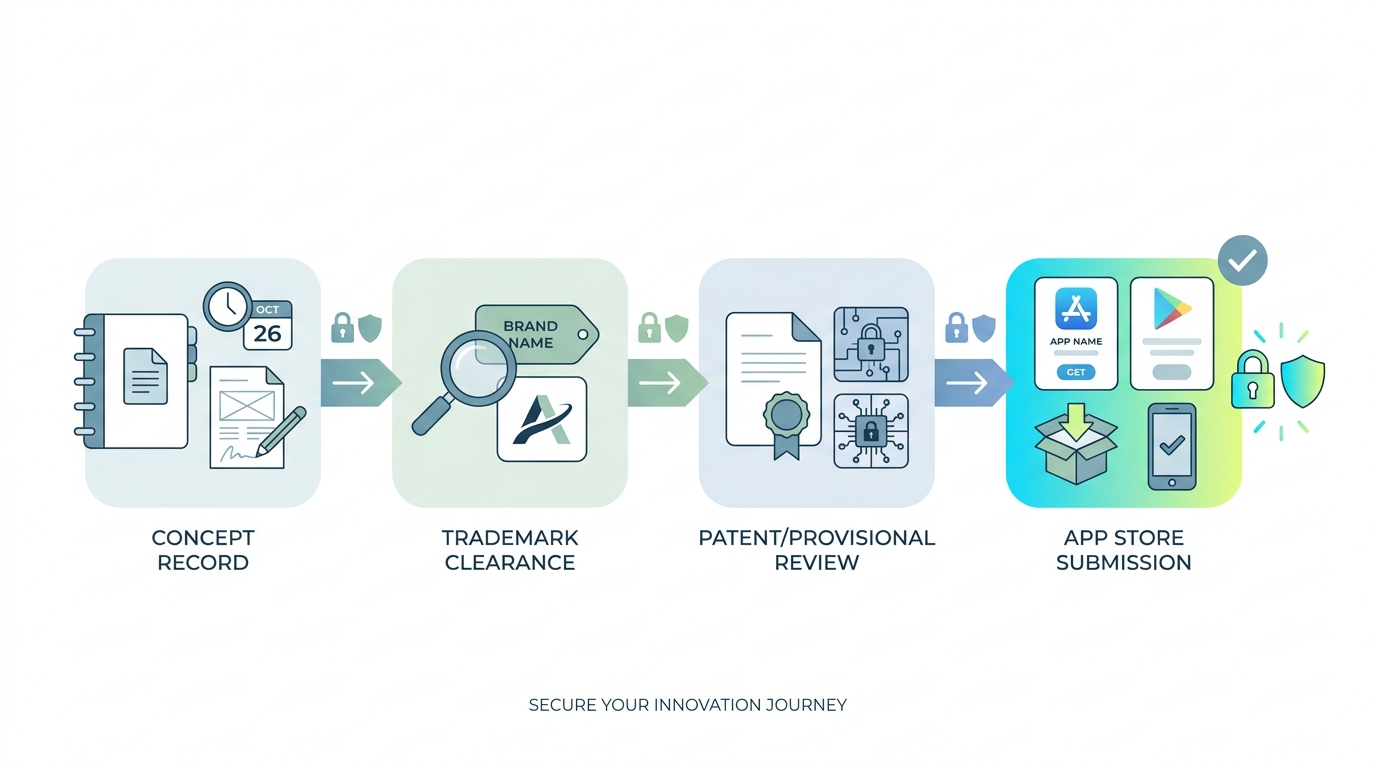
A simple process diagram showing the sequence from documenting the app concept, to clearing the name, to deciding on a patent filing, to preparing App Store and Google Play launch materials after IP checks are complete.
1. Document the concept and authorship trail (fast, high ROI)
Create a dated build brief
Put a one page product brief, core user flow, wireframes, and a feature list in a shared folder with automatic timestamps. Budget 30 to 90 minutes now, then 10 minutes weekly to keep it current.
Preserve version history
Keep iteration artifacts (Figma versions, prototype files, Git commit history) so you can show what existed when. If you are not using Git yet, expect 1 to 2 hours to set up a basic repo and workflow.
Lock down ownership early
Store signed contributor and contractor agreements next to the repo. Doing this after traction can turn into days of cleanup and uncomfortable conversations.
Concrete operational setup (small, real, measurable):
| Item | Tool/artefact | Weekly checkpoint |
|---|---|---|
| Creation trail | Git commit history (GitHub/GitLab) | 10 minute "IP log" note: what shipped and who authored it |
| Ownership proof | Signed IP assignment PDFs in /legal/ | New contributor cannot merge until file exists |
| Brand due diligence | USPTO / TMview search notes in /legal/ | Confirm name is still clear before new campaigns |
| Disclosure timing | "Public disclosure date" milestone in your launch doc | Review before any demo, press, or store submission |
Common failure mode: a contractor refuses to sign assignment later (or asks for more money).
What to do: pause new work, negotiate a paid assignment addendum, and if needed, rewrite or replace the disputed components before you scale distribution.
2. Secure the brand before launch pages go live (but plan for rework)
Run a basic clearance check
Search the name and close variants in target markets, then sanity check app stores for confusingly similar names. A founder can do a first pass in 1 to 3 hours; an attorney search opinion often takes a few days and costs more, but can catch conflicts you will miss.
Reserve assets after screening (not weeks later)
Claim domains, social handles, and store listings after the check, not before, to avoid rework. Tradeoff: you might lose a handle while you screen, so keep this tight.
Treat name confusion as a launch risk
A forced rename can break attribution, reviews, SEO, paid acquisition tracking, and word-of-mouth. If the name is central to your go-to-market, plan a rename contingency before you spend on ads.
Common failure mode: you find a prior mark conflict after you already shipped.
What to do: talk to counsel, consider a fast rebrand, and update store assets, in-app mentions, and support docs in one coordinated release. Expect 1 to 3 days for a small app, longer if you have integrations and affiliates.
3. Decide whether the app has patentable technical novelty (only sometimes worth it)
Test for a technical method
Patents generally reward a new technical solution, not a business concept wrapped in screens. If you cannot describe the novelty without leaning on the business model, it is often a weak candidate.
Use a provisional when timing is tight
If you need to pitch or publish soon, a provisional can buy time before public disclosure (rules vary by jurisdiction). Realistic effort: 1 to 2 weeks of founder time for a usable writeup with diagrams, plus attorney time if you want stronger claims.
Plan for enforcement reality, not just filing
A filing is not a force field. If you ever need to enforce, expect time to gather evidence and money for counsel in the relevant jurisdiction, and there is always a chance you choose not to pursue it based on cost-benefit.
Common failure mode: you publicly disclose (demo day, blog post, app listing) before filing and narrow your options.
What to do: document exactly what was disclosed and when, then talk to counsel quickly about whether a provisional still makes sense for your target markets.
For tradeoffs, checklists, and edge cases, How to Secure User Data in Your Mobile App rounds out this section.
Practical implications: where founders usually get protection wrong
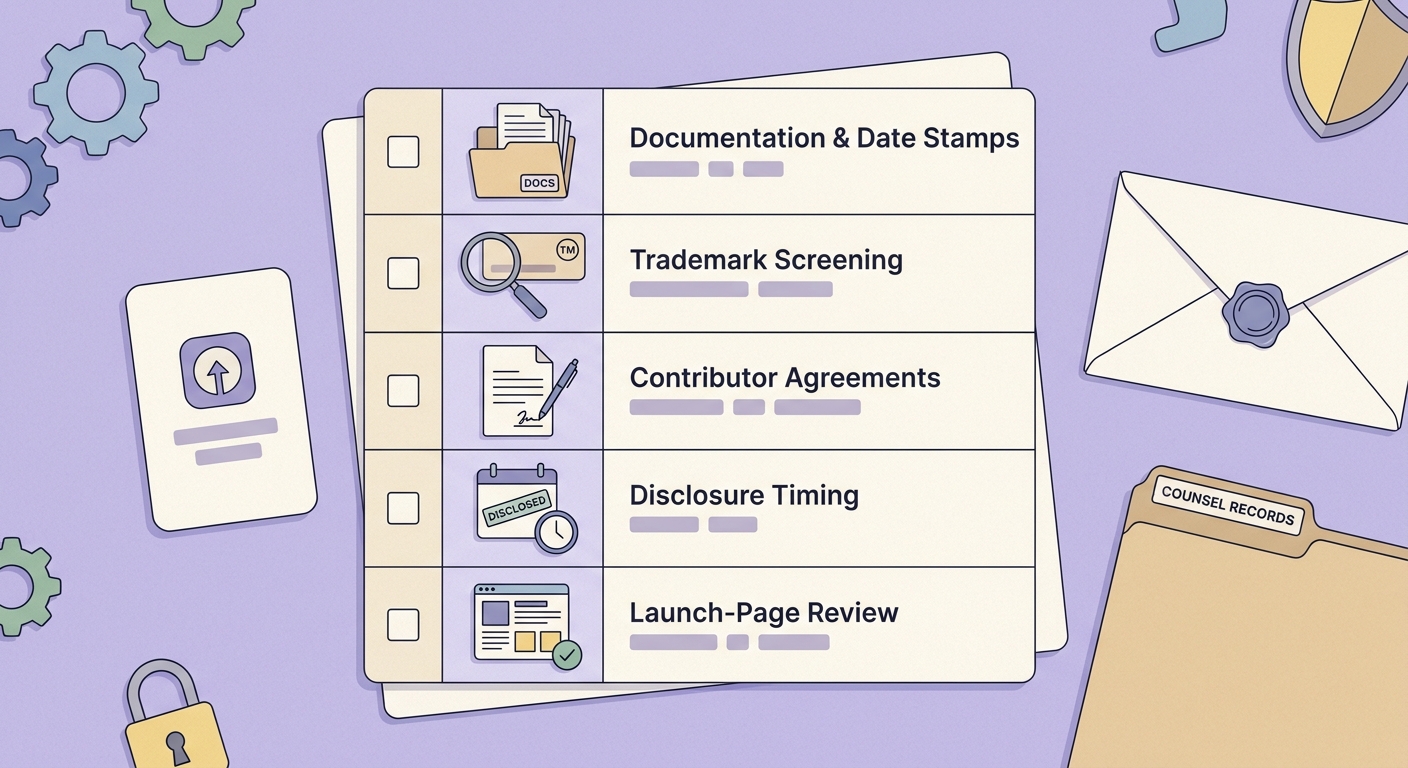
A mobile-friendly checklist block for founders preparing to launch an app, covering documentation, trademark screening, contributor agreements, disclosure timing, and launch-page review before submitting to app stores.
- Thinking an NDA is a moat: it helps manage disclosure, but enforcement is slow and fact-specific, and many investors will not sign.
- Assuming "features are protected": without owned code, registered marks, or filing evidence, your leverage is usually limited to contracts and platform policies.
- Treating pre-launch hype as free: demos, screenshots, and store teasers can count as public disclosure and can complicate patent timing (MindInventory).
App Store and Google Play dependency note: review cycles, contractor schedules, and marketing calendars create real deadlines. If you want to hit "submit" on a specific date, it is typical to start trademark screening, assignment cleanup, and any provisional decision 2 to 4 weeks before that date, because delays are normal.
Does Your App Need a Privacy Policy? (Yes - Here's Why) reframes the same problem with a slightly different lens - useful before you finalize.
Practical effort and cost expectations (so you can schedule it)
| Task | Founder time (typical) | Cash cost (typical) | Dependencies and gotchas |
|---|---|---|---|
| Contract cleanup (assignment + confidentiality) | 2 to 6 hours | Low to moderate | Needs cooperation from every contributor; renegotiation happens |
| Trademark screening + filing decision | 2 to 5 hours | Moderate to high | Conflicts may force a rename; filing varies by country/class and can take months |
| Provisional patent path (if applicable) | 1 to 2 weeks | Moderate to high | Must happen before disclosure; quality depends on detail and diagrams |
| Enforcement readiness (basic) | 1 to 3 hours to set up | Low | Still needs evidence, jurisdiction coverage, and budget if a dispute escalates |
One thing worth noting: the "cheap" plan often costs time. If you are solo, assume you will trade 1 to 2 evenings for setup and then 10 minutes weekly to keep things clean.