PCI compliance for a mobile app is not a checkbox you earn at the end. It is a product and architecture decision you make the moment you choose how checkout works. Teams often get surprised when an in-app payment flow quietly expands scope, slows releases, and raises security expectations from larger buyers.
| Payment flow choice | Typical PCI scope | Typical delivery effort (illustrative) | Common release risks |
|---|---|---|---|
| Hosted redirect or hosted fields | Lower | ~1-3 engineer-days + ~1-2 days QA (often stretches to a week with app review cycles) | UX edge cases, redirects, SCA/3DS handoffs, provider uptime |
| Provider SDK with tokenization | Lower to medium | ~3-10 engineer-days + QA + security review (often 1-2 sprints if device coverage is broad) | Tokenization misconfig, SDK regression on OS updates, device-specific bugs |
| Fully embedded in-app card entry | Higher | ~2-6+ weeks including security, QA, and evidence (varies by controls and assessor expectations) | Logging leaks, masking gaps, observability tooling capture, broader audit evidence |
Explanation: Scope is driven by whether your app or backend ever handles raw PAN/CVV, including through logs, analytics, crash tools, screenshots, screen recording, or backend proxying. The effort ranges above are anecdotal for small teams and vary by provider, validation method (SAQ vs external assessment), and SDLC maturity.
Interpretation: Hosted capture and strong tokenization usually narrow what you must secure and prove, but you give up some UX control and you inherit vendor constraints (including outages and SDK changes).
Reader impact: If you are planning a release, budget time for QA, security review, and evidence collection. In practice, "medium effort" often turns into at least a sprint once you include app store review, regression testing, and fixing edge cases.
What Is App Transport Security and How to Enable It goes deeper on the ideas above and adds concrete next steps.
What does PCI compliance mean in a mobile app?
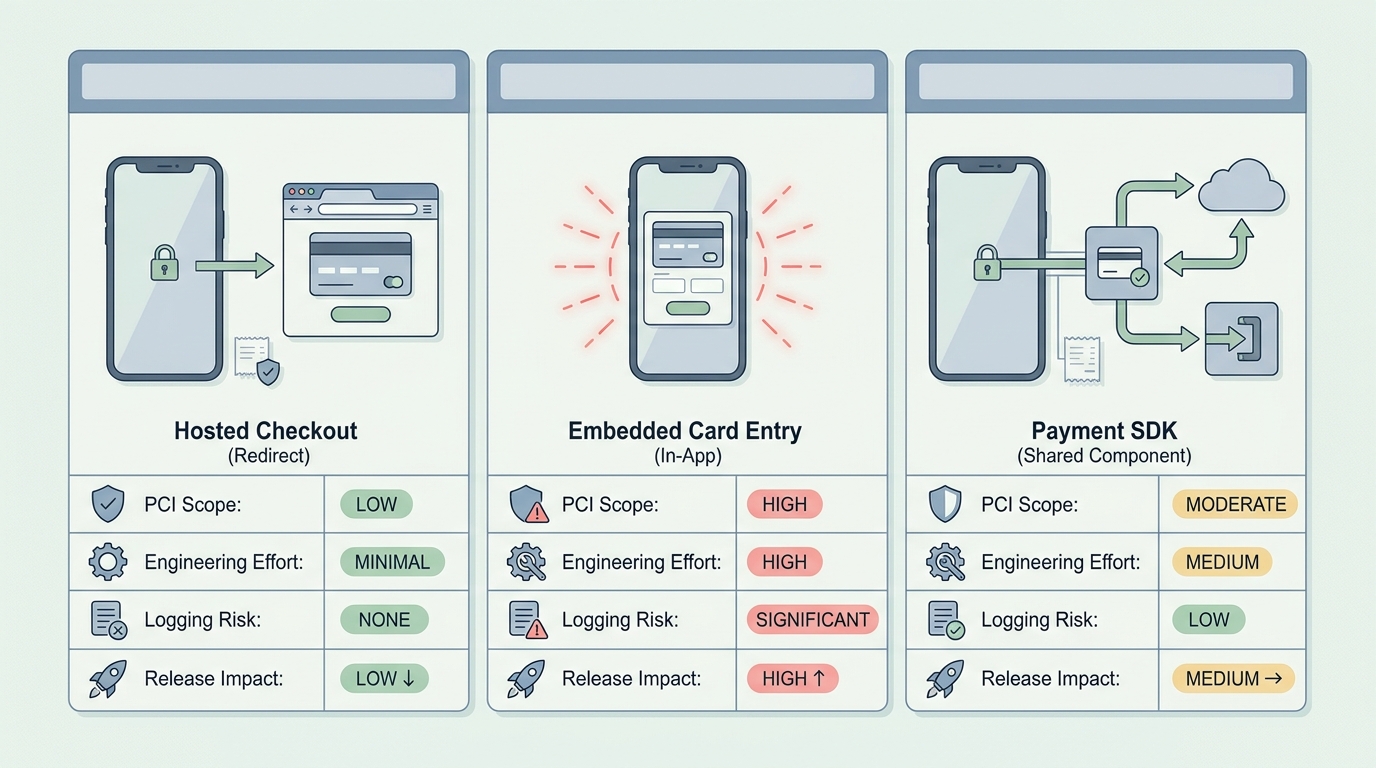
A comparison table showing hosted checkout, embedded card entry, and payment SDK options for a mobile app, with columns for PCI scope, engineering effort, logging risk, and release impact.
PCI scope starts the instant your app collects, transmits, or stores cardholder data like the PAN or CVV. If those values pass through your UI, network stack, logs, or backend, you have created a larger compliance surface area that tends to show up again at every release.
A hosted redirect or hosted payment page often keeps sensitive entry on the provider's UI. An in-app card form pulls you much closer to PCI controls, even if you use a well-known processor or SDK. App Store or Google Play distribution does not reduce PCI responsibility; your payment architecture does.
What counts as "touching card data" on mobile?
It is not just "we store cards." Common accidental touchpoints include debug logs, crash reporting, analytics payloads, session replay, screenshots, or backend proxy endpoints.
Tokenization helps most when you can show the app and your servers never see PAN/CVV in the first place, including via third party tooling.
Map your flow
Sketch the exact path from card entry to authorization, including SDK callbacks, network requests, logs, analytics, and crash tools.
Map your flow
When you move from outline to execution, API Security for Mobile Apps helps close common gaps teams hit here.
Which mobile payment architecture keeps PCI scope the smallest?
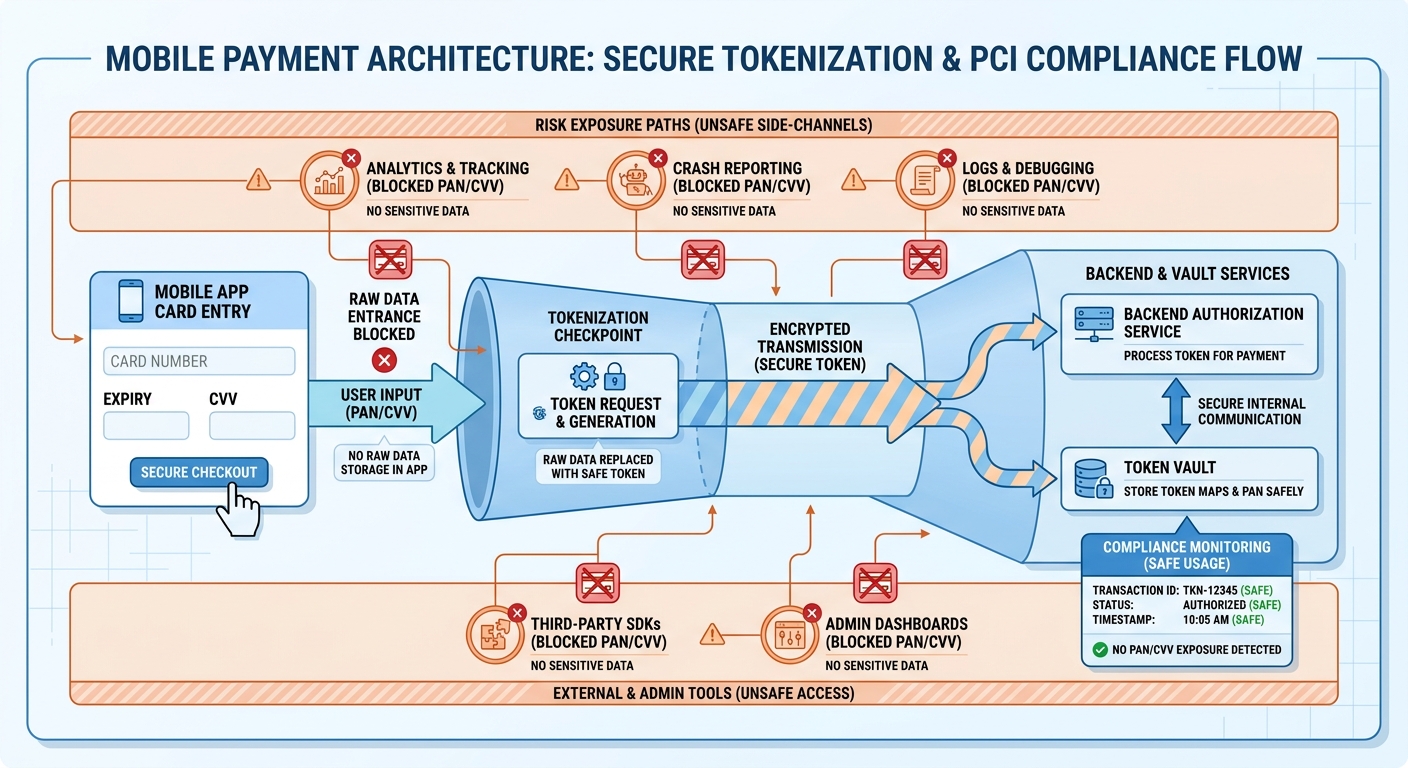
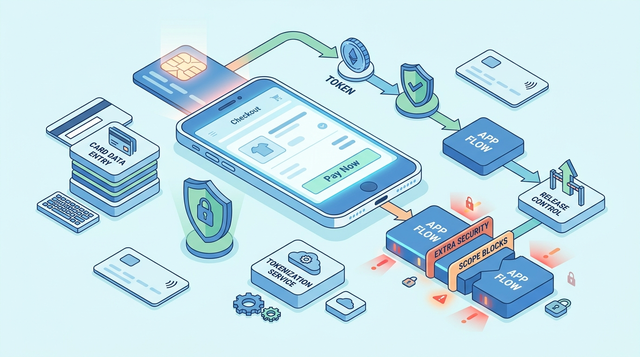
A mobile payment data-flow diagram showing tokenization, encrypted transmission, and safe backend handling, with warning points for analytics, crash reports, logs, and admin dashboards where raw card data should never appear.
| Architecture choice | What it usually means for PCI exposure | Tradeoffs and constraints to expect |
|---|---|---|
| Hosted checkout (redirect or hosted fields) | Provider collects card data, so your app can often stay in a narrower scope. | Less UI control, more dependency on provider UX and uptime. Redirects can affect conversion. SCA/3DS handoffs add edge cases. |
| Provider payment SDK (tokenization) | App runs payment code but should handle tokens, not PAN. | More moving parts: SDK updates, device coverage, correct configuration, and proving your tools never capture sensitive data. |
| Fully embedded custom form | Your app directly handles card entry and data flow, widening scope. | Highest security and evidence burden. Expect more gates, more documentation, and slower releases. Assessor interpretation can vary. |
In practice, the lowest-scope option is not always the right product choice. Some businesses accept more scope to get tighter UX, specific payment methods, or fewer redirects. The tradeoff is ongoing security work and more release friction.
A complementary angle worth comparing lives in How to Secure User Data in Your Mobile App.
What can quietly expand PCI scope during implementation?
| Source of leak | Why it happens | Mitigation (practical) |
|---|---|---|
| Network or HTTP logging | Shared middleware logs requests by default | Disable body logging on payment routes; add PR checks for risky log statements |
| Crash reports and breadcrumbs | SDK captures last inputs or payloads | Configure PII/PCI scrubbing (for example Sentry scrubbing); test with forced crashes on payment screens |
| Analytics events | Teams track "field completed" with values attached | Send booleans or enums only; blocklist sensitive keys |
| Session replay or screen recording | Tools record the UI as seen | Turn off replay on payment screens; verify masking works on real devices |
| Backend proxying | "Convenience" endpoint forwards PAN to provider | Avoid proxying raw PAN/CVV; use hosted or provider tokenization flows |
| Tokenization misconfiguration | Token exists, but PAN still passes through app/server first | Validate by intercepting traffic (for example mitmproxy or Charles Proxy) and inspecting logs and payloads |
One thing worth noting: scope is not static. A single SDK update, logging change, or new analytics tool can reintroduce exposure unless you have guardrails and a repeatable re-test step. Also, "lower scope" can still require SAQs and process controls like access management, vendor management, and incident response.
For tradeoffs, checklists, and edge cases, Froxi AI vs Manual Publishing: Risk, Complexity, and Speed Compared rounds out this section.
What should you have ready for a real release and a real buyer?
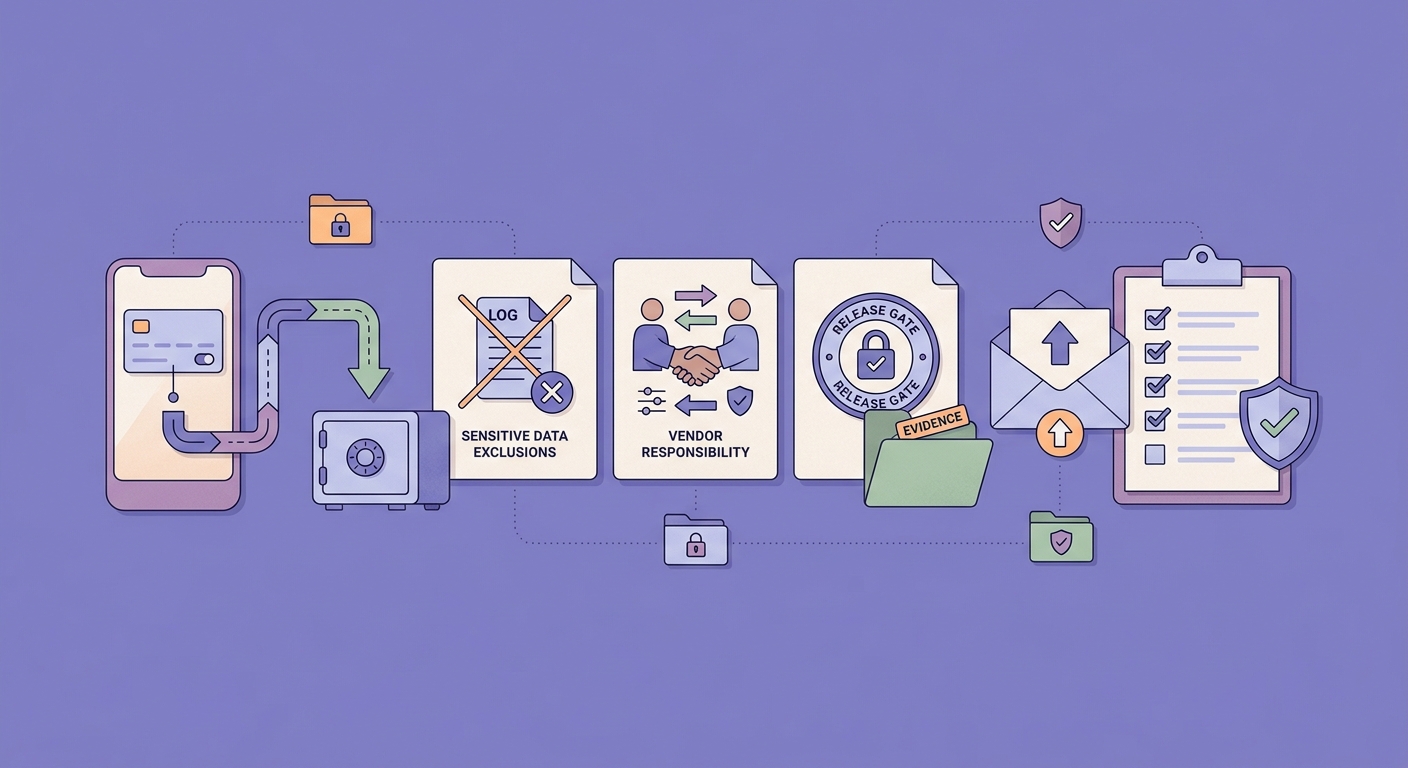
A PCI readiness checklist for a mobile app release covering payment-flow mapping, tokenization, logging exclusions, vendor responsibilities, and app-store submission readiness.
Most teams underestimate the operational work. Engineering implements the flow, QA expands the regression matrix, and someone (security, platform, or a senior engineer) validates tooling, access controls, and evidence.
Here is a realistic ownership split you can plan around:
| Area | Who usually owns it | Time you should expect (typical) |
|---|---|---|
| SDK/config and backend integration | Mobile + backend | 1-5 days, often longer if webhooks and edge cases pile up |
| Device and SCA/3DS QA | QA + mobile | 1-3 days per meaningful change, depending on your device pool |
| Tooling redaction (crash, logs, analytics, replay) | Platform/security | A few hours to a few days, plus re-test after config changes |
| Evidence and buyer questions | Security/GRC or tech lead | 2-8 hours if organized, 1-2+ days if you are assembling after the fact |
A concrete QA target that catches most surprises: test at least 6 device and OS combinations and 3 3DS paths (frictionless, challenge, failure or timeout). Adjust up if your customer base skews to older devices or you support multiple regions.
What is a lean, realistic pre-release checklist?
Map the full data path (including tools)
Document every place card data could enter or leak: UI fields, SDK callbacks, network layer, backend endpoints, logs, analytics, crash reports, session replay, and support tooling.
Prove tokenization is end-to-end
Verify raw PAN/CVV never hits your servers or device logs. Plan a few hours to a couple of days depending on device coverage and how many tools you must configure and re-test.
Define the responsibility boundary
Write down who collects, who tokenizes, who stores, who can access dashboards, and what evidence each party can provide. Expect some back-and-forth with providers, especially when support consoles and webhooks are involved.
Add guardrails before you scale releases
Mask or disable sensitive capture in observability tools, add code review rules for logging, and require extra QA on payment changes. This adds overhead, but it reduces last-minute scope surprises.
When is a formal PCI review worth the time and cost?
It is usually worth it when scope can change: a new checkout flow, a new market, a new payment method, or a new analytics/session replay tool. It is also worth it when an enterprise buyer asks for evidence and you do not have a clean, repeatable story.
If you find PAN in logs, crash dumps, or analytics, treat it like a production incident. Fixing it can involve code changes, vendor configuration, and deletion requests, which can take days to weeks depending on retention policies and whether the vendor supports targeted purges.
Schedule a scoped review
Get a targeted review of your mobile payment flow, tooling, and evidence plan before a high-stakes launch or enterprise security review.
Schedule a scoped review
How to Set Up Apple Pay in Your iOS App reframes the same problem with a slightly different lens - useful before you finalize.